
Generative AI Regression Testing in 2026: Smart Test Selection, Auto-Healing & Full Playbook
The 2026 playbook for generative AI regression testing — LLM-based test impact analysis, smart subset selection, self-healing locators, flaky-test triage, CI wiring, RCTF prompts and every PAA FAQ. Cut regression time 50–80% without losing coverage.

Last updated: July 15, 2026 · 14 min read · By SoftwareTestPilot
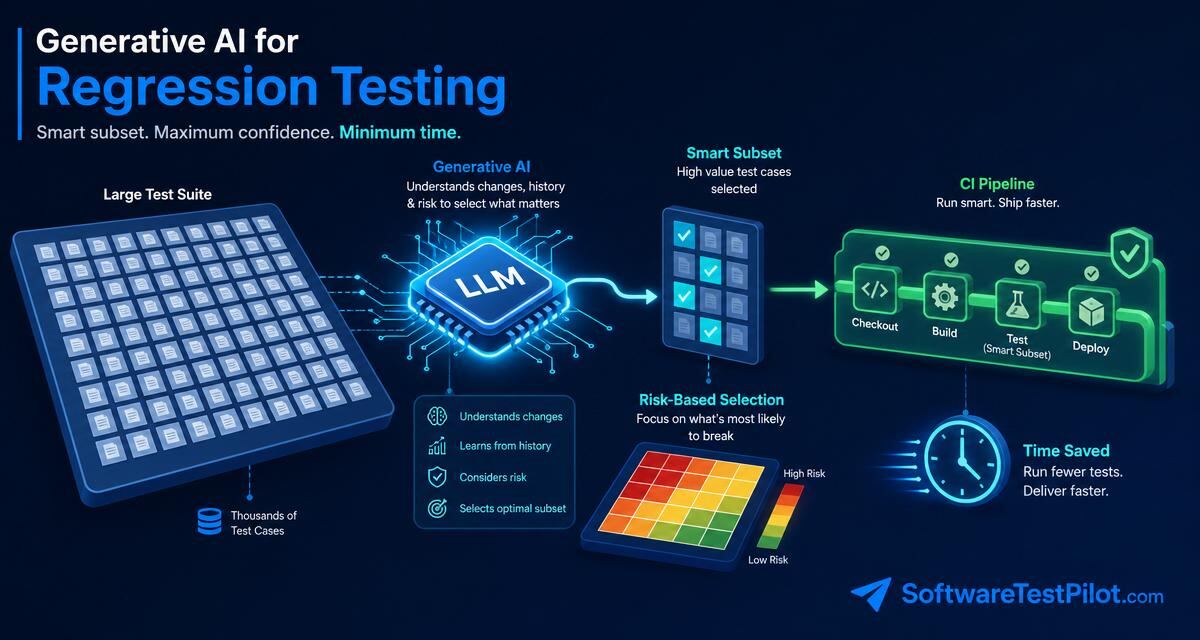
Generative AI regression testing uses LLMs and ML models to pick which regression tests to run for a given code change, heal broken locators on the fly, and triage flaky failures — turning a nightly 4-hour suite into a 15-minute PR gate without losing meaningful coverage. In 2026 this is the biggest AI lever in CI/CD: not writing more tests, but running fewer of the right ones.
This pillar consolidates "AI regression testing", "AI regression test selection", "AI flaky test detection", "AI test impact analysis" and "generative AI for regression". Pair with generative AI for test automation and generative AI Selenium.
Key takeaways
- Regression = risk-based selection + auto-healing + flaky triage. AI helps at all three.
- Use test impact analysis (TIA) with an LLM ranker on top — not an LLM alone.
- Auto-healing locators are a productivity boost, not a replacement for robust selectors.
- Flaky tests are a data problem: cluster failures, then have the LLM propose fixes.
- Never let AI silently skip tests — every skip is logged with a reason and reviewed weekly.
1. What AI-driven regression testing actually looks like
Three concrete workflows:
- Smart selection. A test-impact-analysis engine (Launchable, Testim, Sealights, or an in-house model) maps code changes → likely-affected tests. An LLM re-ranks that list against the PR description and recent incident history.
- Self-healing locators. Frameworks like Playwright role-based locators, Selenium Healenium, Testim and Mabl re-derive selectors when the DOM changes. LLMs suggest the semantic locator (role, name, testid) rather than fragile XPath.
- Flaky triage. A model clusters recent flaky failures by stack trace, DOM state and timing, then proposes the most likely root cause (race, network, animation, teardown).
See CI/CD for test automation for pipeline design and generative AI Playwright for MCP-based healing.
2. RCTF prompt framework
- Role — "You are a senior SDET / ISTQB-Advanced test analyst. Prioritise risk coverage, boundary values and clarity for a QA lead reviewer."
- Context — paste the requirement, user story, OpenAPI spec, page object or stack trace, plus framework + version and the compliance regime (SOC 2, HIPAA, GDPR, EU AI Act) and coverage target.
- Task — one specific artefact: "Generate 15 test cases", "Draft an IEEE 829 test plan section 4", "Write a Playwright E2E for AC-14 with an @axe accessibility check".
- Format — the exact output shape: markdown table, JSON schema, Gherkin, Vitest .test.ts. End with a rubric self-critique.
3. Prompts for regression selection, healing and triage
Prompt 1 — Re-rank a TIA output for a PR
Role: SDET-lead reviewing regression scope for a PR.
Context: PR title + description, changed files, TIA-suggested tests
(list with historical failure rate), last 30 days of incidents.
Task: re-rank tests by risk. Return top 40 + a "must not skip" set for
payments and auth. Justify each inclusion in one line.
Format: markdown table columns Test, Rank, Reason, MustRun (Y/N).
Prompt 2 — Suggest a robust locator
Role: Playwright expert.
Context: [paste failing locator + DOM snippet].
Task: propose the most stable Playwright role-based locator. Prefer
getByRole with name, then getByTestId, then getByLabel. Avoid XPath.
Format: single code line + one-line rationale.
Prompt 3 — Cluster flaky failures
Role: reliability engineer.
Context: [paste last 200 failure records: test id, stack, duration, env].
Task: cluster by root cause (race, network, animation, teardown, data).
Return top 5 clusters with size, example test, hypothesised fix and effort.
Format: markdown table.
Prompt 4 — Weekly skip review
Role: QA lead.
Context: [paste all AI-skipped tests from last 7 days with reasons].
Task: flag any skip that looks unsafe (auth, payments, PII, compliance).
Format: bullet list, one line per unsafe skip.
4. Regression review rubric (before you trust the AI)
- Must-run set is respected — payments, auth, checkout, GDPR export always run.
- Skip is logged, not silent — every skip has a machine-readable reason.
- Healed locator is semantic — role/name/testid, never brittle XPath.
- Flaky fix is validated — a proposed fix runs 20× green before it merges.
- Selection recall — spot-check monthly: full suite vs AI subset, escape rate ≤ 1%.
- Rollback path — one flag flips CI back to full suite in < 2 minutes.
- Attribution — every AI decision (skip, heal, rank) is logged with prompt + model version.
5. Governance and safety
Any LLM workflow that touches product code or customer data must run under governance:
- Enterprise LLM APIs (OpenAI, Anthropic, Google, Azure OpenAI) with a no-training / zero-retention clause. Never a free consumer chat for customer data.
- Redact PII, PANs, JWTs, HARs, secrets and production URLs before any prompt.
- Version prompts in a Git-tracked QA prompt library. Every AI-generated artefact ships with an "AI attribution" line and a human SDET sign-off.
- Map controls to the NIST AI RMF and, for EU products, the EU AI Act.