
Generative AI Playwright & Playwright MCP in 2026: The Complete Guide (Codegen AI, Agents, Prompts & FAQ)
Everything on generative AI + Playwright in 2026 — Playwright codegen AI, Playwright MCP server, LLM agents that drive the browser, prompts for Playwright test authoring, trace viewer triage, CI sharding and every PAA question.

Last updated: July 14, 2026 · 14 min read · By SoftwareTestPilot
Playwright is the fastest-growing E2E framework in 2026, and its integration with LLMs is the deepest of any test tool. This pillar consolidates "generative AI Playwright", "AI Playwright generator", "AI Playwright tests", "prompts for Playwright", "playwright codegen AI", "playwright AI agent" and "playwright MCP" into one canonical guide.
Companion reads: Copilot Playwright, ChatGPT Playwright tests, Playwright complete guide, Playwright framework in TypeScript.
Key takeaways
- Playwright + LLM is the strongest 2026 pairing because Playwright's role-based locators and web-first assertions match how LLMs already write code.
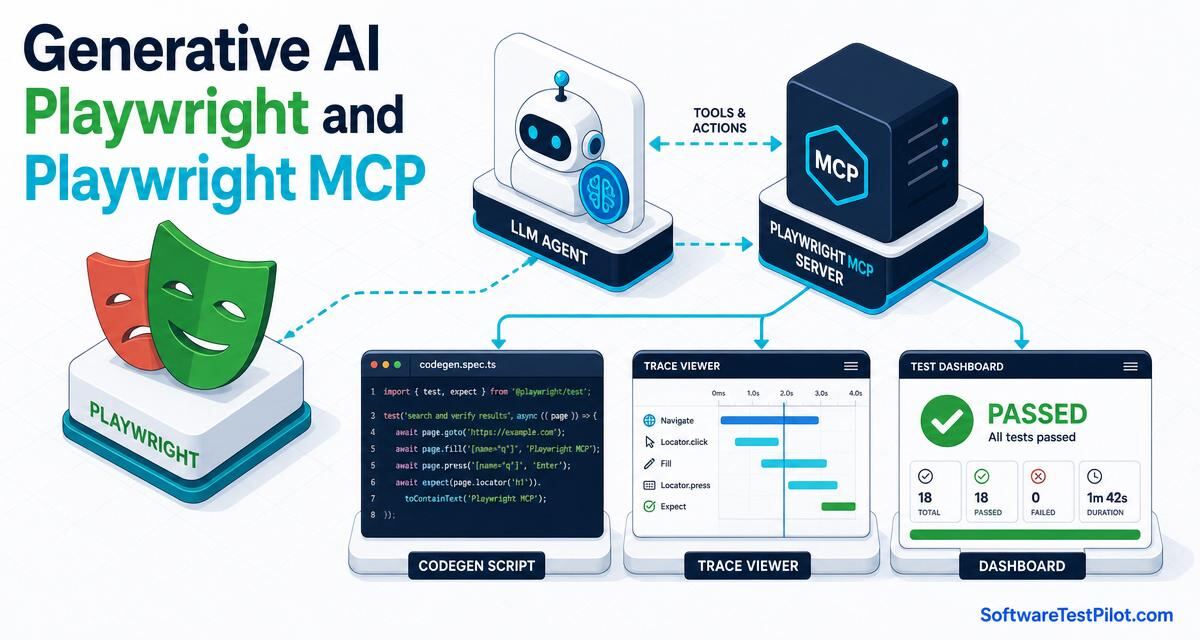
- Playwright MCP (Model Context Protocol server, released 2025) lets any LLM agent — Claude Desktop, Cursor, Copilot Chat — drive a real browser and author verified tests.
- Use codegen + LLM: record with
npx playwright codegen, paste the raw file into the LLM with your framework rules, get a clean spec back.- Trace viewer + LLM is the fastest flake-triage flow in QA today.
- Every AI-authored spec passes lint + your web-first-assertion rule before merge.
1. Playwright MCP — what it is and why it matters
Playwright MCP is Microsoft's Model Context Protocol server for Playwright. It exposes browser primitives (navigate, click, fill, screenshot, snapshot, evaluate) as MCP tools that any MCP-compatible LLM agent can call. Claude Desktop, Cursor, VS Code Copilot Chat and Cline all support it. That means you can prompt: "open example.com, log in as demo/demo, add 3 items to cart, checkout, and write a Playwright spec that reproduces the flow" — and the agent actually drives the browser, then writes the verified test.
Setup (excerpt):
npm i -D @playwright/mcp
# in Claude Desktop settings.json
"mcpServers": {
  "playwright": { "command": "npx", "args": ["@playwright/mcp@latest"] }
}
See the official Playwright MCP repo for the full spec.
2. Playwright codegen + LLM — the fastest authoring loop
Codegen still produces the noisiest possible spec (raw selectors, no assertions). Piped through an LLM with a strict style prompt it becomes shippable in seconds:
npx playwright codegen https://demo.saucedemo.com > raw.spec.ts

# then paste raw.spec.ts to your LLM with this prompt:
Role: senior SDET, Playwright 1.55 TypeScript strict.
Context: raw codegen output below. Framework rules: role-based locators only,
web-first assertions only, no page.waitForTimeout, tags @smoke.
Task: refactor into a clean spec matching the rules.
Format: single .spec.ts file.
3. Prompts for Playwright test authoring
Spec from a user story
Role: senior SDET, Playwright 1.55 TS strict.
Context: user story + AC + LoginPage POM below.
Task: write a spec covering AC-1..AC-4. Tag @regression @auth.
Format: single spec.ts.
API + UI hybrid
Role: senior SDET. Playwright 1.55.
Context: OpenAPI + login flow. Task: seed a user via APIRequestContext,
then run the UI login. Format: helper.ts + spec.ts.
Accessibility check
Role: a11y SDET. Playwright + @axe-core/playwright.
Context: /checkout page. Task: assert no serious/critical WCAG 2.2 AA
violations. Format: a11y.spec.ts.
4. Trace viewer + LLM for flake triage
On CI failure, upload the .zip trace as an artifact. In your triage bot: send the trace's action log + failing assertion + last-known-good diff to the LLM, ask for probable root cause and a one-line fix. Playwright's structured trace is uniquely LLM-friendly. See AI flaky test detection & coverage (upcoming).
5. Playwright AI agents in production
Agent patterns worth adopting in 2026:
- Exploratory agent — MCP-driven LLM crawls the app and flags anomalies (broken links, console errors, a11y violations).
- Regression author agent — reads a merged PR + linked Jira, opens a follow-up PR with a new regression spec.
- Flake-triage agent — runs nightly, closes PRs on stabilised flakes, opens PRs on new ones.
6. Governance
Any generative-AI or LLM workflow that touches product data must run under governance:
- Use paid/enterprise LLM APIs (OpenAI, Anthropic, Google, Azure OpenAI) with a no-training clause — never a free consumer plan for customer data.
- Redact PII, PANs, JWTs, HARs, secrets and production URLs before any prompt.
- Version prompts in a QA prompt library (Git). Every AI-generated artefact ships with an "AI attribution" line and a human SDET sign-off.
- Map controls to the NIST AI RMF and, for EU products, the EU AI Act.