
AI Software Testing Services: How to Buy AI-Powered QA in 2026
The complete buyer's guide to AI software testing services — managed QA vendors, pricing models, SLA templates, governance (SOC 2 / EU AI Act), evaluation rubric, red flags and PAA FAQs. Written for QA leads, engineering managers and CTOs.

Last updated: July 15, 2026 · 14 min read · By SoftwareTestPilot
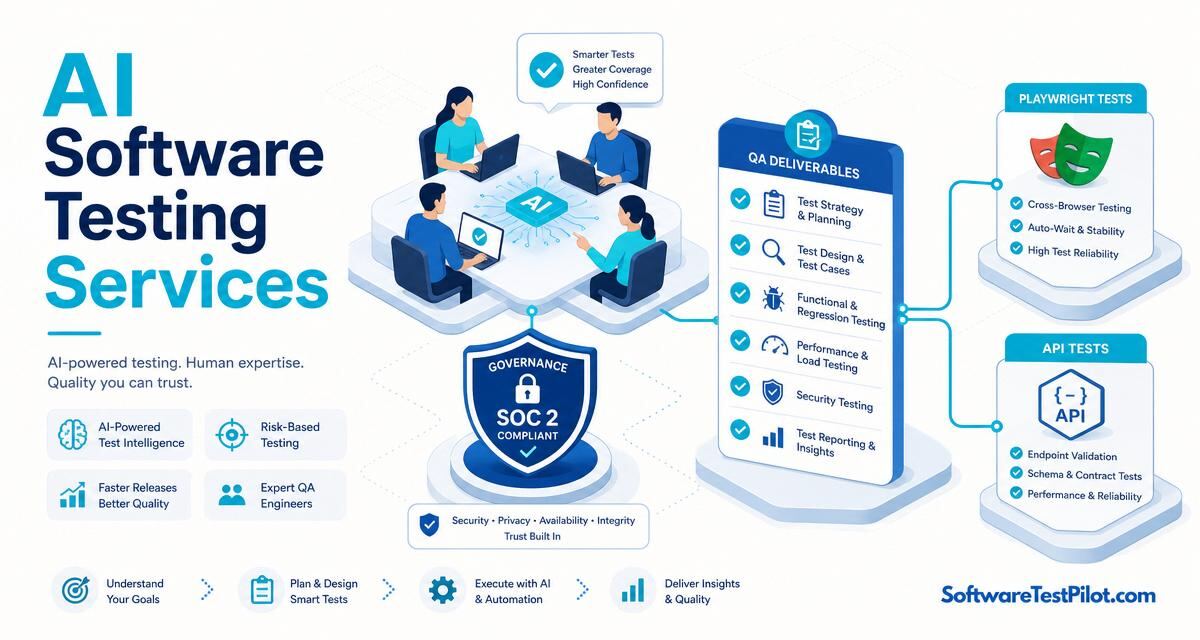
AI software testing services are managed QA engagements — usually a mix of humans and AI-augmented toolchains — sold by testing agencies, consultancies and staff-aug firms. This pillar consolidates every "AI software testing services", "AI QA services", "AI-powered testing services" and "AI testing outsourcing" search into one buyer's guide you can act on before signing a contract.
Buying automation services specifically instead of full QA? Read our sister pillar: AI test automation services. Building instead of buying? See the AI testing platform buyer's guide.
Key takeaways
- Every serious vendor in 2026 uses AI internally — the question is how, on what data, and under what governance.
- Score vendors on a 12-point rubric before the demo, not after.
- Insist on a 4-week POC on a real regression pack, priced at cost.
- Never sign a services SOW without a no-training clause, SOC 2 report and named human reviewer per deliverable.
- The right pricing model is outcome-based (defects escaped, cycle time) for mature teams, T&M for greenfield programs.
1. What counts as an AI software testing service?
A managed engagement that delivers at least three of:
- AI-assisted test design (LLM + human review).
- AI-assisted automation authoring and self-healing.
- AI triage of flaky tests, bugs and logs.
- Synthetic test-data generation with PII controls.
- Model evaluations for GenAI features (RAG accuracy, hallucination, bias).
- Governance artefacts mapped to NIST AI RMF / EU AI Act.
Anything less is traditional QA outsourcing with a marketing skin. See the difference vs. plain QA outsourcing.
2. 12-point vendor evaluation rubric
| # | Criterion | What good looks like |
|---|---|---|
| 1 | Data governance | Enterprise LLM keys, no-training clause, SOC 2 Type II, ISO 27001 |
| 2 | PII controls | Automated redaction pre-prompt; audit log of every prompt |
| 3 | Model transparency | Names of models, versions and providers in every SOW |
| 4 | Human-in-the-loop | Named reviewer per deliverable, not a pool |
| 5 | Evals discipline | Published rubric, pass thresholds, regression alarms |
| 6 | Self-healing scope | Locator-only auto-heal; assertion changes require PR review |
| 7 | Toolchain fit | Playwright/Selenium/Cypress/Appium + your CI without lock-in |
| 8 | Reporting | DORA + defects escaped + AI-attribution on every artefact |
| 9 | Pricing model | Outcome-based for mature teams; T&M for greenfield |
| 10 | Ramp plan | 4-week POC on a real regression pack, at cost |
| 11 | Exit | All prompts, tests, evals delivered in your Git on day one |
| 12 | Compliance | NIST AI RMF mapping; EU AI Act for EU products |
3. Pricing models compared
| Model | Typical range | Best for | Watch out for |
|---|---|---|---|
| Time & materials | $35–$120/hr | Greenfield, unclear scope | Scope creep, low urgency |
| Fixed-price sprint | $8k–$40k / 2 wks | Migration or POC | Change requests inflate cost |
| Managed service (retainer) | $15k–$120k / mo | Steady regression coverage | Complacency, no ROI reporting |
| Outcome-based | Custom | Mature teams with baselines | Gaming the metric — set 3+ KPIs |
| AI-consumption pass-through | Cost + 10–20% | Any | Insist on token-level audit |
4. Contract clauses you must include
- No-training clause — vendor and any sub-processor cannot train models on your data.
- Prompt & artefact ownership — you own every prompt, eval, test and heal-log from day one.
- AI-attribution — every deliverable ships with an AI-attribution line and a named human reviewer.
- Model change notice — 30-day heads-up if the vendor swaps model or provider.
- Exit assistance — 30 days of knowledge transfer at cost; source in your Git.
- Data residency — EU customer data stays in EU regions.
5. Red flags in AI QA vendor pitches
- "We use AI" without naming a model, version or provider.
- Live demo on your production URL in the first meeting.
- Refusal to POC on your own regression pack.
- No SOC 2 Type II report; only Type I or "in progress" for more than 12 months.
- Guarantees like "80% defect reduction in month one" — nobody can promise that responsibly.
- Auto-generated tests merged to main with no human PR review.
6. When to keep it in-house instead
Build in-house if you have 15+ QAs, a solid CI, and one SDET who can champion Copilot + Playwright + evals. Buy services if you need coverage in under 90 days, you're in a regulated industry with governance gaps, or your team lead is at capacity. See the full trade-off in the AI testing platform pillar.
7. Governance & compliance
Every AI-in-testing engagement must run under governance:
- Enterprise LLM APIs with a no-training / zero-retention clause. Never paste customer data into a free consumer chat.
- Redact PII, PANs, JWTs, HARs, secrets and production URLs before any prompt.
- Version prompts, evals and agent tools in Git. Every AI-generated artefact ships with an AI-attribution line and a named human reviewer.
- Map controls to the NIST AI RMF and, for EU products, the EU AI Act.