
Agentic AI Testing with MCP in 2026: How Autonomous QA Agents Actually Work
Agentic AI testing playbook for 2026 — how AI agents plan, execute and report tests via Model Context Protocol (MCP). Tools, guardrails, browser + API automation, sample workflows, PAA FAQs.

Last updated: July 15, 2026 · 14 min read · By SoftwareTestPilot
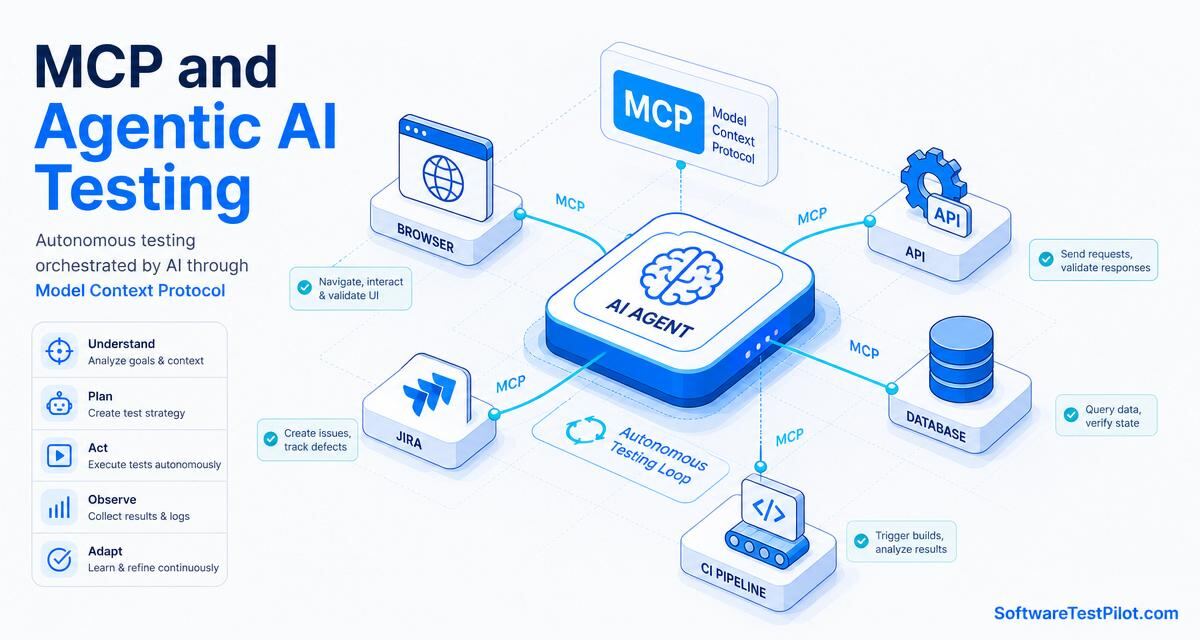
Agentic AI testing puts an LLM in the driver's seat: it plans a test, calls tools (browser, API, database, Jira, CI) via Model Context Protocol (MCP), observes the outcome, and adapts — closer to a junior SDET than a script. In 2026 this is the fastest-moving corner of AI in testing and the topic hiring managers ask about most.
This pillar consolidates "agentic AI testing", "AI agents for QA", "autonomous testing", "MCP for testing", and "Playwright MCP" into one playbook. Pair with generative AI for test automation, AI testing platforms, and LLM code review.
Key takeaways
- Agentic = plan + tools + memory + loop, not just a bigger prompt.
- MCP is the emerging standard for exposing tools (browser, API, DB) to any LLM.
- Start with narrow, low-risk workflows — bug triage, exploratory sessions, regression selection.
- Always keep a human approval step for anything that mutates production or costs money.
- Budget guardrails: token caps, tool-call caps, allow-listed domains.
1. What is agentic AI testing?
An agent is an LLM that runs in a loop: read goal → pick a tool → call it → observe → update plan → repeat until done or blocked. Compared with classic prompt-based test generation, an agent can:
- Explore an unknown app UI or API without a pre-written script.
- Fix its own broken locator by inspecting the current DOM.
- Chain a bug report → duplicate check → Jira create → Slack ping.
- Decide when it doesn't know and hand off to a human.
2. Model Context Protocol (MCP) in one page
MCP is an open protocol (from Anthropic, now supported by OpenAI, Google, Cursor, Continue, Zed and Playwright) that standardises how an LLM discovers and calls external tools. Instead of hard-coding a tool spec into every prompt, you run an MCP server — the agent connects, lists tools, and calls them with typed arguments.
Common MCP servers useful for QA:
- Playwright MCP — github.com/microsoft/playwright-mcp — drive Chromium via natural language.
- Filesystem MCP — read/write scoped test artefacts.
- GitHub MCP — open PRs, comment, read diffs.
- Jira / Linear MCP — create issues, search duplicates.
- Postgres/HTTP MCP — query state and call APIs.
3. Reference architecture
[LLM (Claude / GPT-5 / Gemini)]
       │  plans + reasons
       ▼
[Agent runtime (LangGraph / Anthropic Agents SDK / Cursor)]
       │  MCP tool calls
       ▼
┌──────────────┬──────────────┬──────────────┬──────────────┐
│ Playwright   │ HTTP API     │ Postgres     │ Jira / Slack │
│ MCP          │ MCP          │ MCP          │ MCP          │
└──────────────┴──────────────┴──────────────┴──────────────┘
       │
       ▼
[Observability: token cost, tool trace, screenshots, evals]
4. Five agentic workflows to ship first
- Exploratory session — agent given a charter drives the app for 20 min, produces SBTM notes and 3 candidate bugs.
- Bug intake triage — agent reads a new bug, searches duplicates, proposes severity, drafts the Jira update.
- Regression selection — agent reads a git diff + coverage map, picks the top-N regression tests to run.
- Self-healing E2E — Playwright agent notices a broken locator and proposes a repair PR.
- Release notes + go/no-go — agent reads run history + Jira, drafts release notes and a go/no-go recommendation for a human.
5. Guardrails you must not skip
- Human approval for anything that mutates prod data, files a public bug, or spends money.
- Token + tool-call budget per run (hard cap; auto-abort).
- Allow-list of URLs, domains and MCP tools. Deny everything else.
- Redaction of PII/secrets before any tool call.
- Full trace of prompt, tool call, response and screenshot — replayable in 6 months for audit.
- Model version pinning so a silent upstream update doesn't change behaviour.
6. Worked example — Playwright MCP + Claude for a smoke test
// pseudo-config
{
  "agent": "claude-3.7-sonnet",
  "tools": ["playwright-mcp", "http-mcp", "filesystem-mcp"],
  "goal": "Verify the login smoke path on staging: happy, wrong password, locked account. Take screenshots. Produce a JSON report.",
  "budget": { "tokens": 40000, "tool_calls": 60, "wall_clock_sec": 300 },
  "guardrails": {
    "allowed_domains": ["staging.example.com"],
    "human_approval_for": ["file_bug", "modify_data"]
  }
}
Run it in CI on every deploy. Fail the pipeline if the JSON report contains any status other than passed.
7. Governance
Every AI-in-testing workflow must run under governance:
- Enterprise LLM APIs with a no-training / zero-retention clause. Never paste customer data into a free consumer chat.
- Redact PII, PANs, JWTs, HARs, secrets and production URLs before any prompt.
- Version prompts, evals and agent tools in Git. Every AI-generated artefact ships with an AI-attribution line and a named human reviewer.
- Map controls to the NIST AI RMF and, for EU products, the EU AI Act.