
Generative AI API Testing in 2026: OpenAPI → Postman/RestAssured/Playwright in Minutes
The 2026 guide to generative AI API testing — turn an OpenAPI/Swagger spec into Postman collections, RestAssured Java, Playwright request-context and contract tests using ChatGPT, Claude, Gemini and Copilot. RCTF prompts, rubric, security cases, PAA FAQs.

Last updated: July 15, 2026 · 14 min read · By SoftwareTestPilot
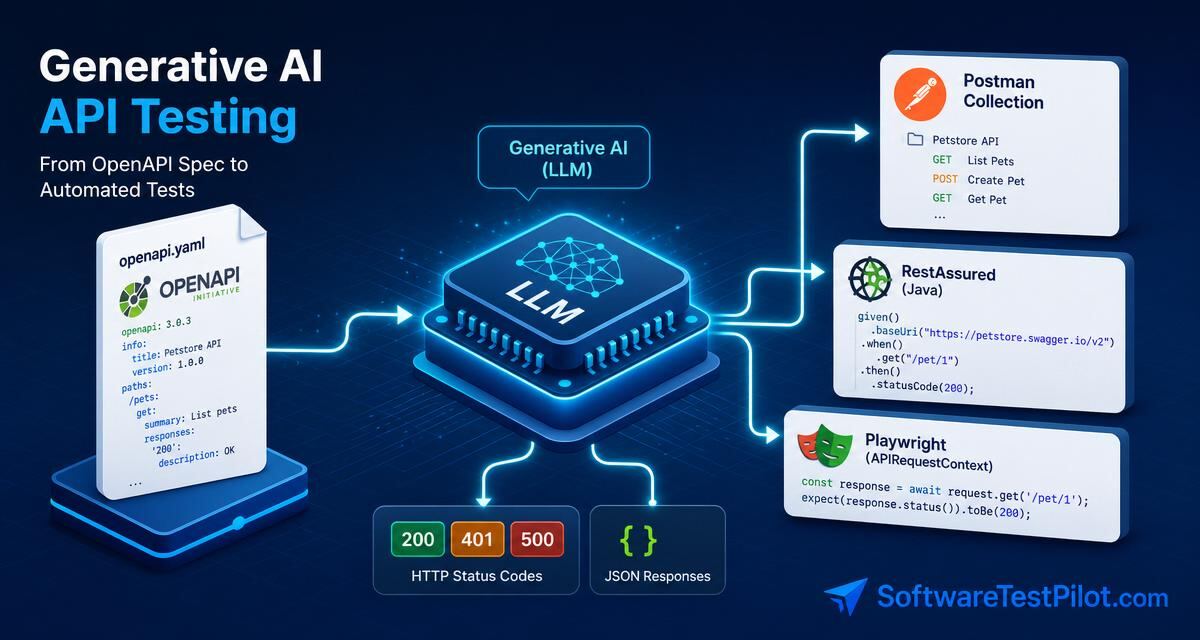
Generative AI API testing is the practice of feeding an OpenAPI/Swagger spec (or a Postman collection, or a curl trace) to an LLM and asking it to produce runnable API tests, contract tests, negative cases and security probes — in Postman, RestAssured, Playwright's request context, Karate, Pytest+httpx or Bruno. It is the fastest way to get a green baseline on a new service before you write a single line of test code by hand.
Consolidates "AI API testing", "ChatGPT for API testing", "AI Postman generator", "AI contract testing" and "generative AI RestAssured". Pair with API testing interview questions, Postman vs RestAssured and generative AI for test automation.
Key takeaways
- Ground the LLM in the spec. Never ask "write API tests for our checkout" — always paste the OpenAPI YAML.
- Ask for 3 cases per endpoint: success (200/201), auth failure (401/403), validation failure (400/422).
- Chain contract testing (Pact / Schemathesis) with LLM-generated exploratory cases.
- Security cases are non-negotiable: OWASP API Top 10 injection, BOLA, mass assignment, rate limits.
- Every generated test runs against a mocked server first, then a staged environment.
1. What AI API testing actually delivers
Six deliverables you can generate today:
- Baseline collection — Postman/Bruno JSON with one happy-path request per endpoint.
- Negative pack — 401, 403, 400, 422, 429, 500 cases.
- Contract tests — Pact consumer + provider, or Schemathesis property tests from the spec.
- OWASP API security probes — BOLA, broken auth, mass assignment, rate limit, SSRF.
- Data-driven runs — Postman iterations / Playwright test.each from a CSV.
- Load smoke — k6/JMeter starter scripts for the top-10 traffic endpoints.
2. RCTF prompt framework
- Role — "You are a senior SDET / ISTQB-Advanced test analyst. Prioritise risk coverage, boundary values and clarity for a QA lead reviewer."
- Context — paste the requirement, user story, OpenAPI spec, page object or stack trace, plus framework + version and the compliance regime (SOC 2, HIPAA, GDPR, EU AI Act) and coverage target.
- Task — one specific artefact: "Generate 15 test cases", "Draft an IEEE 829 test plan section 4", "Write a Playwright E2E for AC-14 with an @axe accessibility check".
- Format — the exact output shape: markdown table, JSON schema, Gherkin, Vitest .test.ts. End with a rubric self-critique.
3. Prompts (Postman, RestAssured, Playwright, Pytest, k6)
Prompt 1 — Postman collection from OpenAPI
Role: senior API SDET.
Context: [paste OpenAPI 3.1 YAML].
Task: generate a Postman v2.1 collection with 3 requests per endpoint —
happy path, auth-failure, validation-failure. Use collection variables for
{{baseUrl}} and {{token}}. Add pm.test assertions on status, schema and
response time (< 800ms p95).
Format: valid Postman v2.1 JSON only.
Prompt 2 — RestAssured / Java
Role: Java SDET, RestAssured 5 + JUnit 5 + AssertJ.
Context: [paste endpoint spec + auth flow].
Task: generate a Test class with @BeforeAll token bootstrap, @Nested groups
per endpoint, ParameterizedTest for validation cases.
Format: single .java file, imports first.
Prompt 3 — Playwright APIRequestContext
Role: Playwright API-testing expert.
Context: [paste endpoint + response schema].
Task: generate a .spec.ts using request.newContext, storageState for auth,
and Zod schema validation on the JSON response.
Format: single Playwright test file.
Prompts 4–7
- Pact consumer test — from a sample request/response, generate a Pact JS/Java consumer spec.
- Schemathesis property tests — from the OpenAPI URL, generate a Schemathesis command and CI job.
- OWASP API Top 10 probes — for each endpoint, generate BOLA, broken auth and mass-assignment cases.
- k6 smoke test — for the top-10 traffic endpoints, generate a k6 script with 50 VUs for 2 minutes.
4. API test review rubric
- Schema-checked — every response asserted against the OpenAPI schema (Ajv, JSON Schema, Zod).
- Auth matrix — anonymous, wrong-role, expired token, valid token — all covered.
- Boundary + validation — min/max/format for every string, number, enum.
- Idempotency — POST vs PUT vs PATCH tested for retry safety.
- Security — OWASP API Top 10 checklist, not just happy path.
- Env isolation — no hard-coded prod URLs; secrets from env / vault only.
- Deterministic — no shared mutable fixture state across tests.
5. Governance and safety
Any LLM workflow that touches product code or customer data must run under governance:
- Enterprise LLM APIs (OpenAI, Anthropic, Google, Azure OpenAI) with a no-training / zero-retention clause. Never a free consumer chat for customer data.
- Redact PII, PANs, JWTs, HARs, secrets and production URLs before any prompt.
- Version prompts in a Git-tracked QA prompt library. Every AI-generated artefact ships with an "AI attribution" line and a human SDET sign-off.
- Map controls to the NIST AI RMF and, for EU products, the EU AI Act.