
Generative AI Test Case Generation in 2026: The Complete Playbook (Prompts, ISTQB Techniques, Gherkin, Test Data & FAQ)
How to use generative AI and LLMs to generate test cases, test scripts, test data, Gherkin scenarios and full test plans — RCTF prompt framework, ISTQB techniques (EP, BVA, DT, ST, UC), free generators, review rubric and every PAA question.

Last updated: July 14, 2026 · 14 min read · By SoftwareTestPilot
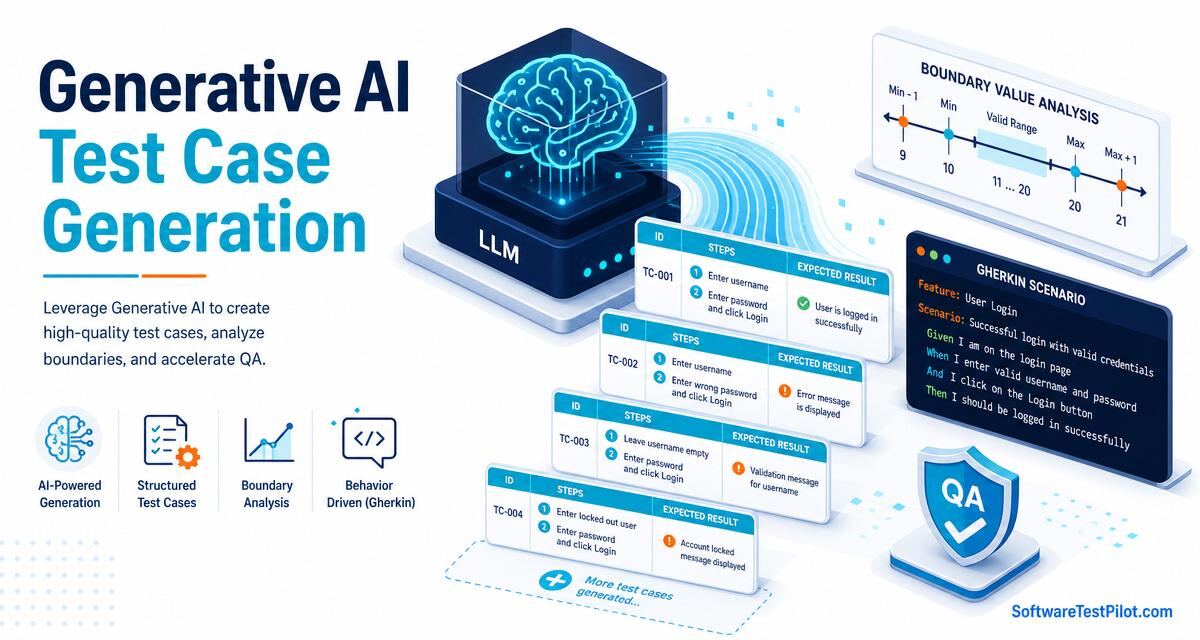
Generative AI test case generation is the practice of prompting an LLM — ChatGPT, Claude, Gemini, GitHub Copilot or an open-source model — to draft test cases, test data, test scripts, Gherkin scenarios and full test plans from a requirement, user story, OpenAPI spec or codebase. Done right it removes 60–80% of the mechanical authoring work while keeping ISTQB-grade coverage. Done wrong it produces plausible-looking cases that miss boundaries and pass every review by accident.
This pillar consolidates the search queries "AI test case generation", "LLM test case generation", "AI test data generator", "AI test script generator", "AI Gherkin generator", "AI test plan generator", "free AI test case generator", "AI unit test generator" and "prompts for test case generation" into a single reference. Pair it with generative AI for test automation, ChatGPT test case generation, Claude test case generation and Gemini test case generation.
Key takeaways
- Use the RCTF prompt framework — Role, Context, Task, Format — every time. Freeform prompts produce freeform garbage.
- Pin ISTQB techniques in the Role: Equivalence Partitioning, Boundary Value Analysis, Decision Tables, State Transition, Use-Case.
- Ask for structured output (markdown table, JSON, Gherkin, JUnit, Vitest). Free-text is not shippable.
- Every AI-drafted test case passes a 7-point human review before it enters the RTM.
- Prefer paid/enterprise LLM APIs with a no-training clause. Never paste raw PII.
1. What generative AI test case generation actually means
The workflow has three moving parts: a source of truth (requirement / user story / spec / code), an LLM and a structured output that lands directly in Jira/Xray, TestRail, qTest, Zephyr or a Vitest/JUnit file. The LLM is not "thinking up" tests — it is applying ISTQB test-design techniques you asked for, to the artefact you pasted, in the format you specified. Skip any of those three and quality collapses.
Modern QA teams use it for six deliverables: functional test cases, negative/boundary cases, Gherkin acceptance scenarios, unit tests, synthetic test data (CSV/JSON) and full IEEE 829 test plans. See our companion pillars on generative AI unit testing and generative AI API testing for the deeper cuts.
2. The RCTF prompt framework
- Role — "You are a senior SDET / ISTQB-Advanced test analyst. Prioritise risk coverage, boundary values and clarity for a QA lead reviewer."
- Context — paste the requirement, user story, OpenAPI spec, page object or stack trace, plus framework + version and the compliance regime (SOC 2, HIPAA, GDPR, EU AI Act) and coverage target.
- Task — one specific artefact: "Generate 15 test cases", "Draft an IEEE 829 test plan section 4", "Write a Playwright E2E for AC-14 with an @axe accessibility check".
- Format — the exact output shape: markdown table, JSON schema, Gherkin, Vitest .test.ts. End with a rubric self-critique.
3. Ten copy-paste prompts for test case generation
Prompt 1 — Functional + negative cases from a user story
Role: senior SDET, ISTQB-Advanced. Apply Equivalence Partitioning and
Boundary Value Analysis. Prioritise risk to revenue.
Context: user story = "As a returning customer I want to reset my password
via email so I can log in again." Acceptance criteria: AC-1 valid email
receives reset link within 60s; AC-2 invalid email shows generic message;
AC-3 link expires after 15 min; AC-4 lockout after 5 failed attempts.
Stack: React 19 + Node 22 + PostgreSQL 16. Compliance: SOC 2.
Task: generate 15 test cases covering happy path, negatives, boundaries,
security and accessibility.
Format: markdown table with columns ID, Title, Preconditions, Steps,
Test Data, Expected Result, Priority (P1-P3), ISTQB Technique.
End with a 7-point self-critique against the AC list.
Prompt 2 — Gherkin scenarios (BDD)
Role: BDD analyst using Cucumber + Gherkin. Follow Given-When-Then strictly.
Context: [paste user story + AC].
Task: produce 6 scenarios — 1 happy path, 3 negatives, 2 edge cases.
Format: single .feature file, tags @smoke @regression @a11y as appropriate.
Prompt 3 — Test data (synthetic, PII-safe)
Role: test data engineer.
Context: schema = users(id uuid, email text, dob date, country_code text,
plan enum('free','pro','enterprise')). 100 rows. GDPR safe.
Task: generate a CSV with edge cases: min/max dob, unicode emails,
country codes from ISO 3166-1 alpha-2, plan distribution 60/30/10.
Format: CSV only, no prose.
Prompts 4–10
- Decision-table cases — for pricing/eligibility rules with 3+ inputs.
- State-transition cases — for order/subscription lifecycles.
- API cases from OpenAPI — paste the spec, ask for 2 cases per endpoint (200, 4xx, auth).
- Unit tests from a function — paste the function + coverage target, ask for Vitest with mocks.
- Regression pack from a bug — paste the bug + fix commit, ask for a regression case.
- Test plan (IEEE 829) skeleton — paste PRD summary, ask for sections 1–8.
- Accessibility cases — paste component + WCAG 2.2 AA target, ask for keyboard + SR cases.
4. The 7-point QA review rubric
Every AI-generated case must pass this rubric before entering the RTM:
- AC traceability — every AC has ≥1 case; every case cites its AC.
- Technique fit — the correct ISTQB technique was applied (BVA on ranges, DT on rules, ST on lifecycles).
- Boundary coverage — min-1, min, max, max+1 for every numeric or length input.
- Negative coverage — auth failure, network failure, malformed input, race conditions.
- Determinism — no vague "system responds appropriately"; expected results are exact.
- Testability — every step is executable manually or by automation in the current environment.
- No hallucination — no invented endpoints, error codes, fields or acceptance criteria.
5. Free and paid AI test case generators in 2026
| Tool | Best for | Free tier | Verdict |
|---|---|---|---|
| ChatGPT (GPT-5 / o5) | Bulk case authoring, Gherkin | Yes (limited) | Best all-round |
| Claude 4.5 Sonnet / Opus | Long PRDs, careful reasoning | Yes | Best for spec-heavy work |
| Gemini 2.5 Pro / 3.1 | 2M-token context, monorepos | Yes | Best for whole-repo ingestion |
| GitHub Copilot Chat | Unit tests inside the editor | Free for students | Best for /tests workflow |
| Testim / Mabl / Applitools GPT | UI test generation + healing | Trial | Best for low-code UI packs |
| Katalon Studio AI | Codeless + AI object recognition | Yes | Solid for hybrid teams |
See our AI testing tools pillar for the deeper scorecard.
6. Governance and safety
Any generative-AI or LLM workflow that touches product data must run under governance:
- Use paid/enterprise LLM APIs (OpenAI, Anthropic, Google, Azure OpenAI) with a no-training clause — never a free consumer plan for customer data.
- Redact PII, PANs, JWTs, HARs, secrets and production URLs before any prompt.
- Version prompts in a QA prompt library (Git). Every AI-generated artefact ships with an "AI attribution" line and a human SDET sign-off.
- Map controls to the NIST AI RMF and, for EU products, the EU AI Act.