SoftwareTestPilot
AI in TestingPublished: 16 min read

ChatGPT Test Case Generation in 2026: The Complete Playbook (Prompts, ISTQB Techniques & FAQ)

The definitive 2026 guide to generating test cases with ChatGPT — ISTQB equivalence partitioning, boundary value analysis, decision tables and state transitions, 12 copy-paste prompts, a 7-point review rubric, ROI and every People Also Ask question Google surfaces.

Avinash Kamble
Founder & QA Engineer at SoftwareTestPilot
Reviewed by Priyanka G.
Share:XLinkedInWhatsApp
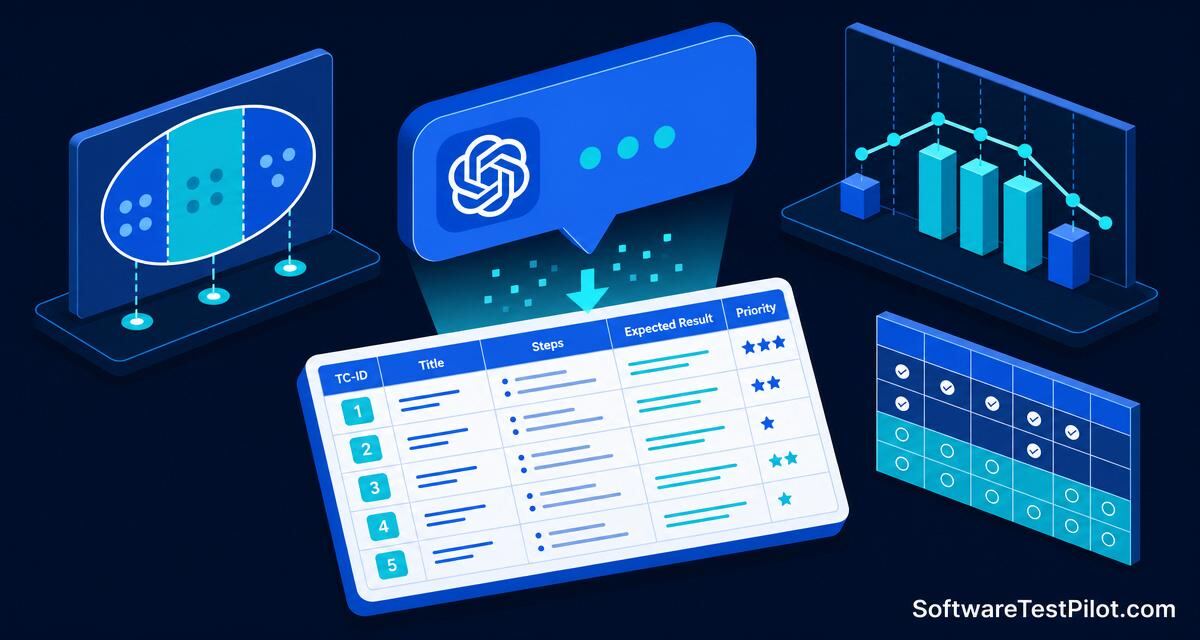
ChatGPT test case generation cover — isometric infographic of a ChatGPT chat bubble producing a numbered test case table with TC-ID, Title, Steps, Expected Result, Priority columns, plus equivalence partitioning, boundary value and decision table visuals, with the SoftwareTestPilot.com wordmark.

Last updated: July 14, 2026 · 16 min read · By Avinash Kamble, reviewed by Priyanka G.

ChatGPT test case generation uses OpenAI's models — alongside Claude Opus 4.5 and Gemini 2.5 Pro — to produce ISTQB-aligned test cases (positive, negative, boundary, decision-table, state-transition, exploratory charters) from acceptance criteria, PRDs, API specs, code diffs or UI screenshots. Done well on a 2026 team, ChatGPT cuts case-design time by 70–85%, raises AC coverage by 25–35 points, and catches missing negative/boundary cases that hand-written suites routinely skip.

Pair with ChatGPT for QA testing, ChatGPT Jira ticket test, ChatGPT Gherkin scenarios and ChatGPT test plan.

Key takeaways

  • Every input source has a matching prompt shape: AC list, PRD, OpenAPI, UI screenshot, code diff.
  • Name the ISTQB techniques explicitly (EP, BVA, DT, ST). Without naming, output is happy-path only.
  • Force per-AC coverage: ≥1 positive, ≥1 negative, ≥1 boundary. Then run gap analysis.
  • Every case row must carry TC-ID, source AC-ID, technique and priority.
  • Review against the 7-point rubric before adding to your test-management tool.

1. Which ISTQB technique for which input

Input                  | Techniques to name in the prompt
-----------------------+------------------------------------------
Numeric field / range  | Equivalence Partitioning + Boundary Value
Rule-driven feature    | Decision Table
Wizard / status flow   | State Transition
API endpoint / OpenAPI | EP + BVA + error-code matrix
UI form                | EP + BVA + accessibility (WCAG 2.2 AA)
Business logic         | Cause-Effect graph or Decision Table
Legacy / undocumented  | Exploratory charters (SBTM)

Reference: ISTQB Foundation Level syllabus.

2. Master prompt: AC list → test case table

You are a senior QA engineer fluent in ISTQB Foundation Level test-
design techniques (Equivalence Partitioning, Boundary Value Analysis,
Decision Tables, State Transition).

Context:
- Feature: [name]
- Acceptance criteria (numbered): [paste]
- Test data profile: [free / paid / admin]
- Priority signal: [risk / P0-P3 hint]
- Existing test IDs in this area: [paste highest ID]

Task: produce a test case table applying EP + BVA + DT + ST as
appropriate. Per AC produce:
- At least 1 positive case
- At least 1 negative case
- At least 1 boundary case
- Additional edge cases (empty, null, unicode, RTL, max length,
  concurrent user, network failure) where applicable

Columns: TC-ID | AC-ID | Title | Preconditions | Steps | Expected |
Priority | Technique | Automatable? (Y/N)

End with:
- Coverage summary: AC-1: N cases | AC-2: N cases | ...
- Self-critique against the 7-point rubric.

3. Prompt: OpenAPI spec → API test cases

You are an API QA engineer.
Given this OpenAPI 3.1 fragment: [paste].
Produce test cases for each endpoint covering:
- 2xx happy path per operation
- Every documented error code (400, 401, 403, 404, 409, 422, 429, 5xx)
- Missing required fields, extra fields, wrong types
- Boundary: min / max length, min / max value, max array size
- Auth: no token, expired token, wrong role
- Rate limit (if documented)
- Contract: response schema matches spec

Columns: TC-ID | Endpoint | Method | Scenario | Preconditions |
Request | Expected status + body assertions | Priority | Technique.

4. Prompt: UI screenshot → test cases (multimodal)

You are a QA engineer. Attached: [UI screenshot / Figma frame].
Task: produce test cases for the visible form using EP + BVA plus
WCAG 2.2 AA accessibility checks (keyboard-only, contrast, label,
error announcement) and i18n (long strings, RTL, unicode).
Do not invent fields not in the image. Flag ambiguous elements as
[VERIFY].
Format: same table as the master prompt.

Best model for this input type in 2026 is typically Gemini 2.5 Pro for pure visual extraction; GPT-5.5 for turning the extraction into the structured table.

5. Prompts for gap analysis, dedup and prioritisation

Coverage gap

You are a QA lead. Given [paste AC list] and [paste existing test titles],
return a table AC-ID | Existing coverage | Gap | Suggested case titles.

Dedup

You are a QA lead. Given [paste 50 test case titles],
return clusters of duplicate or near-duplicate cases (Jaccard > 0.7)
with a recommended keep-vs-merge decision per cluster.

Risk-based prioritisation

You are a QA lead. Given [paste tests] and [paste top 10 release risks],
re-score priorities so P0 covers Severity ≥ 15 risks first. Return a
before/after table with reasoning.

6. The 7-point review rubric

  1. AC coverage — every AC has ≥1 positive + 1 negative + 1 boundary.
  2. Technique diversity — ≥ 3 ISTQB techniques represented.
  3. Deterministic steps — verb-first, one action per line.
  4. Priority accuracy — mapped to release risk, not to case count.
  5. Traceability — TC-ID, AC-ID, source ticket, technique on every row.
  6. Automatable? column populated with a hard Y/N and 1-line reasoning if N.
  7. PII cleanliness — no real customer data.

7. ROI, rollout and honest limits

Honest ranges: authoring 70–85% faster, AC coverage +25–35 points, negative/boundary coverage roughly doubles, dedup catches 15–30% redundant cases. Where ChatGPT still fails: domain-specific business rules with tacit knowledge (invent-a-plausible-but-wrong risk), highly regulated logic without a pasted spec (invented control IDs), and any input where the AC is vague — see the INVEST prompt in the Jira ticket pillar.

Frequently asked questions

1.Can ChatGPT generate test cases?
Yes. In 2026 ChatGPT (with Claude Opus 4.5 and Gemini 2.5 Pro) generates ISTQB-aligned test cases — positive, negative, boundary, decision-table and state-transition — from acceptance criteria, PRDs, OpenAPI specs, UI screenshots or code diffs. Measured lift on healthy QA teams is 70–85% faster authoring and +25–35 points of AC coverage. The QA engineer reviews against a 7-point rubric before adding to Xray, Zephyr Scale or TestRail.
2.What is the best prompt to generate test cases with ChatGPT?
Use the RCTF framework. Role: senior QA engineer fluent in ISTQB EP, BVA, DT and ST. Context: paste the acceptance criteria as a numbered list, the test data profile, priority signals and highest existing TC-ID. Task: per AC produce ≥1 positive, ≥1 negative, ≥1 boundary case plus edge cases where applicable, in a table with TC-ID, AC-ID, Title, Preconditions, Steps, Expected, Priority, Technique and Automatable?. Format: Markdown table with a coverage summary and self-critique against the 7-point rubric.
3.Which ISTQB techniques should I name in the prompt?
Match technique to input. Numeric fields or ranges: Equivalence Partitioning + Boundary Value Analysis. Rule-driven features: Decision Tables. Wizards or status flows: State Transition. API endpoints: EP + BVA + error-code matrix. UI forms: EP + BVA + WCAG 2.2 AA. Legacy or undocumented areas: Exploratory Session-Based Test Management (SBTM) charters. If you don't name them, ChatGPT defaults to happy-path only and negative/boundary coverage collapses.
4.Can ChatGPT generate test cases from an OpenAPI spec?
Yes, and it is one of the highest-ROI prompts. Paste the OpenAPI 3.1 fragment and ask for: 2xx happy path per operation, every documented error code (400, 401, 403, 404, 409, 422, 429, 5xx), missing/extra/wrong-type fields, boundary min/max length and value, auth cases (no token, expired, wrong role), rate limit if documented, and contract assertions (response schema matches spec). Wire the output to Postman, REST Assured or Playwright API tests.
5.Can ChatGPT generate test cases from a UI screenshot?
Yes with a multimodal model. Gemini 2.5 Pro leads on pure visual extraction; GPT-5.5 leads on turning the extraction into a structured test-case table. Attach the screenshot or Figma frame and ask for EP + BVA cases plus WCAG 2.2 AA accessibility checks (keyboard-only, contrast, label, error announcement) and i18n (long strings, RTL, unicode). Explicitly forbid inventing fields not in the image and flag ambiguous elements as [VERIFY].
6.How does ChatGPT compare with dedicated AI test-generation tools?
In 2026, tools like Applitools Autonomous, Tricentis Copilot, Katalon TrueTest and Testim autonomous cover UI-record-and-suggest scenarios well. ChatGPT wins on breadth (any input format), technique naming (explicit ISTQB), and integration with a QA lead's judgement. Most mature teams use both: dedicated tools for browser-level self-healing scripts, ChatGPT for the strategic layer (AC coverage, gap analysis, dedup, prioritisation).
7.How do I stop ChatGPT from generating only happy-path cases?
Three levers in the prompt: (1) name EP + BVA + DT + ST + edge cases explicitly; (2) enforce per-AC minimums ("at least 1 positive + 1 negative + 1 boundary"); (3) end with a coverage summary and a rubric where negative/boundary coverage is a scored criterion. Reject any output where negative/boundary rows don't exist. This one pattern doubles negative/boundary coverage on the first draft.
8.How do I dedupe an AI-generated test suite?
Run the dedup prompt on batches of 50 case titles: ask for clusters of near-duplicates (Jaccard > 0.7) with a keep-vs-merge decision per cluster. On our teams this typically flags 15–30% redundant cases in AI-generated suites, especially when multiple people ran the master prompt on overlapping ACs. Merge into a canonical set before adding to your test-management tool.
9.Should every AI-generated case be automated?
No — force ChatGPT to fill an Automatable? column with Y/N and 1-line reasoning. Good candidates: deterministic UI/API flows with stable oracles. Poor candidates: exploratory charters, one-off compliance evidence, tests that require human judgement (usability, tone). A healthy 2026 suite is roughly 60–75% automated cases, 20–30% manual scripted, 5–10% exploratory charters.
10.Is it safe to paste PRDs and specs into ChatGPT for test generation?
Public specs and generic PRDs are usually fine on ChatGPT Enterprise or Team with training-off. Never paste real customer data, session cookies, payment or health data, or NDA-covered material. Use the redaction template. Regulated workloads (health, payments, gov) should use Azure OpenAI, AWS Bedrock or a self-hosted Llama 4 model. Cross-check governance against the NIST AI Risk Management Framework.
11.How does ChatGPT compare to Claude and Gemini for test case generation?
GPT-5.5 (ChatGPT) is strongest for tightly structured Markdown tables and reliable rubric self-critique. Claude Opus 4.5 wins on long-context work — a 200-page PRD or a 30-endpoint OpenAPI in one prompt. Gemini 2.5 Pro leads on multimodal — screenshots, Figma frames, whiteboard photos into structured cases. Most 2026 QA teams use two of the three depending on input type.
12.How long does ChatGPT test-case generation actually save?
Honest 2026 ranges on healthy teams: authoring drops 70–85% (a 60-minute story shrinks to 8–12 minutes of AI + review). AC coverage rises 25–35 points. Negative and boundary coverage roughly doubles. Missed-AC defect escape drops 40–60% because gap analysis catches uncovered criteria on the first pass. Anything above 10× ROI claim is measuring against a baseline of "no test design at all".
Keep going

Practice these questions

Run a live QA mock interview tailored to this topic and get per-skill scoring in minutes.

Found this useful?
Share:XLinkedInWhatsApp

Was this article helpful?

Cluster · Certifications

More from ISTQB Advanced

Advanced Level Test Analyst & Manager prep.

Pillar guide · 6 articles
More in this cluster
From the Certifications pillar

Keep building your QA edge

Continue reading

Join the QA Community

Connect with fellow testers, share job leads, and get career advice.

Premium QA Resources

Stop Reinventing the Wheel. Upgrade Your QA Arsenal.

Take your testing skills from beginner to Lead Engineer. Supercharge your daily workflow with our premium digital resources.

  • Ready-to-use testing strategy templates
  • Advanced API & UI automation guides
  • ⏱️ Save 10+ hours a week on test planning
4.9/5 rating
Explore All Products

⭐⭐⭐⭐⭐ Trusted by 1,000+ Software Test Pilots • Instant Access