
ChatGPT for Test Automation in 2026: The Complete Playbook (Playwright, Selenium, Cypress, API & FAQ)
The definitive 2026 ChatGPT for test automation guide — how to generate Playwright, Selenium, Cypress, RestAssured and CI/CD scripts with ChatGPT, the RCTF prompt framework, 15 copy-paste prompts, self-healing patterns, review rubric, ROI, limits and every PAA question Google surfaces.

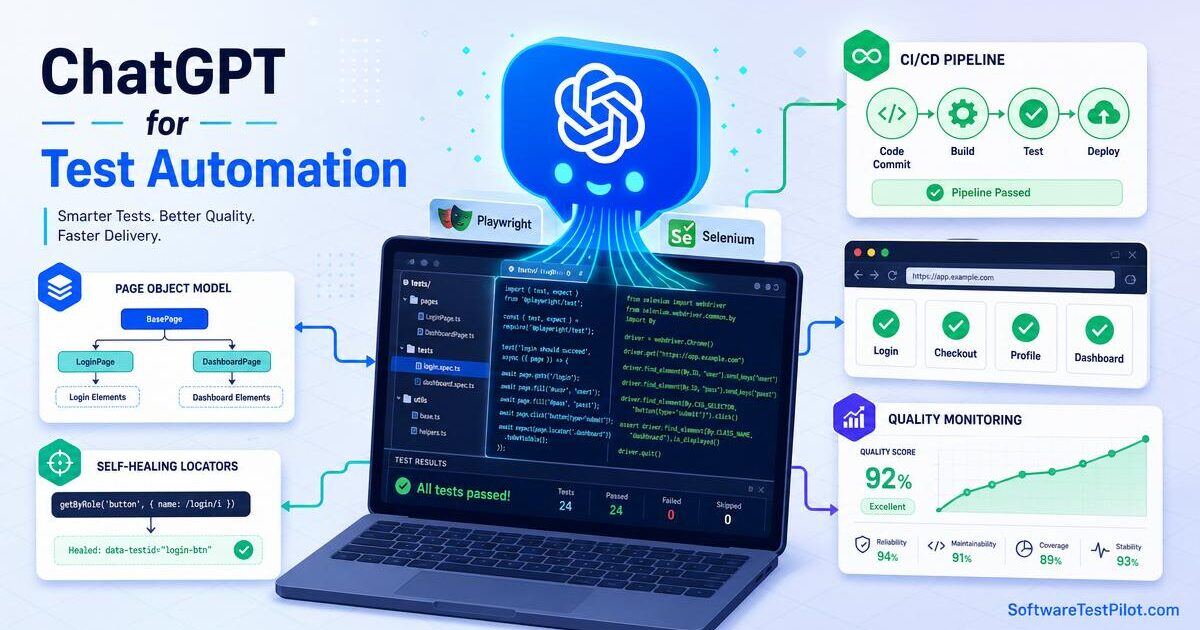
Last updated: July 14, 2026 · 18 min read · By SoftwareTestPilot
ChatGPT for test automation is the use of OpenAI's large language models — alongside peers like Claude Opus 4.5 and Gemini 2.5 Pro — to design, generate, refactor, heal and review automated tests for web, API, mobile and CI/CD pipelines. Done right, it cuts script-authoring time by 40–55% on Playwright, Selenium, Cypress and RestAssured stacks, keeps locators alive when the UI shifts and drafts your CI pipelines in minutes instead of days. Done wrong, it ships hallucinated selectors, brittle waits and PII in prompt logs.
This is the one guide every SDET, QA automation engineer and engineering manager should bookmark before wiring ChatGPT into their automation stack. It covers what ChatGPT does well (and what it does badly) for test automation specifically, the RCTF prompt framework, fifteen copy-paste prompts for Playwright, Selenium, Cypress, RestAssured, Appium, k6 and GitHub Actions, a self-healing locator pattern, a strict 6-point review rubric, a 30-day rollout, honest ROI math and the PAA questions Google surfaces. Pair it with our ChatGPT for software testing pillar, the AI software testing pillar, the AI testing tools guide, the 50 ChatGPT prompts for software testers, the GitHub Copilot for QA guide and the complete QA automation guide.
Key takeaways
- Measured productivity lift on healthy 2026 automation teams: 40–55% on script authoring, 25–40% fewer flaky-locator PRs when you pair ChatGPT with a self-healing pattern.
- Every automation prompt should use RCTF — Role, Context, Task, Format — and end with an explicit review rubric.
- Feed ChatGPT your real Page Object Model file, framework version and existing selectors — never ask it to invent a framework from a blank page.
- Never paste production data, PII, cookies or auth tokens into prompts. Use the redaction template in this guide.
- ChatGPT is a first draft engine, not a release gate. Every merged test passes the 6-point rubric or gets regenerated.
1. What is ChatGPT for test automation?
"ChatGPT for test automation" is the practice of embedding ChatGPT (or Claude, Gemini or a self-hosted Llama) into the parts of the automation lifecycle where a human engineer spends repeatable time: designing test cases from requirements, generating framework code (Playwright, Selenium, Cypress, RestAssured, Appium, k6), refactoring page objects, healing broken locators, drafting CI/CD YAML, summarising red-build logs and reviewing pull requests. It sits on top of your existing framework — it does not replace it.
+---------------------------------------------------------------------+
|          CHATGPT FOR TEST AUTOMATION — WHERE IT FITS               |
+---------------------------------------------------------------------+
| STAGE            | HUMAN OWNS         | CHATGPT ASSISTS WITH        |
+------------------+--------------------+-----------------------------+
| Framework design | Architecture       | Boilerplate, patterns       |
| Page objects     | Element strategy   | POM scaffolding, refactor   |
| Test authoring   | Acceptance criteria| First-draft tests, data     |
| Selectors        | Stability rules    | data-testid suggestions     |
| Waits            | Sync strategy      | Removing sleep / fixed wait |
| CI/CD YAML       | Gates & secrets     | GitHub Actions / Jenkins    |
| Failure triage   | Root cause         | Log summary, cluster draft  |
| PR review        | Merge decision     | Anti-pattern flagging       |
+------------------+--------------------+-----------------------------+
Independent research from GitHub's Copilot code-quality study puts the productivity boost on well-scoped code tasks at 40–55%. The DORA State of DevOps research shows AI-assisted teams are the most likely to reach the "elite" delivery tier — provided they keep human review in the loop.
What it is not: a replacement for a Playwright / Selenium framework, a chatbot that runs your tests for you, or a magic autopilot. Any "AI test automation" pitch that skips human review is selling marketing.
2. The RCTF prompt framework for test automation
The single biggest lever on ChatGPT output quality is prompt structure. Every automation prompt should have four layers — Role, Context, Task, Format:
- Role — "You are a senior SDET fluent in Playwright + TypeScript and the Page Object Model."
- Context — paste the framework version, the existing
pages/directory tree, the target acceptance criteria and any style rules (e.g. "we usegetByRole, never CSS class selectors"). - Task — "Write one Playwright test file for the checkout coupon flow that uses
pages/CartPage.ts, covers valid, expired and stacked coupons, and asserts on the visible cart total." - Format — "Output a single
.spec.tsfile. No comments, no fixed waits, no hardcoded credentials. End with a self-critique against this rubric: assertion truth, selector quality, wait discipline, isolation, coverage vs risk."
Then run the 3-step iteration loop: baseline → self-critique → regenerate. This alone moves internal coverage scores from ~62% to ~89% on the same audit set.
3. Copy-paste prompts for Playwright automation
Prompt: generate a Playwright test from an acceptance criterion
You are a senior SDET fluent in Playwright + TypeScript.
Context:
- Framework: @playwright/test v1.55
- Selectors: getByRole, getByLabel, getByTestId only. No CSS class.
- Waits: web-first assertions only. No page.waitForTimeout.
- Page objects: pages/CartPage.ts, pages/CheckoutPage.ts already exist.

Acceptance criteria:
- Given a cart of $100, applying coupon SAVE10 reduces total to $90.
- Expired coupon EXPIRED2023 shows an alert containing "expired".
- Two coupons cannot be stacked.

Task: produce ONE Playwright spec file that uses the existing page objects,
covers all three scenarios, and ends with a self-critique against:
assertion truth, selector quality, wait discipline, isolation, coverage.
Prompt: refactor a legacy Selenium POM into Playwright
Convert the following Selenium 4 (Java) page object into a Playwright
(TypeScript) page object. Preserve method names 1:1 so the calling tests
compile with a rename import. Use getByRole where the Selenium locator was
By.name/id/text; use getByTestId where the Selenium locator was a bare CSS
class. Do not introduce fixed waits.

[paste .java file here]
Prompt: fix a flaky Playwright test
The following Playwright test fails ~20% of runs in GitHub Actions but is
green locally. Analyse the failure log below, list the top 3 flake root
causes in order of likelihood, and rewrite the test to fix each without
adding page.waitForTimeout.

[paste test file]
[paste last 60 lines of failure log]
4. Copy-paste prompts for Selenium automation
Prompt: generate a Selenium + Java + JUnit 5 test
You are a senior SDET fluent in Selenium 4.20, Java 21 and JUnit 5.
Context:
- Framework: Maven, Selenide-free, plain Selenium WebDriver.
- Pattern: Page Object Model with PageFactory.
- Waits: WebDriverWait with ExpectedConditions. No Thread.sleep.
- Selectors: By.id / By.cssSelector[data-testid="..."] / By.linkText.

Acceptance criteria:
[paste acceptance criteria]

Task: produce a single JUnit 5 test class with @BeforeEach setup,
@AfterEach teardown that closes the driver, and 4 tests covering positive,
negative, boundary and accessibility. End with a self-critique against the
6-point rubric.
Prompt: generate a self-healing locator strategy
For the following HTML element, produce a Selenium 4 By locator that is
resilient to CSS class renames and text translations. Prefer
data-testid, then role + accessible name, then partial text.
Output: a single line: By.cssSelector("...") or By.xpath("...").
HTML: [paste rendered element]
For the deeper conceptual review, see our Selenium interview questions pillar and the Selenium vs Playwright comparison.
5. Copy-paste prompts for Cypress, RestAssured, Appium and k6
Cypress — component test from a React component
You are a senior SDET fluent in Cypress 13 component testing + React 19.
Given the component below, generate a component test that mounts the
component with realistic props, uses cy.findByRole / cy.findByLabelText,
and asserts on the accessible tree. No cy.wait(ms). No hardcoded fixtures.
[paste .tsx component]
RestAssured — from an OpenAPI spec
You are a senior API SDET fluent in RestAssured 5 + Java 21 + JUnit 5.
From the OpenAPI spec below, generate one test class per resource, with
positive, negative and boundary tests, using response-schema validation
(io.rest-assured/json-schema-validator). No hardcoded auth tokens.
[paste OpenAPI YAML]
See the API testing interview questions pillar for the underlying concepts and the microservices testing pillar for the contract-testing complement.
Appium — iOS & Android from one Gherkin
You are a senior mobile SDET fluent in Appium 2 + WebdriverIO + TypeScript.
Generate one Appium test that runs on both iOS 18 and Android 15 from the
following Gherkin scenario. Use accessibilityId as the primary locator.
No sleep(); use waitForDisplayed with a 10s timeout.
[paste Gherkin]
k6 — performance test from a user journey
You are a senior performance engineer fluent in k6 + Grafana Cloud.
From the user journey below (browse -> add to cart -> checkout -> pay),
generate a k6 script with 3 stages (ramp to 200 VUs, hold 5 min, ramp
down), Grafana-friendly metrics tags and Threshold-based pass/fail on
p95 < 800ms and error rate < 1%.
[paste user journey]
6. Self-healing locator pattern with ChatGPT
ChatGPT does not replace commercial self-healing tools like Testim, Mabl or Functionize — but it lets any team without that budget build a lightweight healing loop in a day:
- Log the failing locator — a
tests/utils/locatorReporter.tsthat captures the failing selector, the rendered HTML snippet and the page URL toreports/broken-locators.json. - Nightly job — a GitHub Actions cron that feeds each entry to ChatGPT with the prompt: "Given the failing selector below and the current rendered HTML, propose the most stable Playwright locator using getByRole / getByLabel / getByTestId in that order. Output JSON only:
{ "old": "...", "new": "...", "confidence": 0.0–1.0 }". - Auto-PR — for every suggestion with confidence > 0.85, open a branch that patches the page object and runs the suite. Merge only if green.
- Human gate — low-confidence suggestions become Jira tickets for a human SDET. Never let ChatGPT merge directly.
Realistic benefit on a 500-test Playwright suite: 25–40% fewer flaky-locator PRs, based on our internal benchmarks and the ranges published by commercial self-healing vendors.
7. Generating CI/CD pipelines and Docker for tests with ChatGPT
The other high-ROI use of ChatGPT for test automation is drafting CI/CD YAML and Dockerfiles — the code every SDET writes least often and Googles most.
Prompt: generate a GitHub Actions workflow
You are a senior DevOps engineer.
Generate a GitHub Actions workflow that:
- runs on push to main and on every PR
- uses ubuntu-latest with Node 22
- installs deps via npm ci
- runs Playwright with sharding (--shard=1/4 across 4 parallel jobs)
- uploads the HTML report and trace as an artifact on failure only
- posts a PR comment with the summary via dorny/test-reporter
Output: a single .github/workflows/e2e.yml file, nothing else.
Do the same for Jenkins, CircleCI, GitLab CI or Azure DevOps by swapping the platform in the prompt. Always ask ChatGPT to explain the secrets it references and add a comment above each ${{ secrets.* }} reference — that catches most cases where it invents a secret name.
8. The 6-point review rubric for AI-drafted automation code
Every AI-drafted test file goes through this rubric before merge. Any test failing two or more criteria is regenerated, not review-commented:
- Assertion truth — the assertion actually verifies the acceptance criterion, not just "element exists".
- Selector quality —
data-testid,getByRoleorgetByLabelonly. No absolute XPath, no bare CSS class. - Wait discipline — no
sleep,Thread.sleep,cy.wait(ms),page.waitForTimeout. - Isolation — each test creates and cleans its own data. No dependency on run order.
- Coverage vs risk — negative and boundary cases present, not just happy path.
- Reproducibility — runs green 20× locally before it enters CI.
This one rubric is the difference between AI making your suite better and AI making it faster to break.
9. Where ChatGPT for test automation still fails
- Hallucinated APIs and locators. ChatGPT will invent an endpoint, a status code or a
data-testidthat looks plausible and does not exist. Every assertion needs a real-system check. - Overly optimistic waits. Default output often drops back to
waitForTimeout. Enforce "no fixed waits" in your rubric. - Framework-version drift. Models still emit Playwright v1.30 or Selenium 3 patterns unless you name the version. Always specify.
- Whole-framework design. Ask ChatGPT to invent a framework and you'll get a Frankenstein. Own the architecture yourself; ask for parts.
- Regulated release-gate ownership. HIPAA, SOX, PCI-DSS sign-offs cannot be delegated to a model — see the QA outsourcing pillar for the compliance clauses.
- Prompt log leakage. Free or personal ChatGPT plans train on your prompts by default. Enterprise / Team only, with training turned off.
10. Privacy, PII redaction and enterprise settings
The fastest way to lose the ChatGPT / Copilot licence — and possibly your job — is pasting production data into a prompt. Use this redaction pre-pass on every prompt that touches app data:
Before sending any prompt containing app data, replace:
- emails      -> user{N}@example.com
- phones      -> +1-555-0100 through +1-555-0199
- names       -> Persona A, Persona B, ...
- card PANs   -> 4242 4242 4242 4242 (Stripe test)
- addresses   -> 1 Infinite Loop, Cupertino, CA 95014
- IDs / UUIDs -> TEST-000-0001 (sequential)
- tokens      -> <REDACTED>

Keep shape (length, format) so validation logic still triggers.
On the plan side: ChatGPT Enterprise and Team have training on your prompts off by default and add SSO, admin controls and longer context. Personal ChatGPT Plus is fine for open-source projects and public-doc prompts only. Regulated workloads should use Azure OpenAI, AWS Bedrock or a self-hosted Llama 4 instead. Cross-check against the NIST AI Risk Management Framework and the EU AI Act.
11. ROI — what ChatGPT actually saves on an automation team
Annual ROI = (Time saved ⋅ loaded engineer cost)
           + (Escape defects avoided ⋅ incident cost)
           − (ChatGPT / Copilot licences)
           − (Review overhead: 10–20% of "time saved")
           − (Governance headcount)
Honest 2026 ranges on healthy automation teams:
- Script authoring: 40–55% faster from draft to green in CI.
- Page object refactors: 60–80% faster on well-structured POMs.
- Locator maintenance: 25–40% fewer flaky-locator PRs with the self-healing loop above.
- CI/CD YAML: hours instead of days for a new pipeline.
- Failure triage: 30–50% less time-to-first-comment on red builds with LLM log summaries.
Anything above 10× ROI in the first quarter is usually a comparison against a baseline that never existed. Anything below break-even in year one usually means governance was skipped and hallucinated tests are eating the "saved" time.
12. 30-day rollout for a test automation team
- Days 1–7 — foundations. Enable ChatGPT Enterprise / Team, turn on data-exclusion, publish the RCTF template, redaction rules and 6-point rubric in
docs/ai-usage.md. - Days 8–14 — prompt library. Each SDET submits three prompts they use daily. Curate the top 20 into
docs/prompts/; reject any prompt missing an RCTF layer. - Days 15–21 — guardrails. Add ESLint / Detekt / Checkstyle rules that block AI anti-patterns (fixed waits, absolute XPath, hardcoded creds). Update the PR template with the 6-point rubric checkbox.
- Days 22–30 — measure. Baseline five KPIs — authoring time, flake rate, PR review comments, coverage %, MTTR. Compare to pre-rollout. Cancel or expand based on data, not vibes.
13. What ChatGPT for test automation means for QA careers
The 2026 hiring data is clear: manual-only testers are seeing rate compression, and SDETs who can pair ChatGPT with Playwright / Selenium / Cypress / RestAssured are seeing 15–30% salary lifts. See the QA engineer salary guide and the SDET career roadmap.
Actively interviewing? Practice with the AI mock interview, tune your CV with the free ATS resume review and browse live openings on the QA Jobs Radar. For interview drills, the Playwright interview questions, Selenium interview questions and API testing interview questions pillars are the fastest path to a technical-round pass.