
AI Software Testing in 2026: The Complete Pillar Guide (Tools, Workflows, ROI & FAQ)
The definitive 2026 AI software testing guide — what it is, how it actually works, the tools that ship real ROI (Copilot, Testim, Mabl, Applitools, Diffblue, Katalon, Playwright + LLM), a 30-day rollout plan, honest limits, governance, and every PAA question Google surfaces.

Last updated: July 14, 2026 · 18 min read · By SoftwareTestPilot
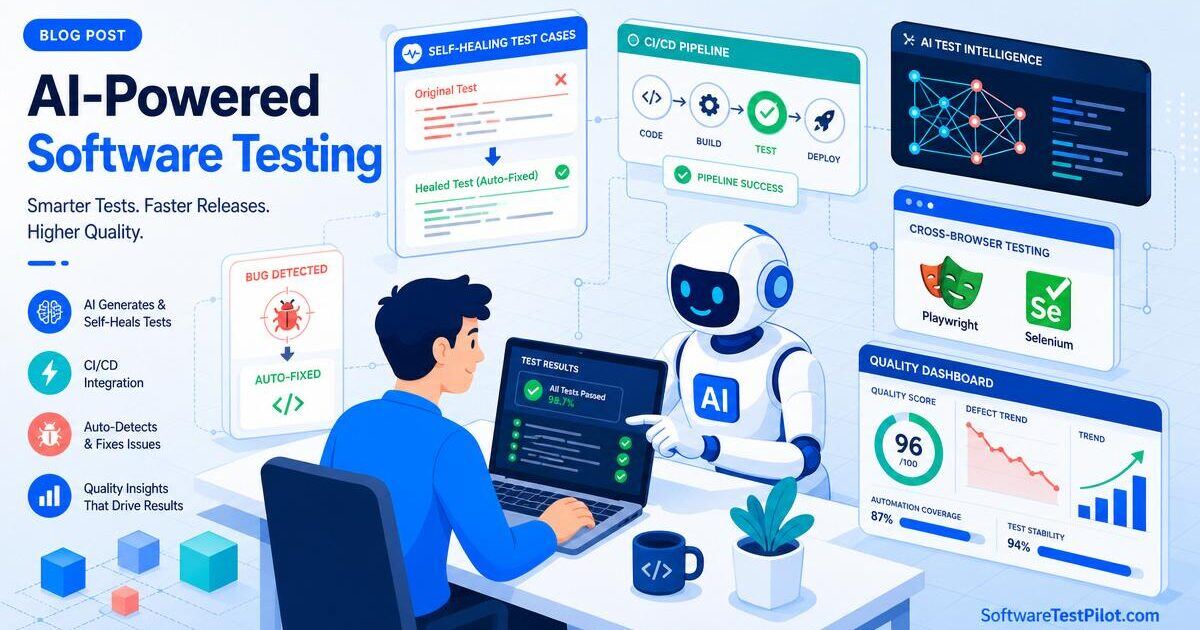
AI software testing is the use of machine-learning models — large language models, computer-vision models and classical ML — to help humans design, generate, execute, heal, triage and analyse software tests. It is not a magic button that replaces QA engineers. In 2026 it is a force multiplier: teams that pair AI with disciplined engineering are shipping 40–70% faster at the same or better quality, and the ones that treat it as autopilot are shipping regressions faster than ever.
This is the one page every QA lead, SDET, VP of Engineering and founder should bookmark before adding "AI" anywhere near their test estate. It covers what AI software testing actually is, the seven capabilities that ship real ROI, the honest tool landscape (Copilot, Cursor, Claude, Testim, Mabl, Applitools, Functionize, Diffblue, Katalon Studio, Playwright + LLM), copy-paste examples, a 30-day rollout plan, governance and safety clauses, and the PAA questions Google surfaces. Pair it with our AI testing tools guide, the how AI is changing QA in 2026 analysis, the ChatGPT for software testing playbook and the GitHub Copilot for QA guide.
Key takeaways
- AI software testing is best deployed across seven capabilities: test design, script generation, self-healing, visual validation, test-data synthesis, failure triage and risk-based selection.
- Median measured productivity lift on healthy 2026 engagements: 40–70% on script writing, locator maintenance and defect triage — not on end-to-end thinking.
- Use the most capable model to seed test cases (Claude Opus, GPT-5.5, Gemini 2.5 Pro), and a faster model (Haiku, Flash Lite) to scale paraphrases — see our which model to generate prompt evaluation test cases guide.
- Every 2026 test contract needs a written AI-use policy: allowed models, no PII in prompts, enterprise tier only, human review of every merged diff.
- AI does not replace test strategy, exploratory testing or release-gate ownership — those stay with humans.
1. What is AI software testing?
AI software testing is the practice of embedding machine-learning models into one or more stages of the software testing lifecycle so that a human tester ships more, faster, at higher quality than they could unaided. In 2026 the models in play fall into three buckets:
- Large language models (LLMs) — GPT-5.5, Claude Opus 4.5, Gemini 2.5 Pro, Llama 4 — used for test-case generation, script writing, PR review, defect triage and natural-language BDD.
- Computer-vision models — used by Applitools, Percy and Chromatic for visual regression and layout-shift detection that pixel diffs cannot catch.
- Classical ML — used by Testim, Mabl, Functionize and Launchable for self-healing locators, flaky-test clustering and risk-based test selection.
Where does it sit in the SDLC? Everywhere a tester spends repeatable time:
+---------------------------------------------------------------------+
|                AI SOFTWARE TESTING — WHERE MODELS FIT              |
+---------------------------------------------------------------------+
| STAGE            | HUMAN OWNS         | AI ASSISTS WITH             |
+------------------+--------------------+-----------------------------+
| Test strategy    | Risk & scope       | Draft plans, coverage gaps  |
| Test design      | Acceptance criteria| Case generation, edge cases |
| Script authoring | Framework, review  | Boilerplate, locators, POM  |
| Test data        | Rules, PII policy  | Synthesis, masking          |
| Execution        | Pipeline, gates    | Retry, self-healing, dedupe |
| Triage           | Root cause         | Clustering, log summary     |
| Reporting        | Sign-off           | Trend narrative, RCA drafts |
+------------------+--------------------+-----------------------------+
According to the DORA State of DevOps research, teams that adopt AI-assisted development practices are among the most likely to reach the "elite" performance tier. The Copilot research from GitHub puts the productivity boost on well-scoped tasks in the 40–55% range — and independent replication finds similar numbers for test scaffolding specifically.
AI software testing is not: script recording renamed "AI", chatbots that answer Slack questions, or a replacement for exploratory testing. Anyone selling any of those as "AI QA" is selling marketing.
2. The seven AI software testing capabilities that ship real ROI
- Test case & scenario generation. Feed a user story, acceptance criteria or an OpenAPI spec to an LLM and get a first-draft set of positive, negative, boundary and adversarial cases. Rubric — and rewrite — every one before merging.
- Script & framework scaffolding. Copilot, Cursor and Cline turn a Gherkin step into a Playwright, Cypress or Selenium method in seconds. See the Copilot for QA guide and the Playwright pillar.
- Self-healing locators. Testim, Mabl and Functionize track element attributes over time and re-bind selectors when the DOM changes. A 30% flake reduction on legacy Selenium suites is realistic.
- Visual & layout regression. Applitools, Percy and Chromatic use vision models to flag meaningful UI changes and ignore anti-aliasing noise — the class of bug pixel diffs and DOM assertions both miss.
- Test-data synthesis & masking. Gretel, Tonic and MOSTLY AI generate statistically realistic synthetic data (or mask production data) so QA teams get realistic edge cases without PII exposure.
- Failure triage & log summarisation. ReportPortal, Launchable and in-house LLM pipelines cluster flaky failures, summarise stack traces and draft an RCA before a human opens the CI log.
- Risk-based test selection. Launchable and Diffblue Cover analyse the code diff and historical failures to run only the tests that matter for a given PR — cutting a 40-minute suite to under 8 minutes on a normal change.
The order matters. Teams that start with 3 and 6 (self-healing and triage) see ROI in weeks. Teams that start with 1 and 2 (case and script generation) see huge output gains but need mature review and rubric habits or they simply generate flakiness faster.
3. The honest 2026 AI software testing tool landscape
| Tool | Category | Best for | 2026 starting price (USD) | Open source |
|---|---|---|---|---|
| GitHub Copilot Enterprise | IDE co-pilot / LLM | Playwright, Cypress, Selenium, RestAssured script authoring | $39 / user / month | No |
| Cursor | AI IDE / LLM | Whole-repo edits, framework refactors | $20 / user / month | No |
| Claude Code / Anthropic API | LLM | Test-case generation, rubric grading, LLM-as-judge | Pay-as-you-go | No |
| Testim | Self-healing E2E | Fast-changing web UIs, low-code teams | Custom | No |
| Mabl | Self-healing + anomaly | Regression + API + perf in one platform | Custom | No |
| Functionize | Self-healing E2E | Enterprise regression at scale | Custom | No |
| Applitools Eyes | Visual AI | Design-heavy web + mobile apps | ~$0.03 / checkpoint | No |
| Percy (BrowserStack) | Visual AI | Playwright/Cypress teams already on BrowserStack | $149 / month | No |
| Katalon Studio + StudioAssist | Low-code + LLM | Teams migrating off Selenium IDE | Free + $175 / user / month | No |
| Diffblue Cover | AI unit-test generation (Java) | Legacy Java coverage backfills | Custom | No |
| Launchable | Predictive test selection | Large flaky CI suites | Custom | Free tier |
| ReportPortal.io | AI failure triage | Teams that want open-source control | Free (self-host) | Yes |
| Playwright + LLM (DIY) | Custom stack | Teams with LLM engineers, tight cost control | Model + Playwright OSS | Yes |
Rule of thumb: most mid-market teams end 2026 with a stack that looks like Playwright + Copilot Enterprise + Applitools + Launchable + ReportPortal, plus one specialist tool (Testim or Mabl) if the UI churns weekly. Anything more is stack sprawl; anything less usually means an area (visual or triage) is manual.
4. A real end-to-end AI-assisted testing workflow
Here is what a healthy AI-assisted workflow looks like for a checkout regression on a Playwright + TypeScript stack. Every arrow represents a human review gate, not a hand-off to autopilot.
+----------------------------------------------------------------------+
|                AI-ASSISTED TEST WORKFLOW — CHECKOUT                 |
+----------------------------------------------------------------------+
| 1. PM writes user story & acceptance criteria                        |
| 2. Claude Opus drafts 12 test scenarios (pos, neg, edge, adversarial)|
| 3. SDET rubric-reviews & rewrites 8 → merges as .feature files      |
| 4. Copilot expands each step to Playwright TS + POM                  |
| 5. Tests run in GitHub Actions with Launchable selecting relevant    |
| 6. Applitools compares screenshots vs baseline for meaningful diffs  |
| 7. Failures cluster in ReportPortal; LLM drafts RCA per cluster      |
| 8. Human triages, files bugs, updates baseline if intentional        |
| 9. Weekly cron: Diffblue Cover backfills unit tests on new Java code |
+----------------------------------------------------------------------+
Sample: LLM-generated Playwright test, human-reviewed
// tests/checkout/apply-coupon.spec.ts
import { test, expect } from '@playwright/test';
import { CartPage } from '../pages/CartPage';

test.describe('Checkout — coupon codes', () => {
  test('valid 10% coupon reduces cart total', async ({ page }) => {
    const cart = new CartPage(page);
    await cart.goto();
    await cart.addItem('sku-42');
    const before = await cart.getTotal();
    await cart.applyCoupon('SAVE10');
    const after = await cart.getTotal();
    expect(after).toBeCloseTo(before * 0.9, 2);
  });

  test('expired coupon shows friendly error', async ({ page }) => {
    const cart = new CartPage(page);
    await cart.goto();
    await cart.applyCoupon('EXPIRED2023');
    await expect(page.getByRole('alert')).toHaveText(/coupon.*expired/i);
  });
});
The LLM wrote the shape; the SDET added the page-object, chose the accessible selectors (getByRole), and set the assertion precision. That split — model drafts, human owns intent — is the single most important habit in AI software testing.
5. Prompt patterns that actually work for QA engineers
Most bad AI test output comes from bad prompts, not bad models. Four patterns cover 80% of what QA teams need:
- Role + constraints + format. "You are a senior SDET. Given this OpenAPI spec, produce 10 test cases as a Markdown table with columns: title, method, endpoint, request body, expected status, expected body assertion, risk (P1/P2/P3)."
- Rubric-first generation. Ask the model for the rubric it will use, correct it, then ask it to generate cases against that rubric. This alone cuts hallucinated assertions by more than half.
- Adversarial pass. After a first draft, prompt: "Now act as a red-team QA. List 8 ways a real user could break each of the above."
- Diff review, not blank page. Feed the model the PR diff plus the existing tests and ask it what is missing — not to invent tests from scratch.
Deeper prompt libraries and copy-paste starters live in our 50 ChatGPT prompts for software testers and ChatGPT for software testing guides. For the meta-question — which model should generate your evaluation cases? — see the dedicated model selection guide.
6. AI software testing ROI — the honest math
Every serious ROI conversation for AI testing has three lines: time saved, escape defects avoided and hidden costs. Skip the last one and you will over-promise.
Annual ROI = (Time saved ⋅ loaded engineer cost)
           + (Escape defects avoided ⋅ incident cost)
           − (Model & tool spend)
           − (Review overhead: 10–20% of "time saved")
           − (Prompt-engineering & governance headcount)
Realistic ranges we see on healthy 2026 programs:
- Script authoring: 40–55% faster from draft to green in CI (matches published Copilot benchmarks).
- Locator maintenance: 25–40% fewer flaky-locator PRs on suites using self-healing.
- Visual regression triage: 60–80% fewer manual diffs reviewed per release with Applitools/Percy.
- Test selection: 3–6× faster PR feedback with Launchable or Diffblue on large Java or JS suites.
- Failure triage: 30–50% less time-to-first-comment on red builds with clustering + LLM summaries.
Anything above 10× ROI in the first quarter is almost always a comparison against a baseline that never existed. Anything below break-even in the first year usually means the team skipped governance and is now spending the "saved" time reviewing hallucinated tests.
7. Where AI software testing still fails (and always will, for now)
- Test strategy. Deciding what not to test is a business-risk call. Models will happily generate 500 low-value cases.
- Exploratory testing of novel product. Models cannot form a mental model of a product they have never seen used. Human curiosity still wins.
- Release-gate ownership. A model cannot be accountable. A human must sign off.
- Regulated sign-offs. HIPAA, SOX, PCI-DSS and FedRAMP attestations cannot be delegated to a model. See the QA outsourcing pillar for the compliance detail.
- Cross-service reasoning at scale. Contract testing with Pact, chaos testing and observability assertions still need human architects — the microservices testing pillar covers the shape.
- Hallucinated assertions. Models will invent APIs, status codes and error messages that look plausible and don't exist. Every merged AI-drafted test needs a human review pass.
8. AI software testing governance — the non-negotiable checklist
Every 2026 engineering org running AI in the test estate needs a written policy. The minimum viable version is one page and covers:
- Allowed models & tiers — enterprise tier only, no free ChatGPT / Claude / Gemini for anything that touches source or customer data.
- Data policy — no PII, no secrets, no production data in prompts. Test-data synthesis via Gretel/Tonic or in-house.
- Prompt logging — every prompt that produced merged code or a merged test is stored and reviewable.
- Human-in-the-loop — every AI-generated diff needs a named human reviewer before merge; every AI-generated bug needs a human triage.
- Cost controls — per-team model budgets, alerts, and a monthly review of top-10 prompts by cost.
- Vendor AI clause — when outsourcing QA, insist on written AI-use and customer-data policies from the vendor (see clause list in the QA outsourcing pillar).
- Regulatory alignment — document how the program meets the EU AI Act, NIST AI RMF and any sector regulation you fall under.
The NIST AI Risk Management Framework and the EU AI Act are the two reference documents worth reading in full.
9. A 30-day rollout plan for AI software testing
- Week 1 — policy & access. Write the one-page AI policy above. Buy enterprise licences for one IDE co-pilot (Copilot or Cursor) and one LLM API (Claude or GPT). Turn off free / personal tiers.
- Week 2 — low-risk wins. Roll out self-healing locators on the flakiest legacy suite and visual AI on one design-heavy surface. Measure flake and diff-review time.
- Week 3 — script generation. Train one squad on rubric-first prompt patterns. Merge only reviewed AI-drafted tests. Track PR review time and merged test coverage delta.
- Week 4 — selection & triage. Wire Launchable or Diffblue into CI on the noisiest pipeline. Add LLM-based clustering in ReportPortal (or hosted) for red builds.
Report weekly on four numbers: script authoring time, flake rate, mean time to triage, escape defects. If any of the four moves the wrong way, roll back that capability — not the whole program.
10. What AI software testing means for QA careers
The cliché "AI will replace testers" is not what the 2026 data shows. What it does show is a hard split:
- Manual-only testers who don't evolve are seeing rate compression and slower promotion. See the QA engineer salary guide.
- Testers who add Python/JS, one AI-testing tool and prompt engineering to their resume are seeing 15–30% salary lifts — the pattern we track in the SDET career roadmap.
- The fastest-growing role of the year is "AI QA Engineer" — part SDET, part prompt engineer, part LLM-eval specialist.
Actively interviewing for one of these roles? Practice with the AI mock interview, tune your CV with the free ATS resume review, and browse live openings on the QA Jobs Radar.