
QA Outsourcing in 2026: The Complete Pillar Guide (Models, Costs, Vendors, FAQ)
The definitive 2026 QA outsourcing pillar guide — what it is, the four engagement models, region-by-region 2026 hourly rates, ROI math, vendor selection scorecard, contract clauses, red flags, a 30-day onboarding plan and PAA FAQs.

Last updated: July 14, 2026 · 17 min read · By SoftwareTestPilot
QA outsourcing is the practice of contracting an external partner to run some or all of your software quality activities — manual, automation, API, performance, security, mobile, exploratory — instead of hiring, training and managing that capacity in-house. Done well it cuts blended testing cost by 40–70%, adds specialised skills you cannot hire fast enough, and gets follow-the-sun coverage live in weeks. Done badly it burns six figures, leaks defects to production, and locks you into a vendor you cannot fire.
This is the one page every VP of Engineering, Head of QA and founder should read before signing an outsourcing contract in 2026. It covers what QA outsourcing actually is, the four engagement models and when each wins, real 2026 rates by region, a 100-point vendor RFP scorecard, non-negotiable contract clauses, a 30-day onboarding plan, ten red flags that predict failure and the PAA questions Google surfaces on this topic. For the deeper vendor-selection playbook see our QA Outsourcing Services buyer's guide; for the tooling side, cross-check the software testing consulting firm guide, the test automation framework consulting playbook, the mobile app testing services buyer's guide and the complete QA automation guide.
Key takeaways
- Typical blended saving vs an in-house US QA team: 40–70%, with 55% as the median across engagements we track.
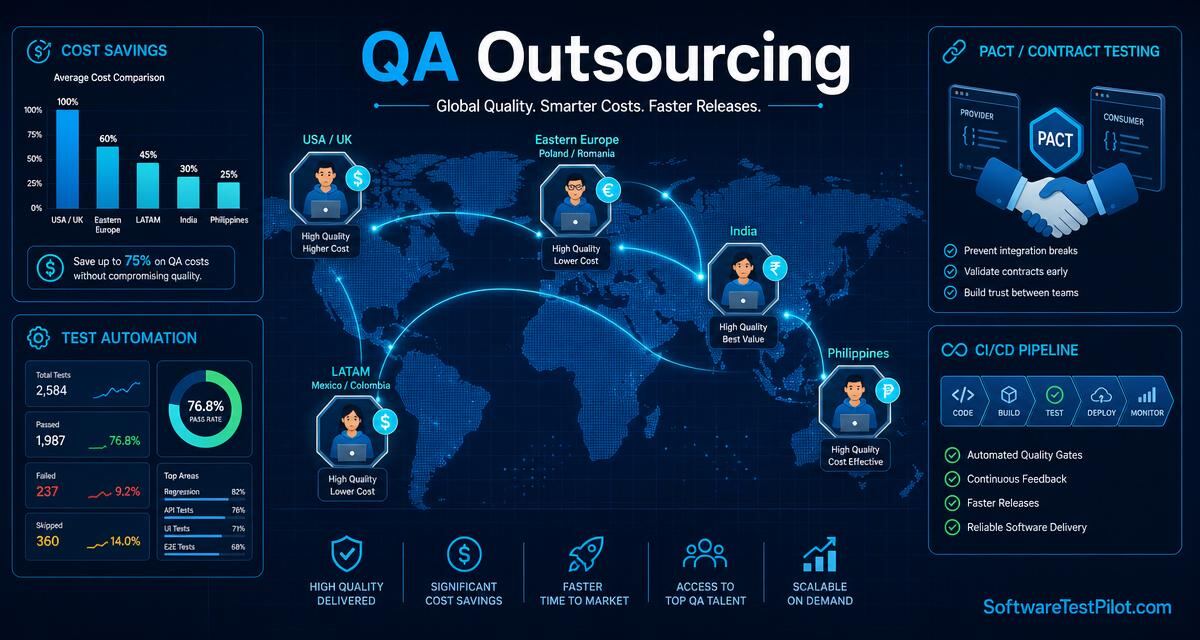
- 2026 blended hourly rates: India $18–$45, Philippines $15–$35, LATAM $28–$70, Eastern Europe $35–$85, US onshore $80–$180.
- Pick your engagement model by who owns the roadmap: staff augmentation when you own it, managed testing when the vendor does.
- Any vendor without SOC 2 Type II, ISO 27001 and a written data processing agreement is a no in 2026.
- A two-sprint fixed-price pilot predicts long-term success far better than any pitch deck.
1. What is QA outsourcing?
QA outsourcing is a contractual relationship in which an external company — onshore, nearshore or offshore — delivers some or all of your software testing activities: test strategy, test case design, manual and exploratory testing, automation framework build and maintenance, API and contract testing, performance and security testing, mobile testing, release certification and production observability.
It sits on a spectrum that most teams navigate over years, not weeks:
+----------------------------------------------------------------------+
|                THE QA SOURCING SPECTRUM — 2026                      |
+----------------------------------------------------------------------+
| 100% IN-HOUSE  <---->  HYBRID  <---->  MANAGED  <---->  100% OUTSOURCED|
|  You hire &         Core team +     Vendor runs      Vendor owns     |
|  train every       vendor for      the QA function    quality end-   |
|  tester            surge / spec.    with a lead        to-end         |
+----------------------------------------------------------------------+
According to the Deloitte Global Outsourcing Survey, more than 70% of enterprises now outsource at least one QA activity, and the number one driver in 2026 is no longer cost — it is access to specialised talent (performance engineers, AI-testing SDETs, security testers) that is genuinely hard to hire full-time. The DORA State of DevOps research is equally clear that test automation coverage — whether built in-house or via a partner — is the single strongest correlate of elite delivery performance.
QA outsourcing is not the same as hiring one freelance tester on Upwork — that is covered in our freelance software tester rate guide — and it is not the same as buying a testing tool. It is a structured service relationship with named engineers, SLAs, deliverables and shared metrics.
2. Why teams outsource QA in 2026
Every outsourcing decision has to answer one question: what would it cost, in time and money, to build the same capability in-house, and how does that compare? These five drivers most often tip the answer to "outsource":
- Cost. A mid-level US automation engineer costs $110k–$150k base plus ~30% loaded (benefits, equipment, tooling). The same seniority in India runs $30k–$55k fully loaded — a 55–65% saving before recruiting cost. Calibrate against our QA engineer salary guide.
- Specialised skills. Performance engineers who know k6 and JMeter, security testers with OWASP ZAP and Burp Suite, AI-testing SDETs or microservices testing specialists are 6–12 months to hire directly. A mature vendor can staff them in under 2 weeks.
- Elastic capacity. Regression seasons, release windows, migrations and audits create huge but temporary demand. Firing full-time engineers when the surge ends is neither humane nor legal in most jurisdictions.
- Follow-the-sun coverage. An India + US or LATAM + EU pairing turns 8-hour cycles into 16–24-hour cycles. Bugs found at 6 PM PT are fixed by 9 AM PT the next day.
- Speed to first green build. A mature vendor arrives with framework templates, reference pipelines and reusable fixtures. Weeks of setup, not quarters — the same reason we built the framework consulting playbook.
3. QA outsourcing rates by region — the 2026 numbers
The rates below are blended benchmarks from active engagements we track across mid-market and enterprise clients. "Blended" means the average across manual, automation and lead roles inside one team — individual specialist rates run 20–40% higher.
| Region | Hourly rate (blended) | Team of 5 / month | Best for | Timezone overlap with US ET |
|---|---|---|---|---|
| India (Bengaluru, Pune, Hyderabad) | $18–$45 | $14k–$32k | Volume manual + automation, mature CMMI 3+ vendors | 2–4 hrs |
| Philippines | $15–$35 | $12k–$26k | Manual, exploratory, English-first BPO experience | 0–2 hrs |
| LATAM (Mexico, Colombia, Argentina) | $28–$70 | $22k–$50k | Real-time collaboration with US teams, nearshore agile | Full overlap |
| Eastern Europe (Poland, Romania, Ukraine) | $35–$85 | $28k–$62k | Deep SDET talent, performance / security specialists | 2–5 hrs |
| Vietnam | $18–$40 | $14k–$29k | Cost-competitive alternative to India for mobile QA | 0–3 hrs |
| US / Canada (onshore) | $80–$180 | $62k–$130k | Regulated industries, on-site audits, top-secret compliance | Full |
| Western Europe (UK, DE, NL) | $90–$200 | $68k–$140k | GDPR-heavy programs, in-country data residency | 3–6 hrs |
Rule of thumb: multiply the hourly rate by ~160 to get monthly cost per engineer. Anything below $15/hour is a warning sign — either shell freelancers with no benefits or a rate no real employee can sustain, and turnover on those contracts is typically > 50% per year.
What drives price within a region
- Seniority mix — teams weighted to leads and SDETs are 30–50% pricier than junior-heavy teams.
- Skill stack — Playwright + TypeScript + AWS + Kubernetes commands a 20–35% premium over Selenium + Java.
- Contract length — 12-month commits usually unlock 8–15% off month-to-month rates.
- Compliance — HIPAA, PCI-DSS or FedRAMP add 10–25% to blended rate.
- Delivery model — managed testing carries a 15–25% vendor margin above staff augmentation for the same headcount.
4. The four QA outsourcing engagement models compared
Every real outsourcing agreement is one of four models, or a hybrid of two. Pick the wrong one and every downstream problem — cost overrun, quality drift, unclear accountability — can be traced back to the model, not the vendor.
+----------------------------------------------------------------------+
|          FOUR QA OUTSOURCING ENGAGEMENT MODELS — 2026               |
+----------------------------------------------------------------------+
| MODEL             | YOU OWN     | VENDOR OWNS     | BEST FOR          |
+-------------------+-------------+-----------------+-------------------+
| 1. Staff aug.     | Roadmap,    | Recruiting,     | Existing QA org   |
|                   | tools, PRs  | benefits, dev   | that needs surge  |
+-------------------+-------------+-----------------+-------------------+
| 2. Managed        | Business    | Team, process,  | No senior QA      |
|    testing        | outcomes    | tools, reports  | leader in-house   |
+-------------------+-------------+-----------------+-------------------+
| 3. Project /      | Scope, UAT  | Delivery, risk  | Framework builds, |
|    fixed-price    |             | of overrun      | migrations        |
+-------------------+-------------+-----------------+-------------------+
| 4. Crowdsourced   | Test plans  | Distributed     | Device coverage,  |
|                   |             | crowd of testers| localisation UX   |
+-------------------+-------------+-----------------+-------------------+
1. Staff augmentation
The vendor supplies named engineers who effectively join your team. They use your Jira, your GitHub, attend your standups and follow your definition of done. You keep architectural control; the vendor handles recruiting, payroll, benefits and replacement risk. Choose when you already have a QA lead in-house, you own the tool stack and framework, and you need to add capacity fast without adding permanent headcount.
2. Managed testing services
The vendor runs your QA function end-to-end: their lead defines process, their team executes, and they own SLAs (e.g. "95% of P1 defects reported within 4 hours"). You review reports and pay a monthly retainer. Choose when you don't have a senior QA leader in-house, you want a single throat to choke on quality outcomes and you're comfortable ceding day-to-day control.
3. Project / fixed-price
You define a bounded scope ("build a Playwright framework covering 40 user journeys, wired into GitHub Actions with Allure reports, delivered in 12 weeks"), the vendor commits a fixed price and takes the overrun risk. Choose when the scope is genuinely bounded — framework builds, tool migrations, security audits, one-off automation of a legacy suite.
4. Crowdsourced testing
Platforms like uTest, Testlio and Applause route your tests to a distributed crowd of thousands of real-world testers on real devices, browsers and locales. You pay per-test-cycle or per-bug. Choose when you need real-device or real-location coverage no vendor could staff internally — mobile release smoke across 300 device profiles, localisation UX in 30 countries, accessibility spot checks.
Most mature programs blend two models: staff augmentation for day-to-day regression, plus a fixed-price project for the framework build, plus crowdsourced for release-week device coverage.
5. What to outsource (and what to keep in-house)
Not every QA activity should leave the building. After 100+ outsourcing reviews, this is the split we recommend to engineering leaders:
| Activity | Outsource? | Why |
|---|---|---|
| Regression suite execution | Yes | Repeatable, well-documented, benefits from scale |
| Automation framework build | Yes (fixed-price) | Vendor templates cut months of setup |
| API & contract testing | Yes | Fast ROI — see the API testing pillar and microservices testing guide |
| Performance / load testing | Yes | Specialised skills, episodic demand — see k6 tutorial |
| Security testing (DAST, SCA) | Yes | Certified partners, tooling-heavy |
| Mobile device coverage | Yes (crowdsourced) | Impossible to match in-house device farm |
| Localisation / UX QA | Yes (crowdsourced) | Needs real users in real geographies |
| Test strategy & architecture | Keep in-house | Tied to product roadmap and risk appetite |
| Release gate ownership | Keep in-house | Accountability for shipping stays with your team |
| Compliance sign-off (SOX, HIPAA) | Keep in-house | Legal accountability cannot be delegated |
| Exploratory testing of core product | Mostly keep | Requires deep product empathy — small in-house team + vendor overflow works well |
The pattern: outsource execution and specialised skills, keep strategy, ownership and product-critical judgement.
6. The 100-point vendor selection scorecard
Every serious QA outsourcing decision should run through an RFP against 3–5 shortlisted vendors. Weight the categories to match your risk profile — regulated fintech pushes compliance higher; a Series B SaaS pushes technical fit higher.
| Category | Weight | What to score |
|---|---|---|
| Technical fit | 25 | Depth in your stack (Playwright, Selenium, k6, Appium), sample framework code, real GitHub repos |
| Delivery process | 15 | Onboarding plan, sprint cadence, defect SLAs, escalation path, reporting cadence |
| Security & compliance | 15 | SOC 2 Type II, ISO 27001, GDPR / HIPAA / PCI where relevant, DPA template, data residency |
| People & retention | 15 | Named engineers, seniority mix, annual attrition (< 15% is healthy), replacement SLA |
| Communication | 10 | English fluency, timezone overlap, weekly report format, incident response time |
| Commercial | 10 | Rate card transparency, currency risk, exit clause, IP assignment, warranty on deliverables |
| References | 10 | Two live references at your scale in your industry, one that ended the engagement (why?) |
Ten red flags that predict a failed engagement
- Rate quoted below regional market floor (see the rates table above).
- Refusal to name the specific engineers who will work on your account.
- No SOC 2 Type II or ISO 27001; "working on it" for > 12 months.
- No sample framework, sample report or sample defect trend graph.
- Sales lead will not put you in touch with the delivery lead.
- Attrition rate above 25% per year, or "we don't track it".
- Fixed-price project with no acceptance or exit criteria written down.
- Contract has no IP-assignment clause — every line of code they write must be yours.
- No written data-processing agreement (DPA) or sub-processor list.
- Uncomfortable answering "tell me about an engagement that ended badly and why".
7. Contract clauses you must not skip
These clauses are non-negotiable in any 2026 QA outsourcing contract. Missing any of them is a leverage loss you will pay for the first time something goes wrong.
- IP assignment of all deliverables — test scripts, framework code, docs, dashboards — to you, with no vendor retention rights.
- Data processing agreement aligned to GDPR (and CCPA where relevant) with a named sub-processor list, right to audit and 24-hour breach notification.
- Security schedule covering encryption at rest and in transit, MFA on all shared systems, laptop-level device policy, background checks, and audit-log retention.
- Current SOC 2 Type II and ISO 27001 reports, refreshed annually, with the vendor's most recent bridge letter attached.
- Measurable SLAs (defect-report time, test-cycle turnaround, coverage %) with 10–20% fee-at-risk if missed.
- Warranty of 30–90 days on delivered code, so genuine defects get fixed at no extra cost.
- Clean 30-day exit clause with paid transition assistance and a documented handover plan.
- Mutual NDA plus 12-month non-solicit of engineers on both sides.
- Liability cap of at least 12× monthly fees — uncapped for gross negligence, IP breach and data breach.
- Governing law in your jurisdiction, not the vendor's.
8. The 30-day onboarding plan that actually works
The first four weeks decide whether an engagement pays off or drifts. Use this cadence for every new vendor, staff-aug or managed:
- Week 1 — access & legal. Provision SSO, VPN, Jira, GitHub, test environments; sign DPA, NDA and IP assignments; publish a written Way of Working doc (definition of done, PR review rules, on-call expectations).
- Week 2 — product & framework context. Vendor engineers pair with your team on the architecture, the current test suite, the CI pipeline and the top-10 defect classes. Read-outs every second day.
- Week 3 — first real epic. Hand ownership of one bounded epic (e.g. "automate the checkout regression") to the vendor, with your lead as reviewer, not implementer.
- Week 4 — steady-state cadence. Weekly written report (coverage delta, defect trend, flake trend, blocked items), monthly business review, quarterly capacity review.
Realistic productivity curve: ~40% in week 2, ~65% by week 4, full effectiveness (parity with a comparable in-house engineer) by month 4–6. Anyone promising day-one full velocity is selling, not delivering.
9. QA outsourcing ROI — the math on one page
The honest ROI framework has three lines: cost avoided, speed gained and quality delta. Skip any of them and you're either selling or getting sold.
Annual ROI = (Cost avoided + Value of speed + Value of quality) − Vendor fees − Internal management overhead

Where:
  Cost avoided     = (In-house fully-loaded cost per FTE) × (# FTE replaced or not hired)
  Value of speed   = (Revenue ⋅ days-earlier-shipped) or (avoided cost of delay per initiative)
  Value of quality = (Cost of an incident) × (# incidents avoided) + (Support ticket delta)
  Overhead         = ~10–15% of vendor fees (a lead's time managing the vendor)
Real-world ranges we see from healthy engagements: 2.5–5× ROI in year one, 4–8× in year two once framework leverage compounds. Anything above 8× is usually a comparison against an in-house baseline that never actually existed.
10. QA outsourcing for regulated industries
Regulated workloads (healthcare, banking, insurance, defense, public sector) can be outsourced, but only to vendors that hold the specific certifications your regulator requires. Non-exhaustive 2026 checklist:
- US healthcare (HIPAA) — signed BAA, PHI redaction rules, physical security controls.
- Card data (PCI-DSS) — scope isolation, tokenisation-first test data, annual attestation.
- US federal (FedRAMP) — Moderate baseline minimum, US-person controls.
- EU personal data (GDPR) — DPA, data residency clauses, sub-processor list, DPO contact.
- Financial services (SOX) — separation of duties, audit trails, retention policies.
For the most sensitive workloads (defense, critical national infrastructure), onshore or fully in-house is still usually the right answer. For everything else, a certified nearshore or offshore partner is defensible — provided data residency, sub-processor lists and the right to audit are all written into the contract.
11. How AI is reshaping QA outsourcing in 2026
AI-assisted testing has moved from novelty to line-item in every serious RFP. What has actually changed in the last twelve months:
- Productivity gains of 40–70% on locator generation, boilerplate script writing, test-data generation and defect triage — measured on real engagements, not vendor slides.
- Rate pressure: buyers are pushing for either a 10–15% rate cut or an equivalent scope expansion on renewal.
- New required clauses: written AI-use policy, list of allowed models, customer-data policy (no PII in prompts), and Copilot / Cursor / Claude enterprise-tier requirements.
- Shift in skills mix: fewer script writers, more test designers and reviewers — the roles we break down in the SDET career roadmap.
For the deeper how-to see our AI testing tools guide, the how AI is changing QA in 2026 analysis, and the ChatGPT for software testing playbook.
12. Startup vs enterprise — different playbooks
Pre-seed / seed startup
You almost certainly don't have a senior QA leader. A managed testing partner with a small (2–3 person) India or Philippines team is usually the fastest path to safety while founders focus on product. Budget: $5k–$15k/month. Skip staff-aug — you have no one to manage the augmented staff.
Series A / B
Hire one senior in-house QA lead first. Then use outsourcing for surge capacity, framework builds and specialised skills (performance, security, mobile devices). The in-house lead protects institutional knowledge; the vendor provides elasticity. Budget: $15k–$60k/month depending on scale.
Enterprise
You almost always run a hybrid: an in-house Quality Engineering platform team plus multiple vendor pods for regression, performance and specialised programs. Standardise on one Pact Broker, one microservices testing pattern and one CI pipeline across all vendors, or you'll end up with N incompatible test estates. Budget: $60k–$500k+/month.
Actively hiring in-house instead of (or alongside) outsourcing? Point candidates at the QA Jobs Radar, the AI mock interview and the free ATS resume review.
For the full vendor-selection walkthrough — engagement models, SLAs, pricing bands, and exit clauses — read our detailed guide to QA outsourcing services.