The 3-Minute Whiteboard Testing Trick That Impresses Interviewers (ACCORD Framework)
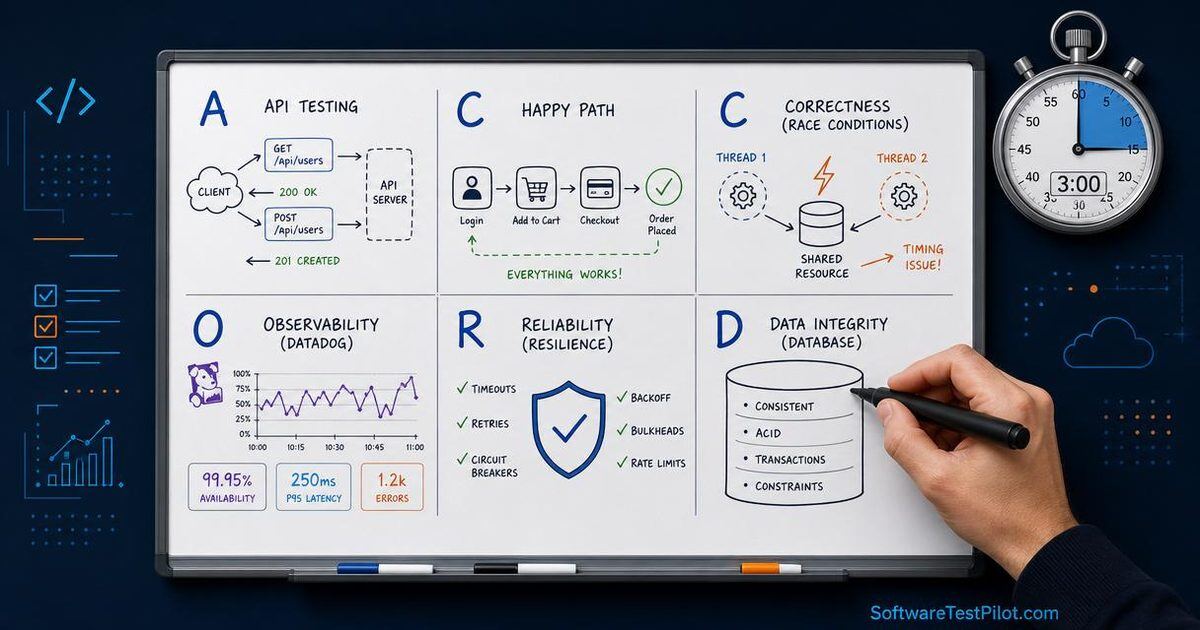
Stop rattling off random test cases. The ACCORD 6-quadrant whiteboard framework — Architecture, Core happy path, Concurrency, Observability, Recovery, Data state — takes control of any senior QA or SDET interview in the first 3 minutes.

Last updated: July 1, 2026 · 11 min read · By Avinash K
You’re twenty minutes into a technical interview for a Senior QA / SDET role paying $140,000+ base. Resume chat has gone smoothly. Then the Engineering Manager hands you a marker (or shares a Zoom whiteboard) and drops the classic open-ended prompt:
“Imagine we’re building an Uber-like ride-share app. How would you test the dynamic fare calculation service?”
Most candidates panic and start firing off random bullet points — “test negative distance, test surge, test iPhone UI, test GPS drop…” That’s the fastest way to get rejected on a senior screen. Random lists signal missing structure and missing systems thinking.
Top hiring managers on our QA Jobs Radar aren’t testing whether you can brainstorm 50 checks. They’re testing three specific competencies: structural taxonomy, risk prioritisation, and full-stack awareness. This guide gives you the exact 3-minute whiteboard framework — ACCORD — that answers all three at once and reframes the interview as a peer architectural collaboration.
Key takeaways
- Draw six ACCORD quadrants on the whiteboard in the first 45 seconds — take control before speaking.
- Architecture · Core happy path · Concurrency · Observability · Recovery/Security · Data state — one letter per box.
- Anchor to API contracts first, UI last. Senior interviewers reward backend risk framing.
- Narrate continuously on remote screens — never fall silent while drawing on Excalidraw or Miro.
- Be ready to transition into live Playwright/TypeScript code that implements Quadrant 1.
1. Why random bullet-point brainstorming fails senior screens
When an interviewer asks you to test an elevator, a vending machine, a payment gateway, or a ride-share app, they already assume you can list functional checks. They’re looking for three things:
- Structural taxonomy — can you carve a messy open-ended problem into clean engineering domains?
- Risk prioritisation — do you distinguish a P0 (double-billing a customer) from a P3 (font kerning on iOS)?
- Full-stack awareness — do you look past the UI to API contracts, DB transactions, and observability?
+-----------------------------------------------------------------------------------+
|                  WHITEBOARD INTERVIEW EVALUATION MATRIX                           |
+-----------------------------------------------------------------------------------+
| REJECTED APPROACH (Disorganised brainstorming):                                   |
| - One long column of 20 random bullets                                            |
| - Jumps between UI clicks, API calls, DB checks                                   |
| - Interviewer disengages after ~90 seconds                                        |
+-----------------------------------------------------------------------------------+
| HIRED APPROACH (ACCORD framework):                                                |
| - Splits the board into 6 structured quadrants in 45 seconds                       |
| - Populates each quadrant with prioritised, full-stack engineering strategy       |
| - Interviewer starts asking follow-ups instead of judging                         |
+-----------------------------------------------------------------------------------+
The delta is entirely about presentation structure, not raw test-case volume. Same brain, different frame — a completely different offer band.
2. The ACCORD whiteboard framework
Whenever an open-ended prompt lands, pause five seconds and say: “Great problem space. To evaluate this comprehensively across engineering layers, I’ll structure my strategy using ACCORD — let me draw out the architectural boundaries first.” Step to the board and divide it into six boxes.
+-----------------------------------+-----------------------------------------------+
| A - ARCHITECTURE & API CONTRACTS  | C - CORE HAPPY PATH & VALUE                   |
| Data flow, microservices          | Golden transactional user journey             |
| OpenAPI/JSON schema verification  | Deterministic end-to-end coverage             |
+-----------------------------------+-----------------------------------------------+
| C - CONCURRENCY & EDGE CASES      | O - OBSERVABILITY & LOG TRACING               |
| Race conditions, load spikes      | Datadog / Prometheus / Sentry telemetry       |
| Network latency, retries, 429s    | Trace IDs and SLO/alerting SLAs               |
+-----------------------------------+-----------------------------------------------+
| R - RECOVERY & SECURITY           | D - DATA STATE & SANDBOXING                   |
| BOLA/IDOR authorisation           | Ephemeral Docker/DB seeding                   |
| Transaction rollback on crash     | Idempotent API data factories                 |
+-----------------------------------+-----------------------------------------------+
A — Architecture & API contracts
Never open with UI clicks. Ask: “Is fare calculation done on the client or a backend microservice?” Anchor your automation strategy at the API contract layer — schema validation, boundary payloads, error envelopes. See our 5 critical API testing mistakes for the exact contract patterns interviewers expect.
C — Core happy path & value
Define the revenue-generating transaction: driver match → GPS distance → base fare × surge → ledger charge. State that this path is CI-blocking with 100% pass reliability.
C — Concurrency & edge cases
Address distributed stress: 50k simultaneous requests at concert dismissal, mid-trip network drops, HTTP 429 throttling. Reference Playwright page.route for network simulation and k6 for load spikes.
O — Observability & log tracing
Think like an SRE: “If pricing fails in prod, tests alone won’t debug it. I assert that the pricing service emits structured JSON logs with correlation trace IDs to Datadog when fares deviate >3σ from the historical mean.”
R — Recovery & security
Automate BOLA/IDOR checks: verify Rider A can’t manipulate Rider B’s fare webhook or tamper with the surge multiplier via MITM proxy. Confirm graceful rollback when the payment service crashes mid-charge.
D — Data state & sandboxing
Reject shared static staging. Explain programmatic API data factories that seed synthetic ride history into ephemeral Postgres Docker containers per worker — the same pattern in our CI/CD flake fixes guide.
3. Verbatim transcript — testing a ride-share fare service
Here’s exactly what this sounds like in the room. Read it out loud with a timer; it lands in about 3 minutes.
[INTERVIEWER] “Imagine we’re building the backend dynamic fare calculation service for an Uber-like
app. Walk me through your testing strategy.”

[CANDIDATE] “I’d love to. To evaluate this across functional correctness and distributed system
resilience, I’ll structure it on the whiteboard using the ACCORD quality framework. Let me draw
the six quadrants.”

*(30 seconds drawing the 6 boxes)*

[CANDIDATE] “Quadrant 1 — Architecture & API Contracts. I assume fare calculation is a backend
service exposed via POST /v1/fares/calculate. UI tests are slow, so my primary automation targets
this contract directly with Playwright request context or REST Assured. I assert strict JSON
schema: pickupLat, dropLat, and time match expected types; invalid coordinates return clean 400s,
not unhandled 500s.”

[CANDIDATE] “Quadrant 2 — Core Happy Path. The golden journey is: Distance Fare + Time Fare ×
Surge Multiplier. I’d seed known GPS coordinates and verify the computed total matches our
financial ledger to the cent.”

[CANDIDATE] “Quadrant 3 — Concurrency & Edge Cases. Real-world physics: what happens when a ride
finishes in a tunnel with zero cell signal? I’d simulate connection drops and webhook retry loops
with page.route interception, and run k6 spike tests to verify surge pricing doesn’t lock up when
20k concurrent requests hit the gateway after a game.”

[CANDIDATE] “Quadrant 4 — Observability. If a customer is billed $4,000 for a 2-mile ride from a
GPS glitch, we need instant alerting. I’d verify the pricing service emits structured error logs
with unique trace IDs into Datadog whenever a fare exceeds three standard deviations from the
historical mean.”

[CANDIDATE] “Quadrant 5 — Recovery & Security. Financial risk. I’d automate BOLA checks —
verifying Rider A can’t submit a fare payload bearing Rider B’s user ID, or tamper with the
surge multiplier via a MITM proxy.”

[CANDIDATE] “Quadrant 6 — Data State & Sandboxing. To test surge accurately, we can’t rely on
shared staging where other devs mutate surge state. I’d spin up ephemeral Postgres containers,
seed exact driver-supply and rider-demand ratios via API factories, run the suite in isolated
parallel workers, and tear down on completion.”

*(marker down)*

[CANDIDATE] “That covers full-stack quality architecture across ACCORD. Which quadrant would you
like to dive deeper into first — API contract automation or the containerised data factories?”
Ending with that “which quadrant do you want to dive into?” question is the killer move — you’ve just handed the interviewer a menu instead of waiting to be graded.
4. Remote whiteboarding on Zoom, Meet, and Teams
In 2026 over 70% of senior SDET screens happen remotely. You won’t have a physical marker — you need a rehearsed digital muscle memory.
- Excalidraw or Miro. Practise drawing a clean 6-box grid using keyboard shortcuts. Colour Quadrant 2 (Happy Path) green and Quadrant 5 (Security) red so the interviewer can visually anchor to priority.
- Notion / VS Code live markdown. If drawing is awkward, share your screen and type six bold H2 headings (A/C/C/O/R/D) live, filling bullets underneath as you speak. This looks decisive on any camera.
- Tablet + Apple Pencil. The premium option for repeat interviewers. Share the tablet via AirPlay or an iPad screen-mirror app for real handwritten diagrams.
Pro-tip: speak before you type
Never fall silent while drawing. Narrate: “As I draw this Architecture box in the top-left, I’m thinking about how we prevent frontend hydration failures from masking a backend contract regression…” Continuous narration keeps the interviewer engaged and proves communication mastery.
5. Transitioning ACCORD into live code
Once the whiteboard piece lands, expect the pivot: “Great architecture — can you write the Playwright API assertion for that Quadrant 1 fare contract right now?” Be ready to open VS Code and type this cleanly:
// Live interview: verifying the fare calculation contract
import { test, expect } from '@playwright/test';
import { z } from 'zod';

const FareResponseSchema = z.object({
  fareId: z.string().uuid(),
  baseAmount: z.number().positive(),
  surgeMultiplier: z.number().min(1.0).max(5.0),
  totalEstimatedFare: z.number().positive(),
  currency: z.literal('USD'),
});

test('calculates fare deterministically and enforces strict OpenAPI schema', async ({ request }) => {
  const response = await request.post('https://api.softwaretestpilot.com/v1/fares/calculate', {
    headers: { Authorization: `Bearer ${process.env.TEST_API_TOKEN}` },
    data: {
      pickupLat: 37.7749, pickupLng: -122.4194,
      dropLat: 37.8044, dropLng: -122.2712,
      rideTier: 'PREMIUM_XL',
    },
  });

  expect(response.status()).toBe(200);
  const payload = await response.json();

  // Runtime schema contract
  const validation = FareResponseSchema.safeParse(payload);
  expect(validation.success).toBe(true);

  // Business math
  const expectedTotal = Number((payload.baseAmount * payload.surgeMultiplier).toFixed(2));
  expect(payload.totalEstimatedFare).toBe(expectedTotal);
});
Rehearse the full whiteboard + code combo out loud in a real dry-run. Our AI Mock Interview runs simulated architectural whiteboarding and pushes back under pressure. Then align your resume to your systems-thinking story with the ATS Resume Reviewer, and shortlist Principal SDET openings on the QA Jobs Radar. For deeper senior playbooks see the 7 truths senior SDETs know and SDET vs QA salary gap.
6. Conclusion & your 24-hour action step
Open-ended technical prompts don’t have to trigger panic. Swap disorganised bullet-point brainstorming for the ACCORD framework and you position yourself as a Quality Architect — exactly the profile hiring managers pay six figures for.
Your 24-hour action step
Grab a sheet of paper or open Excalidraw. Pick a random system — a coffee maker, an ATM, or Netflix streaming. Set a phone timer for 3:00, draw the six ACCORD quadrants, and deliver your strategy out loud. Repeat until it flows without hesitation — ideally record and self-review three iterations before your next real screen.