
ChatGPT Test Plan in 2026: The Complete Playbook (IEEE 829 Template, Risk Matrix, RACI & FAQ)
The definitive 2026 ChatGPT test plan guide — how to generate an IEEE 829 / ISTQB-aligned test plan with ChatGPT, including scope, entry/exit criteria, risk matrix, RACI, schedule, environment and traceability, plus 12 copy-paste prompts, a 7-point QA review rubric, ROI and every PAA question Google surfaces.

Last updated: July 14, 2026 · 18 min read · By SoftwareTestPilot
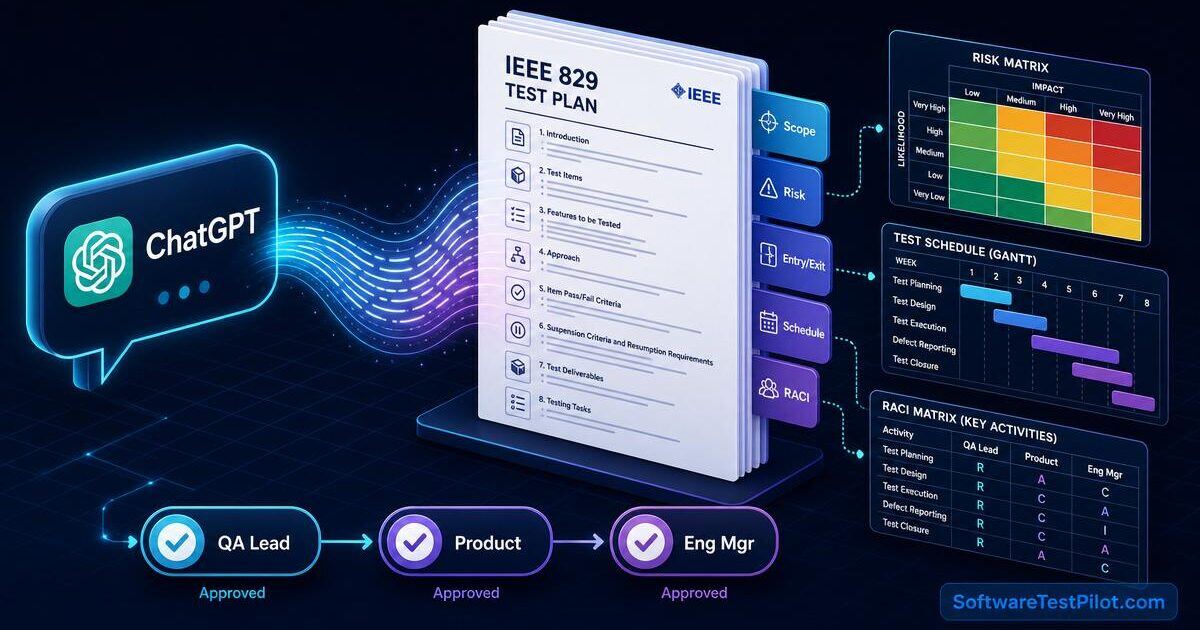
A ChatGPT test plan is an IEEE 829 / ISTQB-aligned software test plan drafted with OpenAI's large language models — alongside Claude Opus 4.5 and Gemini 2.5 Pro — then reviewed, edited and signed off by a human QA lead. Used well on a 2026 QA team, ChatGPT cuts test-plan authoring time from 2–3 days to 60–90 minutes, standardises scope, risk, entry/exit criteria, RACI and traceability across every squad, and turns the plan from a compliance artefact into a living document that is actually read. Used badly, it produces a generic five-page template with no risk assessment, invented compliance references and empty schedule tables.
This is the pillar every QA lead, test manager and SDET should bookmark before asking ChatGPT for another test plan. It covers what a modern test plan must include in 2026, the RCTF prompt framework, twelve copy-paste prompts (master plan, feature-level plan, risk matrix, entry/exit criteria, RACI, schedule, environment, traceability, test summary report), a strict 7-point QA review rubric, ISO/IEC/IEEE 29119 and ISTQB alignment, ROI, governance and the People Also Ask questions Google surfaces. Pair it with our ChatGPT for QA testing pillar, the ChatGPT for software testing pillar, the ChatGPT for test automation pillar, the ChatGPT Playwright tests pillar, the ChatGPT write Selenium code pillar, the 50 ChatGPT prompts for software testers and the GitHub Copilot for QA guide.
Key takeaways
- A ChatGPT-drafted test plan should follow ISO/IEC/IEEE 29119-3 or IEEE 829-2008 structure and align with the ISTQB Foundation Level definition of a test plan.
- Every prompt should follow RCTF — Role, Context, Task, Format — and paste the PRD, acceptance criteria, regulatory scope (SOC 2, HIPAA, PCI DSS, GDPR, EU AI Act) and prior-release incident list.
- Non-negotiable sections: scope + out-of-scope, features to be tested, test approach, entry/exit criteria, suspension/resumption, deliverables, environment, schedule, risk matrix (probability × impact), RACI, assumptions, dependencies, sign-off.
- Never accept AI output that invents CVEs, compliance clauses, tickets or metrics. Ground every claim in a pasted source.
- ChatGPT is a first draft engine, not the QA lead. Every AI-drafted test plan passes the 7-point rubric or gets regenerated.
1. What is a ChatGPT test plan?
A test plan is the document that defines what will be tested, how it will be tested, who owns each activity, when it happens, and the criteria that gate entry, exit, suspension and release. ISTQB Foundation Level defines it as "a document describing the scope, approach, resources and schedule of intended test activities." The current standard is ISO/IEC/IEEE 29119-3; many enterprises still use the older IEEE 829-2008 outline.
A ChatGPT test plan is that document, drafted by ChatGPT (or Claude, Gemini or self-hosted Llama 4) from a prompt that includes the PRD, acceptance criteria, regulatory context and prior-release incident data, then reviewed and signed off by a human QA lead. It replaces the "blank Word template" problem that eats 2–3 QA-lead days per release.
+---------------------------------------------------------------------+
|              CHATGPT TEST PLAN — WHERE IT FITS                     |
+---------------------------------------------------------------------+
| SECTION            | HUMAN OWNS         | CHATGPT ASSISTS WITH      |
+--------------------+--------------------+---------------------------+
| Scope / out-of     | Business truth     | Drafts from PRD           |
| Features tested    | Priority           | Extract from AC + PRD     |
| Approach           | Strategy           | Levels + techniques draft |
| Entry / exit       | Release gate       | SMART criteria draft      |
| Suspension         | Risk tolerance     | Trigger + resume rules    |
| Deliverables       | Contract           | List from approach        |
| Environment        | Ops truth          | Env matrix + data needs   |
| Schedule           | Delivery date      | Gantt + milestone draft   |
| Risk matrix        | Business impact    | 5x5 probability x impact  |
| RACI               | Org truth          | R/A/C/I per activity      |
| Traceability       | Coverage           | Requirement -> test map    |
| Sign-off           | Approval           | Approver list             |
+--------------------+--------------------+---------------------------+
What it is not: a test strategy (that's a higher-level policy document; ISTQB uses "test strategy" for the multi-project posture and "test plan" for the release/project), a test-case document, or a status report. Do not conflate them — enterprise auditors do check.
2. The RCTF prompt framework for test plans
The single biggest lever on ChatGPT output quality for test plans is prompt structure. Every prompt should have four explicit layers — Role, Context, Task, Format:
- Role — "You are an ISTQB Advanced Test Manager fluent in ISO/IEC/IEEE 29119-3 and IEEE 829-2008. You write test plans that pass SOC 2 Type II and ISO 27001 audits."
- Context — paste the PRD or one-pager, the acceptance criteria, the release scope, the tech stack, the applicable compliance frames (SOC 2, HIPAA, PCI DSS, GDPR, EU AI Act, ISO 27001), the prior-release incident list, the team org chart with RACI-capable roles, and the target release date.
- Task — "Produce a full release test plan for Release 24.7 following the IEEE 829-2008 outline: 1 Introduction … 16 Approvals. Length ~2,500 words. Include a 5×5 risk matrix, entry/exit criteria as SMART bullets, a RACI table for the 8 key activities, and a traceability matrix stub linking each acceptance criterion to a test level."
- Format — "Output in Markdown with H2 for each numbered section. End with a self-critique against this rubric: 29119 conformance, scope completeness, entry/exit measurability, risk assessment quality, RACI coverage, traceability completeness, assumption/dependency clarity."
Then run the 3-step iteration loop: baseline → self-critique → regenerate. On our internal audits this alone moves test-plan completeness scores from ~55% to ~92% on the same release.
3. Copy-paste prompt: master release test plan (IEEE 829 outline)
You are an ISTQB Advanced Test Manager fluent in ISO/IEC/IEEE 29119-3
and IEEE 829-2008. You write test plans that pass SOC 2 Type II and
ISO 27001 audits.

Context:
- Product: [name + 1-line description]
- Release: 24.7, target date [YYYY-MM-DD]
- Scope in this release: [paste list from PRD or Jira Epic]
- Explicitly out of scope: [paste]
- Tech stack: [FE / BE / infra]
- Compliance frames: [SOC 2 + HIPAA / PCI DSS / GDPR / EU AI Act]
- Prior 3 releases' top defects: [paste]
- Team: [paste roles: QA Lead, SDETs, Devs, PM, SRE, Sec]

Task: produce a full release test plan for Release 24.7 following the
IEEE 829-2008 outline:
1  Test Plan Identifier
2  References
3  Introduction (purpose, scope, objectives)
4  Test Items (in scope) & 4a Not-in-scope
5  Features to be Tested
6  Features NOT to be Tested (with rationale)
7  Approach (levels + techniques + tools + AI/automation policy)
8  Item Pass/Fail Criteria
9  Suspension & Resumption Criteria
10 Test Deliverables
11 Testing Tasks
12 Environment (env matrix + test data + PII policy)
13 Responsibilities (RACI for 8 key activities)
14 Staffing & Training
15 Schedule (Gantt-style bullets, milestones, buffer)
16 Risks & Contingencies (5x5 probability x impact matrix)
17 Approvals (QA Lead, Product, Eng Mgr, Sec)

Format:
- Markdown, H2 per numbered section.
- Entry / exit criteria as SMART bullets (Specific, Measurable, etc.).
- Include a 5x5 risk matrix as a Markdown table.
- Include a RACI table for the 8 key activities.
- Include a traceability matrix stub linking each acceptance criterion
  to test level (unit / integration / system / UAT).
- End with a self-critique against: 29119 conformance, scope completeness,
  entry/exit measurability, risk assessment quality, RACI coverage,
  traceability completeness, assumption/dependency clarity.
4. Copy-paste prompt: feature-level (sprint) test plan
You are an ISTQB Advanced Test Manager.
Context:
- Feature: [name]
- Acceptance criteria: [paste]
- Sprint: [X], target date [YYYY-MM-DD]
- Owning squad: [name] — roles + names
- Cross-team dependencies: [paste]
- Test data needs (PII / masked / synthetic): [paste]

Task: produce a 1-page feature test plan with:
- Scope + out-of-scope
- Test levels & techniques (equivalence partitioning, boundary,
  decision table, state transition, exploratory charters)
- Entry / exit criteria (SMART, per level)
- Environment + test data strategy
- Risks (top 5 with mitigation)
- Deliverables (test cases, automation, TSR)
- Owner + reviewer + approver

Format: Markdown, max 800 words. End with a self-critique against the
7-point rubric.
5. Copy-paste prompts: risk matrix, entry/exit, RACI, schedule
Prompt: generate a 5×5 risk matrix
You are an ISTQB Advanced Test Manager fluent in ISO 31000.
Context: [paste release scope, tech stack, prior incidents].

Task: produce a top-15 release risk register. For each risk:
- ID, Category (Product / Technical / Process / External / Compliance)
- Description
- Probability (1–5), Impact (1–5), Severity = P x I
- Mitigation (specific test activity that reduces P or I)
- Contingency (what we do if it fires)
- Owner (role, not name)
- Trigger metric (measurable signal)

Also output a 5x5 heatmap as a Markdown table (rows = Probability,
columns = Impact) with risk IDs placed in the correct cell.
End with the top 3 "must-mitigate" risks (Severity ≥ 15).
Prompt: generate SMART entry / exit criteria
You are an ISTQB Advanced Test Manager.
Context: [paste release scope + non-functional requirements].

Task: generate entry and exit criteria for each test level
(unit, integration, system, UAT). Each criterion must be SMART:
- Specific (what)
- Measurable (number, %, threshold)
- Achievable (given current tooling)
- Relevant (ties to a release risk or NFR)
- Time-bound (by end of which phase)

Example: "Exit — System test: 100% of P0/P1 test cases executed,
0 open P0 defects, ≤ 5 open P1 defects with product-approved workarounds,
critical-path unit coverage ≥ 80%, p95 API latency ≤ 400ms on the staging
load profile, no regression in the top-20 user journeys, by Day 12."

Output as a Markdown table per level. Reject vague criteria like
"quality is good" or "most tests pass".
Prompt: generate a RACI matrix
You are an ISTQB Advanced Test Manager.
Context: [paste team roles].

Produce a RACI table for these 8 release-level activities:
test plan authoring, test case design, test data provisioning,
environment setup, automation build, execution (functional + NFR),
defect triage, release sign-off.
Rules: exactly ONE Accountable per row. Reviewers are Consulted.
Output as a Markdown table. Flag any row where the same person is both
R and A on more than 4 rows (bottleneck warning).
Prompt: generate a schedule (Gantt-style)
You are an ISTQB Advanced Test Manager.
Context:
- Release date: [YYYY-MM-DD]
- Working days available: [N]
- Blackout dates (holidays, freezes): [paste]
- Team capacity (person-days per role): [paste]

Produce a phase-by-phase schedule: Test Planning, Test Design,
Environment Setup, Test Data, Automation Build, System Test,
Regression, UAT, Release. For each: start, end, duration in days,
owner role, dependencies, 15% buffer explicit.
Output as a Markdown table + a bullet list of top 5 schedule risks.
6. Prompts for NFR, compliance and traceability
Prompt: derive an NFR test coverage matrix
You are an ISTQB Advanced Test Manager fluent in ISO/IEC 25010 quality
characteristics (performance, security, usability, reliability,
maintainability, portability, compatibility, functional suitability).
Context: [paste NFRs].

Produce a table mapping each ISO 25010 characteristic to:
- Applicable this release? (Y/N + why)
- Target metric (e.g. p95 latency ≤ 400ms; WCAG 2.2 AA; RPO ≤ 15min)
- Test technique & tool (k6 / OWASP ZAP / axe-core / Chaos Mesh)
- Owner role
- Exit threshold
Flag any NFR without a measurable target or an owning role.
Prompt: derive compliance test coverage
You are an ISTQB Advanced Test Manager fluent in SOC 2, HIPAA, PCI DSS,
GDPR, EU AI Act and NIST AI RMF.
Context: [paste product + regulated data types].

For each applicable control, produce:
- Control ID (real ID, not invented). If unsure, say "VERIFY".
- Testable expectation
- Test level (unit / integration / system / pen-test)
- Evidence artefact (screenshot / log / report)
- Owner role
Do NOT invent control numbers. Flag "VERIFY" anywhere a specific
control ID is uncertain, so the human reviewer can confirm.
Prompt: generate a traceability matrix
You are an ISTQB Advanced Test Manager.
Context: [paste acceptance criteria as a numbered list].

Produce a Markdown table with columns:
AC ID | AC text | Test level | Test technique | Test case ID | Automated? |
Risk ID it mitigates.
Every AC must map to at least one test case. Flag ACs with no test
coverage as GAP.
7. Prompts for the Test Summary Report (release close-out)
Prompt: draft a Test Summary Report from run data
You are an ISTQB Advanced Test Manager fluent in IEEE 829-2008 TSR
format.
Context: paste (1) exec summary numbers (tests planned/executed/passed/
failed/blocked), (2) defect log (open by severity, closed, escaped),
(3) coverage %, (4) NFR results (p95 latency, error rate), (5) any
exit-criteria exceptions.

Task: produce a Test Summary Report following IEEE 829-2008 outline:
1 TSR Identifier, 2 Summary, 3 Variances (planned vs actual),
4 Comprehensive Assessment, 5 Summary of Results (per test item),
6 Evaluation (against exit criteria), 7 Summary of Activities,
8 Approvals.
Output: Markdown, ~1,200 words. No invented numbers — use only what I
pasted. Flag any missing data as [MISSING].
8. The 7-point review rubric for AI-drafted test plans
Every AI-drafted test plan goes through this rubric before sign-off. Any plan failing two or more criteria is regenerated, not review-commented:
- Standard conformance — IEEE 829-2008 or ISO/IEC/IEEE 29119-3 section headings are all present. No renamed or missing sections.
- Scope completeness — every acceptance criterion is either "in scope" with a test level assigned or "out of scope" with a written rationale. No AC left implicit.
- Entry / exit measurability — every criterion is SMART. Reject "quality is good", "most tests pass", "stable enough".
- Risk assessment quality — 5×5 matrix with probability × impact scored, mitigation is a specific test activity (not "test more"), owner role assigned.
- RACI coverage — every key activity has exactly ONE Accountable. No unstaffed row. No single person R+A on more than 4 rows.
- Traceability completeness — every AC links to at least one test case; every top-5 risk links to at least one mitigating test activity.
- Assumption & dependency clarity — every external dependency (env, data, third party, feature flag) is listed with an owner and a due date; every assumption is explicit.
This one rubric is the difference between AI turning your test plan into a living document and AI turning it into a compliance liability.
9. Where a ChatGPT test plan still fails
- Invented compliance IDs. ChatGPT will cite "SOC 2 CC7.4" or "HIPAA §164.502" that don't match your actual audit scope. Always force it to flag uncertain IDs as VERIFY.
- Generic risk registers. Without prior-incident data, you get "risk: bugs in production, mitigation: test more". Always paste the last 3 releases' top defects.
- Vague exit criteria. Default output says "most tests pass". Enforce SMART in the prompt AND in the rubric.
- Fake schedule confidence. ChatGPT will happily fit 6 weeks of work into 2 weeks. Always paste team capacity and blackout dates.
- RACI bottlenecks. Default output makes the QA Lead R+A on 12 rows. The rubric catches this — reject and regenerate.
- Standard drift. Models mix IEEE 829-1998 and 29119 headings. Pin one standard per prompt.
- PII leakage. The single fastest way to lose a licence is pasting real customer data into the PRD or incident list. Use the redaction template.
10. Privacy, PII redaction and governance
The fastest way to lose the ChatGPT licence — and possibly your job — is pasting production PRDs containing customer names, real incident logs with PII, or contracts under NDA. Use this redaction pre-pass on every prompt:
Before sending any prompt containing app data, replace:
- emails      -> user{N}@example.com
- phones      -> +1-555-0100 through +1-555-0199
- names       -> Persona A, Persona B, ...
- customer names -> Customer Alpha, Bravo, Charlie
- card PANs   -> 4242 4242 4242 4242 (Stripe test)
- addresses   -> 1 Infinite Loop, Cupertino, CA 95014
- IDs / UUIDs -> TEST-000-0001 (sequential)
- incident IDs / Jira keys -> INC-0001, PROJ-0001
- financial figures -> round to nearest order of magnitude

Keep shape (format, length) so the plan structure is still meaningful.
On the plan side: ChatGPT Enterprise and Team have training on your prompts off by default and add SSO, admin controls and longer context. Personal ChatGPT Plus is fine for open-source and public-doc prompts only. Regulated workloads (health, payments, gov) should use Azure OpenAI, AWS Bedrock or a self-hosted Llama 4. Cross-check every policy against the NIST AI Risk Management Framework and the EU AI Act.
11. ROI — what ChatGPT actually saves on test planning
Annual ROI = (Hours saved ⋅ loaded QA-lead cost)
           + (Escape defects avoided ⋅ incident cost)
           + (Audit-finding reductions ⋅ remediation cost)
           − (ChatGPT / Copilot licences)
           − (Review overhead: 15–25% of "hours saved")
           − (Governance headcount)
Honest 2026 ranges on healthy QA teams:
- Master release test plan: from 2–3 days to 60–90 minutes of drafting + 30–60 minutes of QA-lead review. Net: 60–75% faster.
- Feature/sprint plans: from 3–4 hours to 20–30 minutes.
- Risk register: 50–70% faster with a higher hit-rate on real risks when prior-incident data is pasted.
- RACI: seconds instead of a 30-minute meeting.
- Traceability matrix: 60–80% faster; higher AC coverage.
- Test Summary Report: from 4–6 hours to 45–60 minutes.
Anything above 10× ROI in the first quarter is a comparison against a baseline that never existed (i.e. teams that skipped test planning entirely). Anything below break-even in year one usually means governance was skipped and hallucinated compliance references are eating "saved" time in audit prep.
12. 30-day rollout for a QA team
- Days 1–7 — foundations. Enable ChatGPT Enterprise / Team, turn on data-exclusion, publish the RCTF template, redaction rules and 7-point rubric in
docs/ai-usage.md. Pin ISO/IEC/IEEE 29119-3 (or IEEE 829-2008 for legacy shops) as the reference standard. - Days 8–14 — prompt library. Convert the top 10 team artefacts (master plan, feature plan, risk register, RACI, TSR) into curated prompts in
docs/prompts/test-plans/; reject any prompt missing an RCTF layer or a compliance frame. - Days 15–21 — guardrails. Update the release PR template with the 7-point rubric checkbox. Add a "VERIFY" grep step to CI that fails a plan PR if any compliance ID is unverified.
- Days 22–30 — measure. Baseline five KPIs — plan authoring hours, plan completeness score (rubric %), audit findings on QA plans, defect escape rate, AC coverage %. Compare to pre-rollout. Cancel or expand based on data, not vibes.
13. What ChatGPT test plans mean for QA careers
The 2026 hiring data is clear: QA leads and test managers who can pair ChatGPT with ISO/IEC/IEEE 29119, risk-based testing and RACI ownership are seeing 15–30% salary lifts. QA leads who still hand-craft template-driven test plans in Word are seeing rate compression. See the QA engineer salary guide and the SDET career roadmap.
Actively interviewing? Practice with the AI mock interview, tune your CV with the free ATS resume review and browse live openings on the QA Jobs Radar. For technical rounds, work through the manual testing interview questions, Selenium interview questions, API testing interview questions and SQL interview questions pillars.