
How to Use ChatGPT & AI to Write Test Cases (Without Fluff) in 2026
Stop generating generic AI checklists. Learn the context-rich prompting architecture QA engineers use to produce edge cases, API payloads, Gherkin files and Playwright TypeScript with ChatGPT and Claude.

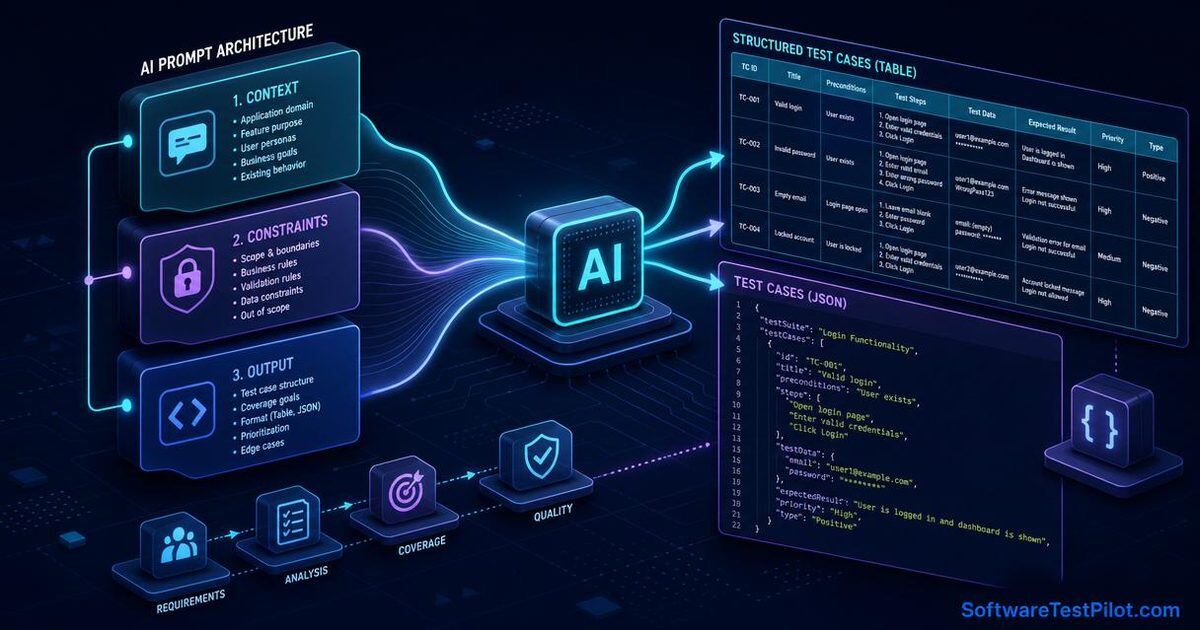
When ChatGPT, Claude 3.5 Sonnet and OpenAI o1 landed in QA workflows, influencers declared manual test design dead. In reality, if you type "write comprehensive test cases for our checkout" into a chat window you get a shallow, boilerplate checklist your engineering manager will spot in seconds.
AI models are not psychic quality architects — they are high-speed semantic synthesis engines. Give them zero architectural context and you get zero-value output. Feed them OpenAPI schemas, business constraints and strict output formats and you get production-grade pairwise matrices, adversarial API payloads and Playwright TypeScript in seconds.
This guide breaks down the Context-Rich Prompting Architecture senior SDETs use in 2026, plus four copy-paste Mega-Prompts you can paste into ChatGPT or Claude today. Pair it with our 50 ChatGPT prompts for QA testers and GitHub Copilot for QA tutorial, and check live AI-focused SDET compensation on the SoftwareTestPilot QA Jobs Radar.
1. The context gap: why generic prompts produce junior checklists
Large Language Models predict the most statistically probable next token from their training distribution. If your prompt lacks domain specificity, the model reverts to the average of every generic testing tutorial written in the last decade.
+-----------------------------------------------------------------------------------+
|                        THE ZERO-SHOT AI PROMPT TRAP                               |
+-----------------------------------------------------------------------------------+
| [USER PROMPT]: "Write test cases for a login API endpoint."                       |
|                                                                                   |
| [AI OUTPUT]: 10 generic cases: valid/invalid password, empty fields,              |
|              SQL injection ' OR 1=1 --, XSS <script> strings.                    |
|                                                                                   |
| [REALITY]: The endpoint uses OAuth 2.0 PKCE with a code_verifier, enforces        |
|            Redis rate limits and returns HTTP 422 with a custom JSON schema.      |
|            AI output is 100% wrong.                                               |
+-----------------------------------------------------------------------------------+
Three hallucination vectors of zero-shot QA prompts
- Missing business constraints — the AI has no idea whether your fintech allows negative balances, whether checkout supports split shipments, or what RBAC rules govern your admin dashboard.
- Ignorance of system architecture — without instructions it defaults to slow UI browser flows instead of fast API contract checks or DB transaction assertions.
- Unstructured output — conversational markdown that cannot be exported into TestRail, Jira or Playwright fixtures without hours of cleanup.
2. Context-rich prompting architecture
To make an AI model reason like a Staff SDET earning $160,000+, construct prompts with four layers instead of one vague sentence.
+-----------------------------------------------------------------------------------+
|                  CONTEXT-RICH QA PROMPT ARCHITECTURE                              |
+-----------------------------------------------------------------------------------+
| LAYER 1  ROLE & MINDSET ANCHORING                                                 |
|          e.g. Principal SDET, API Security Auditor, BDD Architect                 |
+-----------------------------------------------------------------------------------+
| LAYER 2  STRUCTURAL GROUND TRUTH INJECTION                                        |
|          Paste OpenAPI / Swagger YAML, SQL DDL, JSON schemas                      |
+-----------------------------------------------------------------------------------+
| LAYER 3  METHODOLOGICAL CONSTRAINTS                                               |
|          Pairwise, Boundary Value Analysis, BOLA / IDOR security checks           |
+-----------------------------------------------------------------------------------+
| LAYER 4  DETERMINISTIC OUTPUT FORMATTING                                          |
|          Gherkin BDD, JSON payloads, TypeScript Playwright assertions             |
+-----------------------------------------------------------------------------------+
Feed an OpenAPI YAML file alongside strict boundary rules and the model stops guessing — it parses your data types, enum boundaries and required fields, generating matrices that match your backend contract exactly.
3. Mega-Prompt 1 — Pairwise & Boundary Value edge-case matrix
Use this when analysing multi-variable business rules (pricing engines, insurance underwriting, checkout discount stacks) to maximise combinatorial coverage with minimum bloat.
You are a Lead Quality Architect and Senior SDET specialising in
combinatorial test design and risk-based quality engineering.

TASK
Analyse the provided system requirements and generate an exhaustive
Pairwise Orthogonal Array test matrix combined with strict 3-Point
Boundary Value Analysis (BVA).

METHODOLOGICAL CONSTRAINTS
1. Pairwise Testing: every possible pair of parameter values must be
   tested at least once — no redundant combinations.
2. 3-Point BVA: for every continuous numeric/date parameter cover
   Min-1 (invalid), Min (valid), Nominal, Max (valid), Max+1 (invalid).
3. Include >= 3 negative security / authorisation edge cases
   (race conditions, concurrent writes, malformed injection).

OUTPUT FORMAT
Return a Markdown table with exactly these columns:
| Test ID | Scenario Category | Parameter Combination |
| Expected System State | Risk Severity (P0-P3) |
| Verification Layer (API / UI / DB) |

SYSTEM REQUIREMENTS & CONSTRAINTS
[PASTE YOUR USER STORY, ACCEPTANCE CRITERIA, OR BUSINESS RULES HERE]
4. Mega-Prompt 2 — User stories → strict Gherkin feature files
Translate messy PM acceptance criteria into clean, executable BDD feature files for Cucumber or the Playwright BDD runner.
You are an Enterprise Test Automation Architect and Agile BDD Specialist.

TASK
Convert the raw acceptance criteria into a syntactically valid
BDD/Gherkin .feature file ready for automation execution.

AUTHORING RULES
1. Declarative, imperative syntax focused on business intent.
   AVOID:  When user clicks button #submit
   PREFER: When the client submits a valid registration payload
2. Use Scenario Outline + Examples: tables whenever testing multiple
   input variations, status codes, or user tiers.
3. Extract common setup (auth, DB seeding) into a Background: block.
4. Tag every scenario for CI: @smoke, @regression, @api, @security, @p1.

OUTPUT FORMAT
Return only the valid Gherkin .feature code inside a markdown code block.

RAW ACCEPTANCE CRITERIA
[PASTE YOUR JIRA USER STORY AND ACCEPTANCE CRITERIA HERE]
See our BDD with Cucumber guide for how these files plug into a real automation framework.
5. Mega-Prompt 3 — Synthetic API JSON payloads with error states
Use this when building API automation in Postman, RestSharp, REST Assured or Playwright APIRequestContext to generate valid happy-path payloads plus adversarial negative payloads instantly.
You are a Principal API Security Auditor and SDET specialising in
REST / GraphQL contract testing.

TASK
Analyse the provided OpenAPI / Swagger schema and generate 5 complete,
ready-to-use synthetic JSON request payloads.

PAYLOAD REQUIREMENTS
1. Nominal Happy Path — 100% valid, realistic data conforming to types,
   enums and regex patterns.
2. Boundary Maximums — strings at maxLength, integers at maximum,
   arrays at maxItems.
3. Missing Required Fields — omit critical required fields to test
   HTTP 400 contract handling.
4. Type Contamination — booleans in int fields, SQL strings in email fields.
5. IDOR / BOLA Security Vector — inject foreign user IDs to test
   Broken Object Level Authorisation.

OUTPUT FORMAT
Each payload inside a labelled JSON code block, with one sentence
explaining the expected HTTP status and schema assertion.

OPENAPI SCHEMA DEFINITION
[PASTE YOUR OPENAPI YAML OR SWAGGER JSON SCHEMA HERE]
Pair with our Postman API testing tutorial or REST Assured tutorial to run the generated payloads.
6. Mega-Prompt 4 — Playwright TypeScript assertions from OpenAPI
Bridge AI generation and real code execution — feed your API schema into the model and get a production-ready Playwright TypeScript spec using native APIRequestContext.
You are a Principal SDET and TypeScript Playwright Automation Expert.

TASK
Write a complete, production-ready Playwright TypeScript test file
(tests/api/contractVerification.spec.ts) using Playwright's native
APIRequestContext to verify the provided API contract.

CODING RULES
1. Define strict TypeScript interface types for the expected response.
2. Use Playwright's native request fixture — DO NOT import Axios or
   node-fetch.
3. Async tests validating HTTP status, payload types (typeof) and
   business rules.
4. Include a test for 401 Unauthorized when bearer auth is omitted.
5. 100% syntactically valid, cleanly formatted, ready for CI/CD.

OUTPUT FORMAT
Return only the complete TypeScript code block, no chatter.

TARGET API SPECIFICATION
[PASTE YOUR ENDPOINT DETAILS, HEADERS, AND JSON SCHEMA HERE]
Use our Playwright testing tutorial and Playwright + TypeScript guide to wire the generated spec into a real project.
7. Enterprise governance & data privacy rules
AI prompting accelerates test creation dramatically — but feeding internal corporate data into public LLMs creates serious legal and security exposure.
+-----------------------------------------------------------------------------------+
|                        AI DATA PRIVACY GOVERNANCE RULES                           |
+-----------------------------------------------------------------------------------+
| 1. NEVER PASTE PII                                                                |
|    No real customer emails, card numbers, SSNs or production DB rows.             |
+-----------------------------------------------------------------------------------+
| 2. SANITISE PROPRIETARY IP & API KEYS                                             |
|    Scrub internal hostnames, JWT bearer tokens and proprietary algorithms         |
|    before pasting OpenAPI schemas into public models.                             |
+-----------------------------------------------------------------------------------+
| 3. USE SOC2-COMPLIANT ENTERPRISE MODELS                                           |
|    Standardise on Azure OpenAI, AWS Bedrock or ChatGPT Enterprise —               |
|    contracts that guarantee your data is NOT used for training.                   |
+-----------------------------------------------------------------------------------+
Demonstrate 10x testing velocity with PII sanitisation and SOC2 discipline and you become an indispensable quality leader — read the OWASP security testing checklist for the wider governance picture.
8. Turning AI workflows into interview leverage
Live six-figure listings on the SoftwareTestPilot QA Jobs Radar now include a recurring requirement: "Demonstrated ability to leverage AI and LLMs to accelerate test automation workflows."
Update your resume with the SoftwareTestPilot ATS Resume Reviewer and add a bullet like:
Engineered context-rich LLM prompting pipelines integrating OpenAPI schemas into generative automation workflows, accelerating Playwright API test suite creation by 65% while enforcing strict data-privacy standards.
Then rehearse the answer to the classic hiring-manager question — "How do you verify AI-generated test cases aren't hallucinating?" — using the AI Mock Interview Coach. See our SDET career roadmap for the wider skill ladder.
9. Your 24-hour action step
Take one complex user story or API endpoint from your current sprint. Copy Mega-Prompt 3 or Mega-Prompt 4 above, paste your endpoint specification into the constraint block and run it through ChatGPT or Claude.
Inspect the resulting JSON payloads or Playwright TypeScript assertions, integrate them into your test repository, and benchmark AI-focused SDET compensation bands on the SoftwareTestPilot QA Jobs Radar.