
AI-Powered Test Automation Services: The Complete Guide to Intelligent Quality Assurance
Transform QA with AI-powered test automation services — self-healing tests, intelligent test generation, visual AI regression, and ML-driven analytics for modern software teams in the USA.

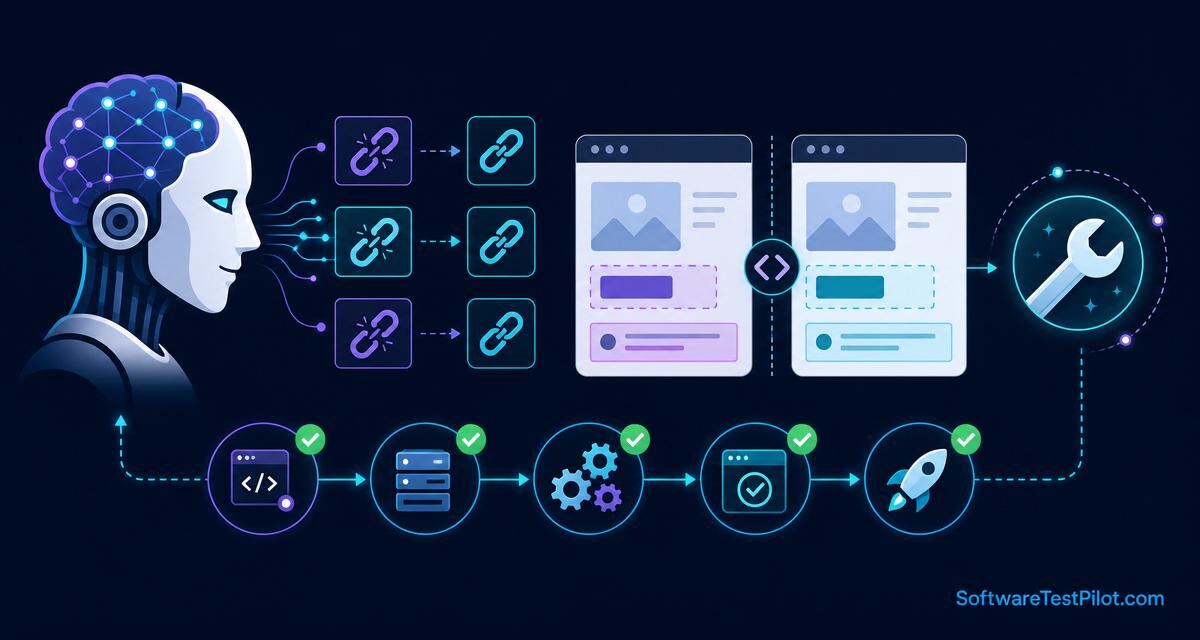
AI-powered test automation services turn brittle Selenium suites, endless locator maintenance and slow release cycles into a self-healing, self-prioritising QA engine that keeps pace with modern software delivery. Where traditional automation broke every time a developer renamed a button, intelligent test automation uses machine learning, computer vision and natural language processing to adapt automatically, generate coverage from requirements, and flag exactly which tests matter for each change.
US enterprises are under pressure to ship faster with smaller QA teams, in stacks where UIs, APIs and mobile surfaces change weekly. Manual regression cannot scale; classical automation has hit its maintenance ceiling. That is why demand for AI QA automation — self-healing tests, visual AI, risk-based test selection, agentic test generation — has grown 40%+ year-over-year across US QA budgets in 2026.
Pair with: our 15 best AI testing tools, self-healing tests guide, and AI model testing services guide.
Limitations of conventional test automation
- Maintenance tax — 30–40% of automation engineer time spent fixing broken locators and flaky waits.
- Coverage gaps — hand-written scripts cover happy paths; edge cases stay untested.
- Slow authoring — each new user journey takes hours of engineering time.
- No prioritisation — every regression run executes every test; feedback is slow and expensive.
- UI-only vision — DOM assertions miss real visual regressions users actually see.
How AI addresses these problems
AI-powered platforms observe applications, learn their structure, generate tests from natural-language intent, repair locators automatically, compare screens visually, and predict which tests are most likely to catch the current change. The ROI shows up as fewer flaky failures, higher meaningful coverage, faster pipelines and QA teams that spend time on exploratory and quality-strategy work instead of fixing selectors.
Understanding AI-Powered Test Automation
Modern AI-driven QA is built on four families of AI technology, each solving a specific pain point in the traditional automation stack.
Computer vision for testing
Vision models compare rendered screens pixel- and layout-aware, distinguishing meaningful regressions (a truncated CTA, a misaligned modal) from acceptable rendering variance across browsers and devices. Applitools, Percy, Chromatic and Playwright's own visual snapshots have all moved from raw pixel diffs to AI-assisted comparisons.
Natural language processing for test creation
NLP-powered platforms let product managers and manual testers write test intent in plain English — "log in as a paid user and export a CSV of last month's orders" — and translate it into executable steps against the live DOM. This collapses the gap between requirements and executable automation.
Machine learning for pattern recognition
ML models learn how tests fail, which locators are stable, which tests are historically flaky and which changes tend to break which suites. Those patterns drive prioritisation, deflaking and predictive analytics.
Self-healing test automation
Self-healing tests automatically repair broken element locators at runtime using a scored combination of DOM attributes, visual context, position and semantic role. A test that would have failed on #submit-btn disappearing keeps running because the platform recognises the new [data-test="checkout"] button as the same element. The result is dramatically lower maintenance cost and far higher trust in the pipeline.
These four capabilities compose. The most valuable AI-powered test automation services combine visual AI, NLP authoring, self-healing and ML analytics into a single workflow — not just one shiny feature.
Implementing AI-Powered Test Automation
Rolling out intelligent test automation is a change-management project as much as a tooling project. The programs that succeed follow a disciplined sequence.
1. Assessment and strategy
- Inventory existing test suites, flake rates and maintenance cost per release.
- Identify the 2–3 workflows that consume the most QA capacity today.
- Set measurable goals: e.g. cut maintenance hours 50%, reduce release-cycle time 30%, raise meaningful coverage 25%.
- Decide the deployment model — SaaS, self-hosted, hybrid — based on data-residency and compliance needs (SOC 2, HIPAA, PCI, FedRAMP).
2. Tool selection
- Shortlist 3–4 platforms that fit your stack (web, mobile, API, desktop).
- Run a paid pilot on real production workflows, not vendor demos.
- Score each tool on self-healing accuracy, authoring speed, CI integration, reporting, cost at scale and vendor stability.
- Include your engineers in the decision — a tool the team distrusts is a tool that gets abandoned.
3. Technology integration architecture
AI testing tools must live inside your existing delivery stack, not beside it. Wire them into:
- Source control and PR pipelines (GitHub Actions, GitLab CI, Azure DevOps, Jenkins).
- Test-management tools (Xray, Zephyr, TestRail) and defect trackers (Jira, Linear).
- Observability platforms (Datadog, New Relic, Grafana) for correlated runtime and test signals.
- Feature flag systems so tests can toggle experiments deterministically.
4. Pilot implementation
Pick one product team, one high-value regression suite and one 6-week window. Measure before-and-after maintenance cost, flake rate, coverage and cycle time. Publish the results internally — a successful pilot is the fastest way to unlock budget for a broader rollout. Programs that skip the pilot almost always over-buy and under-adopt.
AI-Powered Test Generation
AI test generation is where most teams see the fastest coverage lift. Instead of writing every script by hand, engineers describe intent and review AI-generated scenarios.
Requirements-based test generation
Modern platforms parse user stories, acceptance criteria and BDD scenarios, then emit executable test steps aligned to the live UI. Coverage that used to take a sprint takes an afternoon, and stories ship with tests attached instead of a tech-debt ticket.
Model-based testing with AI
Given a formal model of application behaviour (state machine, sequence diagram, OpenAPI spec), AI generators produce test cases that traverse states, exercise transitions and exploit boundary conditions. This is especially powerful for API testing and workflow-heavy enterprise apps.
State model inference
Crawler-based tools autonomously explore the application, infer its state graph, and generate tests that cover discovered flows. This finds edge cases hand-written suites miss — modal interactions, error states, deep-linked views. Combine with AI test generation patterns for maximum leverage.
Coverage optimisation
- Deduplicate near-identical tests using similarity scoring.
- Prioritise generated tests by predicted defect-catch probability.
- Cap suite size so pipelines stay fast — quantity is not coverage.
Always keep a human review step. Generated tests are a starting point, not an audit-ready artefact.
Intelligent Test Maintenance
Maintenance is where classical automation dies. ML-powered testing flips the economics.
Self-healing test automation
When a test fails because a locator no longer resolves, self-healing engines evaluate candidate elements using a multi-signal score: DOM attributes, visual position, semantic role, text content, historical repair data. The best match becomes the new locator, the run continues, and the platform logs the healing for engineer review. Mature platforms report 60–90% of locator-related failures healed automatically.
Locator intelligence
- Multi-attribute locators — never rely on a single brittle selector.
- Auto-suggested
data-testattributes when the platform detects instability. - Blast-radius analysis — surface every test affected by a single component change.
Visual testing and regression detection
Visual AI compares full-page and component-level snapshots across browsers and viewports, flagging meaningful differences and ignoring cosmetic noise (anti-aliasing, dynamic timestamps, ad slots). This catches CSS regressions, broken responsive layouts, and third-party rendering issues that DOM assertions never see. Baselines are versioned per branch so PRs review visual diffs alongside code diffs.
Maintenance learning
Every healing action feeds a learning loop. The platform gets better at your app's specific patterns over time — which components change most, which attributes are stable in your codebase, which test flakiness maps to real product bugs. Choose vendors that expose this learning as reports, not just black boxes.
Test Intelligence and Analytics
The second big lever of AI QA automation is deciding what to run and interpreting what happened.
Risk-based test selection
Instead of executing every test on every commit, ML models predict which tests are most likely to fail given the current diff, using signals like changed files, historical failure correlation, module ownership and recent flakiness. Pipelines shrink from hours to minutes without losing meaningful coverage — a critical unlock for trunk-based teams.
Change impact analysis
- Map code paths to test coverage.
- Highlight untested modules touched by a PR.
- Suggest additional tests to generate for unfamiliar changes.
Flaky test detection
ML classifiers separate genuine defects from environmental flakiness using retry patterns, failure signatures, correlated infrastructure metrics and time-of-day trends. Confirmed flakes are quarantined automatically and routed to owners with a repro bundle — no more failing CI on the same intermittent test for weeks.
Predictive quality analytics
- Defect-density prediction per module and per release.
- Release-readiness scoring combining test pass rate, coverage, flakiness and risk.
- Trend dashboards for leadership: mean-time-to-repair, escaped-defect rate, automation coverage over time.
Testing AI Systems with AI
As products ship AI features of their own, QA teams need methods to validate model-backed behaviour. This is where AI-powered test automation services intersect with model QA.
Testing AI-enhanced applications
- Assertion strategies that tolerate acceptable output variance (semantic similarity, rubric scoring, ranges).
- Golden-set regression suites for LLM and ML features on every release.
- Prompt-injection and safety tests as first-class checks in CI.
AI component testing
Model outputs are validated for accuracy, calibration and fairness against curated evaluation sets. See our AI model testing services guide and machine learning QA testing playbook for the full dimensional coverage.
Integration testing for AI
- Verify data contracts between application code and model APIs.
- Simulate provider failures and rate limits — apps must degrade gracefully.
- Track latency and cost per request as first-class SLOs.
Testing pipelines for AI systems
Wire training, evaluation and deployment checks into CI: data-quality gates block bad training runs, evaluation gates block underperforming models, and shadow deployment validates behaviour on production traffic before promotion. Reuse the same discipline you apply to backend services.
Governance and Quality Assurance for AI Testing
AI-driven test tooling introduces its own quality risks. A responsible program governs its testing AI the same way it governs product AI.
Test governance framework
- Defined roles: test owners, platform owners, quality-engineering leads.
- Documented policies for AI usage, data handling and evidence retention.
- Approval gates before generated tests enter regression suites.
- Auditable logs of self-healing decisions and their reviewers.
Bias in AI testing
Self-healing engines can drift toward locators that pass but no longer represent the user's intent (e.g. healing to a hidden fallback button). Visual AI can systematically miss low-contrast issues affecting accessibility. Review healing history and visual-diff decisions regularly to catch these biases early.
Fairness in AI testing systems
Include accessibility scenarios and inclusive-design test data (localised names, RTL languages, high-contrast modes, screen-reader flows) in every regression suite. AI tooling makes it cheaper to run these — take the opportunity.
Quality standards
Adopt an ISO/IEC 25010 quality model, or the NIST AI Risk Management Framework for AI-heavy portfolios, and map every AI testing capability to it. Standards turn tribal knowledge into repeatable process.
Building AI Testing Capabilities
Tooling without people is shelfware. Sustained value from AI-driven QA comes from building durable team capability.
Team skills and development
- Test-design fundamentals — risk analysis, boundary values, decision tables, exploratory testing.
- AI literacy — model capabilities, limitations, prompt design, evaluation methodology.
- Programming for tool configuration, custom validators and CI integration (JavaScript / Python / TypeScript at minimum).
- Data skills — SQL, log analysis, basic statistics for interpreting flake and coverage trends.
Free curricula from Test Automation University and community programming from Ministry of Testing are excellent baselines; research from projects like STAMP feeds the next generation of amplification techniques.
Process integration
- Definition of done includes automated tests, visual coverage and passing risk-selected suite.
- Every bug fix ships with a regression test — generated or authored.
- Flaky tests are quarantined within one sprint or deleted.
Agile testing integration
Testers pair with developers during story refinement to generate scaffolding tests early. AI authoring makes this practical instead of aspirational.
DevOps integration
Push everything into pipelines: risk-selected regression on PRs, full regression on nightlies, visual AI on every UI change, performance smoke on staging. Publish results to a single dashboard your leadership actually opens.
Tools and Technologies for AI Test Automation
No single vendor owns the whole space. A realistic 2026 stack combines 3–5 tools.
AI testing platforms
- Testim, Functionize, Mabl, Katalon Studio AI, ACCELQ, Tricentis Tosca with Vision AI — end-to-end platforms with self-healing, NLP authoring and analytics.
- Applitools, Percy (BrowserStack), Chromatic — visual AI regression at scale.
- Sauce Labs, BrowserStack, LambdaTest — cross-browser and device execution with AI-assisted diagnostics.
Open-source AI testing tools
- Playwright with codegen, trace viewer and screenshot assertions — strong open baseline.
- Selenium 4 plus community self-healing extensions (Healenium).
- Playwright Test Generator and LLM-based test authoring assistants integrated with Cursor, Copilot and Cline.
- Research amplification tools from initiatives like STAMP for mutation-based test enrichment.
Visual testing tools
- Applitools Eyes, Percy, Chromatic, Loki, Storybook Visual Testing.
- Playwright's built-in
toHaveScreenshot()for teams that prefer open-source baselines.
Emerging technologies
- Agentic testers that plan, execute and adapt multi-step exploratory sessions autonomously.
- LLM-powered test authoring from Figma designs, PRDs or production session recordings.
- Predictive test selection baked into major CI vendors as a first-class feature.
- Digital twins of production for load and chaos scenarios driven by AI traffic generators.
Compare candidates in our 15 best AI testing tools roundup before finalising a shortlist.
Measuring AI Test Automation Success
What gets measured gets funded. Publish a monthly scorecard so leadership can see the return on the AI-powered test automation services budget.
Key performance indicators
- Test maintenance hours per release (target: −50% within 6 months).
- Meaningful coverage — lines and journeys covered by non-flaky tests.
- Flake rate — % of runs failing for non-product reasons.
- Defect escape rate — production incidents traceable to missed test coverage.
- Release cycle time — commit to production.
- Time to author a new critical-path test.
ROI measurement
| Benefit | Typical range | How to quantify |
|---|---|---|
| Maintenance savings | 30–60% | Engineer hours × loaded cost |
| Coverage lift | 20–40% | Story-level automation ratio |
| Cycle-time improvement | 20–35% | Lead time for change (DORA) |
| Escaped defect reduction | 15–30% | Sev-1/2 incidents per quarter |
Continuous improvement
Run a monthly test-quality review: top flaky tests, top maintenance offenders, coverage trend, escaped defects. Turn every incident into a permanent test. Retire tests that no longer catch anything — a smaller, sharper suite beats a bloated one.
Capability maturity
- Ad-hoc: hand-written scripts, no analytics.
- Repeatable: CI-integrated regression, basic reporting.
- AI-augmented: self-healing and visual AI in use, generation piloted.
- Predictive: risk-based selection, flake auto-quarantine, analytics on dashboards.
- Autonomous: agentic exploration, continuous test synthesis, quality signals wired into release decisions.
Conclusion — the future of intelligent QA
AI-powered test automation services are not a replacement for good QA thinking — they are the leverage that lets QA thinking scale. The organisations winning with intelligent automation treat AI as an engineering discipline: piloted with rigour, measured against DORA metrics, integrated into every stage of delivery, and governed like any other production system.
The transformation potential is significant. Teams routinely report 50%+ reductions in maintenance hours, 25%+ increases in meaningful coverage, and materially fewer escaped defects within the first year. Just as importantly, senior QA engineers stop babysitting selectors and start doing the exploratory, architectural and quality-strategy work that only humans can do.
The next 24 months will see agentic testers, LLM-powered authoring and predictive selection become table stakes. Teams that build a mature intelligent test automation practice now will outship teams that stay on hand-written Selenium suites — the same way CI/CD-native teams outshipped waterfall shops a decade ago.
Take the next step
- Practice AI-QA interview scenarios in the AI Mock Interview.
- Position yourself for senior AI-QA roles with a strong resume ATS review.
- Go deeper on AI testing tools, self-healing tests, AI model testing services, and generative AI application testing.