
Machine Learning QA Testing: Complete Guide to Quality Assurance for ML Systems
Machine learning QA testing playbook — data quality gates, model validation, fairness and bias detection, adversarial robustness, MLOps testing, drift monitoring, and compliance for US ML teams.

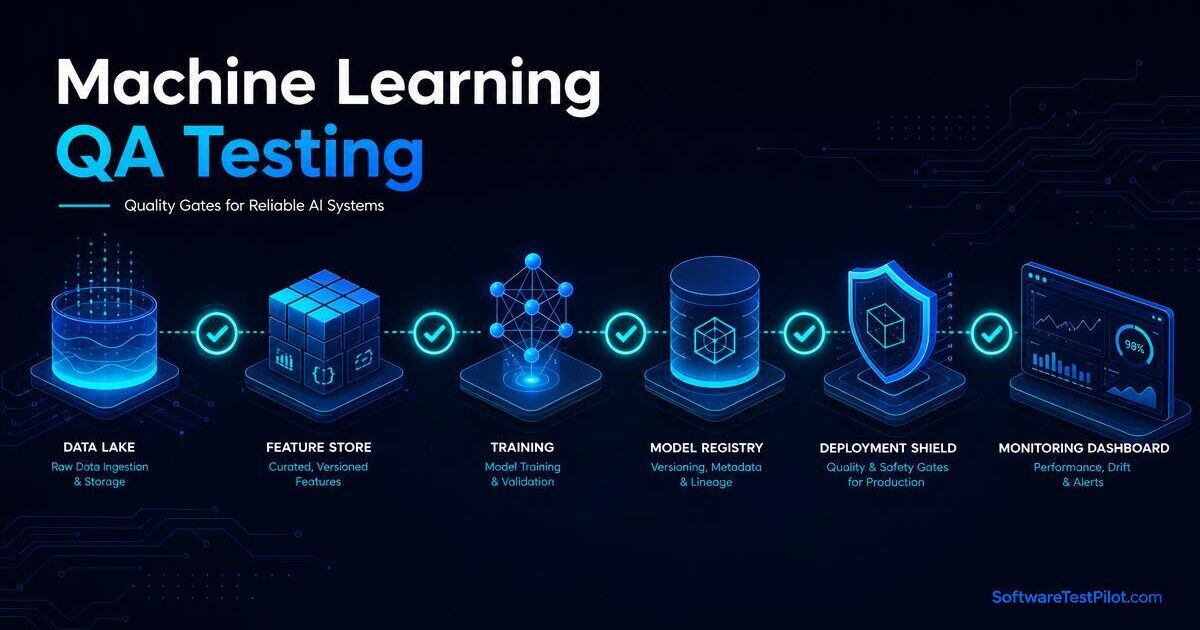
Machine learning QA testing is the engineering discipline that keeps ML systems accurate, fair, secure, and reliable from the first training run to the tenth production incident you never have. Where classical QA verifies that deterministic code behaves as specified, ML QA verifies that a probabilistic system trained on data behaves within tolerance across changing conditions — a fundamentally different problem.
US enterprises now embed models in credit decisions, medical triage, fraud, hiring, insurance and self-driving software. Every one of those models can silently degrade, drift, or discriminate. This guide is a 2026 playbook for QA managers, data-science leaders and engineering VPs who need ML testing services and AI QA practices that survive audits, incidents and leadership changes.
Pair with: our AI model testing services guide, LLM chatbot testing services guide, and 15 best AI testing tools.
Why ML failures cost more than software bugs
- Blast radius — one model serves millions of predictions an hour; a bad weight update is an incident, not a bug.
- Silent decay — models degrade quietly with drift; nothing goes red until KPIs do.
- Regulatory exposure — the EU AI Act, NIST AI RMF, NYC Local Law 144 and SR 11-7 all attach real cost to bad ML.
- Reputation risk — a screenshot of a discriminatory prediction outlives any hotfix.
Understanding the Machine Learning Development Lifecycle
Effective machine learning testing maps to the ML lifecycle, not the classic SDLC. Every stage introduces its own failure modes and demands its own tests.
The stages you actually test
- Data collection and labelling — schema drift, label noise, sampling bias.
- Feature engineering — training/serving skew, leaky features, unstable transforms.
- Training — reproducibility, seed control, overfitting, exploding loss.
- Evaluation — holdout hygiene, slice metrics, calibration.
- Packaging and registry — model signature, dependencies, provenance.
- Deployment — shadow, canary, rollback, latency SLOs.
- Monitoring — data drift, concept drift, performance drift, cost drift.
- Retraining and governance — approval gates, audit trail, sign-off.
Feature engineering is a testable surface
Half the production ML incidents in 2026 trace back to features — the same encoder computed differently in training vs serving, a timestamp feature that quietly starts leaking future information, a categorical bucket that changes cardinality. Unit-test transforms, contract-test feature schemas and enforce training/serving parity in CI.
MLOps and CI/CD for ML
Every commit to a modelling repo should trigger data validation, transform unit tests, a small training run, and evaluation against a golden set. Only green pipelines promote to staging; only staged models with passing fairness and robustness scores promote to production. Platforms like MLflow, Kubeflow, SageMaker Pipelines and Vertex AI codify these stages — but the tests remain your responsibility.
Data Quality Testing for Machine Learning
Data is the code of ML. If the training set is broken, no hyper-parameter tuning fixes the model. Mature AI model QA programs test data with the same rigour as application code.
What to check on every dataset
- Schema and type validation — column presence, dtypes, ranges, enum membership.
- Missingness and duplication — null rates by feature and per segment; duplicate rows and near-duplicates.
- Distribution monitoring — mean, variance, quantile shifts vs a reference dataset (PSI, KS-test).
- Label quality — inter-annotator agreement, class imbalance, label leakage.
- Data leakage detection — timestamps, IDs or target-derived features appearing in training data.
- Feature correlation drift — correlations that reversed sign since the previous snapshot.
- Sensitive-attribute audit — presence and proxies for protected classes.
Tooling
Automate with Great Expectations, Deequ, Soda Core, or TensorFlow Data Validation. Data tests should block a training run the same way a failing unit test blocks a deploy — no red, no train.
Feature distribution analysis
Compare production features against training features on every batch. Silent shifts in one feature — say, a new mobile app version changing a device string — can flip predictions long before overall accuracy moves. Log per-feature PSI and alert on threshold breach.
Model Performance Testing
Performance testing for ML is not a load test — it is a rigorous evaluation of prediction quality and generalisation across slices. Aggregate accuracy hides the failures customers actually hit.
Accuracy metrics
- Classification — precision, recall, F1, ROC-AUC, PR-AUC, per-class and per-slice.
- Regression — MAE, RMSE, MAPE, quantile loss.
- Ranking / recommenders — NDCG, MAP, hit-rate, coverage, diversity.
Generalisation testing
- Hold-out and time-based splits — never evaluate on data the model has seen; time series always split by time.
- k-fold cross-validation — stabilises estimates on small datasets.
- Out-of-distribution evaluation — new geographies, new user cohorts, new time windows.
Calibration testing
A model that predicts 80% likely default should be right about 80% of the time. Measure calibration with reliability diagrams and Brier scores. Miscalibrated probabilities silently break every downstream threshold and cost calculation.
Error analysis
Do not stop at aggregate accuracy. Bucket errors by:
- Confusion-matrix cells (which class is confused with which)
- Confidence bands (are wrong predictions high-confidence?)
- Segment (new users, mobile devices, night traffic, non-English content)
- Cost impact (which errors carry the highest business cost?)
Golden sets and regression suites
Curate a golden set of ~500 examples covering critical cases and every past escaped defect. Every candidate model must pass the golden set before promotion. This is the ML equivalent of a smoke test — and the single highest-leverage QA artefact you can build.
Fairness and Bias Testing in Machine Learning
Fairness testing is the fastest-moving compliance surface in US ML QA and the area where automated tools alone are not enough.
Common fairness definitions
| Definition | What it measures | Typical use |
|---|---|---|
| Demographic parity | Equal positive-prediction rate across groups | Marketing, opportunity access |
| Equalised odds | Equal TPR and FPR across groups | Credit, medical, criminal justice |
| Predictive parity | Equal precision across groups | Risk scoring where FP cost dominates |
| Calibration by group | Predicted probability matches observed rate per group | Insurance pricing, underwriting |
Detection workflow
- Identify protected attributes and reasonable proxies (ZIP, device, name).
- Compute each fairness metric per group and per intersection (e.g. Black women, over-60 rural).
- Compare against a documented threshold — the 4/5ths rule is a common US baseline for adverse impact.
- If disparity exceeds threshold, apply mitigations: reweighting, adversarial debiasing, post-processing thresholds.
- Re-test — mitigations trade accuracy for fairness; the trade-off must be explicit and signed off.
Compliance documentation
Every fairness test must produce a signed, timestamped artefact — dataset hash, metric per group, threshold, mitigation, sign-off. Store it in the model registry alongside the weights. When the regulator or auditor arrives, you retrieve the report in seconds, not weeks. Frameworks like Model Cards and Datasheets for Datasets standardise the shape of this documentation.
Tooling
Open-source options include IBM AI Fairness 360, Fairlearn, and Google What-If Tool. Vendor platforms like Credo AI and Fiddler layer governance workflows on top for enterprise programs.
Robustness and Security Testing
Robustness testing answers a simple question: what happens when the input is noisy, adversarial, or out of distribution? For any customer-facing model, the answer must be documented, not guessed.
Attack classes to cover
- Evasion attacks — perturbations that flip predictions (FGSM, PGD, Carlini-Wagner).
- Data poisoning — malicious samples inserted during training to plant a backdoor.
- Model extraction — probing a public API to reconstruct the underlying model.
- Membership inference — determining whether a record was in the training set (privacy risk).
- Natural perturbations — blur, compression, sensor noise, typos, encoding shifts.
Model integrity verification
- Sign model artefacts (Sigstore, cosign) and verify signatures at load time.
- Hash training data snapshots and evaluation sets; store hashes in the registry.
- Fail-closed when signature or hash mismatch — no silent fallback to a stale model.
Supply-chain security for ML
Models pulled from Hugging Face, weights loaded from S3, and training data sourced from third parties all extend your attack surface. Scan for malicious pickled code, pin dependency versions, and treat public model hubs the same way you treat public npm registries — with SBOMs, allowlists, and mirrored internal registries.
Production ML System Testing
Offline evaluation predicts accuracy; production testing proves outcomes. Bridging the two is where most ML programs lose value.
Deployment validation
- Smoke-test the packaged artefact — schema, dependencies, latency, memory.
- Verify training/serving parity on a canary batch — same inputs must produce same outputs.
- Confirm feature-store connectivity and freshness before enabling traffic.
Shadow mode
Run the new model in parallel with the incumbent without acting on predictions. Compare distributions, disagreement rate, latency, and cost. Shadow mode is the safest way to validate on real traffic.
Canary and progressive rollout
Route 1% → 5% → 25% → 100% of traffic to the new model, gated on health metrics (accuracy proxy, downstream KPI, error budget). Automate rollback on threshold breach; manual rollback in the middle of an incident is a broken control.
A/B testing for ML
When a new model is directionally different, statistically compare business KPIs — not just accuracy. Guardrails matter: watch for Simpson's paradox, novelty effects and interference between models. Pre-register the primary metric and minimum detectable effect.
Monitoring and Observability Testing
Monitoring only helps if the alerts are trusted. Testing your monitoring is a first-class QA activity — not a nice-to-have.
What to monitor
- Data drift — feature distributions shift (PSI, KL divergence).
- Concept drift — the input-output relationship changes.
- Performance drift — ground-truth accuracy degrades once labels arrive.
- Prediction drift — output distribution shifts before labels are available (early warning).
- Cost and latency drift — a model that costs 3x more to serve is a broken model.
Drift-detection testing
Inject simulated drift into staging streams and verify the monitoring pipeline detects and alerts within SLA. Measure false-positive rate on quiet weeks — noisy alerts get ignored and become the reason a real incident is missed.
Rollback testing
Every production ML system needs a tested rollback path: previous model version, previous feature-transform version, previous data snapshot. Chaos-test the rollback quarterly. An untested rollback is not a rollback.
Production quality assurance
Sample production predictions weekly for human review, focusing on low-confidence outputs, high-impact segments and adversarial-looking inputs. Feed every confirmed defect back into the golden regression set — this closes the loop that separates high- and low-performing ML teams.
Testing ML Pipelines and Infrastructure
Models live inside pipelines. Each stage is a microservice and needs its own tests.
- Data pipeline tests — schema, freshness, row-count deltas, contract tests between producers and consumers.
- Feature store tests — training/serving parity, point-in-time correctness, backfill validation, TTLs.
- Model serving tests — latency SLOs, throughput under load, cold-start behaviour, graceful degradation when the model is unavailable.
- Integration tests — end-to-end scenarios that exercise ingestion → features → prediction → downstream consumer.
- Failure-injection tests — kill the feature store, poison a batch, throttle the DB — verify the pipeline degrades safely and pages the right owner.
Reuse the same discipline you would apply to a payments backend. If a broken payments deploy would trigger an incident review, a broken model deploy deserves the same treatment.
Building an ML Quality Assurance Program
Tools without a program produce dashboards no one reads. Structure the program around ownership, rubrics and gates.
Organisational structure
- A central ML QA / Responsible AI team owns standards, tooling and audits.
- Embedded QA engineers sit inside product ML teams and enforce those standards daily.
- A model risk committee reviews high-impact models before launch — modelled on the MRM function common in US banks under SR 11-7.
Maturity model
| Level | State | Signal |
|---|---|---|
| 1 | Ad-hoc | Notebooks, no tests, no monitoring |
| 2 | Repeatable | Golden sets, offline metrics tracked |
| 3 | Governed | Data + fairness + robustness tests in CI |
| 4 | Monitored | Drift, calibration and KPIs on dashboards with SLAs |
| 5 | Optimised | Automated retraining, closed-loop feedback, board-level reporting |
Team capabilities
ML QA engineers blend classical testing, statistics (hypothesis testing, confidence intervals), Python data tooling and enough security background to reason about adversarial risk. Career paths for this role are covered in our SDET career roadmap.
Continuous improvement
Run a monthly ML QA review: escaped defects, drift incidents, fairness violations, rollback drills. Turn every finding into a permanent test. Programs that skip this review stay at maturity level 2 forever.
Tools and Technologies for ML Testing
No single vendor covers every dimension. A realistic 2026 stack combines 4–6 tools.
Testing frameworks
- TensorFlow Model Analysis (TFMA) — slice-based evaluation at scale.
- PyTorch + torchmetrics — evaluation primitives inside training loops.
- Deepchecks and Giskard — batteries-included model + data test suites.
- pytest + custom fixtures — the backbone of CI-level tests on transforms and models.
Data quality
- Great Expectations, Soda Core, Deequ, TFDV — schema, distribution and constraint tests.
Fairness and interpretability
- IBM AI Fairness 360, Fairlearn, Google What-If Tool.
- SHAP, LIME, Integrated Gradients for local and global explanations.
Adversarial / security
- CleverHans, Foolbox, Adversarial Robustness Toolbox (ART).
Monitoring platforms
- SageMaker Model Monitor, Azure ML Data Drift, Vertex AI Model Monitoring.
- Third-party: Arize, Fiddler, WhyLabs, Evidently AI.
Emerging technologies
2026 has brought rapid growth in synthetic edge-case generation, agent-trajectory evaluation and continuous alignment testing tied to fine-tuning pipelines. Expect consolidation — bet on open standards over closed platforms.
Regulatory Compliance for ML Testing
US ML regulation in 2026 is a patchwork: sector rules, state laws and federal guidance. Testing must produce evidence for whichever regimes apply.
- NIST AI Risk Management Framework — the de-facto US standard cited in federal contracts and enterprise procurement.
- EU AI Act — extraterritorial reach for any US company serving EU users; high-risk systems require conformity assessments.
- NYC Local Law 144 — mandatory bias audits for automated employment decision tools.
- HIPAA and FDA SaMD — clinical ML must document validation datasets and predicate comparisons.
- SR 11-7 / OCC 2011-12 — model risk management for US banks and fintechs.
- GDPR Article 22 — right to meaningful information about automated decisions; explainability is a compliance artefact.
Documentation requirements
Every ML QA activity should output signed, timestamped artefacts — dataset hashes, evaluation reports, fairness metrics, adversarial scores, monitoring logs — stored in an auditable model registry with clear traceability between requirements, tests and results. Model Cards and System Cards standardise the format.
Conclusion — the ROI of machine learning QA
Machine learning QA testing is no longer optional infrastructure. Every model in production is either being tested by your QA team or by your customers, regulators and journalists — those are the only two options.
The organisations winning with ML treat model quality as an engineering discipline: data tests in CI, fairness and robustness as release gates, shadow before canary, monitoring dashboards owned by named humans. The ROI shows up as fewer incidents, faster audits, higher model velocity and — increasingly — insurance premiums and enterprise contracts that require documented ML testing services.
The next 24 months will bring more regulation, more attacks and more expectations on responsible AI. Teams that build a mature QA practice now will ship faster than teams that bolt it on after their first public failure.
Take the next step
- Practice ML QA interview scenarios in the AI Mock Interview.
- Position yourself for AI-QA roles with a strong resume ATS review.
- Go deeper on AI model testing services, LLM chatbot testing services, and the AI-powered bug detection tools roundup.