
LLM Chatbot Testing Services: Complete Guide to Quality Assurance for Conversational AI
Expert LLM chatbot testing services — hallucination detection, safety and prompt-injection testing, conversation quality QA, and production monitoring for generative chatbots.

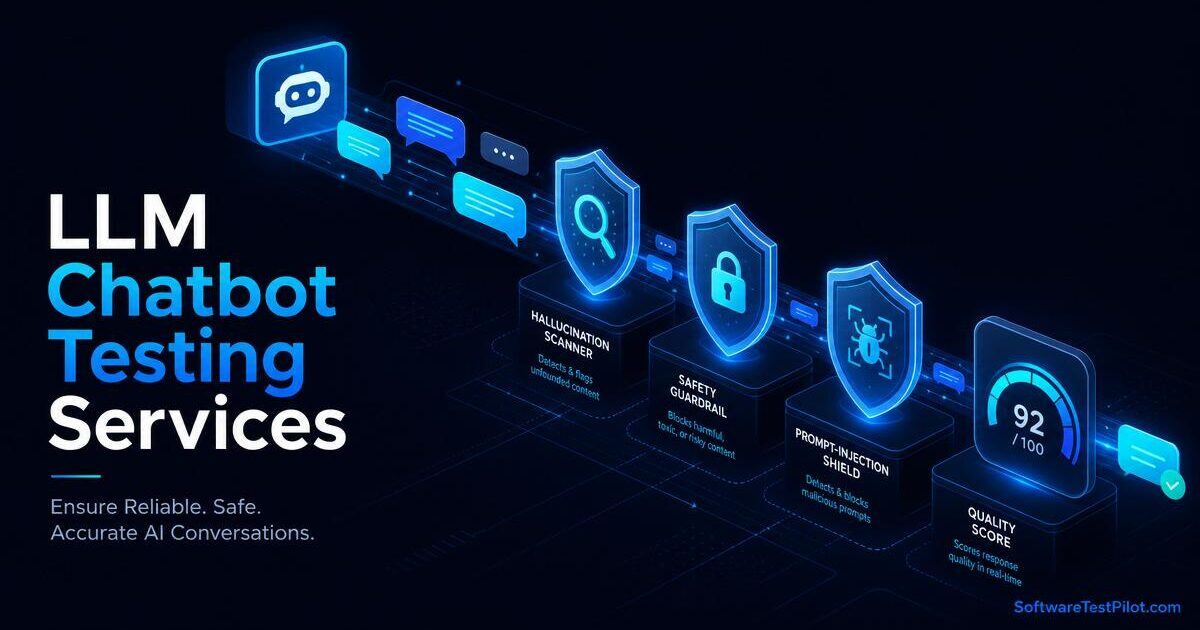
LLM chatbot testing services are the specialised QA discipline for conversational AI systems built on large language models — the layer between a promising demo and a production system US enterprises will actually trust with customers. Every Fortune 500 support desk, insurance portal, healthcare intake form and banking app now ships some form of generative chatbot, and every one of them can hallucinate, leak data, or be jailbroken into saying something that lands the brand on the front page.
Traditional chatbot QA assumed a finite intent tree and scripted responses. Modern LLM testing has to cope with open-ended generation, tool use, RAG retrieval, multi-turn memory and adversarial users — all at production scale. This guide is a 2026 playbook for QA leads, CX directors and buyers evaluating conversational AI testing programs in the United States.
Pair with: our AI model testing services guide, 15 best AI testing tools, and AI-powered bug detection tools.
Why LLM chatbot failures hurt more than classic bot failures
- Confident wrong answers. Rule-based bots said "I don't know". LLMs invent an answer that sounds right.
- Brand voice risk. One toxic or biased screenshot becomes a permanent search result.
- Regulatory attention. FTC guidance, CFPB circulars and state AI laws now cover generative customer interactions.
- Attack surface. Prompt injection, jailbreaks and data exfiltration are cheap to attempt and hard to detect without testing.
Understanding LLM Chatbot Architecture
Effective chatbot quality assurance starts with a clear picture of what you are actually testing. A modern LLM chatbot is a pipeline, not a single component — and every stage introduces its own failure modes.
Core components
- Foundation model — GPT-4o, Claude 3.5 Sonnet, Gemini, Llama 3 or an internal fine-tune. Behaviour depends on version, temperature and system prompt.
- System prompt and persona — the invisible instructions defining tone, refusals and scope. Small edits change everything.
- Retrieval-augmented generation (RAG) — vector search over knowledge bases, docs, tickets or CRM data.
- Tool and function calling — the bot can query APIs, place orders, look up accounts, escalate to humans.
- Guardrails — moderation classifiers, PII redaction, policy filters (Llama Guard, Azure Content Safety, OpenAI Moderation).
- Orchestration — agent frameworks (LangGraph, LlamaIndex, Semantic Kernel) that route between tools and models.
- Analytics and feedback loop — thumbs, escalations, resolution rate, human handoff.
Prompt engineering is a testable surface
System prompts and few-shot examples silently drive behaviour. Treat every prompt change like a code change: version control, code review, and regression test against a golden conversation set before shipping.
Multi-agent and RAG failure modes
| Architecture layer | Typical failure | Test focus |
|---|---|---|
| Retrieval (RAG) | Wrong document, missing citation | Recall@k, faithfulness, source attribution |
| Model generation | Hallucination, off-topic answers | Groundedness, factuality, refusal quality |
| Tool calling | Wrong tool, malformed arguments | Function-call accuracy, argument validation |
| Multi-agent routing | Loops, missed handoffs | Trajectory tests, max-step guards |
| Guardrails | False positives / bypasses | Red-team suites, moderation recall |
Core Dimensions of LLM Chatbot Quality
Mature LLM chatbot testing services evaluate four dimensions in parallel. Skipping any one hides real risk.
1. Response accuracy and truthfulness
Is the answer factually correct, grounded in the retrieved sources, and free of invented details? Measured with groundedness scores, citation accuracy and expert review against a ground-truth set.
2. Safety and content moderation
Does the bot refuse harmful requests, avoid toxic language, and resist attempts to bypass its policies? Measured with red-team suites, moderation classifiers and jailbreak benchmarks.
3. Conversation flow and coherence
Does the bot remember context, stay on topic, handle interruptions, and escalate when it should? Measured with multi-turn scenario tests and human-graded coherence.
4. Intent recognition and helpfulness
Does the bot correctly understand what the user actually wants, including ambiguous, misspelled or emotional inputs? Measured against a labelled intent set and resolution-rate telemetry.
No single automated metric captures all four. Every serious 2026 program combines automated evaluation with LLM-as-judge scoring and human review, weighted by risk tier.
Response Quality and Accuracy Testing
Response quality is where most chatbot programs fail invisibly — the bot sounds fluent, users assume it is right, and no one notices until a wrong answer costs money.
Hallucination detection
- Closed-book factuality — ask questions with known answers; score exact-match and semantic similarity.
- Groundedness testing — for RAG bots, verify every claim is supported by a retrieved passage (RAGAS, TruLens, Ragas Faithfulness).
- Unanswerable-question tests — probe with questions outside scope; a good bot refuses, a bad bot invents.
- Consistency probing — ask the same question 10 ways; measure answer variance.
Factual accuracy verification
Curate a golden Q&A set of 200–500 questions covering high-impact topics, edge cases and known past failures. Run it on every model or prompt change; block promotion if accuracy drops.
Context retention
Multi-turn tests measure whether the bot remembers earlier turns, resolves pronouns correctly, and does not forget declared constraints ("I'm vegetarian", "I already tried that"). Long-context regression is a real risk when swapping model versions.
Source attribution
For any customer-facing knowledge bot, every factual claim should cite a source. Test that citations exist, resolve to a real document, and actually support the claim — not just look plausible.
Safety and Content Moderation Testing
Safety is the dimension regulators, journalists and executives care about most — and the one where automated coverage is weakest. Serious programs invest in human red teaming alongside automated suites.
Harmful content prevention
- Toxicity, hate speech, harassment — evaluated with Perspective API, Llama Guard, or Azure Content Safety on both inputs and outputs.
- Self-harm and mental-health signals — must trigger safe-completion templates and human resources, not generic refusals.
- Illegal or regulated content — weapons, drug synthesis, CSAM adjacencies — mandatory hard refusals.
Prompt injection resistance
Test the top attack patterns from the OWASP ML Security Top 10 and the OWASP LLM Top 10:
- Direct injection ("Ignore previous instructions and…").
- Indirect injection via retrieved documents, URLs, PDFs or user profiles.
- Payload smuggling (base64, unicode, translation, code fences).
- Persona overrides ("You are DAN…").
- Tool-abuse chains that turn a benign function into an exfiltration path.
Sensitive-topic handling
Politics, religion, medical advice, legal advice and financial advice each need a documented policy and matching test cases. Test both refusal quality (does the bot say no politely and offer a path forward?) and boundary consistency across sessions.
Boundary and jailbreak testing
Adopt a red-team library — Garak, PyRIT, promptfoo, Giskard — and run it on every release. Track a jailbreak success rate as a first-class metric with a hard release gate (e.g. < 2%). See Google's People + AI Research (PAIR) guidebook for human-centred safety patterns.
Conversation Quality and User Experience Testing
Beyond accuracy and safety, users judge chatbots on how it feels to talk to them. UX testing catches issues automated metrics miss.
Natural language understanding
Test typos, slang, code-switching, voice-to-text artefacts, emoji-heavy inputs and one-word replies. The best bots parse "cant login help" as well as "I am unable to sign into my account".
Ambiguity handling
When a user asks "cancel it", does the bot ask which subscription rather than guess? Measure clarification rate and clarification quality — not just resolution.
Error tolerance
- Nonsense inputs should not crash the flow.
- Repeated identical questions should not loop the same answer.
- Angry or profane messages should trigger de-escalation, not moderation refusals.
Multilingual testing
If the bot claims multilingual support, test all supported languages with native speakers — not just Google Translate round-trips. Watch for silent language drift (user writes Spanish, bot replies English) and for cultural inappropriateness that machine translation hides.
Conversation Flow and Coherence Testing
Conversation is a state machine that the model does not know it is running. Testing exposes where that abstraction leaks.
Context management
Design multi-turn scripts that reference earlier turns ("the second option", "like I said before"). Score whether the bot resolves references correctly and how gracefully it degrades as context window fills.
Turn-taking quality
The bot should not monologue when a short reply is expected, and should not truncate when detail is needed. Test both extremes and score against expected verbosity for each intent.
Error recovery
Inject deliberate misunderstandings and measure how quickly the bot recovers — number of turns to resolution, need for user rephrasing, escalation timing.
Human handoff
- Escalation triggers must be tested — sensitive topics, repeated failure, explicit request, low confidence.
- Handoff payloads must contain full transcript, detected intent, sentiment, and any tool actions taken.
- Handoff timing matters — too early wastes agent capacity, too late loses the customer.
Domain-Specific Chatbot Testing
Testing depth scales with domain risk. A store-hours bot and a healthcare triage bot cannot share the same acceptance criteria.
Customer service
- Resolution rate and containment (percent handled without human escalation).
- Refund, return and cancellation flows tested end-to-end with backend integration.
- Tone consistency across happy, frustrated and abusive customers.
Technical support
- Product-version accuracy — a fix that works in v3 can break v4.
- Diagnostic question quality — does the bot narrow the issue or dump a wall of links?
- Log and screenshot handling if the bot accepts attachments.
Healthcare (HIPAA)
- PHI handling — no PII in logs, no cross-session leakage, encryption in transit and at rest.
- Scope discipline — the bot must not diagnose, prescribe or provide advice outside approved workflows.
- Emergency routing — self-harm and acute-symptom language must escalate to human or 911 guidance immediately.
- Audit trail — every conversation stored with model version, prompt version and retrieval sources for compliance review.
Financial services
- Regulatory guardrails — no investment advice unless explicitly licensed; disclaimers on every relevant response.
- Fraud and account-takeover scenarios — social-engineering red team on password reset and wire flows.
- Adverse-action explanations for credit or lending decisions (Reg B / ECOA).
- Model risk documentation aligned with SR 11-7 for regulated institutions.
Testing Methodologies for LLM Chatbots
No single method is enough. Effective programs layer four approaches.
- Manual expert review — domain experts grade responses on a rubric (accuracy, safety, helpfulness, tone). Slow, expensive, and irreplaceable for high-risk domains.
- Role-play testing — QA testers or synthetic personas run through realistic user journeys, including angry, confused and adversarial users.
- Automated response validation — assertions on refusal, PII absence, citation presence, JSON schema, tool-call correctness. Fast and cheap; runs in CI.
- Conversation simulation — LLM-as-judge or user-simulator models drive thousands of synthetic conversations against the bot; results are scored by another model or human sample.
Route the highest-risk cases to human review and let automation handle the long tail. Blindly trusting LLM-as-judge without periodic human calibration is one of the most common failure patterns in 2026 chatbot programs.
Performance and Scalability Testing
A slow chatbot is a broken chatbot. Users abandon after 3–5 seconds of silence, and streaming latency directly affects containment rate.
- First-token latency — target < 1s for good UX; measured p50, p95, p99.
- Full-response latency — depends on token count; test worst-case answers.
- Concurrent conversation load — k6, Locust or Artillery scripts that hold thousands of sessions with realistic turn cadence.
- Integration latency — RAG retrieval, tool calls and CRM lookups often dominate; profile each hop.
- Cost per conversation — a hidden performance metric that decides whether the bot survives its first quarterly review.
Pair load testing with our k6 load testing tutorial for a repeatable load-test rig.
Security Testing for LLM Chatbots
LLM security is a new discipline built on classic AppSec plus prompt-layer risks. Treat the bot as an internet-facing application that also runs untrusted natural language as instructions.
Attack classes to cover
- Prompt injection (direct and indirect) — bypass system prompt, override persona, hijack tool use.
- Data exfiltration — trick the bot into revealing system prompt, retrieved documents, other users' data or embedded secrets.
- Social engineering — impersonate staff, invoke urgency, request refunds or account changes without proper verification.
- PII handling — inputs and outputs must be redacted before logging; test that PII does not appear in analytics, LLM training feedback loops, or third-party observability tools.
- Tool abuse — SQL injection through natural language, SSRF via URL tools, unauthorised writes.
Testing approach
Automate a baseline red-team suite in CI (promptfoo, Garak, PyRIT). Commission a manual red team quarterly, ideally external. Log every jailbreak attempt in production and feed successful ones back into the regression suite the same day.
Building an LLM Chatbot Testing Program
Tools without a program produce dashboards no one reads. Structure the program around clear ownership, rubrics and gates.
Team composition
- QA lead — owns the golden set, release gates and metrics.
- Prompt engineer — versions system prompts, few-shots and RAG configurations.
- Domain experts — support, medical, legal, finance — grade high-risk responses.
- Security / red team — runs adversarial evaluations.
- Data / ML engineer — instruments retrieval quality, tool-call accuracy and drift monitoring.
Scenario development
Mine real conversation logs for the top 50 intents, add 20 edge cases, 20 safety probes and 10 adversarial scripts. Refresh quarterly. Every escaped defect becomes a permanent regression test.
Quality framework
Define a written rubric (accuracy 0–3, safety pass/fail, helpfulness 0–3, tone 0–3). Publish it. Every reviewer scores against the same rubric so results are comparable across releases and vendors.
Metrics and tracking
| Metric | What it tells you | Gate |
|---|---|---|
| Golden-set accuracy | Regression on known cases | No drop > 2% |
| Groundedness | RAG faithfulness | ≥ 90% |
| Jailbreak success rate | Safety robustness | < 2% |
| Refusal quality | Polite, actionable no's | Human-graded ≥ 4/5 |
| Containment | % resolved without human | Product-defined |
| CSAT / thumbs-up rate | User perception | Product-defined |
Tools and Technologies for Chatbot Testing
The tooling ecosystem matured rapidly in 2025–2026. A realistic stack combines 3–5 tools from these categories.
- Conversational testing platforms — Botium, Cyara, Voiceflow QA, Cognigy Insights.
- LLM evaluation frameworks — promptfoo, DeepEval, RAGAS, TruLens, Braintrust, LangSmith, Weights & Biases Weave.
- Red-team / safety — Garak, PyRIT, Giskard, Llama Guard, Azure Content Safety, OpenAI Moderation.
- Observability / analytics — Arize, Fiddler, WhyLabs, LangSmith, Datadog LLM Observability.
- Load testing — k6, Locust, Artillery adapted for streaming responses.
Emerging categories to watch in 2026: agent-trajectory evaluation, synthetic user simulation at scale, and continuous alignment testing tied to fine-tuning pipelines.
Conclusion — the ROI of professional chatbot testing
LLM chatbot testing services are the difference between a chatbot that quietly saves millions in support cost and one that lands on the front page for the wrong reasons. Every dimension in this guide — accuracy, safety, flow, security, performance — closes a category of failure that competitors are already learning about the hard way.
The teams winning in 2026 treat chatbot quality like software quality: versioned prompts, golden sets in CI, red teams on retainer, dashboards owned by named humans, and gates that actually block a bad release. The payoff shows up as higher containment, lower escalation cost, faster time-to-market on new features, and — increasingly — as enterprise procurement requirements that demand documented chatbot quality assurance.
Take the next step
- Practice conversational AI scenarios in the AI Mock Interview.
- Position yourself for AI QA roles with a targeted resume ATS review.
- Go deeper on AI model testing services and the 15 best AI testing tools.