
What Is Software Testing? The Complete 2026 Guide for QA Engineers
A 2500-word 2026 guide to software testing — clear definition, why it matters, SDLC & STLC diagram, testing types, techniques (BVA, EP, decision tables), bug life cycle, tools, career path and AI-in-QA trends. Written for freshers and working QA engineers.

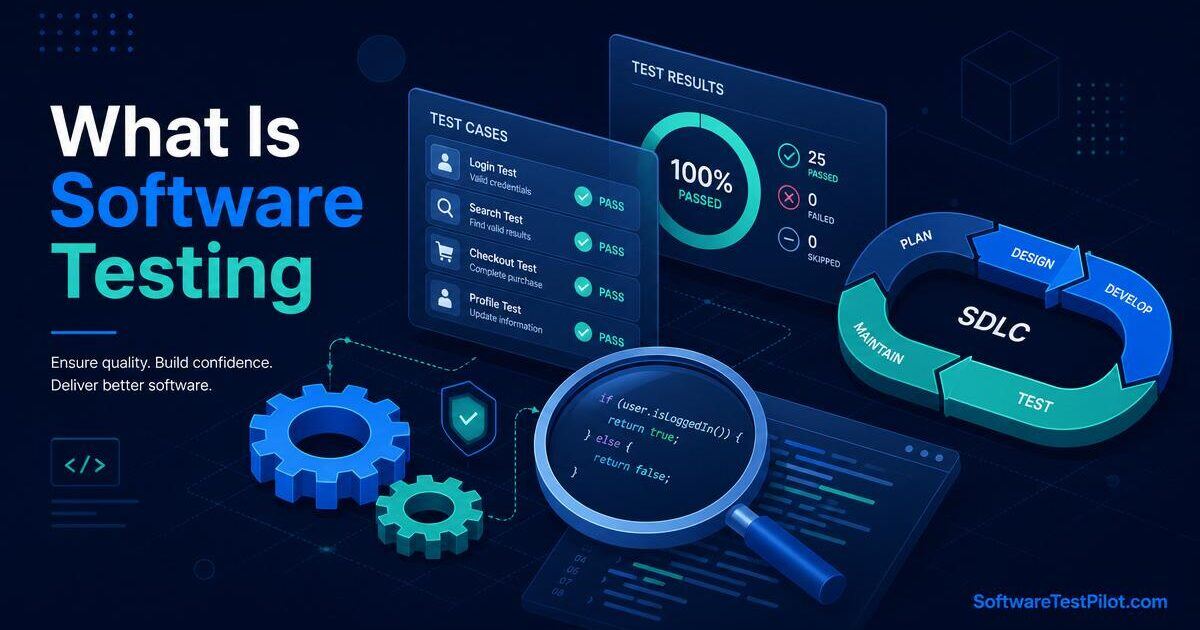
Software testing in one paragraph
Software testing is the disciplined process of evaluating an application — its features, code, data, performance and security — against what the business promised and what real users need. Testing does not guarantee bug-free software (nothing does); it lowers the probability that a defect reaches production and buys the team confidence to ship. In 2026, testing is no longer a phase you bolt on before release. It runs continuously — inside pull requests, staging environments and even production — orchestrated by humans, CI pipelines and, increasingly, AI copilots such as GitHub Copilot and generative AI. This guide walks you through every concept a modern QA engineer should own — with a full SDLC diagram, worked examples and links to deeper interview prep.
If you are just starting out, pair this article with our software testing interview questions for freshers hub and the complete pillar. Working professionals should jump to 3-year or senior variants after finishing this page.
1. What is software testing? A precise definition
The ISTQB glossary defines testing as “the process consisting of all lifecycle activities, both static and dynamic, concerned with planning, preparation and evaluation of software products and related work products to determine that they satisfy specified requirements, to demonstrate that they are fit for purpose and to detect defects.”
Break that down and three ideas stand out:
- Lifecycle activity — testing spans requirements, design, code, deployment and maintenance, not just a “test phase”.
- Static and dynamic — you test by reading artefacts (requirements reviews, static code analysis) and by executing code (unit, integration, system, UAT).
- Requirements & fitness for purpose — verification asks “did we build it right?”, validation asks “did we build the right thing?”. Modern testing owns both.
A common trap for freshers is confusing error, defect and failure. An error is a human mistake in code or thinking. That mistake becomes a defect (also called a bug or fault) once it lives in the software. A failure is the observable incorrect behaviour when the defect executes. Every failure has a defect behind it, but not every defect fails — dead code paths hide many.
2. Why software testing matters (with real numbers)
Testing is not overhead — it is one of the highest-leverage investments a product team can make. Three data points every QA engineer should be able to quote:
- Cost of defects grows exponentially. Boehm's curve and the IBM Systems Sciences Institute put the cost of a defect at ~1× in requirements, ~5× in design, ~10× in coding and up to 100× in production.
- CrowdStrike, July 2024 — a single untested content update in the Falcon sensor bricked ~8.5 million Windows hosts, disrupted airlines, banks and hospitals and wiped ~$5.4B of value from S&P 500 insurers.
- Knight Capital, 2012 — a partially deployed order-router lost $440M in 45 minutes. Root cause: legacy code re-activated in production without regression testing.
Testing prevents these outages, keeps regulated systems (finance, healthcare, aviation) compliant, protects user data and — perhaps most importantly for engineering morale — lets developers refactor without fear. A team without tests eventually stops changing the code, and stagnant code is where startups die.
3. Where testing fits in the SDLC — the full diagram
The Software Development Life Cycle (SDLC) is the sequence of phases a product moves through, from idea to sunset. Testing is not a single box at the end; it wraps around every phase. Below is the canonical loop with QA activities called out at each stage.
          ┌──────────────────────────────────────────────────────────┐
          │              SOFTWARE DEVELOPMENT LIFE CYCLE             │
          └──────────────────────────────────────────────────────────┘

     ┌──────────────┐      ┌──────────────┐      ┌──────────────┐
     │  1. PLAN /   │ ───▶ │  2. DESIGN / │ ───▶ │  3. DEVELOP  │
     │  REQUIREMENTS│      │  ARCHITECTURE│      │  (CODE)      │
     └──────┬───────┘      └──────┬───────┘      └──────┬───────┘
            │                     │                     │
     ┌──────▼───────┐      ┌──────▼───────┐      ┌──────▼───────┐
     │ QA: review   │      │ QA: test     │      │ QA: unit +   │
     │ acceptance   │      │ strategy,    │      │ component    │
     │ criteria,    │      │ test plan,   │      │ tests, code  │
     │ risks, RTM   │      │ testability  │      │ review, SAST │
     └──────────────┘      └──────────────┘      └──────────────┘
                                                        │
                                                        ▼
     ┌──────────────┐      ┌──────────────┐      ┌──────────────┐
     │  6. MAINTAIN │ ◀─── │  5. DEPLOY / │ ◀─── │  4. TEST     │
     │  (feedback   │      │  RELEASE     │      │  (SIT, UAT,  │
     │  loop)       │      │              │      │  perf, sec)  │
     └──────┬───────┘      └──────┬───────┘      └──────┬───────┘
            │                     │                     │
     ┌──────▼───────┐      ┌──────▼───────┐      ┌──────▼───────┐
     │ QA: prod     │      │ QA: smoke,   │      │ QA: system,  │
     │ monitoring,  │      │ blue/green,  │      │ regression,  │
     │ incident RCA │      │ canary tests │      │ E2E, non-func│
     └──────────────┘      └──────────────┘      └──────────────┘

                     ▲                                    │
                     └────────────────────────────────────┘
                          Continuous feedback → next sprint
Five things to notice on the diagram:
- Testing starts in Plan — reviewing acceptance criteria and the Requirement Traceability Matrix (RTM) prevents 30–40% of downstream defects.
- Every phase has an exit gate — you cannot leave a phase until entry criteria for the next are met (e.g. unit coverage ≥ 80% before system testing).
- Deploy is a test phase too — canary releases and feature flags are testing techniques applied to production.
- Maintenance feeds back to Plan — every incident becomes a regression test in the next sprint (this is the “pesticide paradox” antidote).
- The loop never stops — modern SaaS ships 10–200× per day; the SDLC is a wheel, not a waterfall.
Common SDLC models you must be able to compare in interviews: Waterfall (sequential, rigid, good for regulated systems), V-Model (each dev phase paired with a matching test level), Iterative / Spiral (risk-driven cycles) and Agile / Scrum / Kanban (short sprints, embedded QA). We drill deeper in the software testing interview questions pillar.
4. STLC — the Software Testing Life Cycle
If SDLC is the whole product's journey, the STLC is QA's parallel life cycle inside it. Every STLC phase has entry criteria, activities, deliverables and exit criteria.
- Requirement Analysis — read stories, question ambiguity, build the RTM. Deliverable: reviewed acceptance criteria.
- Test Planning — scope, schedule, resources, risks, tools. Deliverable: test plan & strategy.
- Test Case Design — apply BVA, EP, decision tables. Deliverable: reviewed test suite in TestRail / Zephyr / Xray.
- Test Environment Setup — DEV, QA, STAGING, UAT, PROD. Deliverable: healthy env with representative data.
- Test Execution — run manual + automation, log defects, retest, regress. Deliverable: run reports, defect metrics.
- Test Closure — exit report, lessons learned, test asset archive. Deliverable: sign-off & retrospectives.
Interviewers love the phrase “entry and exit criteria”. Memorise one concrete example per phase. See our 3-year experience interview guide for full sample answers.
5. The 7 principles of software testing
- Testing shows the presence of defects, not their absence. Passing tests never prove software is bug-free.
- Exhaustive testing is impossible. Use risk-based coverage and test design techniques instead.
- Early testing saves time and money. Shift-left: involve QA in requirements, not just execution.
- Defect clustering. ~80% of defects come from ~20% of modules — concentrate effort where it hurts.
- Pesticide paradox. The same tests stop finding bugs; refresh them with new inputs and exploratory sessions.
- Testing is context-dependent. A banking app is not a mobile game — tools and rigour must fit the domain.
- Absence-of-errors fallacy. Bug-free software that no one wants is still a failure — validate business value.
6. Types & levels of testing you must know
Testing is organised on two axes — the level (how much of the system you touch) and the type (what quality attribute you probe).
Levels
- Unit — one function/class in isolation. Owned by developers. Tools: JUnit, pytest, Jest, xUnit.
- Integration — modules talking to each other. Approaches: big-bang, top-down, bottom-up, sandwich.
- System — the whole product end-to-end against requirements. Owned by QA.
- Acceptance (UAT) — business users validate against real scenarios before go-live. Alpha (in-house) vs Beta (external).
Types
- Functional — features, business rules, error handling.
- Non-functional — performance, security, usability, reliability, compatibility, accessibility.
- Structural — code coverage, branch coverage (white-box).
- Change-related — smoke, sanity, regression, retest.
Two comparisons that appear in almost every interview:
- Smoke vs sanity — smoke is a shallow, wide check on a new build (do the core flows work?). Sanity is a narrow, deep check on a specific area after a bug fix. Both are subsets of regression.
- Black-box vs white-box vs grey-box — black-box tests inputs/outputs without seeing code, white-box tests internal paths, grey-box combines the two (typical for API + DB validation).
7. Manual vs automation testing in 2026
The old debate is over — every serious QA team does both. Manual testing is where human judgement, curiosity and domain empathy live: exploratory sessions, usability, edge-case invention. Automation is where you buy speed, reliability and coverage at scale: regression, cross-browser, load, API and CI/CD gates.
Rule of thumb for what to automate:
- Stable, repetitive, deterministic flows (login, checkout, search).
- Data-driven tests (100 rows of a decision table).
- High-risk business paths that must never regress.
- Anything running in a CI pipeline on every pull request.
Keep exploratory, usability, ad-hoc and one-off UAT scenarios manual. If you are choosing your first automation tool, start with our Playwright vs Selenium comparison and the Playwright vs Selenium interview pillar. For API automation, jump into API testing interview questions.
8. Core test design techniques (with worked examples)
Test design techniques are how you turn a vague requirement into a small, powerful set of test cases. Interviewers will ask you to demonstrate at least three.
Boundary Value Analysis (BVA)
Test values at the edges of input ranges — min-1, min, min+1, max-1, max, max+1. Example: a password field accepting 8–20 characters gives you tests at 7, 8, 9, 19, 20 and 21 characters. Boundary bugs cluster where developers used the wrong operator (< vs ≤).
Equivalence Partitioning (EP)
Divide inputs into partitions where behaviour should be identical, then test one representative per partition. For an age field valid 18–60: one test in <18 (invalid), one in 18–60 (valid), one in >60 (invalid) — three tests replace dozens.
Decision Tables
List all combinations of conditions and expected actions. Perfect for loan approval, discount rules or feature flags. Guarantees complete logical coverage.
State Transition & Use Case
Model states (logged-out → logged-in → locked) or actor flows (customer → cart → checkout → payment). Each valid + invalid transition becomes a test.
Exploratory & Error Guessing
Charter-driven exploration and experience-based probing find bugs that scripted tests miss — empty fields, zero values, unicode, session timeouts. Manage them with Session-Based Test Management (SBTM).
Practice these techniques against real UIs on our practice pages or generate scenarios in the AI Mock Interview.
9. The bug life cycle every tester must know
New ──▶ Assigned ──▶ Open ──▶ In Progress ──▶ Fixed ──▶ Retest ──▶ Verified ──▶ Closed
  │                              │              │            │
  │                              │              │            └──▶ Reopened (if bug reappears)
  │                              │              └──▶ Rejected / Not-a-Defect
  │                              └──▶ Deferred (fixed in future release)
  └──▶ Duplicate / Not-Reproducible
A production-grade bug report contains: title, environment (browser/OS/build), preconditions, exact reproduction steps, actual vs expected result, severity + priority, screenshots or video, console/network logs, reproducibility % and a link to the failing test case.
Severity vs priority — severity is business impact (Critical/High/Medium/Low), priority is urgency of fix (P1–P4). A typo in the CEO's name on the homepage is low severity, high priority. A crash in a rarely used export feature is high severity, low priority.
10. The 2026 QA tool stack
- Test management — Jira, TestRail, Zephyr, Xray.
- UI automation — Playwright, Selenium 4, Cypress.
- API automation — Postman, REST Assured, RestSharp, k6.
- Performance — JMeter, k6, Gatling.
- Security — OWASP ZAP, Burp Suite, Snyk.
- Mobile — Appium, Espresso, XCUITest.
- CI/CD — GitHub Actions, Jenkins, GitLab CI, CircleCI.
- Observability — Grafana, Datadog, Sentry for shift-right testing.
- AI copilots — GitHub Copilot, ChatGPT, Claude, Cursor for test generation and self-healing locators.
New to the stack? Start with our Postman tutorial, then move to Playwright or Selenium WebDriver.
11. Software testing as a 2026 career
Software testing is one of the most accessible engineering careers — you can enter with a non-CS degree in 4–6 months of focused study. Typical ladder:
- Manual QA / Junior QA (0–2 yrs) — write and execute test cases, log defects.
- QA Automation Engineer (2–5 yrs) — Playwright/Selenium, API tests, CI/CD.
- SDET (4–8 yrs) — build frameworks, own testability, code alongside developers.
- Senior / Lead SDET (7+ yrs) — architecture, mentoring, non-functional strategy.
- QA Manager / Principal / Director (10+ yrs) — org design, hiring, quality strategy.
2026 US salary bands (source: our internal jobs radar): Junior $70–95k, Automation $95–135k, SDET $130–180k, Senior SDET $170–230k, Lead / Principal $210–310k+. India: ₹4–8 LPA / ₹9–18 LPA / ₹18–35 LPA / ₹35–60 LPA / ₹60L–1.2Cr. See the full breakdown in the QA salary hub and browse live openings on the QA Jobs Radar.
When you are ready to interview, work through the experience-tier pillars in order — Freshers, 3 years, Senior — and polish your CV with the software testing resume format guide and free ATS Resume Review.
12. What is different about software testing in 2026?
- AI-native test generation. Copilots draft Playwright specs, self-heal broken locators and summarise flaky-test root cause. Read how AI is changing QA in 2026.
- Shift-right in production. Feature flags, canary deploys and observability-driven tests catch what staging cannot.
- Contract testing between microservices. Pact and Spring Cloud Contract replace brittle end-to-end suites.
- Accessibility as a first-class requirement. WCAG 2.2 audits are now blocking in most enterprise pipelines.
- QA owns non-functional gates. Performance budgets, security SLAs and privacy tests all live under Quality Engineering.