
SDLC Phases: The Complete 6-Phase Guide for QA (2026)
SDLC phases explained end-to-end for QA engineers: requirements, design, implementation, testing, deployment, maintenance. Diagrams, Agile/Waterfall/V-model comparison, and where QA fits in each phase.

Last updated: July 17, 2026 · 13 min read · By SoftwareTestPilot
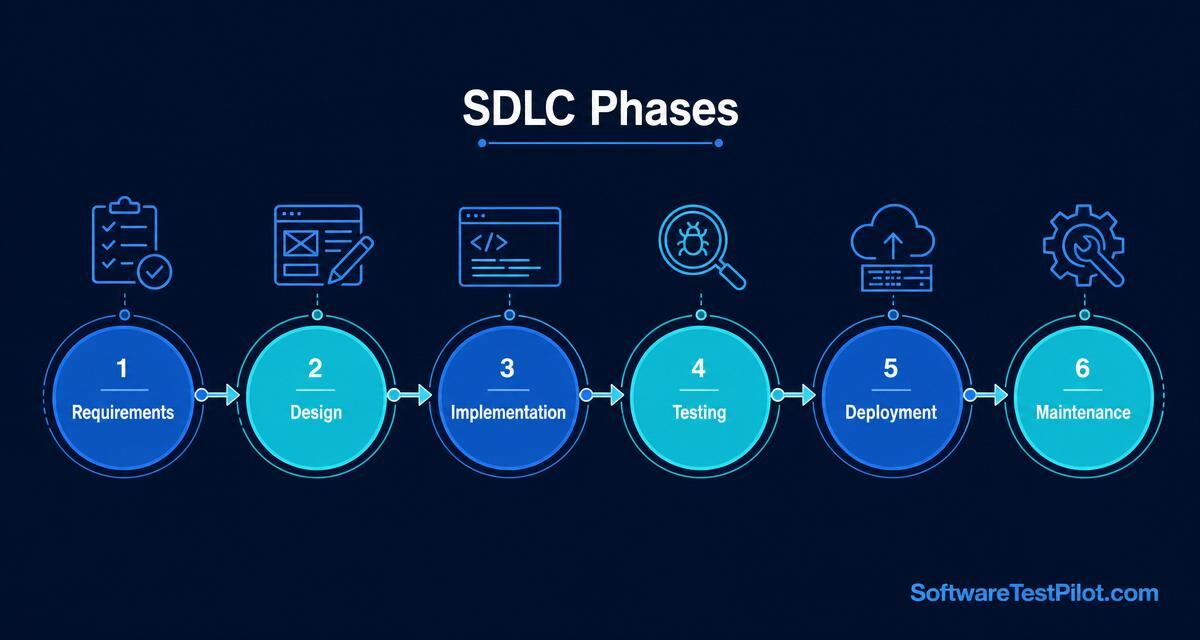
The Software Development Life Cycle (SDLC) is the six-phase workflow every software team follows — implicitly or explicitly — to turn a business idea into a shipped, maintained product. Knowing SDLC cold is the difference between a QA engineer who takes tickets and one who is invited into design reviews. This guide walks you through all six phases, compares Waterfall / V-Model / Agile, and pins down exactly where QA adds value in each phase. It is written for 2026 hiring standards where shift-left is table stakes and CI/CD collapses several phases into one deployment.
Pair with the STLC guide (STLC nests inside the Testing phase of SDLC) and the software testing interview questions pillar.
Key takeaways
- SDLC has 6 canonical phases: Requirements → Design → Implementation → Testing → Deployment → Maintenance.
- Waterfall runs them sequentially; Agile iterates through them every sprint; V-Model pairs each dev phase with a matching test phase.
- QA belongs in every phase, not just Testing — shift-left is the 2026 baseline.
- Modern CI/CD collapses Deployment into an automated step run many times per day.
1. Requirements analysis
Goal: capture what the software must do, who will use it, and which quality attributes matter (performance, security, accessibility).
Outputs: business requirements document (BRD), functional specification, user stories, acceptance criteria.
QA's role: attend requirement grooming, ask “how will we test this?” on every story, log ambiguity as defects before code is written. This is where the highest-leverage bugs are prevented.
2. Design
Goal: decide how the system will meet the requirements — architecture, database schema, APIs, UX flows, security boundaries.
Outputs: HLD (high-level design), LLD (low-level design), API contracts, wireframes, threat model.
QA's role: review design documents for testability, propose the test pyramid shape, define the test plan and environment strategy, agree on API contract tests.
3. Implementation / Coding
Goal: developers build the features per the design.
Outputs: source code, unit tests, code review approvals, CI green builds.
QA's role: pair with developers on unit-test design, write API contract tests and E2E scaffolding in parallel with feature branches, keep the CI/CD pipeline green.
4. Testing (STLC lives here)
Goal: validate that the built software meets requirements and non-functional targets.
Outputs: executed test cases, defect log, exit report, sign-off.
QA's role: execute the full STLC — test planning, design, environment setup, execution, defect management, closure. This is the phase where the previous three phases pay dividends: cleaner requirements = clearer tests, better designs = fewer surprises, disciplined coding = faster regression.
5. Deployment
Goal: release the tested build to production users.
Outputs: release notes, runbooks, monitoring dashboards, feature flags.
QA's role: smoke tests in production immediately after release, monitor error rates and p95 latency, own rollback criteria. In modern trunk-based-development teams, this happens many times per day and is fully automated — QA's job is to make the smoke pack fast and reliable.
6. Maintenance
Goal: keep the software running and evolving — bug fixes, security patches, minor enhancements.
Outputs: hotfixes, patch releases, backlog grooming, postmortems.
QA's role: reproduce production incidents, add regression tests for every recurring bug, own the postmortem's “how do we detect this next time?” column. This is where a good regression suite compounds — every fix adds a permanent guardrail.
7. Waterfall vs V-Model vs Agile: how SDLC actually runs
| Model | Phase execution | When to use | QA implication |
|---|---|---|---|
| Waterfall | Sequential, one after another | Fixed scope, regulated domains | Testing squeezed at the end; long feedback loops |
| V-Model | Sequential with matching test phase per dev phase | Safety-critical, medical, aerospace | Every dev artifact has a paired test artifact |
| Agile / Scrum | All 6 phases iterated every sprint | Most modern SaaS and product teams | QA embedded in the team; shift-left mandatory |
| DevOps / CD | Agile + automated deployment many times a day | Cloud-native teams | QA owns fast, reliable regression + observability |
8. Shift-left: QA in phases 1–3, not just 4
The biggest lever any QA engineer has in 2026 is refusing to wait for the Testing phase. Every ambiguity caught in Requirements costs 1x; the same defect caught in Testing costs ~10x; caught in Maintenance ~100x (see Boehm's cost-of-defect curve). Sit in requirement grooming. Review design docs. Pair on unit tests. Read the shift-left with AI copilots guide and the QA engineer roadmap for the seniority path.
9. Your 24-hour action step
Map your current sprint to the six phases. Identify one phase where QA is absent or reactive. Volunteer a concrete artefact — a test plan, a testability review comment, a smoke pack — to fill that gap. That is the fastest visible upgrade in your seniority. Rehearse SDLC questions on the AI Mock Interview, benchmark comp on the QA Salary Guide. Reference: NIST's SDLC definition.
10. 2026 SDLC evolution — AI-augmented phases and quality gates
In 2026 the phase boundaries are getting blurrier because AI copilots pull activities left. Requirements analysts run Claude/Gemini over PRDs to auto-generate ambiguity and testability lint reports before design even begins. Design reviews attach an AI-generated threat model plus a first-cut STRIDE matrix. Devs land features with copilot-authored unit + contract tests, and QA spends the freed cycles on exploratory charters, chaos drills and production observability. A modern gate looks like this:
| Phase | Human-owned deliverable | AI-augmented artifact | Exit signal |
|---|---|---|---|
| Requirements | PRD + acceptance criteria | Ambiguity + testability lint | 0 unresolved "fuzzy" ACs |
| Design | Arch decision record | Threat model + STRIDE table | All HIGH risks mitigated |
| Build | Feature + unit tests | Copilot-generated edge cases | Branch coverage >80% |
| Verify | System + acceptance suite | Auto-generated regression map | Escape rate <3% |
| Release | Change record + runbook | Rollback playbook draft | Rollback tested in staging |
| Operate | SLO dashboard | Anomaly summarizer | Error budget >0 |
Use this table as your Definition of Done per phase — teams that formalise it hit ~30% faster lead time (2026 DORA cohort).