
Test Plan Template: The 2026 IEEE-829 Guide (with Example)
Free test plan template for 2026 QA teams: IEEE-829 sections explained, filled-in example, checklist, risk matrix, entry/exit criteria, and how to use it in Agile sprints. Download and adapt.

Last updated: July 17, 2026 · 12 min read · By SoftwareTestPilot
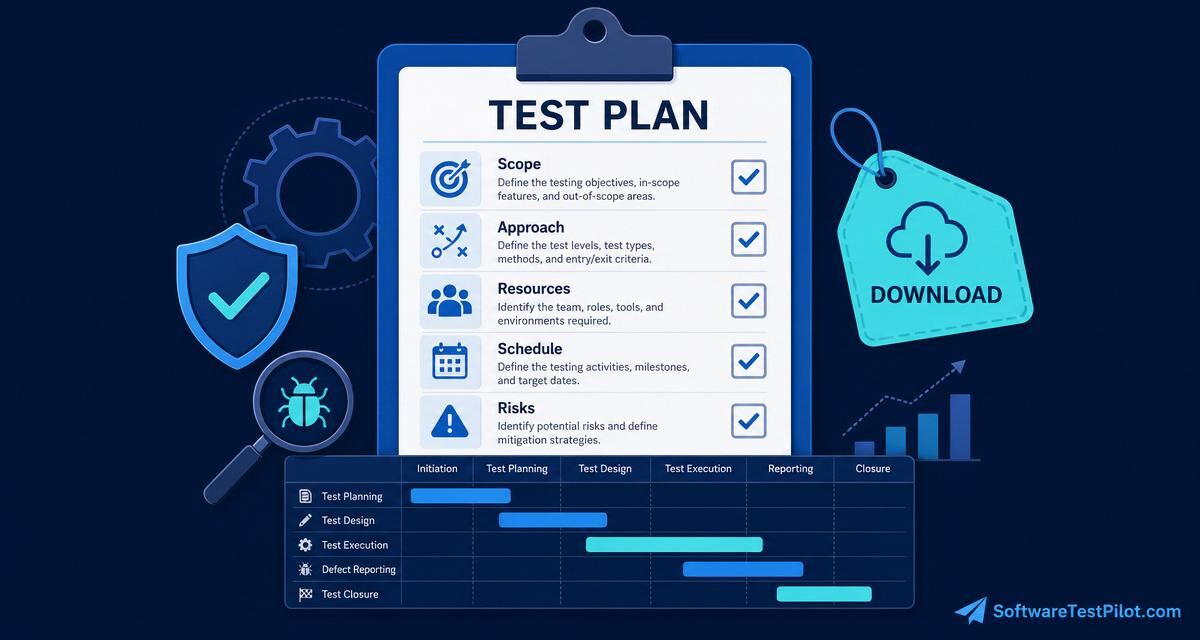
A test plan is the QA equivalent of an engineering design doc — one page (or many) that pins down what you will test, how you will test it, who owns which slice, and how you will know when you are done. This guide gives you the IEEE-829 standard sections adapted to a modern 2026 Agile team, a filled-in example you can copy into Confluence or Notion, and the entry/exit criteria that separate a useful test plan from a compliance artefact nobody reads.
Once your plan is ready, pair it with the test case template and the software testing interview questions pillar.
Key takeaways
- A test plan answers what, how, who, when, and done-when in one place.
- IEEE-829 gives you the section headings; Agile teams keep it living and short (2–4 pages).
- Entry and exit criteria are what turn a test plan from documentation into a real quality gate.
- Store it next to the code (Confluence, Notion, or the repo) — not in an inbox thread.
1. The 11 IEEE-829 test plan sections
- Test plan identifier — a unique ID (e.g.
TP-CHECKOUT-2026-Q3). - Introduction — one paragraph on the product, release, and business context.
- Test items — features, modules, APIs, and versions in scope.
- Features to be tested — the explicit in-scope list.
- Features NOT to be tested — the explicit out-of-scope list (and why).
- Approach — test levels, types, techniques, tools, and environments.
- Item pass/fail criteria — what “this feature is tested” means per item.
- Suspension & resumption criteria — when to stop testing, when to restart.
- Test deliverables — plan, cases, defect log, exit report.
- Test environment / tasks / responsibilities / schedule / staffing — the operational block.
- Risks & mitigations — what could derail the plan and how you will react.
2. Copy-paste test plan template
+-----------------------------------------------------------------------------+
| TEST PLAN: [Product / Feature Name]                                         |
+-----------------------------------------------------------------------------+
| ID:            TP-[project]-[year]-[quarter]                                |
| Version:       0.1                                                          |
| Author:        [Your name] · Reviewer: [QA lead]                            |
| Last updated:  YYYY-MM-DD                                                   |
+-----------------------------------------------------------------------------+
| 1. INTRODUCTION                                                             |
|    - Product, release, business context (2-3 sentences).                    |
|                                                                             |
| 2. IN-SCOPE                                                                 |
|    - Feature A                                                              |
|    - Feature B                                                              |
|                                                                             |
| 3. OUT-OF-SCOPE                                                             |
|    - Feature X (reason)                                                     |
|                                                                             |
| 4. APPROACH                                                                 |
|    - Levels: unit (dev), integration (SDET), system + UAT (QA)              |
|    - Types: functional, regression, performance, security, accessibility    |
|    - Techniques: BVA, EP, decision table, state transition                  |
|    - Tools: Playwright, Postman, k6, axe-core                               |
|    - Environments: DEV → QA → STAGING → PROD                                |
|                                                                             |
| 5. ENTRY CRITERIA                                                           |
|    - Requirements signed off                                                |
|    - Build deployed to QA env                                               |
|    - Test data seeded                                                       |
|                                                                             |
| 6. EXIT CRITERIA                                                            |
|    - 100% planned tests executed                                            |
|    - 0 P0/P1 defects open                                                   |
|    - Regression pack green in CI                                            |
|    - UAT sign-off                                                           |
|                                                                             |
| 7. RISKS                                                                    |
|    - Risk / Likelihood / Impact / Mitigation                                |
|                                                                             |
| 8. SCHEDULE                                                                 |
|    - Test design:   DD/MM - DD/MM                                           |
|    - Test exec:     DD/MM - DD/MM                                           |
|    - UAT:           DD/MM - DD/MM                                           |
|                                                                             |
| 9. DELIVERABLES                                                             |
|    - Test plan (this doc), test cases, defect log, exit report              |
+-----------------------------------------------------------------------------+
Adapt to your tool of choice — Confluence, Notion, GitHub markdown, or a shared Google Doc. What matters is that the plan is living and reviewable in pull requests, not a PDF nobody opens.
3. Entry and exit criteria — the part that matters
90% of test plans fail because they list activities without gates. Well-written entry and exit criteria turn the plan into a contract with engineering leadership.
Sample entry criteria — must all be true before test execution starts:
- Requirements have been reviewed and signed off.
- Build is deployed to the QA environment and smoke-tested green.
- Test data has been seeded (users, orders, edge-case rows).
- All P0 blocking bugs from the previous release are closed.
Sample exit criteria — must all be true before you sign off:
- 100% of planned test cases executed.
- 0 P0 / P1 defects open, ≤ 2 P2 defects deferred with product-owner sign-off.
- Regression suite green in CI for 3 consecutive runs.
- UAT completed with business sign-off.
- Performance NFRs met (p95 < 400ms on the checkout API).
4. How Agile teams keep the plan alive
IEEE-829 was written for waterfall projects. Modern teams shrink the doc and update it every sprint:
- One plan per epic, not per release. Attach it to the epic ticket in Jira / Linear.
- Living doc, versioned in Git or Confluence — no PDFs.
- Reviewed at sprint planning, closed at sprint retro.
- Linked to CI dashboards, not to email chains.
For the automation harness that makes exit criteria measurable, see our CI/CD mastery guide.
5. Building a useful risk matrix
Every project ships with risks. Rank them by likelihood × impact and pre-agree the mitigation before the sprint starts:
| Risk | Likelihood | Impact | Mitigation |
|---|---|---|---|
| Payment gateway sandbox flaky | High | Blocks E2E | Stub with Playwright page.route |
| Test data resets nightly | Medium | Slows exec | Seed via API in beforeEach |
| New auth flow slips scope | Medium | Delays UAT | Parallel test design; scope out of MVP |
6. Test plan questions in interviews
Interviewers ask for a test plan to check whether you can lead a release, not just execute cases. Practice the whole flow — introduction, scope, approach, entry/exit — out loud on the AI Mock Interview. Deep prep in the 3-year experience Q&A hub and senior Q&A hub.
7. Your 24-hour action step
Copy the template in section 2 into your team's wiki. Fill in the fields for your current sprint's biggest feature. Get a peer to review it in 30 minutes. That single artefact will make you visibly more senior to your engineering manager. Benchmark comp on the QA Salary Guide. Reference: the full IEEE-829 documentation standard.
11. 2026 test-plan reality check — what actually goes in the plan (and what to delete)
The 25-page IEEE 829 test plan died with waterfall. A 2026 test plan is a living, 1–2 page document per epic that answers five questions crisply. Anything longer is documentation theatre. Below is the distribution of what elite (DORA top-quartile) teams actually keep versus what they cut.
| Section | Keep or cut? | 2026 rationale |
|---|---|---|
| Scope + out-of-scope | Keep — 3 bullets | Prevents scope creep, biggest source of missed defects |
| Risk-based test priorities | Keep — a table | Focuses limited time on highest-impact areas |
| Test approach per layer (unit / integration / E2E) | Keep — one line each | Ties plan to the test pyramid |
| Environments + data | Keep — link to runbook | Env drift is the #1 flaky-test root cause |
| Entry & exit criteria | Keep — measurable | e.g. “E2E <2% flake”, “0 P0/P1” |
| Full test-case catalogue | Cut — link to Zephyr/TestRail | Cases live in the tool, not a Word doc |
| Detailed schedule & Gantt | Cut | Sprint board is the schedule |
| Roles & responsibilities | Cut unless regulated | Team charter covers this once |
Risk-based prioritisation in 3 columns
The one artifact that always pays for itself is a risk matrix. Rate each feature by (a) likelihood of defect and (b) impact if it breaks. Multiply. Assign test depth accordingly:
| Risk score | Test coverage | Example |
|---|---|---|
| 9 (High × High) | Unit + Integration + E2E + exploratory + monitoring alarm | Payment capture |
| 6 (Med × High) | Unit + Integration + one E2E happy path | Password reset |
| 3 (Low × Med) | Unit + smoke | Profile avatar upload |
The 5 questions a 2026 test plan must answer
- What are we shipping and to whom?
- Which risks are we investing test effort in, and which are we accepting?
- Which layer of the pyramid catches which risk?
- What must be true to stop testing (exit criteria)?
- Who is on call if it breaks in production?
Common interview follow-ups
- What is the difference between a test plan and a test strategy? Strategy is org-level and stable; plan is release/epic-level and rewritten every few weeks. Deep dive on test strategy vs test plan.
- Who signs off the test plan? QA lead drafts, engineering + product ratify at sprint planning.
- How do you keep the plan alive? Review it in every sprint retro; delete anything stale, add anything the retro exposed.