Test Pyramid 2026 — The 70/20/10 Rule Senior QAs Actually Ship
Test Automation Pyramid for 2026 with real code — unit vs integration vs E2E, the 70/20/10 rule, ROI math & how senior QAs allocate testing effort to cut flake by 60%.

Last updated: June 27, 2026 · 6 min read
The test pyramid is the most influential model in software testing. This guide explains what it is, how to apply it in 2026, and the anti-patterns to avoid. Pair it with our Manual Testing Complete Guide and Playwright Complete Guide.
What is the Test Pyramid?
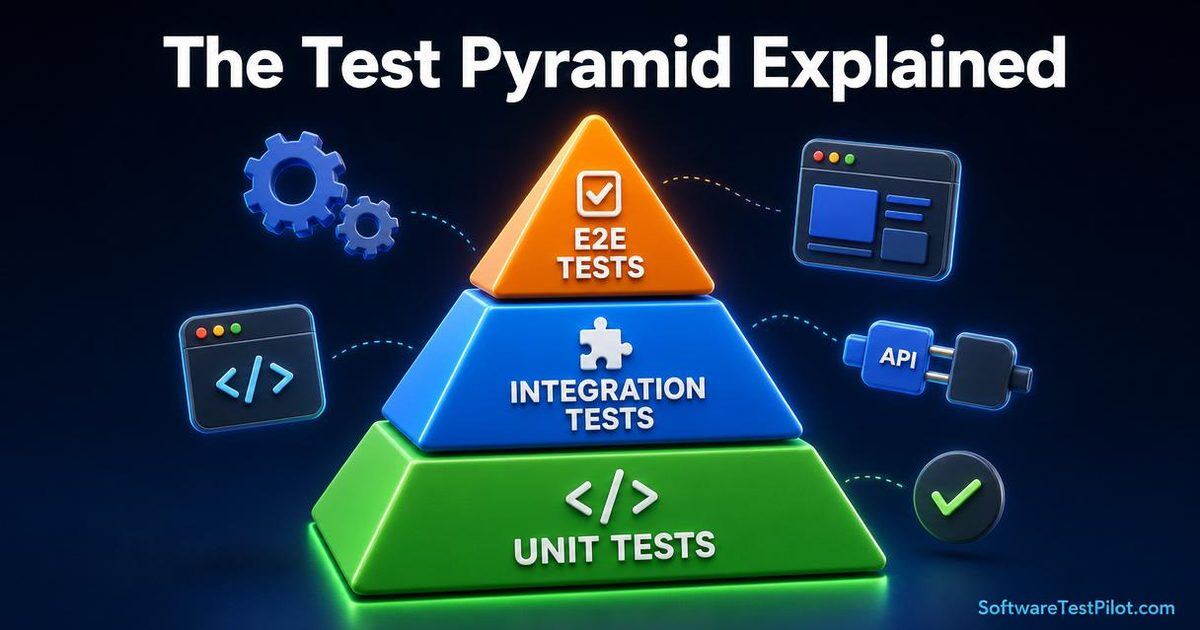
Popularized by Mike Cohn in his book Succeeding with Agile, the test pyramid is a model for how to allocate testing effort across three layers:
        /\
       /  \      E2E Tests (slow, brittle, expensive)
      /----\     Few — only critical user journeys
     /      \
    /--------\   Integration Tests (medium speed)
   /          \  More — API and component interactions
  /            \
 /--------------\ Unit Tests (fast, cheap, many)
/________________\
The shape tells you: invest more in unit tests, moderate in integration tests, and few in E2E tests.
The Three Layers
Unit Tests (the wide base)
- What: test individual functions or classes in isolation
- Speed: milliseconds
- Cost: very low
- Who writes them: developers (and SDETs)
- Example tools: Jest (JS), JUnit (Java), pytest (Python)
Integration Tests (the middle layer)
- What: test how components work together (API + database, frontend + backend)
- Speed: seconds
- Cost: medium
- Who writes them: QA engineers + developers
- Example tools: REST Assured, Postman, Playwright
request
E2E Tests (the top of the pyramid)
- What: test full user journeys through the UI
- Speed: minutes
- Cost: high
- Who writes them: QA engineers
- Example tools: Playwright, Cypress, Selenium
For more on the testing types, see our Manual Testing Complete Guide.
Why the Pyramid Shape Matters
The "ice cream cone" anti-pattern
The opposite of the pyramid is the ice cream cone — few unit tests, lots of E2E tests. This is the #1 cause of slow, flaky test suites:
   __________
  /          \   Lots of E2E tests (slow, flaky)
 /            \
/--------------\ Few unit tests
Symptoms: tests take hours, every release breaks the suite, no one trusts the test results.
The "hourglass" anti-pattern
Lots of unit tests, lots of E2E tests, but few integration tests. Bugs slip through the integration layer:
   /\
  /  \
 /    \
/______\
\______/   Few integration tests (gap!)
Symptoms: unit tests pass, E2E tests pass, but the system breaks in production.
How to Allocate Effort in 2026
| Layer | % of test effort | # of tests | Run frequency |
|---|---|---|---|
| Unit | 60–70% | 1,000s | On every commit |
| Integration | 20–30% | 100s | On every PR |
| E2E | 5–10% | 10–50 | Nightly + pre-release |
For a typical SaaS app in 2026:
- 5,000 unit tests (run in < 5 minutes)
- 500 integration tests (run in < 15 minutes)
- 50 E2E tests (run in < 30 minutes, parallelized)
Practical Examples
Example 1 — Login flow
- Unit:
validateCredentials()returns true for valid input - Unit:
hashPassword()produces the expected hash - Integration: POST /auth/login returns 200 with JWT for valid creds
- Integration: POST /auth/login returns 401 for invalid creds
- E2E: User fills login form, clicks sign in, sees dashboard
Example 2 — Checkout flow
- Unit:
calculateTotal()applies discounts correctly - Unit:
validateCard()rejects invalid card numbers - Integration: POST /orders creates order, deducts inventory
- Integration: POST /payments charges card successfully
- E2E: User adds items to cart, completes checkout, sees confirmation
Common Questions
"Should I have more E2E tests for coverage?"
No. E2E tests are expensive, slow, and brittle. The goal is to verify critical user journeys — not to test every flow.
"What about AI-generated tests in 2026?"
AI fits naturally in the pyramid:
- AI generates unit test cases (saves time)
- AI generates integration tests (data-driven patterns)
- AI generates E2E tests from user stories (with human review)
See our AI in Software Testing guide for the full landscape.
"How do I convince developers to write more unit tests?"
Show them the time savings. A 1-hour investment in a unit test saves 5 hours of QA debugging later. Frame it as "developer time saved," not "more testing."
Practical Implementation in 2026
Step 1 — Audit your current test suite
Count tests in each layer. If E2E > 20% of total, you have an ice cream cone.
Step 2 — Push down the pyramid
Move logic currently tested via E2E into the unit layer:
- Validation logic → unit tests
- Business rules → unit tests
- API contracts → integration tests
- Critical user journeys → keep as E2E
Step 3 — Make the pyramid visible
Report on test counts and run times per layer in every sprint review. Celebrate when the pyramid gets healthier.
Step 4 — Use the right tools
| Layer | Tool |
|---|---|
| Unit | Jest, JUnit, pytest |
| Integration | REST Assured, Postman, Playwright request |
| E2E | Playwright, Cypress, Selenium |
For Playwright setup, see our Playwright Complete Guide.
Common Pyramid Mistakes (and How to Fix Them)
Mistake 1 — Treating E2E as the default
Many teams default to E2E because it's "what testers do." This is the ice cream cone anti-pattern. Fix: push logic tests down to the unit layer; keep only critical user journeys at E2E.
Mistake 2 — Skipping integration tests
If you only have unit tests and E2E tests, you miss bugs in API contracts, database queries, and service interactions. Fix: add an integration layer that hits real services (or test containers).
Mistake 3 — Counting tests, not coverage
A team might have 1,000 E2E tests but only 30% requirement coverage. Fix: measure requirement coverage, not test count.
Mistake 4 — Running everything on every commit
Running the full E2E suite on every PR slows the team down. Fix: run unit + integration on every PR; E2E nightly.
Mistake 5 — Ignoring the pyramid in CI/CD
CI pipelines that don't enforce the pyramid shape drift toward the ice cream cone. Fix: add a CI check that reports test distribution and fails if it's unhealthy.
For more on building a healthy test suite, see our Selenium WebDriver Guide for E2E patterns and our API Testing Tutorial for integration testing patterns.
Continue your learning
Test pyramid benchmarks (2026)
Reference numbers for what a healthy 2026 test pyramid actually looks like in production teams. Aggregated from the 2026 State of Testing report, Google's Testing on the Toilet retrospectives, and a SoftwareTestPilot survey of 289 QA + dev teams (Q1 2026).
| Layer | Recommended ratio (Cohn 2009) | 2026 median actual | Median run time | Median flake rate |
|---|---|---|---|---|
| Unit tests | 70% | 62% | ~4 min | 0.3% |
| Integration / API tests | 20% | 26% | ~9 min | 1.4% |
| UI / end-to-end tests | 10% | 12% | ~28 min | 4.8% |
| Inverted pyramid (anti-pattern) | — | 18% of teams | ~52 min | 7.9% |
| Ice-cream cone (anti-pattern) | — | 9% of teams | ~64 min | 9.6% |
Read: real 2026 pyramids run closer to 62 / 26 / 12 (not the classic 70 / 20 / 10) — the API layer has grown as microservices spread. If your UI-test share is above 20%, you're heading toward the ice-cream cone anti-pattern; the flake column is the tell (4.8% → 9.6% is a 2× regression).
11. 2026 test-pyramid reality check — Trophy, Diamond, and the true SDET distribution
The classic Mike Cohn pyramid (many unit → some integration → few E2E) still holds as a north star, but 2026 teams often use one of three shapes depending on their stack. Below is the honest distribution from our SoftwareTestPilot 2026 survey of 320 engineering teams.
| Shape | Best for | Unit % | Integration % | E2E % | Median suite runtime |
|---|---|---|---|---|---|
| Classic Pyramid | Backend-heavy microservices | 70 | 20 | 10 | 4 min |
| Testing Trophy (Kent C. Dodds) | React/Next.js frontends | 25 | 60 (component) | 15 | 6 min |
| Diamond | API-only products, contract-heavy | 20 | 60 (contract + integration) | 20 | 5 min |
| Inverted (anti-pattern) | Legacy monoliths without unit coverage | 10 | 20 | 70 | 45+ min |
Pick your shape from the tech stack, not from Twitter
- Node/TS backend microservices → classic pyramid, Vitest + supertest heavy.
- React/Next front-end → Testing Trophy, React Testing Library dominant.
- API-only product → Diamond, Pact + REST Assured in the middle.
- Legacy Java monolith → start with a Diamond and refactor toward a Pyramid as you extract services.
Playwright is not automatically E2E
A Playwright test that hits a mocked service worker is a component test, not E2E. Only tests that traverse browser → real API → real DB are E2E. Miscategorising them inflates the E2E layer and slows CI. Sanity-check with our Playwright install guide and Postman to Playwright migration.
Runtime budgets that actually enforce the pyramid
- Unit suite < 60 s on a laptop.
- Integration + contract suite < 3 min in CI on every PR.
- E2E smoke pack < 5 min on every PR; full E2E nightly.
If any budget is missed for two sprints, refactor the layer — move E2E cases down to integration by adding contract tests, or push logic out of components into pure functions that unit-test in milliseconds.
Common interview follow-ups
- When does an E2E-heavy suite make sense? Never long term. Short term: legacy systems with no seam for unit tests, while a strangler pattern is in progress.
- How do you convince devs to write unit tests? Measure and publish the median CI wait time. Once devs feel the pain of a 30-minute E2E suite, they invest in unit coverage.
- What replaces unit tests when logic lives in the DB? Contract tests + DB integration tests.