
AI Test Automation Services: Buyer's Guide, Rubric & Pricing for 2026
AI test automation services buyer's guide — how vendors deliver Playwright/Selenium/Cypress suites with LLM authoring, self-healing locators, evals and CI integration. Rubric, pricing, SLA templates, red flags and PAA FAQs.

Last updated: July 15, 2026 · 14 min read · By SoftwareTestPilot
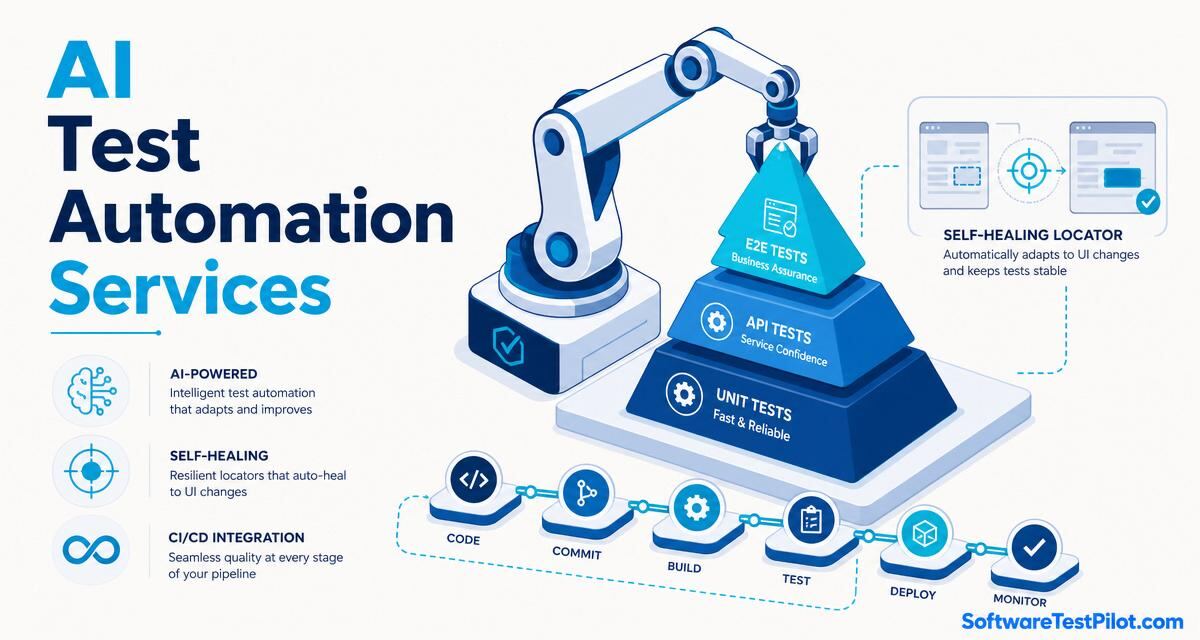
AI test automation services are focused engagements that deliver AI-augmented automated test suites — Playwright, Selenium, Cypress, Appium, REST — integrated into your CI, with self-healing locators, evals and dashboards. This pillar consolidates every "AI test automation services", "AI automation testing services", "AI-powered test automation vendor" and "AI QA automation partner" search into one buyer's guide you can act on before signing.
Need broader QA (manual + automation + evals)? See AI software testing services. Building in-house instead? See the AI testing platform buyer's guide and generative AI for test automation.
Key takeaways
- Automation-only scope means you can measure success in weeks, not quarters.
- Insist on framework portability — no vendor-locked recorder DSL.
- Self-healing must be locator-scoped, PR-reviewed, and logged; never silent assertion changes.
- Every generated test ships with an eval score and a named human reviewer.
- Pricing is best as fixed-price sprint (POC) then per-suite retainer.
1. What's in scope (and what isn't)
In scope for automation services: test authoring, page objects/API layers, self-healing, flaky-test triage, CI wiring, dashboards, coverage reporting, migration between frameworks.
Not in scope (needs a broader QA engagement): release go/no-go, exploratory testing, model-graded evals of your product's own GenAI features, security testing, compliance audits.
2. 10-point vendor rubric
| # | Criterion | Good |
|---|---|---|
| 1 | Framework portability | Delivers vanilla Playwright/Selenium/Cypress — no proprietary DSL |
| 2 | Locator strategy | Role/label-based first; XPath only as a fallback |
| 3 | Self-healing | Locator-only; PR-based; heal log in Git |
| 4 | Evals | Every AI-generated test scored on a 7-point rubric before merge |
| 5 | Flake budget | <1% flake rate, published weekly |
| 6 | CI integration | GitHub Actions / GitLab CI / Jenkins with parallel shards |
| 7 | Reporting | Allure / Playwright HTML + DORA metrics |
| 8 | Test data | Synthetic, seeded, PII-safe — see our AI test data generator pillar |
| 9 | Exit | All tests, prompts, evals in your Git from day one |
| 10 | Governance | No-training clause; SOC 2 Type II; AI-attribution |
3. Run a 4-week POC before you sign
- Week 1: vendor ingests your app, prior tests and CI. Publishes a coverage baseline.
- Week 2: generates 30 AI-authored tests. You score them on the 7-point rubric. Anything below 5/7 does not count.
- Week 3: wires self-healing + evals in CI. First heal event opens a PR.
- Week 4: hand-over doc, DORA baseline, and a written retro. Kill or renew.
Price the POC at cost. Any vendor who refuses this is optimising for lock-in.
4. Pricing benchmarks
| Model | Range | Best for |
|---|---|---|
| Fixed-price POC (4 wks) | $18k–$45k | First engagement |
| Per-suite retainer | $6k–$25k / suite / mo | Steady maintenance |
| Migration sprint (10 wks) | $60k–$180k | Selenium → Playwright, Protractor → Cypress, etc. |
| Outcome (flake %, cycle time) | Custom | Mature teams with baselines |
| AI-consumption pass-through | Cost + 10–20% | Any — insist on token audit |
5. SLA clauses that matter
- Flake rate <1% (rolling 30-day), or you pay 50%.
- Suite runtime cap (e.g., <12 min for smoke, <35 min for full regression).
- All heal events open a PR within one CI run.
- Human reviewer named per PR.
- Vendor uses enterprise LLM keys with no-training clause; SOC 2 Type II annual.
- Every prompt, test and eval delivered in your Git — you own it on day one.
6. Red flags
- Proprietary recorder DSL that only runs on their cloud.
- Self-healing that silently rewrites assertions.
- No published flake rate; no evals; no rubric.
- "We can migrate 5,000 tests in two weeks." (Nobody responsibly can.)
- No SOC 2 Type II; no named model / provider list.
- Vendor keeps your tests behind their login after the SOW ends.
7. Build in-house instead?
Build if you have one Copilot-fluent SDET, Playwright installed, and CI you already trust. Buy if you need a coverage spike in under 60 days, or you're migrating frameworks. Hybrid: pay a vendor to bootstrap 300 tests + evals, then run steady-state internally. See the trade-off in the AI testing platform pillar.
8. Governance & compliance
Every AI-in-testing engagement must run under governance:
- Enterprise LLM APIs with a no-training / zero-retention clause. Never paste customer data into a free consumer chat.
- Redact PII, PANs, JWTs, HARs, secrets and production URLs before any prompt.
- Version prompts, evals and agent tools in Git. Every AI-generated artefact ships with an AI-attribution line and a named human reviewer.
- Map controls to the NIST AI RMF and, for EU products, the EU AI Act.