SoftwareTestPilot
AI in TestingPublished: 15 min read

AI Testing Platform in 2026: Top Tools, Buying Guide & Build-vs-Buy Playbook

Complete AI testing platform buyer's guide — top vendors (Testim, Mabl, Applitools, Functionize, Katalon AI, Copilot for QA), evaluation rubric, self-healing tests, evals, agentic runners, pricing and PAA FAQs.

Avinash Kamble
Founder & QA Engineer at SoftwareTestPilot
Reviewed by Priyanka G.
Share:XLinkedInWhatsApp
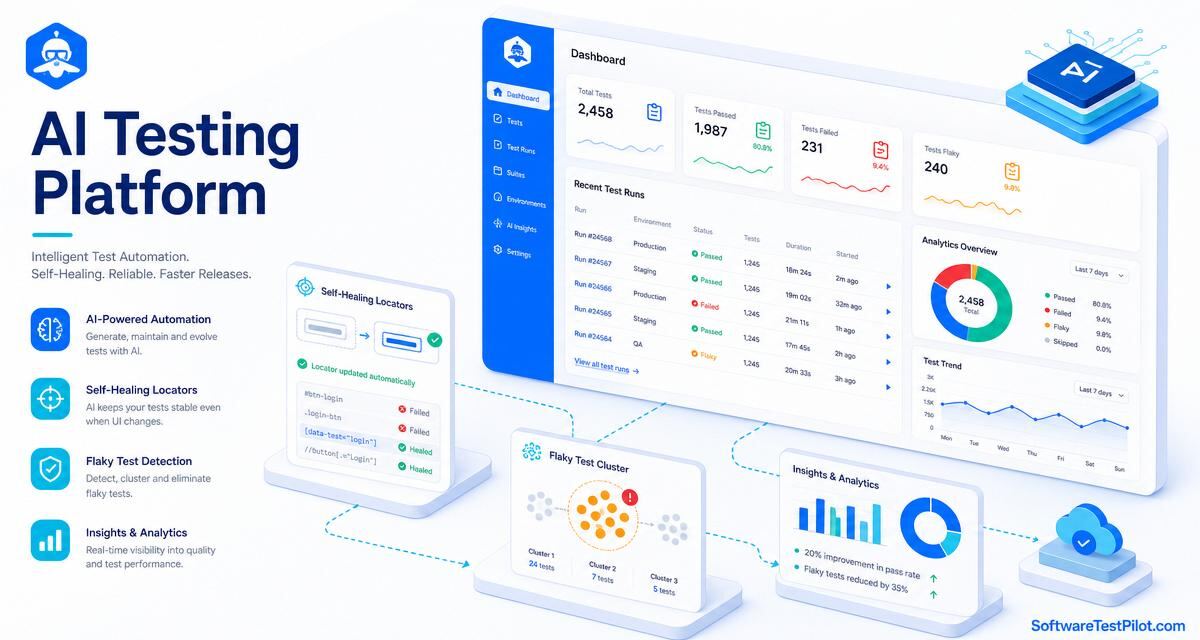
AI testing platform cover — SaaS dashboard with test runs, self-healing locators, flaky-test cluster and analytics charts. SoftwareTestPilot.com wordmark.

Last updated: July 15, 2026 · 14 min read · By Avinash Kamble, reviewed by Priyanka G.

An AI testing platform is a hosted or self-managed toolchain that uses AI to author, execute, heal, triage and report on tests — usually across UI, API and mobile. This pillar consolidates every "AI testing platform", "AI test automation platform", "best AI QA tools" and "AI-driven testing platform" search into one buying rubric and a shortlist you can trust.

Pair with generative AI for test automation and AI flaky test detection.

Key takeaways

  • Every serious platform in 2026 offers: authoring, self-healing, evals, and agentic runners.
  • Score vendors on a 10-point rubric — do not buy on the demo video alone.
  • Build (Copilot + Playwright + evals) beats buy for teams under 15 QAs; buy beats build past 40 QAs or heavy regulation.
  • Lock down data residency, no-training clauses and audit logs before signing.
  • Always run a 4-week POC against a real regression pack — never a synthetic one.

1. What an AI testing platform must do in 2026

  1. Authoring — natural language → executable test (UI, API, mobile).
  2. Self-healing — locator + assertion repair on UI drift with a diff and human approval.
  3. Test data — synthetic, PII-safe data generation on demand.
  4. Evals — regression scoring for non-deterministic outputs (LLM apps, RAG).
  5. Flaky-test detection — clustering, quarantine, root-cause hints.
  6. Agentic runner — an AI agent that can drive a browser or API via MCP.
  7. Reporting — release-ready go/no-go summary with linked evidence.
  8. Governance — SSO, audit logs, data residency, no-training clause, EU AI Act mapping.
  9. Integrations — GitHub/GitLab, Jira, Slack, PagerDuty, CI providers.
  10. Extensibility — SDK/API so your team can plug in custom evals or tools.

2. Top AI testing platforms compared

PlatformBest forSelf-healingLLM/evalsAgenticPricing
Testim (Tricentis)Web UIYesAdd-onBetaQuote
MablWeb + APIYesYesBetaTiered
ApplitoolsVisual + a11yYesN/AN/ATiered
FunctionizeEnterprise UIYesYesYesQuote
Katalon (StudioAssist)Full lifecycleYesYesBetaFreemium
Tricentis ToscaSAP / enterpriseYesYesYesQuote
Playwright + Copilot + promptfooProduct teamsDIYDIYDIYFree tools

Also worth watching: BrowserStack Low Code Automation, Aqua Cloud, ACCELQ, Perfecto Scriptless, and open-source Auto-Playwright/Playwright-MCP. For the pure-open-source stack, see generative AI Playwright.

3. The 10-point evaluation rubric

  1. Does it work on our app (real POC, not sandbox)?
  2. Self-healing precision > 85% on our top-50 flaky tests?
  3. Data residency and no-training clause in writing?
  4. SSO + RBAC + audit logs?
  5. API/SDK for custom evals and tools?
  6. Reporting integrated with our Jira / Slack / CI?
  7. Total cost per year including seats + runs + storage?
  8. Onboarding time to first green run (< 2 weeks)?
  9. Support SLA and named CSM?
  10. Exit plan — can we export tests and history?

4. Build vs buy in 2026

Build (Copilot + Playwright + promptfoo + Grafana) wins when: team ≤ 15 QAs, one product surface, in-house dev capacity, low regulation. Runtime cost is basically free, but you pay in engineering hours.

Buy wins when: team ≥ 40 QAs, multiple products, regulated industry, need a single pane of glass and vendor accountability. Expect $50k–$500k/year all-in for a mid-market platform.

5. Running a 4-week POC that doesn't lie

  1. Week 1 — pick 3 real user journeys and your top-20 flaky tests. Freeze the app version.
  2. Week 2 — vendor authors + runs the pack on your staging.
  3. Week 3 — trigger 5 realistic UI changes and measure heal rate.
  4. Week 4 — score against the rubric, calculate 12-month TCO, decide.

6. Governance

Every AI-in-testing workflow must run under governance:

  • Enterprise LLM APIs with a no-training / zero-retention clause. Never paste customer data into a free consumer chat.
  • Redact PII, PANs, JWTs, HARs, secrets and production URLs before any prompt.
  • Version prompts, evals and agent tools in Git. Every AI-generated artefact ships with an AI-attribution line and a named human reviewer.
  • Map controls to the NIST AI RMF and, for EU products, the EU AI Act.

Frequently asked questions

1.What is an AI testing platform?
A hosted or self-managed toolchain that uses AI (typically LLMs plus computer-vision or DOM models) to author tests from natural language, self-heal broken locators, generate test data, cluster flaky failures and drive browsers or APIs as an agent. Modern platforms also add LLM-app evals for non-deterministic outputs.
2.Which is the best AI testing platform in 2026?
There is no single best. For web UI + a11y regression, Applitools leads on visual AI. For end-to-end SaaS, Mabl and Testim are the mature choices. For enterprise / SAP, Tricentis Tosca. For product teams that want to keep control, Playwright + Copilot + promptfoo is the strongest open stack.
3.Do AI testing platforms replace Selenium and Playwright?
No — most platforms run on top of Selenium or Playwright and add authoring, healing and reporting layers. Your engineers still see standard drivers underneath, which is why the exit plan and export format matter in the buying rubric.
4.How much does an AI testing platform cost?
Freemium tiers exist (Katalon, Applitools eyes). Team plans run $2–5k/month. Enterprise contracts range $50k–$500k+ per year depending on seats, parallel runs, storage and support. Always calculate a 3-year TCO including implementation and change management.
5.Are AI testing platforms safe for regulated data?
Yes, if procured correctly. Require: data residency in your region, a written no-training / zero-retention clause, SOC 2 Type II or ISO 27001 report, SSO+SCIM, audit logs, and evidence of NIST AI RMF / EU AI Act mapping. Never send production PII without redaction.
6.What is self-healing in an AI testing platform?
The platform detects that a locator or assertion no longer matches the DOM/API, proposes a repair based on nearby signals and prior runs, and either auto-applies (fast) or queues for human review (safe). Precision above 85% and easy revert are non-negotiable.
7.Do these platforms support API and mobile testing?
Most cover web UI first, then API. Mabl, Katalon, Tricentis and Functionize now include mobile web and native app coverage; specialist mobile platforms include HeadSpin, Kobiton and BrowserStack App Automate. Confirm devices in scope before signing.
8.Which platform is best for LLM app testing (not just UI)?
Platforms that ship evals are best: Mabl, Katalon StudioAssist, and open-source promptfoo / DeepEval / Ragas. Look for regression scoring on non-deterministic outputs, RAG grounding checks, and hallucination detection.
9.Can I use ChatGPT or Claude as an AI testing platform?
As authors, yes — via the chat UI or an SDK inside Playwright/Selenium. They lack the runner, reporting, integrations and governance a full platform provides, so treat them as a building block, not a replacement.
10.What about GitHub Copilot for QA — is that a platform?
It is an IDE assistant, not a platform. Combined with Playwright/Vitest, promptfoo evals and GitHub Actions it becomes a lightweight AI testing platform your team already owns. Good default for teams under 15 QAs.
11.How do agentic AI testing platforms differ?
They add an autonomous agent that plans, executes and reports on tests using tools exposed via Model Context Protocol (browser, API, DB, ticketing). See our <a href='/blog/ai-in-testing/agentic-ai-testing-with-mcp'>agentic AI testing with MCP</a> pillar for the deep dive.
12.How do I convince my manager to fund an AI testing platform?
Show three numbers from a 4-week POC: (1) hours saved authoring tests, (2) percentage flaky tests healed automatically, (3) reduction in escape defects. Frame the ask as ROI, not tooling — most platforms pay back within 6–9 months at team sizes of 20+.
Keep going

Practice these questions

Run a live QA mock interview tailored to this topic and get per-skill scoring in minutes.

Found this useful?
Share:XLinkedInWhatsApp

Was this article helpful?

Cluster · AI in Testing

More from AI Testing Tools

Testim, Mabl, Functionize, self-healing platforms.

Pillar guide · 8 articles
More in this cluster
From the AI in Testing pillar

Keep building your QA edge

Continue reading

Join the QA Community

Connect with fellow testers, share job leads, and get career advice.

Premium QA Resources

Stop Reinventing the Wheel. Upgrade Your QA Arsenal.

Take your testing skills from beginner to Lead Engineer. Supercharge your daily workflow with our premium digital resources.

  • Ready-to-use testing strategy templates
  • Advanced API & UI automation guides
  • ⏱️ Save 10+ hours a week on test planning
4.9/5 rating
Explore All Products

⭐⭐⭐⭐⭐ Trusted by 1,000+ Software Test Pilots • Instant Access