
AI Flaky Test Detection in 2026: Cluster, Triage & Fix (Playbook + FAQ)
The 2026 playbook for AI-driven flaky test detection — cluster failing tests by root cause (race, network, timing, teardown, data), triage with LLM hypotheses, ship fixes, wire quarantine into CI. RCTF prompts, rubric, PAA FAQs.

Last updated: July 15, 2026 · 14 min read · By SoftwareTestPilot
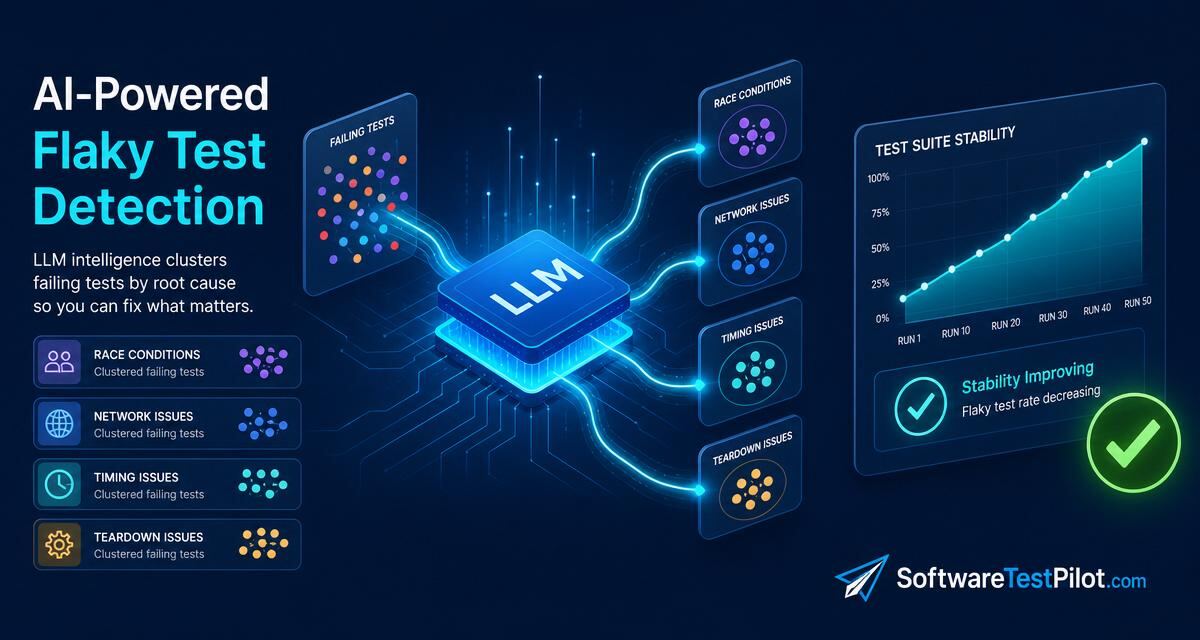
AI flaky test detection is the practice of using ML clustering and LLM analysis to cut through the noise of intermittent failures — grouping them by root cause (race, network, timing, teardown, data, environment), proposing the most likely fix, quarantining the worst offenders and reporting stability trends to leadership. Flakiness is the single biggest reason mature CI pipelines lose developer trust; AI is the fastest way to reverse the trend.
Consolidates "AI flaky test detection", "flaky test triage", "AI quarantine", "test stability ML". Pair with generative AI regression testing and CI/CD for test automation.
Key takeaways
- Flakiness is a data problem — you cannot fix what you do not measure.
- Cluster failures by stack trace + DOM + timing + env before you hypothesise a fix.
- Quarantine ruthlessly but log every quarantine with an owner and SLA.
- Retire quarantined tests after 30 days with no fix — they are lying to you.
- Ship weekly stability trend reports to eng leadership — it is what unlocks headcount.
1. What counts as flaky
A test is flaky if it produces different results on the same code and inputs. Common causes:
- Race — assertion runs before the SUT settles.
- Network — real HTTP or DNS in a test that should be mocked.
- Timing — hard-coded sleeps, animations, debounce/throttle.
- Teardown — shared state (DB row, cookie, localStorage) leaking across tests.
- Data — non-deterministic fixture (random UUID, current time).
- Environment — flaky agent, container, browser version.
Reference: Meta's probabilistic flakiness engineering.
2. RCTF framework
- Role — "You are a senior SDET / ISTQB-Advanced test analyst. Prioritise risk coverage, boundary values and clarity for a QA lead reviewer."
- Context — paste the requirement, user story, OpenAPI spec, page object or stack trace, plus framework + version and the compliance regime (SOC 2, HIPAA, GDPR, EU AI Act) and coverage target.
- Task — one specific artefact: "Generate 15 test cases", "Draft an IEEE 829 test plan section 4", "Write a Playwright E2E for AC-14 with an @axe accessibility check".
- Format — the exact output shape: markdown table, JSON schema, Gherkin, Vitest .test.ts. End with a rubric self-critique.
3. Prompts (cluster, hypothesise, quarantine, report)
P1 — Cluster last-N failures
Role: reliability engineer.
Context: [last 500 failure records: test id, stack, browser, os, duration,
time-of-day, retry-count].
Task: cluster by root cause (race, network, timing, teardown, data, env).
Return top 8 clusters with size, example test, hypothesised cause, effort.
Format: markdown table.
P2 — Hypothesise a fix for one flaky test
Role: Playwright/Selenium expert.
Context: [test source + 20 recent failures with stack + DOM snapshot].
Task: 3 ranked hypotheses. For each: explanation, minimal patch, how to
verify the fix (20 consecutive greens).
Format: markdown with fenced code diffs.
P3 — Quarantine policy check
Role: QA lead running the weekly flaky review.
Context: [current quarantine list with age + owner + SLA].
Task: flag any test past SLA (14 days) for retirement or forced fix.
Format: JSON {retire: [], escalate: [], keep: []}.
P4 — Stability trend narrative
Role: eng manager writing a weekly QA update.
Context: [8 weeks of pass-rate, flaky count, mean-time-to-quarantine,
mean-time-to-fix].
Task: 5-bullet exec summary + one graph description + one recommendation.
Format: markdown, < 150 words.
4. The flaky test lifecycle (weekly cadence)
- Detect — CI marks a test flaky if pass-rate over last 20 runs is 30–95%.
- Cluster — nightly job runs P1 against the week's failures.
- Assign — top clusters get an owner within 48h.
- Quarantine — take the test out of the merge gate; keep running it on a separate lane.
- Fix or retire — 14-day SLA. No fix = retire. No exceptions.
- Report — weekly stability trend to eng leadership.
5. Flaky-test review rubric
- Data-grounded — every flaky verdict from ≥ 20 runs, not one anecdote.
- Owned — every quarantined test has a named owner + SLA.
- Retired ruthlessly — no test in quarantine longer than 30 days.
- Fix validated — 20 consecutive greens before out of quarantine.
- Root-cause tracked — cluster/category logged for trend analysis.
- No silent skip — every quarantine visible on a dashboard.
- Trend reported — weekly stability report to leadership.
6. Tools
| Tool | Best for |
|---|---|
| Launchable | Predictive test selection + flaky detection |
| Trunk Flaky Tests | Auto-quarantine + fix workflow |
| Datadog CI Visibility | Test flakiness dashboards + APM correlation |
| BuildPulse | Flaky test tracking + notifications |
| ReportPortal AI | OSS test analytics + ML classification |
7. Governance
Any AI workflow that touches product data or code must run under governance:
- Enterprise LLM APIs with a no-training / zero-retention clause. Never a free consumer chat for customer data.
- Redact PII, PANs, JWTs, HARs, secrets and production URLs before any prompt.
- Version prompts in a Git-tracked QA prompt library. Every AI-generated artefact ships with an "AI attribution" line and a human SDET sign-off.
- Map controls to the NIST AI RMF and, for EU products, the EU AI Act.