
Generative AI Unit Testing in 2026: LLM Prompts, Vitest/JUnit/PyTest Templates, Coverage & FAQ
The complete 2026 guide to generative AI unit testing — how to use ChatGPT, Claude, Gemini and GitHub Copilot to write Vitest, Jest, JUnit and PyTest suites, hit 90% coverage, kill flakiness and pass code review. RCTF prompts, rubric, PAA FAQs.

Last updated: July 15, 2026 · 14 min read · By SoftwareTestPilot
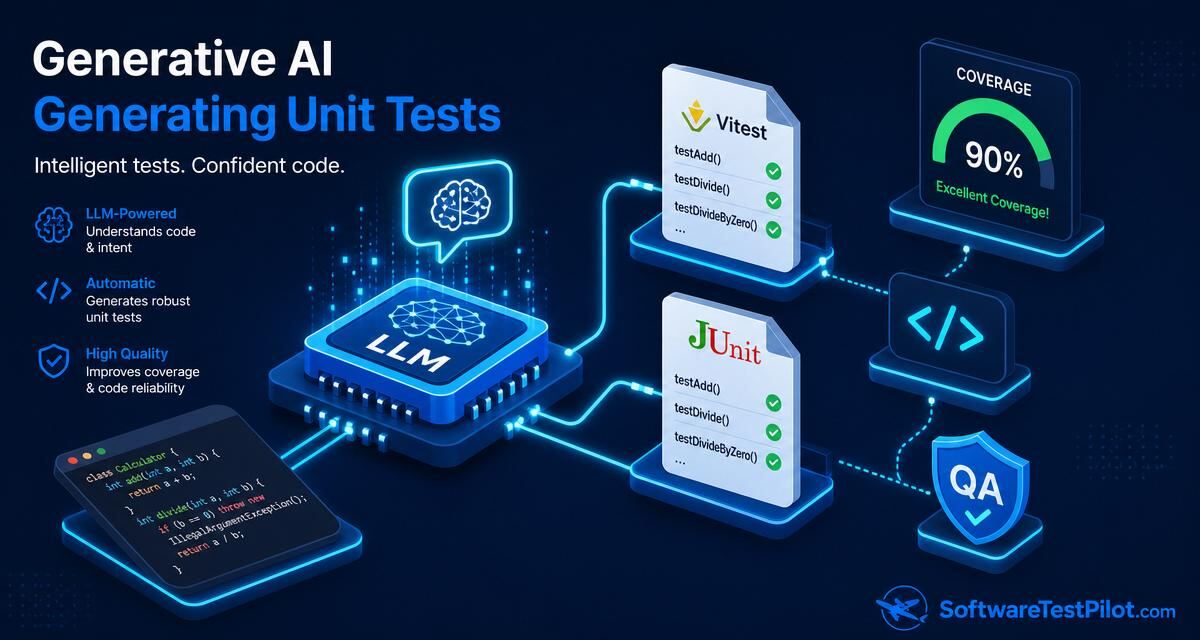
Generative AI unit testing is using an LLM — ChatGPT, Claude, Gemini or GitHub Copilot — to draft unit tests from a function, class or module and its coverage target. In 2026 this is the single highest-ROI use of AI in QA: unit tests are small, deterministic, easy to review, and the LLM has millions of open-source examples to imitate. Teams that adopt the RCTF prompt framework consistently hit 80–95% branch coverage in a fraction of the manual time.
This pillar consolidates the searches "AI unit test generator", "generative AI unit testing", "LLM unit tests", "Copilot unit tests" and "AI unit test generator for Python / Java / JavaScript". Pair with generative AI for test automation, GitHub Copilot unit tests and generative AI test case generation.
Key takeaways
- Feed the LLM the function plus its coverage target and the framework version. Vague prompts produce vague tests.
- Ask for AAA-structured tests (Arrange-Act-Assert), fakes/mocks by name, and branch coverage of every
if,switch,catch.- Reject any AI-generated test that asserts on implementation details instead of behaviour.
- Run the AI suite against a mutation-testing tool (Stryker, PIT, mutmut) — it is the only honest coverage signal.
- Version your unit-test prompts in a Git-tracked prompt library.
1. What generative AI unit testing actually solves
Manual unit testing is 80% mechanical: name the test, arrange inputs, call the SUT, assert the output, repeat for each branch. LLMs are excellent at exactly this shape of work — they replicate the AAA pattern, cover happy and negative paths, and produce mock scaffolding in the framework you name. What they cannot do is choose the right behaviour to assert, or spot a missing acceptance criterion. That is why every AI-generated suite needs a human reviewer with the requirement in one hand and a mutation-testing report in the other.
Companion reads: GitHub Copilot unit tests, GitHub Copilot: write tests and generative AI Selenium for the E2E side.
2. The RCTF prompt framework for unit tests
- Role — "You are a senior SDET / ISTQB-Advanced test analyst. Prioritise risk coverage, boundary values and clarity for a QA lead reviewer."
- Context — paste the requirement, user story, OpenAPI spec, page object or stack trace, plus framework + version and the compliance regime (SOC 2, HIPAA, GDPR, EU AI Act) and coverage target.
- Task — one specific artefact: "Generate 15 test cases", "Draft an IEEE 829 test plan section 4", "Write a Playwright E2E for AC-14 with an @axe accessibility check".
- Format — the exact output shape: markdown table, JSON schema, Gherkin, Vitest .test.ts. End with a rubric self-critique.
3. Copy-paste prompts (Vitest, JUnit, PyTest, xUnit, Go)
Prompt 1 — Vitest / TypeScript
Role: senior TypeScript engineer. Follow Vitest 3 idioms and AAA.
Context: [paste function]. Framework: Vitest 3.2 + Node 22.
Task: generate a .test.ts covering every branch, boundary and thrown error.
Format: single file, describe/it blocks, vi.mock for I/O, no snapshots
unless the output is deterministic. End with a self-critique noting any
untested branch.
Prompt 2 — JUnit 5 / Java
Role: SDET, JUnit 5 + Mockito 5 + AssertJ.
Context: [paste class + method]. Coverage target: 90% branch.
Task: generate a MyClassTest.java with @ParameterizedTest for boundary
values and @Nested groups for happy vs negative paths.
Format: complete .java file, imports first, one assertion per test where
practical.
Prompt 3 — PyTest / Python
Role: Python 3.12 QA engineer, pytest 8 + pytest-mock + hypothesis.
Context: [paste function + docstring]. Target: 95% line + branch coverage.
Task: generate test_module.py with parametrised cases, one hypothesis
property test for numeric inputs, and monkeypatch for network calls.
Format: single file, no fixtures duplicated, mark slow tests @pytest.mark.slow.
Prompts 4–8 (short)
- xUnit / C# — Theory + InlineData for boundaries, Moq for interfaces, FluentAssertions.
- Go — table-driven tests with t.Run subtests, testify/assert, no external mocks.
- Kotlin — JUnit 5 + MockK + assertk, one @Nested per branch.
- Refactor for testability — ask the LLM to first suggest a seam (interface / DI) then generate the tests.
- Mutation-guided top-up — paste Stryker/PIT survivors, ask for exactly the tests that would kill them.
4. The 7-point unit-test review rubric
- Behaviour, not implementation — no asserting on private state or call order unless it is the contract.
- Branch coverage — every
if,switch,catchhas a passing and failing case. - Boundary values — min-1, min, max, max+1 for every numeric or length input.
- Mocks are honest — no over-mocking, no mocking the SUT.
- Determinism — no reliance on Date.now, Math.random, network, filesystem without fakes.
- Naming — tests read as a spec (
it("rejects an expired token")). - Mutation score — Stryker/PIT/mutmut score ≥ 70% on the changed file.
5. Coverage, mutation testing and CI wiring
Line/branch coverage is easy to game — a test that calls the function without asserting still counts. Pair the AI suite with Stryker (JS/TS/C#), PIT (Java) or mutmut (Python) to see how many introduced mutants survive. In CI, fail the build if mutation score drops below 70% on the changed files, not the whole repo — this keeps the signal fast and blame-friendly. See CI/CD for test automation for the pipeline shape.
6. Governance and IP safety
Any LLM workflow that touches product code or customer data must run under governance:
- Enterprise LLM APIs (OpenAI, Anthropic, Google, Azure OpenAI) with a no-training / zero-retention clause. Never a free consumer chat for customer data.
- Redact PII, PANs, JWTs, HARs, secrets and production URLs before any prompt.
- Version prompts in a Git-tracked QA prompt library. Every AI-generated artefact ships with an "AI attribution" line and a human SDET sign-off.
- Map controls to the NIST AI RMF and, for EU products, the EU AI Act.