
LLM for QA Testing in 2026: The Complete End-to-End Playbook (Prompts, Tools, Governance & FAQ)
The 2026 end-to-end playbook for using LLMs in QA — test planning, test case design, automation, exploratory testing, bug reporting, Jira triage, release readiness. Vendor-neutral prompts for ChatGPT, Claude, Gemini, Copilot. Rubric, governance, PAA FAQs.

Last updated: July 15, 2026 · 14 min read · By SoftwareTestPilot
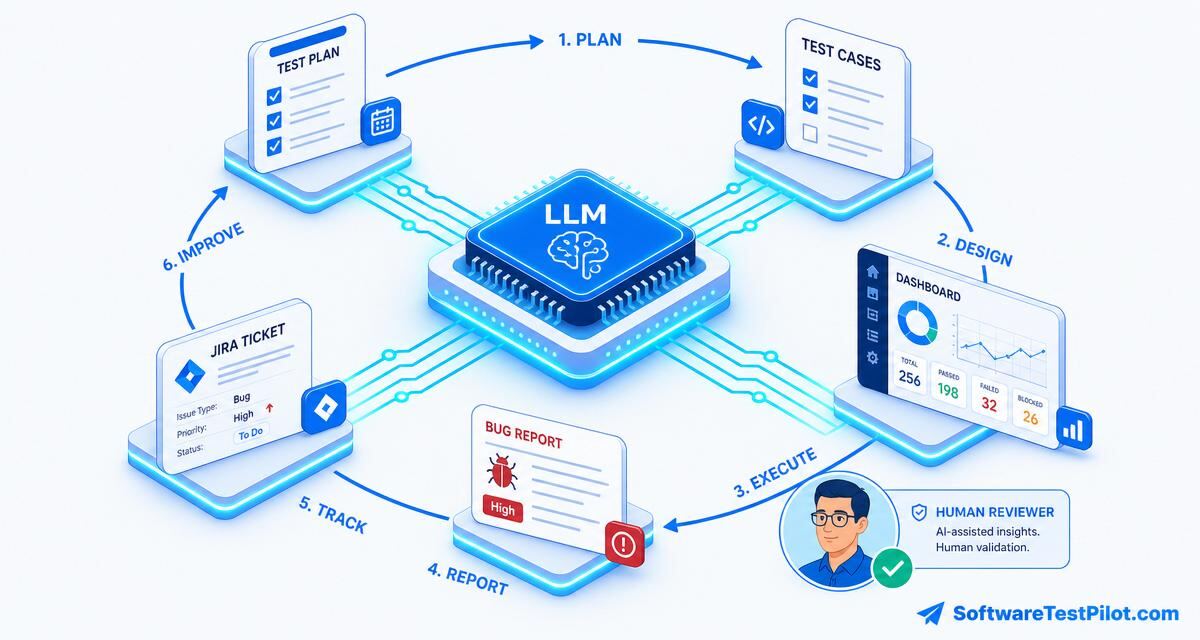
LLM for QA testing is the umbrella practice of embedding large language models across the entire QA lifecycle — from test planning and requirements review, through case design and automation, into execution, bug reporting, Jira triage and release readiness. In 2026 the question is no longer "should QA use LLMs" but "which parts of QA are LLM-first, which are LLM-assisted, and which stay human-only."
This pillar consolidates "LLM for QA testing", "LLM QA", "LLM test automation", "LLM QA workflow" and "generative AI in QA lifecycle". It sits on top of the per-tool pillars (ChatGPT, Claude, Gemini, Copilot) and the technique pillars (test case generation, test automation, unit testing, regression testing, API testing, code review).
Key takeaways
- LLM-first: test case authoring, test data generation, bug report drafting, release notes.
- LLM-assisted: automation scripting, exploratory session notes, flaky triage, PR review.
- Human-only: risk-based prioritisation, stakeholder trade-offs, go/no-go, ethical judgement.
- Use the RCTF prompt framework everywhere. Freeform prompts do not scale.
- Every LLM output is signed off by a named QA engineer before it ships.
1. LLM across the QA lifecycle
| Phase | Best LLM use | Guardrail |
|---|---|---|
| Requirements review | Draft acceptance criteria, spot ambiguities, generate testability questions | PO owns final AC |
| Test planning | Draft IEEE 829 sections 1–8 from PRD summary | QA lead owns risk/scope |
| Test case design | Generate cases via ISTQB techniques (EP, BVA, DT, ST, UC) | 7-point rubric review |
| Test data | Generate PII-safe CSV/JSON with edge cases | Never real customer data in prompts |
| Automation | Draft Playwright/Selenium/Cypress/RestAssured scripts | Human refactor + code review |
| Exploratory testing | Session-based notes + hypothesis generation | Tester owns charters |
| Bug reporting | Draft repro steps, expected/actual, severity rationale | Never fabricate logs |
| Jira triage | Cluster tickets, propose severity, suggest owners | Lead approves before assign |
| Release readiness | Summarise test runs, escape risk, outstanding P0/P1 | Release manager owns go/no-go |
2. The universal RCTF prompt framework
- Role — "You are a senior SDET / ISTQB-Advanced test analyst. Prioritise risk coverage, boundary values and clarity for a QA lead reviewer."
- Context — paste the requirement, user story, OpenAPI spec, page object or stack trace, plus framework + version and the compliance regime (SOC 2, HIPAA, GDPR, EU AI Act) and coverage target.
- Task — one specific artefact: "Generate 15 test cases", "Draft an IEEE 829 test plan section 4", "Write a Playwright E2E for AC-14 with an @axe accessibility check".
- Format — the exact output shape: markdown table, JSON schema, Gherkin, Vitest .test.ts. End with a rubric self-critique.
3. Ten lifecycle prompts
Prompt 1 — Ambiguity finder on a user story
Role: senior BA + QA lead.
Context: [paste user story + AC].
Task: list every ambiguity, missing detail or untestable phrase.
Format: markdown table columns Phrase, Why-ambiguous, Question-for-PO.
Prompt 2 — IEEE 829 test plan skeleton
Role: QA lead. Follow IEEE 829-2008 template.
Context: [paste PRD summary + release date + risk notes].
Task: draft sections 1-8. Flag any section you do not have data for.
Format: markdown, sections numbered.
Prompt 3 — Risk-based scope reducer
Role: QA lead cutting a 400-case regression pack to fit a 2-hour window.
Context: [paste case list with historical failure + impact].
Task: pick top 80 cases by risk × recency; justify each in one line.
Format: markdown table + a "cut list" of the removed 320 with rationale.
Prompt 4 — Bug report drafter
Role: SDET writing a Jira bug that a dev can fix without a follow-up chat.
Context: [paste repro + screenshot description + env + logs excerpt].
Task: draft Title, Summary, Steps to reproduce, Expected, Actual, Env,
Severity, Priority, Suggested owner. Cite the exact log line.
Format: Jira-ready markdown.
Prompts 5–10 (short)
- Exploratory session notes — from a raw voice-note transcript, produce a session report (charter, coverage, findings, follow-ups).
- Flaky triage — cluster 200 recent failures by root cause and propose fixes.
- Release notes for QA — from git log + Jira export, draft internal QA release notes.
- Go/no-go summary — from run + bug data, draft the release-readiness slide.
- Retro input — from 30 days of QA metrics, propose 3 improvement bets.
- Interview drill — generate 10 role-specific QA interview questions with model answers.
4. Lifecycle-wide rubric
- Grounded — every output cites the source (AC, log line, ticket, commit).
- Structured — output matches the requested schema exactly.
- Signed off — named QA engineer owns every artefact before it ships.
- Attributed — "AI-drafted, human-reviewed" line on the artefact + prompt ID.
- PII-safe — no customer data, secrets, tokens or production URLs in prompts.
- Reproducible — prompt versioned in the QA prompt library.
- Metric-tracked — time saved, rework rate, escape rate reviewed monthly.
5. LLM tooling for QA in 2026
Vendor-neutral stack most teams settle on:
- General reasoning — GPT-5, Claude 4.5 Sonnet/Opus, Gemini 2.5 Pro.
- IDE-native automation — GitHub Copilot, Cursor, Cline/Continue.
- PR review — Copilot code review, CodeRabbit, Qodo Merge.
- UI E2E with AI — Playwright + Playwright MCP, Testim, Mabl, Applitools.
- Jira/ticket AI — Atlassian Intelligence, Jira Rovo agents.
- Observability — Datadog Bits AI, Sentry Autofix.
See AI testing tools scorecard for the deeper comparison.
6. Governance, ethics and compliance
Any LLM workflow that touches product code or customer data must run under governance:
- Enterprise LLM APIs (OpenAI, Anthropic, Google, Azure OpenAI) with a no-training / zero-retention clause. Never a free consumer chat for customer data.
- Redact PII, PANs, JWTs, HARs, secrets and production URLs before any prompt.
- Version prompts in a Git-tracked QA prompt library. Every AI-generated artefact ships with an "AI attribution" line and a human SDET sign-off.
- Map controls to the NIST AI RMF and, for EU products, the EU AI Act.