
Generative AI for Test Automation in 2026: The Complete Guide (LLMs, Frameworks, Playwright/Selenium/Cypress & FAQ)
The definitive 2026 guide to generative AI and LLMs for test automation — how to generate Playwright, Selenium and Cypress scripts, build an AI-augmented automation framework, wire it into CI and keep it maintainable. RCTF prompts, rubric and every PAA question.

Last updated: July 14, 2026 · 14 min read · By SoftwareTestPilot
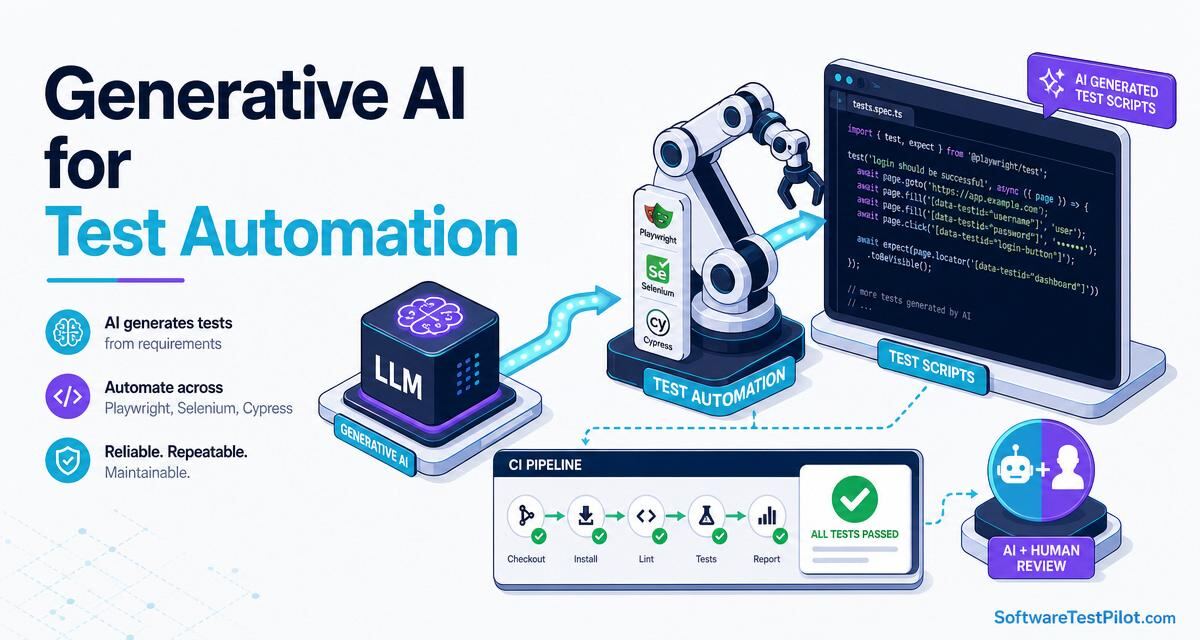
Generative AI for test automation means using LLMs to draft, refactor, heal and review Playwright, Selenium, Cypress, Appium and RestAssured scripts — from a requirement, a page object, an OpenAPI spec or a rendered DOM snapshot. This pillar consolidates "generative AI for test automation", "LLM test automation", "LLM software testing" and "AI test automation framework" into one reference.
Companion pillars: generative AI Selenium, generative AI Playwright, generative AI Cypress, GitHub Copilot test automation, Gemini test automation and Claude for test automation.
Key takeaways
- LLMs are best at three automation tasks: scaffolding new tests, refactoring locators/waits and explaining failures.
- Always ground prompts in the real page object, real network trace and real framework version. No grounding = flaky, hallucinated code.
- Auto-generated scripts must pass linting, deterministic waits, and a human review before merging.
- Wire the LLM into CI as a flake triage assistant, not an autonomous test author.
- Track ROI as CI green-rate, MTTR on flakes and net new coverage per sprint — not "tests generated".
1. The AI-augmented automation framework
A modern AI-augmented framework has five layers:
- Contracts layer — OpenAPI, GraphQL SDL, Storybook stories. The LLM's ground truth.
- Page/API objects — hand-written or LLM-refactored. Always human-owned.
- Test files — LLM-scaffolded from the page/API object, reviewed by SDET.
- Fixtures & data — LLM-generated CSV/JSON with a redaction check.
- CI + triage — LLM summarises failures, proposes locator fixes, opens PRs. Human merges.
See our Playwright framework in TypeScript guide for a hand-built baseline to layer AI onto.
2. RCTF prompts for automation
- Role — "You are a senior SDET / ISTQB-Advanced test analyst. Prioritise risk coverage, boundary values and clarity for a QA lead reviewer."
- Context — paste the requirement, user story, OpenAPI spec, page object or stack trace, plus framework + version and the compliance regime (SOC 2, HIPAA, GDPR, EU AI Act) and coverage target.
- Task — one specific artefact: "Generate 15 test cases", "Draft an IEEE 829 test plan section 4", "Write a Playwright E2E for AC-14 with an @axe accessibility check".
- Format — the exact output shape: markdown table, JSON schema, Gherkin, Vitest .test.ts. End with a rubric self-critique.
3. Prompts that produce shippable automation code
Prompt A — Playwright E2E from a page object
Role: senior SDET, Playwright 1.55, TypeScript strict.
Context: paste LoginPage page object and AC-14 ("lockout after 5 failed attempts").
Task: write a Playwright test that covers AC-14. Use role-based locators,
web-first assertions, no page.waitForTimeout, tag @regression @auth.
Format: single test.ts file, no comments except JSDoc.
Prompt B — Selenium 4 Java from a manual test case
Role: senior SDET, Selenium 4.28 Java 21, TestNG, Page Factory.
Context: paste manual case TC-045 and LoginPage.java.
Task: implement TC-045 using existing page objects. Add explicit waits with
WebDriverWait, no Thread.sleep.
Format: LoginTest.java only.
Prompt C — Cypress component test
Role: senior SDET, Cypress 15, React 19, TypeScript.
Context: paste <PricingCard/> component + Storybook story.
Task: write a component test covering happy path, disabled state and
keyboard activation.
Format: PricingCard.cy.tsx only.
4. Self-healing locators and AI flake triage
The highest-ROI automation use of an LLM is not generating tests — it is triaging failures. Wire your CI so that on every red run, the pipeline sends the LLM: the failing test source, the diff since last green, the DOM snapshot at failure, and the last 50 network requests. Ask it for a root cause + suggested one-line fix. Teams that adopt this pattern report 40–60% shorter MTTR on flakes. See AI flaky test detection & coverage (upcoming).
5. Governance
Any generative-AI or LLM workflow that touches product data must run under governance:
- Use paid/enterprise LLM APIs (OpenAI, Anthropic, Google, Azure OpenAI) with a no-training clause — never a free consumer plan for customer data.
- Redact PII, PANs, JWTs, HARs, secrets and production URLs before any prompt.
- Version prompts in a QA prompt library (Git). Every AI-generated artefact ships with an "AI attribution" line and a human SDET sign-off.
- Map controls to the NIST AI RMF and, for EU products, the EU AI Act.