
Generative AI Cypress in 2026: LLM Prompts, cy.* Code Generation & Component Testing Guide
How to use generative AI (ChatGPT, Claude, Gemini, Copilot) to generate Cypress 15 tests — E2E, component tests, custom commands, prompts for Cypress, network stubbing, CI parallelisation and every PAA question.

Last updated: July 14, 2026 · 14 min read · By SoftwareTestPilot
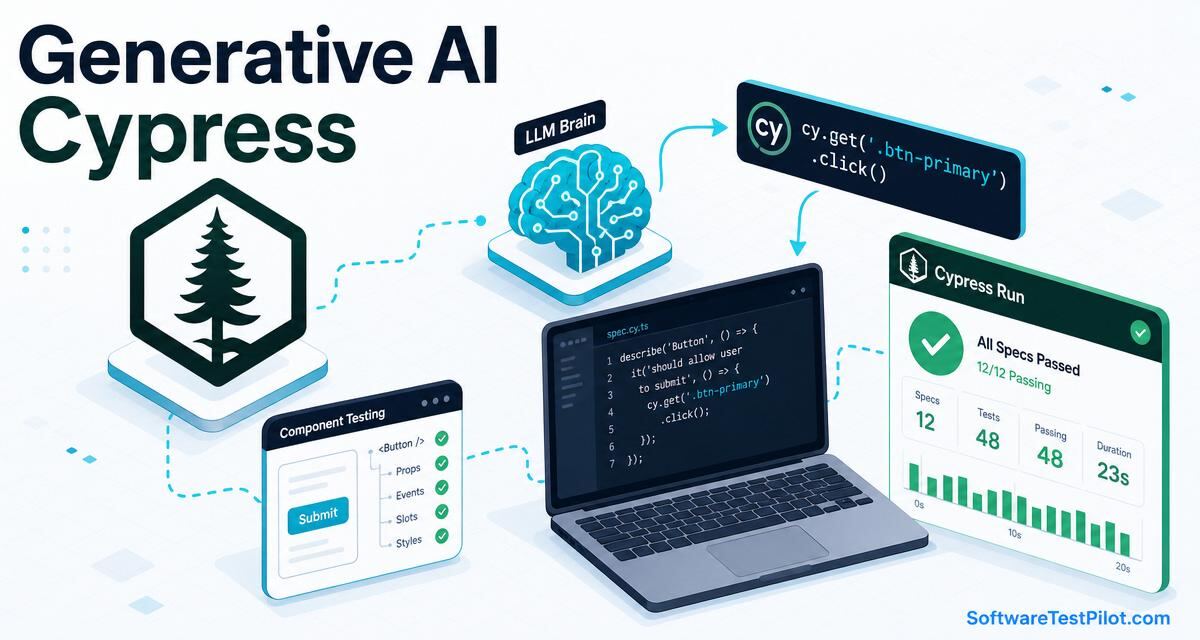
Generative AI Cypress means using an LLM to draft, refactor and maintain Cypress 15 test code — E2E, component tests, custom commands and CI configuration. This pillar consolidates "generative AI Cypress", "AI Cypress code generator" and "prompts for Cypress". If you are choosing between Cypress and Playwright, read Playwright vs Selenium and the Playwright pillar first — LLMs produce slightly cleaner Playwright.
Key takeaways
- Cypress's chainable
cy.*API is easy for LLMs to write and easy for humans to review.- Prompt with the exact component / URL / API contract — LLMs hallucinate
cy.get('.mystery-class')otherwise.- Ban
cy.wait(ms). Insist oncy.intercept+ alias waits.- Cypress component testing (with React 19 / Vue 3.5) is a great LLM entry point — small surface, high value.
- Track ROI on component-test coverage delta, not lines generated.
1. Copy-paste prompts for Cypress
E2E from a user story
Role: senior SDET, Cypress 15 TypeScript.
Context: user story + AC + LoginPage custom commands.
Task: write cypress/e2e/login.cy.ts covering AC-1..AC-4. Use cy.session
for auth, cy.intercept + cy.wait('@alias') for network — no cy.wait(ms).
Format: single .cy.ts file.
Component test
Role: senior SDET, Cypress 15 component runner, React 19, TS.
Context: paste <PricingCard/> component and its props.
Task: cypress/component/PricingCard.cy.tsx covering default, disabled and
keyboard activation. Use mount() from cypress/react.
Format: single .cy.tsx file.
Custom command generation
Role: senior SDET, Cypress 15 TS.
Context: repeated login snippet across 12 specs.
Task: extract into cypress/support/commands.ts as cy.loginAs(role).
Add TypeScript declaration.
Format: commands.ts + updated declaration.
2. Network stubbing with LLMs
One of Cypress's biggest advantages is cy.intercept. Prompt the LLM to draft intercepts from your OpenAPI spec + fixture JSON, then have it wire alias waits into the spec. Result: deterministic tests without a real backend.
3. Cypress in CI with AI assistance
Ask the LLM to generate a GitHub Actions workflow with Cypress Cloud parallelisation across N containers, Node cache, artifacts on failure, and an auto-comment PR summariser. LLMs know the cypress-io/github-action patterns well.
4. Governance
Any generative-AI or LLM workflow that touches product data must run under governance:
- Use paid/enterprise LLM APIs (OpenAI, Anthropic, Google, Azure OpenAI) with a no-training clause — never a free consumer plan for customer data.
- Redact PII, PANs, JWTs, HARs, secrets and production URLs before any prompt.
- Version prompts in a QA prompt library (Git). Every AI-generated artefact ships with an "AI attribution" line and a human SDET sign-off.
- Map controls to the NIST AI RMF and, for EU products, the EU AI Act.