SoftwareTestPilot
AI in TestingPublished: 13 min read

Generative AI Selenium in 2026: LLM Prompts, WebDriver Code Generation & Migration Guide

How to use generative AI and LLMs (ChatGPT, Claude, Gemini, Copilot) to generate Selenium WebDriver 4.x code in Java, Python and C# — Page Object generation, prompts for Selenium, self-healing locators, migration to Playwright and every PAA question.

Avinash Kamble
Founder & QA Engineer at SoftwareTestPilot
Reviewed by Priyanka G.
Share:XLinkedInWhatsApp
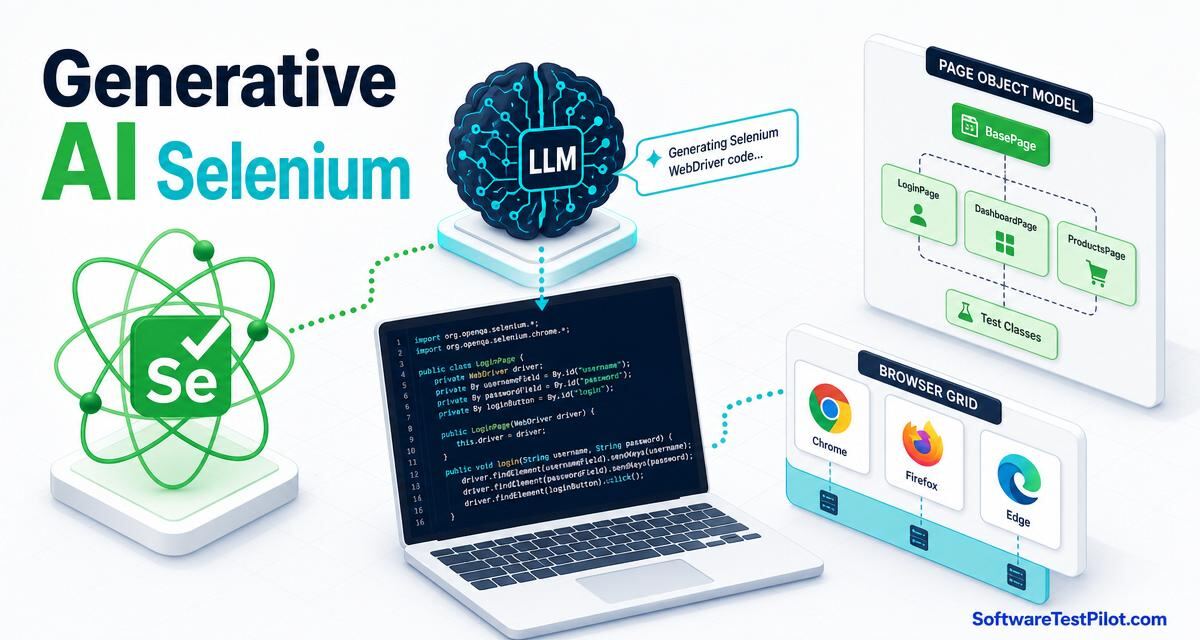
Generative AI Selenium cover — Selenium atom logo with an LLM generating a Java WebDriver code snippet, a Page Object Model diagram and a Chrome/Firefox/Edge browser grid.

Last updated: July 14, 2026 · 14 min read · By Avinash Kamble, reviewed by Priyanka G.

Generative AI Selenium means using an LLM to draft, refactor and maintain Selenium WebDriver 4.x code — Java, Python or C#. This pillar consolidates "generative AI Selenium", "LLM for Selenium", "AI Selenium generator" and "prompts for Selenium". If you already have a working Selenium framework, LLMs will remove 50–70% of the boilerplate. If you are choosing between Selenium and Playwright, read Playwright vs Selenium first — LLMs are meaningfully better at Playwright.

Key takeaways

  • Selenium 4 + Java 21 is still the most-generated stack because it has the largest public training corpus.
  • Always paste the existing Page Object and the current locator strategy — LLMs invent XPaths otherwise.
  • Ban Thread.sleep. Insist on WebDriverWait + expected conditions.
  • Use LLMs for the boring 80%: locators, page objects, TestNG data providers, CI YAML.
  • Migration prompt: give it the Selenium test + tell it to convert to Playwright — a legitimate 2026 use.

1. Copy-paste prompts for Selenium

Page Object generation

Role: senior SDET, Selenium 4.28 Java 21, PageFactory, WebDriverWait only.
Context: paste HTML fragment or DOM snapshot of the login page.
Task: generate LoginPage.java with @FindBy locators (prefer id > data-testid > css),
methods enterUsername, enterPassword, submit, getErrorMessage.
Format: single LoginPage.java file.

Test method from a manual case

Role: senior SDET, Selenium 4 + TestNG.
Context: paste TC-045 + LoginPage.java above.
Task: write LoginTest.java implementing TC-045. Use @DataProvider for the 4
credential combinations. No Thread.sleep.
Format: LoginTest.java only.

Selenium Grid + Docker YAML

Role: DevOps for QA. Selenium Grid 4, Docker Compose.
Task: generate docker-compose.yml with hub + 2 chrome nodes + 1 firefox node,
plus a GitHub Actions workflow that runs the suite in parallel on 3 shards.
Format: two files, no prose.

2. Self-healing locators for Selenium

Selenium 4's relative locators + an LLM = a pragmatic self-healing pattern. On failure, capture the DOM, ask the LLM to propose a new locator anchored on stable text/aria attributes, run the test again on the new locator, and if green, open a PR with the diff. Never auto-merge — a stale test that "passes" on the wrong element is worse than a red one.

3. Migrating Selenium to Playwright with an LLM

One of the most common 2026 uses. Prompt:

Role: senior SDET fluent in Selenium 4 Java and Playwright 1.55 TypeScript.
Context: paste LoginTest.java + LoginPage.java.
Task: convert to Playwright/TypeScript using role-based locators and
web-first assertions. Preserve @DataProvider as a Playwright test.each.
Flag any behaviour that changes between the two frameworks.
Format: two files — login.spec.ts + LoginPage.ts.

See Playwright vs Selenium for the migration checklist.

4. Governance

Any generative-AI or LLM workflow that touches product data must run under governance:

  • Use paid/enterprise LLM APIs (OpenAI, Anthropic, Google, Azure OpenAI) with a no-training clause — never a free consumer plan for customer data.
  • Redact PII, PANs, JWTs, HARs, secrets and production URLs before any prompt.
  • Version prompts in a QA prompt library (Git). Every AI-generated artefact ships with an "AI attribution" line and a human SDET sign-off.
  • Map controls to the NIST AI RMF and, for EU products, the EU AI Act.

Frequently asked questions

1.Can ChatGPT write Selenium tests that actually work?
Yes when you paste the real Page Object, real framework version and real acceptance criteria. Blind prompts produce plausible code that fails on the first run because of invented locators or sleeps.
2.Which LLM writes the best Selenium code in 2026?
GPT-5 and Claude 4.5 Sonnet lead on Java Selenium 4. Gemini 2.5 Pro is best when you paste a whole repo. Copilot is best inside the IDE for line-by-line completions.
3.Should I still learn Selenium if AI can write it for me?
Yes. You review the AI output, tune locators and fix flakes. Without Selenium fundamentals you cannot spot bad code. See our Selenium interview questions guide.
4.How do I stop the LLM from writing Thread.sleep?
Add 'No Thread.sleep. Use WebDriverWait with ExpectedConditions only.' to the Role line. Reject any output that violates it — do not merge and re-prompt.
5.Can AI generate Selenium Grid / Docker configuration?
Yes and this is one of its best uses. Prompt for docker-compose.yml with hub + N nodes, plus a matching GitHub Actions or Jenkins pipeline. Verify pinned image versions.
6.Is generative AI good enough to migrate Selenium to Playwright?
For 80% of a suite, yes. Use the migration prompt in section 3, review each converted file, run in parallel with the Selenium suite for one sprint, then decommission.
7.What about generative AI Selenium in Python or C#?
Excellent for both. Change the Role line ('Selenium 4 Python 3.13 + pytest' or 'Selenium 4 C# .NET 9 + NUnit'). Output quality is similar to Java.
8.Does AI-generated Selenium code work with Selenium IDE?
You can paste an exported IDE .side file and ask the LLM to refactor it into proper WebDriver code — a common 2026 modernisation path.
9.Can LLMs help debug flaky Selenium tests?
Yes. Paste the test source + the last 3 failure stack traces + the DOM snapshot. Ask for a probable root cause and a one-line fix. Track MTTR before/after — most teams see a 40%+ drop.
10.Are there open-source AI Selenium generators?
Yes — self-hosted Qwen 2.5-Coder-32B or Llama 3.3-70B via Ollama produce solid Selenium 4 Java. Quality trails GPT-5 by ~15% on complex scenarios but privacy is airtight.
11.How do I add AI to my existing Selenium framework without breaking it?
Add three things: a prompt library at /prompts/selenium/, a CI job that summarises failures with an LLM, and an AI-attribution field in your PR template. Do not rip and replace.
12.Will generative AI make Selenium engineers obsolete?
No. It removes the mechanical typing but increases demand for engineers who can review AI output, tune locators, and design test strategy. The role name changes from 'automation engineer' to 'AI-augmented SDET'.
Keep going

Practice these questions

Work through 300+ Selenium questions with Java code snippets, Selenium 4, Grid, framework patterns and CI/CD scenarios.

Found this useful?
Share:XLinkedInWhatsApp

Was this article helpful?

Keep building your QA edge

Practice these questions live

Rehearse with an AI QA interviewer that scores your answers in real time.

Start a Free AI Mock Interview →

Continue reading

Join the QA Community

Connect with fellow testers, share job leads, and get career advice.

Premium QA Resources

Stop Reinventing the Wheel. Upgrade Your QA Arsenal.

Take your testing skills from beginner to Lead Engineer. Supercharge your daily workflow with our premium digital resources.

  • Ready-to-use testing strategy templates
  • Advanced API & UI automation guides
  • ⏱️ Save 10+ hours a week on test planning
4.9/5 rating
Explore All Products

⭐⭐⭐⭐⭐ Trusted by 1,000+ Software Test Pilots • Instant Access