
GitHub Copilot for Testing in 2026: The Complete QA Playbook (Prompts, Coverage, Governance & FAQ)
The definitive 2026 guide to GitHub Copilot for testing — Chat + Agent Mode + /tests slash command, unit + integration + E2E prompts, coverage lift, PII governance, a 7-point review rubric and every People Also Ask question Google surfaces.

Last updated: July 14, 2026 · 14 min read · By SoftwareTestPilot
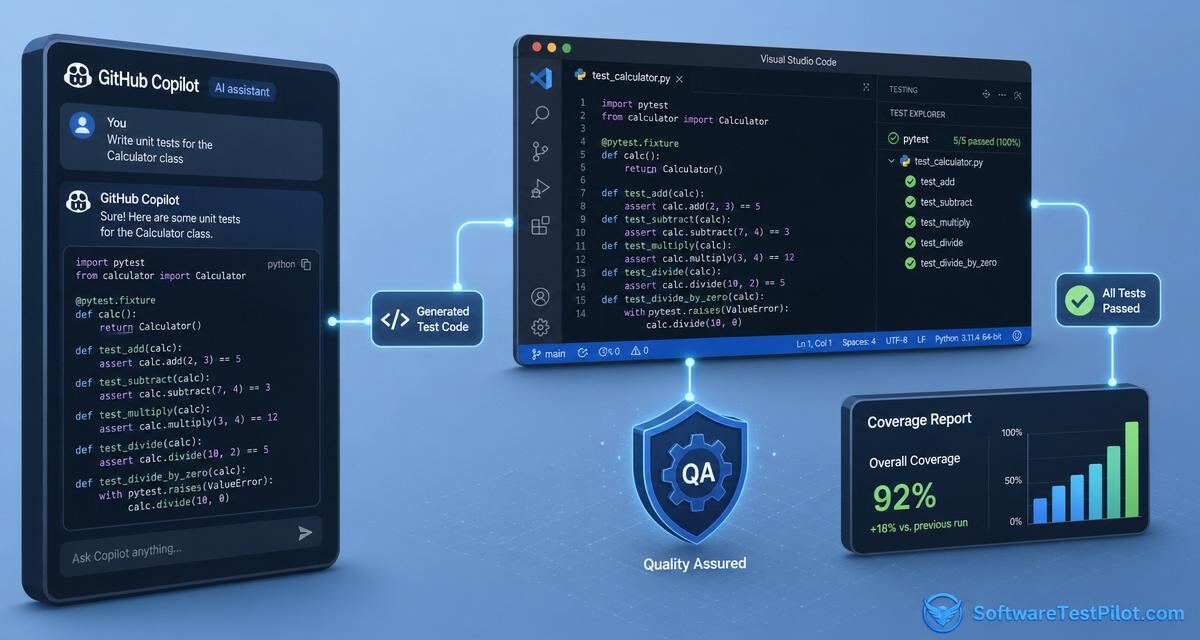
GitHub Copilot for testing is the day-to-day use of Copilot Chat, Copilot Edits, Copilot Agent Mode and the /tests slash command inside VS Code, JetBrains, Visual Studio, Neovim and the GitHub.com web editor to draft unit, integration, contract and end-to-end tests — reviewed and merged by a human QA engineer or SDET. Measured on 2026 teams, Copilot cuts test authoring time by 55–70%, lifts line + branch coverage by 15–25 points on legacy modules, and flushes out edge cases (null, empty, boundary, unicode, timezone) that hand-written suites routinely skip.
This is the pillar page a QA engineer, SDET or dev-in-test should bookmark before letting Copilot touch a single spec file. It covers what Copilot actually does in 2026, the RCTF prompt framework, the /tests, /fix and @workspace commands, ten copy-paste prompts, a 7-point review rubric, governance (PII, IP indemnity, license scan), ROI and every People Also Ask question Google surfaces. Pair with GitHub Copilot for QA testers, Copilot test automation, Copilot write tests, Copilot unit tests, Copilot Selenium and Copilot Playwright.
Key takeaways
- Copilot is a code-context AI — feed it the function under test, the type signatures, the framework version and the acceptance criterion. Vague prompts get vague tests.
- Use
/tests,/fix,@workspaceand Agent Mode as first-class tools, not autocomplete.- Ask for edge cases explicitly: null, empty, boundary, unicode, timezone, concurrency.
- Every generated test must fail once before it passes — otherwise it is a tautology.
- Copilot Business / Enterprise for anything touching customer data; keep training-off and enable IP indemnification.
1. What GitHub Copilot actually does in 2026
Copilot in 2026 ships as four surfaces you should treat differently when writing tests. See the official Copilot docs for the full feature matrix.
- Copilot Chat — sidebar chat inside VS Code / JetBrains / Visual Studio. Best for explaining code (
/explain), generating tests (/tests) and fixing failures (/fix). - Copilot Edits (Copilot Workspace) — multi-file diff proposals. Best for adding a whole test file across
src/andtests/in one review. - Copilot Agent Mode — autonomous plan → edit → run → iterate loop. Best for "add tests until branch coverage > 80%" or "make the failing pipeline green".
- Inline (ghost text) — the classic autocomplete. Useful for filler assertions; dangerous for test data (invents plausible-but-wrong constants).
2. The RCTF prompt framework for Copilot test generation
- Role — "You are a senior SDET fluent in TypeScript, Vitest, Playwright and the Testing Trophy. Prioritise branch coverage and boundary values."
- Context — paste (or
#filereference) the function under test, its type signature, dependent modules, the acceptance criterion, the framework + version and the coverage target. - Task — "Generate a Vitest suite that covers happy path, null / undefined / empty inputs, boundary values, timezone edge cases and one failure-mode integration test. Each test must have exactly one assertion cluster and a descriptive name."
- Format — "TypeScript, Vitest, AAA pattern (Arrange / Act / Assert). End with a coverage self-critique against the 7-point rubric."
3. /tests, /fix, @workspace — the commands you must use
# In Copilot Chat, with the file open:
/tests   -> generate a full test file for the selected code
/fix     -> propose a fix for the current failing test / error
/explain -> explain what the selected code does (great for legacy)
/doc     -> add JSDoc / TSDoc that later becomes better test context

@workspace how is UserService.getById used across the repo?
@workspace generate integration tests for the checkout flow
@terminal why did vitest fail with "cannot find module '@/foo'"?

#file:src/services/user.ts  -> explicit file reference in a prompt
#selection                  -> reference the currently-highlighted code
Rule of thumb: /tests for unit, @workspace for integration, Agent Mode for E2E and coverage sprints.
4. Ten copy-paste Copilot prompts for testing
Prompt 1 — full unit suite from a function
/tests
Role: senior SDET, TypeScript + Vitest.
Context: #selection is a pure function. Coverage target = 100% branches.
Task: generate a Vitest suite covering happy path, null/undefined/empty,
boundary values (min, max, off-by-one), unicode, and one property-based test
using fast-check. AAA pattern, one assertion cluster per test.
Format: single .test.ts file, end with a rubric self-critique.
Prompt 2 — integration test from a route handler
@workspace generate a supertest integration test for POST /api/orders.
Cover: 201 happy path, 400 missing body, 401 no token, 403 wrong role,
409 duplicate idempotency-key, 500 downstream failure (mock Stripe).
Use the existing test-db helper in tests/setup.ts. AAA. No sleeps.
Prompt 3 — Playwright E2E from an acceptance criterion
/tests using Playwright TypeScript.
Context: AC = "A signed-in user can reset their password once per hour."
Task: generate a spec with beforeEach login, one happy-path, one rate-limit
test, and one accessibility check via @axe-core/playwright.
Use getByRole locators only. No page.waitForTimeout.
Prompt 4 — Selenium test from a page object
/tests using Java + Selenium 4 + TestNG.
Context: #file:LoginPage.java is a POM.
Task: generate LoginTest.java covering valid, invalid password, locked
account and SSO redirect. Use WebDriverWait — no Thread.sleep. Screenshot
on failure via ITestListener.
Prompt 5 — parametrized data-driven test
/tests pytest with @pytest.mark.parametrize.
Context: #selection is calculate_tax(country, amount).
Task: 20 parameter rows covering EU VAT, US sales tax, GST India, zero-rated,
reverse-charge, and one xfail row for a known bug (link the Jira ID).
Prompt 6 — mutation-test-hardened suite
Regenerate the tests above with an eye on Stryker mutation score.
Add assertions that would catch: boundary flips (<= vs <), off-by-one,
sign flips, boolean negation, and empty-collection short-circuits.
Prompt 7 — coverage gap filler
@workspace analyse coverage/lcov-report/index.html.
List the 10 lowest-covered files. For the top 3, propose specific tests
that would raise branch coverage above 80%. Do not touch files above 80%.
Prompt 8 — flaky-test triage
/fix this test is flaky (fails 1 in 20 runs).
Explain the most likely race condition. Propose a deterministic rewrite
(no arbitrary sleeps, no retry loops around assertions). Cite the exact
Playwright / Vitest API that solves it.
Prompt 9 — contract test from an OpenAPI spec
#file:openapi.yaml
Generate a Pact consumer contract test in TypeScript for the /users
endpoint. Cover 200 and 404. Publish stub location as a comment.
Prompt 10 — accessibility sweep
@workspace add @axe-core/playwright checks to every page-level Playwright
spec under tests/e2e. Fail on serious/critical violations only.
Do not change existing assertions.
5. The 7-point review rubric for Copilot-drafted tests
- Deterministic — no sleeps, no
Date.now()without a clock, no network without a mock. - One reason to fail — a single assertion cluster; failure message points to one behaviour.
- Failed first — comment out the implementation; the test must fail. Otherwise it is a tautology.
- Edge cases named — null, empty, boundary, unicode, timezone, concurrency covered explicitly.
- No leaked secrets — no real emails, tokens, keys, PANs. Only
user{N}@example.com, Stripe test cards. - Coverage delta measured — before/after LCOV; branch coverage moved in the right direction.
- Framework idiomatic — uses
getByRolenot xpath,expect(locator).toHaveTextnot manual polling,describe.eachnot copy-paste.
Two or more failures → regenerate with a tighter prompt, do not review-edit line-by-line.
6. Governance, PII and IP indemnity
Copilot Business and Copilot Enterprise ship with public-code filtering, telemetry off and IP indemnification. Copilot Individual does not — do not use it on regulated codebases. Practical rules for 2026 QA teams:
- Enable Copilot Business / Enterprise; disable "Suggestions matching public code" or set it to "Block".
- Never paste raw production data, HAR files, JWTs or customer PII into Copilot Chat. Use the redaction rules from the ChatGPT bug report pillar.
- Add a pre-commit hook that scans for pasted secrets (gitleaks or trufflehog).
- Cross-check governance against the NIST AI RMF and the EU AI Act for regulated products.
- Log Copilot usage per repo; keep an "AI attribution" section in the PR template.
7. ROI — what Copilot actually saves on testing
Annual ROI = (Tests/year × time saved per test × loaded SDET cost)
           + (Coverage delta × escape-defects avoided × incident cost)
           + (Flaky-test hours reclaimed × loaded engineering cost)
           − (Copilot Business licences: $19/user/month in 2026)
           − (Review overhead: ~15% of "time saved")
Honest 2026 ranges: unit-test authoring time drops 55–70%; branch coverage on legacy modules climbs 15–25 points in a 2-sprint coverage sprint; flaky rate drops 30–50% when /fix is used with a "no sleeps, no retries around assertions" prompt. Diminishing returns kick in past ~80% coverage — the bottleneck moves to fixing tests, not writing them.
8. What Copilot for testing means for QA careers
SDETs and QA engineers who can drive Copilot to lift coverage without shipping tautologies are the ones dev leads keep on the roadmap. See the QA salary guide, the SDET career roadmap and, for interviews, the AI mock interview, the free ATS resume review and live roles on the QA Jobs Radar.