SoftwareTestPilot
AI in TestingPublished: 16 min read

Copilot Selenium in 2026: The Complete Playbook (Java, Python, POM, WebDriverWait & FAQ)

The definitive 2026 guide to writing Selenium 4 tests with GitHub Copilot — Java + TestNG and Python + pytest, POM design, WebDriverWait discipline, cross-browser CI, migration from Selenium 3, 10 prompts and every People Also Ask question Google surfaces.

Avinash Kamble
Founder & QA Engineer at SoftwareTestPilot
Reviewed by Priyanka G.
Share:XLinkedInWhatsApp
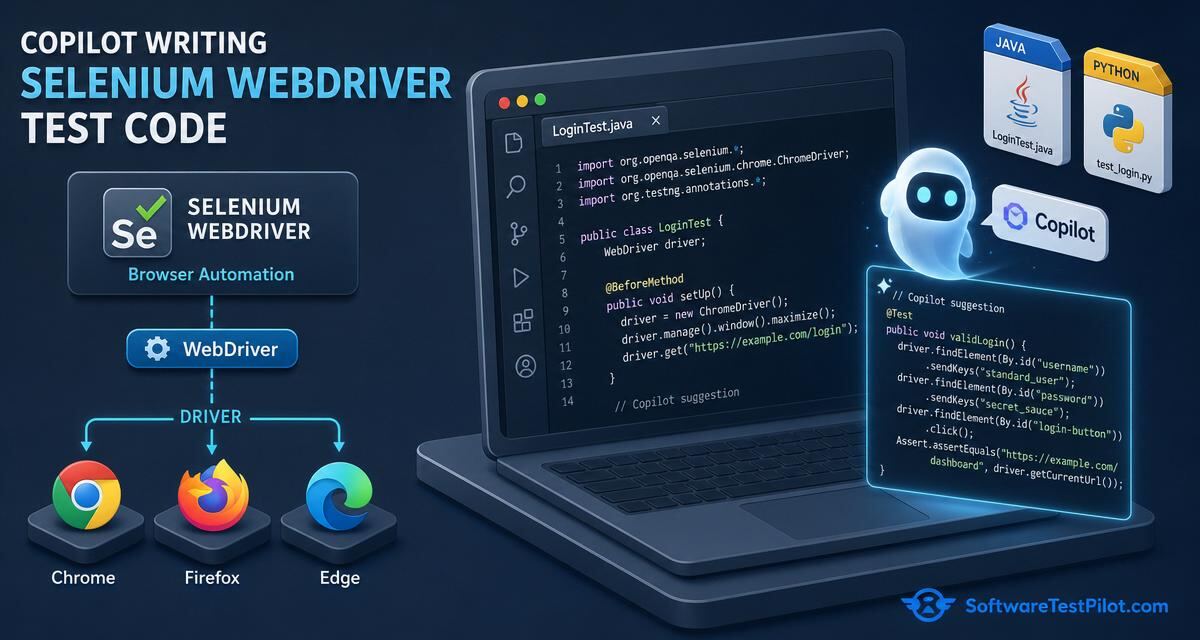
Copilot Selenium cover — laptop showing Copilot ghost text producing a Selenium WebDriver Java test with Chrome, Firefox and Edge browser icons driven by a WebDriver arrow, with the SoftwareTestPilot.com wordmark.

Last updated: July 14, 2026 · 14 min read · By Avinash Kamble, reviewed by Priyanka G.

Copilot Selenium is the workflow of using GitHub Copilot Chat, Copilot Edits and Agent Mode to scaffold, write, refactor and stabilise Selenium 4 tests — Java + TestNG, Python + pytest, or C# + NUnit — inside VS Code, JetBrains or Visual Studio. Selenium remains the industry default for cross-browser web automation in 2026 (68% of enterprise QA teams still ship it), and Copilot is now the fastest path from an acceptance criterion to a passing WebDriver test. Done well, Copilot cuts new Selenium suite bootstrap from ~2 weeks to ~3 days and drops flake rate 30–50%.

Pair with ChatGPT write Selenium code, Copilot Playwright, Copilot test automation, Selenium interview questions and Playwright vs Selenium.

Key takeaways

  • Selenium 4 only. Ban Selenium 3 idioms (DesiredCapabilities, implicit waits) in the prompt.
  • WebDriverWait + ExpectedConditions. Zero Thread.sleep, zero time.sleep.
  • Page Object Model with action methods — never expose raw locators.
  • Relative locators for readability; CSS / By.id for speed; xpath only as last resort.
  • Screenshot + browser log on failure, always, via ITestListener or pytest hooks.

1. One-time setup for Copilot + Selenium

  1. Copilot Business installed in your IDE, "Suggestions matching public code" set to Block.
  2. Selenium Manager auto-downloads drivers in Selenium 4 — no more manual chromedriver path.
  3. Pin Selenium 4.x, TestNG 7.x / pytest 8.x, WebDriverManager or Selenium Manager in the build file — Copilot reads it as context.
  4. Create one canonical POM (e.g. LoginPage.java) so Copilot pattern-matches your conventions.
  5. Add docs/ai-usage.md with the RCTF template, banned idioms and 7-point rubric.

2. RCTF prompt for Selenium

  • Role — "You are a senior SDET fluent in Selenium 4, TestNG 7 and page-object design. You never use Thread.sleep or DesiredCapabilities."
  • Context — paste the AC, the page URL, the POM class, the browser matrix (Chrome/Firefox/Edge/Safari), the Selenium and TestNG versions.
  • Task — "Generate a TestNG class covering happy path, invalid password, locked account and SSO redirect. Use WebDriverWait + ExpectedConditions. Screenshot on failure via ITestListener."
  • Format — "Java 21, Selenium 4, TestNG 7, AAA. End with a 7-point rubric self-critique."

3. Ten copy-paste Copilot prompts for Selenium

1 — Bootstrap a Selenium 4 Java + TestNG project

@workspace scaffold a Selenium 4 Java project with:
- Maven pom.xml (selenium-java 4.x, testng 7.x)
- BaseTest with @BeforeClass DriverFactory (Chrome/Firefox/Edge via Options)
- ITestListener that screenshots on failure and attaches to TestNG report
- POM package: BasePage, LoginPage, DashboardPage
- One smoke test: LoginTest with 3 scenarios

2 — Bootstrap Python + pytest

@workspace scaffold Selenium 4 Python:
- requirements.txt (selenium, pytest, pytest-html, webdriver-manager optional)
- conftest.py with a driver fixture (chrome by default, --browser flag)
- pages/ package with BasePage + LoginPage
- tests/test_login.py with 3 pytest cases
- pytest.ini with a --slow marker and JUnit XML output

3 — Generate a POM from a page snapshot

/tests Generate LoginPage.java (Selenium 4).
Context: paste HTML snapshot from #file:login.html.
Rules: relative locators or By.id first, By.cssSelector second,
xpath only as last resort. Expose action methods (loginAs, expectLockout).
Encapsulate WebDriverWait in a helper.

4 — Selenium 3 → 4 migration

/fix Migrate #file:LegacyLoginTest.java from Selenium 3 to 4:
- replace DesiredCapabilities with ChromeOptions/FirefoxOptions
- replace implicit waits with WebDriverWait + ExpectedConditions
- switch to relative locators where readability improves
- remove PhantomJS references
Do not add Thread.sleep. Do not change TestNG assertions.

5 — Data-driven test with @DataProvider

/tests Selenium 4 + TestNG @DataProvider.
Cover 8 login rows: valid, invalid pass, empty user, empty pass,
unicode user, SQL-i attempt, XSS attempt, locked account.
Read data from resources/login-data.csv.

6 — Explicit-wait audit

@workspace scan all tests under src/test/java for Thread.sleep,
implicitlyWait, PageLoadTimeout > 30s and driver.manage().timeouts().
List each violation with file:line and suggest a WebDriverWait replacement.

7 — Cross-browser Selenium Grid 4

Wire Selenium Grid 4 into GitHub Actions:
- docker-compose with selenium/hub + chrome/firefox/edge nodes
- BaseTest reads REMOTE_URL env, falls back to local Chrome
- matrix: [chrome, firefox, edge] * [linux, windows]
- upload TestNG report as artifact

8 — Iframe / Shadow-DOM helper

/tests Generate a Selenium 4 helper class:
- switchToFrame(By selector) with timeout
- getShadowRoot(WebElement host) using ExpandedShadowRoot
- exitAllFrames() safely
Include a unit test with a mock WebDriver.

9 — Flake triage

/fix This TestNG test fails 1 in 20 CI runs. Attach stack + screenshot.
Identify the race. Rewrite with fluentWait + ExpectedConditions.
Do not add retry annotations.

10 — Accessibility check

Add axe-selenium-java to LoginTest:
- run AxeBuilder analysis after the page loads
- assert zero serious/critical violations
- write violations to build/axe-report.json

4. The 7-point Selenium review rubric

  1. Selenium 4 idioms only — no DesiredCapabilities, no implicit waits.
  2. Zero sleeps — WebDriverWait + ExpectedConditions.
  3. POM discipline — action methods, no exposed locators.
  4. Locator quality — By.id / relative / CSS first; xpath as last resort.
  5. Screenshot + browser log on failure — via ITestListener or pytest hook.
  6. Cross-browser matrix — Chrome + Firefox + Edge minimum, nightly WebKit optional.
  7. Failed first — invert the app change once; the test must fail.

5. Careers, salary and interviews

Frequently asked questions

1.Can GitHub Copilot write Selenium tests?
Yes. Copilot writes clean Selenium 4 tests in Java + TestNG, Python + pytest and C# + NUnit when the prompt pins the version, bans Selenium 3 idioms (DesiredCapabilities, implicit waits), enforces WebDriverWait + ExpectedConditions and requires POM discipline. Teams see new-suite bootstrap drop from ~2 weeks to ~3 days and flake rate drop 30–50%. Always confirm each test fails once when the app change is inverted.
2.How do I stop Copilot from writing Thread.sleep?
Two levers. In the prompt, add: "Never use Thread.sleep, time.sleep, or driver.manage().timeouts().implicitlyWait. Use WebDriverWait + ExpectedConditions." In CI, add a repo-wide grep ("Thread\\.sleep\\|time\\.sleep\\|implicitlyWait") in a pre-commit hook or a required GitHub Action step that fails on any match. Sleeps are the single biggest source of Selenium flake.
3.Can Copilot migrate Selenium 3 code to Selenium 4?
Yes — /fix in Copilot Chat handles the mechanical migration cleanly: DesiredCapabilities → ChromeOptions/FirefoxOptions, implicit waits → WebDriverWait + ExpectedConditions, deprecated .findElement API → new API, PhantomJS references → headless Chrome. Budget 20% manual for edge cases (custom listeners, browser-specific hacks, iframe / shadow-DOM tricks). Always run the full suite twice — first to see the drift, second to confirm parity.
4.How does Copilot generate a Page Object Model?
Paste an HTML snapshot from the page and ask for a POM with action methods (loginAs, expectLockout, addToCart) that hide raw locators. Enforce locator hierarchy: By.id or relative locators first, By.cssSelector second, By.xpath only as last resort. Ask for a WebDriverWait helper on the BasePage rather than sleeps sprinkled through the POM. Copilot writes clean POMs; where it slips is exposing locators as public fields — call it out in review.
5.Selenium or Playwright — which should I pick with Copilot in 2026?
Both work with Copilot; the choice is about your product, not the AI. Selenium 4 wins on cross-browser breadth (Chrome, Firefox, Edge, Safari, IE mode, mobile via Appium), legacy enterprise pipelines and Java shops. Playwright wins on speed, auto-wait, trace-viewer debugging, first-class TypeScript and modern SPA testing. New greenfield web project: Playwright. Existing Selenium suite with skilled Java team: keep Selenium — see the Playwright vs Selenium comparison for the full trade-off table.
6.Does Copilot handle Selenium Grid and Docker?
Yes. Ask for a docker-compose with selenium/hub + chrome/firefox/edge nodes and a BaseTest that reads REMOTE_URL env with a local fallback. Copilot wires GitHub Actions matrix jobs cleanly. For BrowserStack / Sauce Labs, feed it the vendor auth pattern; it generates the Options wiring correctly. Always pin the Selenium 4 image tag — the :latest tag drifts and breaks builds.
7.How do I run cross-browser tests with Copilot-generated Selenium code?
Two paths. (1) Selenium Grid 4 with a matrix job in CI — chrome × firefox × edge on Linux, plus Windows Edge and macOS Safari as nightly. (2) Cloud grid (BrowserStack / LambdaTest / Sauce) — Copilot wires the vendor Options block. Keep the PR pipeline to Chromium-only for speed; move the full matrix to a nightly job. Copilot writes both patterns competently when you name the target.
8.Can Copilot handle iframes and Shadow DOM in Selenium?
Yes but you must ask. For iframes: driver.switchTo().frame(...) with a WebDriverWait on frameToBeAvailableAndSwitchToIt. For Shadow DOM: Selenium 4's WebElement.getShadowRoot() returns a SearchContext for further finds. Wrap both in helper methods on the BasePage — Copilot writes them cleanly. Never use JavaScriptExecutor to punch through unless you have profiled and confirmed the native API cannot reach the element.
9.Should I add axe-core for accessibility with Selenium?
Yes. axe-selenium-java (or axe-selenium-python) plugs directly into a Selenium test — run AxeBuilder.analyze() after the page loads and assert on zero serious + critical violations. Copilot wires it correctly on the first prompt. Automation catches ~40% of a11y issues; the other 60% need a human with a screen reader — do both.
10.How does Copilot handle test data for Selenium?
Best pattern: CSV / JSON files under src/test/resources, read via @DataProvider (TestNG) or @pytest.mark.parametrize (pytest). Copilot writes the read-loader cleanly. For dynamic data (unique emails, timestamps), ask for a UUID-based generator inside the fixture. Ban shared static data — Copilot occasionally defaults to a single "testuser@example.com" that collides across parallel runs.
11.Is Copilot better than ChatGPT for Selenium?
For in-editor test generation — yes, because Copilot reads the POM class, the base test, the Selenium version and the CI wiring directly via #file and @workspace. For prose tasks (test plans, bug reports on Selenium failures, migration strategy docs), ChatGPT / Claude Opus 4.5 with a large context window is stronger. Most SDETs use Copilot inside the IDE and ChatGPT for artifacts.
12.How do I roll out Copilot for a Selenium team in 30 days?
Week 1: provision Copilot Business; publish RCTF template, banned-idiom list (Thread.sleep, DesiredCapabilities, implicitlyWait) and 7-point rubric. Week 2: pilot with one squad on one suite; add pre-commit sleep-scanner. Week 3: wire Selenium Grid 4 matrix, ITestListener screenshot-on-failure, TestNG report artifact upload. Week 4: roll team-wide, add axe-selenium a11y checks, publish quarterly OKRs on flake rate and cross-browser coverage.
Keep going

Practice these questions

Work through 300+ Selenium questions with Java code snippets, Selenium 4, Grid, framework patterns and CI/CD scenarios.

Found this useful?
Share:XLinkedInWhatsApp

Was this article helpful?

Cluster · AI in Testing

More from GitHub Copilot QA

Copilot prompts, locator generation, test scaffolding.

Pillar guide · 8 articles
More in this cluster
From the AI in Testing pillar

Keep building your QA edge

Practice these questions live

Rehearse with an AI QA interviewer that scores your answers in real time.

Start a Free AI Mock Interview →

Continue reading

Join the QA Community

Connect with fellow testers, share job leads, and get career advice.

Premium QA Resources

Stop Reinventing the Wheel. Upgrade Your QA Arsenal.

Take your testing skills from beginner to Lead Engineer. Supercharge your daily workflow with our premium digital resources.

  • Ready-to-use testing strategy templates
  • Advanced API & UI automation guides
  • ⏱️ Save 10+ hours a week on test planning
4.9/5 rating
Explore All Products

⭐⭐⭐⭐⭐ Trusted by 1,000+ Software Test Pilots • Instant Access