SoftwareTestPilot
AI in TestingPublished: 16 min read

Copilot Playwright in 2026: The Complete Playbook (TypeScript, Auto-Wait, Trace Viewer, Sharding & FAQ)

The definitive 2026 guide to writing Playwright tests with GitHub Copilot — TypeScript, page-object pattern, getByRole locators, trace viewer, CI sharding, visual regression, accessibility, 10 prompts and every People Also Ask question Google surfaces.

Avinash Kamble
Founder & QA Engineer at SoftwareTestPilot
Reviewed by Priyanka G.
Share:XLinkedInWhatsApp
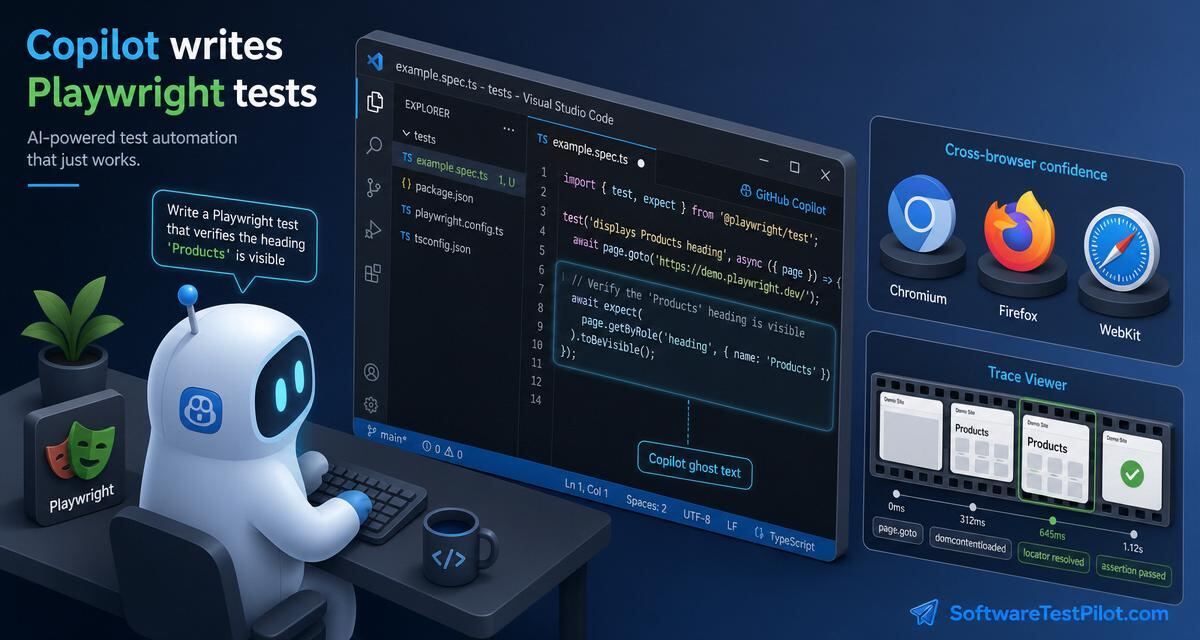
Copilot Playwright cover — VS Code with Copilot ghost text producing a Playwright TypeScript test using page.getByRole, cross-browser Chromium/Firefox/WebKit badges and a trace-viewer film-strip, with the SoftwareTestPilot.com wordmark.

Last updated: July 14, 2026 · 14 min read · By Avinash Kamble, reviewed by Priyanka G.

Copilot Playwright is the workflow of using GitHub Copilot Chat, Copilot Edits and Copilot Agent Mode to scaffold, write, refactor and stabilise Playwright TypeScript tests inside VS Code, JetBrains or the GitHub.com web editor. Playwright is the fastest-growing E2E framework of 2026 (68% year-over-year adoption growth) and Copilot is the shortest path from an acceptance criterion to a passing spec across Chromium, Firefox and WebKit. Done well, teams cut new-suite bootstrap from ~2 weeks to ~3 days, drop flake rate 30–50% and stabilise CI wall time under 8 minutes.

Pair with ChatGPT Playwright tests, Copilot Selenium, Copilot test automation, Playwright interview questions and Playwright vs Selenium.

Key takeaways

  • getByRole / getByLabel first; data-testid last; xpath never.
  • Auto-wait via expect(locator).toHaveText and friends — zero page.waitForTimeout.
  • One storageState.json per role; global setup logs in once.
  • Trace on retry, screenshot + video on failure, HTML report as CI artifact.
  • Shard 4-way in CI; blob-merge reports; nightly full browser matrix.

1. One-time setup for Copilot + Playwright

  1. Copilot Business installed in VS Code; "Suggestions matching public code" = Block.
  2. npm init playwright@latest — accepts the default TypeScript config.
  3. Add a global-setup.ts that logs in once and writes storageState.json to test-results/.
  4. Add fixtures.ts exporting a signedInPage fixture and a ariaSnapshot helper.
  5. Pin Playwright version in package.json — Copilot reads it as context and drifts otherwise.
  6. Add docs/ai-usage.md with the RCTF template and 7-point rubric.

2. RCTF prompt for Playwright

  • Role — "You are a senior SDET fluent in Playwright TypeScript, page-object pattern and deterministic waits."
  • Context — paste the AC, the POM, the storageState fixture, the browser matrix (chromium/firefox/webkit), the Playwright version and the CI wall-time budget.
  • Task — "Generate a spec that logs in via storageState, covers happy path + 2 error paths + 1 @axe-core/playwright a11y check, uses getByRole locators only, and completes in under 8 seconds in CI."
  • Format — "TypeScript, one describe per feature, trace on retry, screenshot on failure. End with a 7-point rubric self-critique."

3. Ten copy-paste Copilot prompts for Playwright

1 — Scaffold a Playwright TS project

@workspace scaffold Playwright TypeScript:
- playwright.config.ts with projects=[chromium, firefox, webkit],
  retries=2, trace='on-first-retry', screenshot='only-on-failure',
  video='retain-on-failure'
- global-setup.ts that logs in and writes storageState.json
- fixtures.ts exporting a signedInPage fixture
- tests/smoke.spec.ts (home, login, dashboard)

2 — Generate a POM from an ARIA snapshot

/tests Generate CheckoutPage.ts (Playwright TS).
Context: paste page.locator('main').ariaSnapshot() output.
Rules: getByRole first, getByLabel second, data-testid last, xpath never.
Expose actions (addAddress, applyCoupon, pay) — not raw locators.

3 — Auto-wait audit

@workspace scan tests/**/*.spec.ts for page.waitForTimeout,
setTimeout, sleep, and driver.pause. List file:line for each hit.
Suggest an expect(locator).toBeVisible / toHaveText replacement.

4 — Selenium → Playwright migration

/fix Migrate #file:LoginTest.java (Selenium) to Playwright TS:
- driver.findElement(By.id) -> page.getByRole/getByLabel
- WebDriverWait -> auto-wait via expect(locator).toHaveText
- @BeforeMethod -> test.beforeEach with the signedInPage fixture
Preserve test names.

5 — Cypress → Playwright migration

@workspace convert tests/e2e/**/*.cy.ts to Playwright.
Map: cy.visit -> page.goto, cy.get -> page.getByRole/getByLabel,
cy.intercept -> page.route. Flag any Cypress custom command with no
1:1 mapping as // TODO.

6 — Cross-browser sharding

Add sharding to playwright.config.ts + .github/workflows/e2e.yml:
- 4 shards on the GitHub Actions matrix per browser project
- merge blob reports with @playwright/test/reporter/blob
- upload HTML report as artifact only on failure
- fail the build on any console.error in a spec

7 — Visual regression

/tests Add expect(page).toHaveScreenshot() checks to
tests/e2e/checkout.spec.ts. Mask timestamps and user avatars.
Threshold 0.02. Update baselines only when --update-snapshots is passed.

8 — Accessibility sweep

@workspace wire @axe-core/playwright into every *.spec.ts under
tests/e2e. Fail only on serious + critical. Emit machine-readable
report to axe-results.json.

9 — API + UI hybrid

/tests Playwright TS.
Seed the state via request.newContext() POST /api/orders (bypass UI),
then verify the order appears in the UI at /orders.
Use a fresh unique email per test. AAA layout.

10 — Flake triage

/fix This Playwright test fails 1 in 15 CI runs. Trace attached.
Identify the race. Rewrite without waitForTimeout, without retry
around assertions, using auto-wait. Cite the exact Playwright API.

4. The 7-point Playwright review rubric

  1. Locator quality — getByRole / getByLabel first; xpath forbidden.
  2. Auto-wait — zero waitForTimeout; use expect(locator).* matchers.
  3. Data hygiene — unique inputs per test; no shared state.
  4. Assertion clarity — one behaviour per test; failure message names the bug.
  5. Trace / screenshot / video on failure — configured in playwright.config.ts.
  6. Runs in CI — passes headless in the matrix, not just locally.
  7. Flake budget — retries used / total < 3% over 20 CI runs.

5. Trace viewer — the debugging superpower

Trace Viewer is Playwright's killer feature and Copilot's best debugging companion. Configure trace: 'on-first-retry' in playwright.config.ts. When a flake reproduces in CI, attach the trace.zip to /fix in Copilot Chat with the failing assertion — Copilot reads the DOM snapshot, the action log and the network log, identifies the race and proposes a deterministic rewrite. This single loop is worth adopting Copilot for on any Playwright team.

6. Careers, salary and interviews

Frequently asked questions

1.Can GitHub Copilot write Playwright tests?
Yes and this is one of the strongest Copilot use cases in 2026 — Playwright's typed API and mature docs mean Copilot generates near-idiomatic code on the first pass. Point /tests at a page object with an RCTF prompt (Role: senior SDET; Context: AC + POM + storageState; Task: happy + 2 error + 1 a11y check with getByRole; Format: TypeScript, trace on retry). Teams see new-suite bootstrap drop from ~2 weeks to ~3 days and flake rate drop 30–50%.
2.How do I stop Copilot from using page.waitForTimeout?
Ban it explicitly in the Role and Task blocks: "Never use page.waitForTimeout, setTimeout or sleep. Use expect(locator).toBeVisible / toHaveText auto-wait." Add a pre-commit grep ("waitForTimeout\\|setTimeout\\|sleep\\(") that fails the commit on any match. Run @workspace scan monthly to catch drift. Sleeps are the #1 cause of Playwright flake and the #1 tell of Copilot output that has not been reviewed.
3.Which Playwright locators should Copilot use?
Strict hierarchy: getByRole first (accessible, resilient to CSS churn), getByLabel second (form fields), getByPlaceholder and getByText third, data-testid last (only when semantics fail), xpath never (brittle and unreadable). Pin this in the prompt and Copilot obeys. Where it slips is falling back to page.locator('.some-css') — call it out in review and regenerate.
4.How do I generate a Playwright POM with Copilot?
Two paths. (1) Paste an HTML snapshot of the page and ask for a POM with action methods. (2) Better: run page.locator('main').ariaSnapshot() in the app once, paste the output, and ask Copilot to generate a POM that queries by role and label from that snapshot. The second yields a POM that survives CSS refactors. Expose actions (addAddress, applyCoupon, pay) — never raw locators as public fields.
5.Can Copilot Agent Mode fix Playwright flakes?
Yes — the flagship use case. Attach the trace.zip and the last 20 lines of the CI log; give Agent Mode a goal ("make this test pass 20 consecutive runs without waitForTimeout, without retry around assertions") and a budget (30 min, one file). Agent Mode plans, edits, runs playwright test --repeat-each=20, iterates. Review the diff — occasionally it weakens the assertion instead of fixing the race; that is the failure mode to catch.
6.How do I set up cross-browser CI sharding with Copilot?
Ask for a GitHub Actions matrix with 4 shards × 3 browser projects (chromium, firefox, webkit), --shard=${shard}/4 in the command, blob reporter output, and a merge step (npx playwright merge-reports --reporter html blob-report/*) that uploads a single HTML artifact only on failure. Copilot writes this correctly on the first prompt. Keep the PR pipeline to chromium-only; move the full matrix to a nightly job for cost.
7.Playwright or Selenium — which does Copilot handle better?
Both well. Copilot is slightly stronger on Playwright because the API is smaller, typed and modern — the training data is more consistent. Playwright also gives Copilot a debugging superpower: trace.zip → /fix. Selenium 4 output quality is very close when the prompt bans Thread.sleep and pins Selenium 4 idioms. Choose based on your product, not on Copilot capability — see the Playwright vs Selenium comparison.
8.How do I add visual regression with Copilot + Playwright?
expect(page).toHaveScreenshot('checkout.png', { mask: [page.getByTestId('timestamp'), page.getByTestId('avatar')], threshold: 0.02 }). Copilot writes this cleanly when you ask for it explicitly. Never let it regenerate baselines silently — gate updates behind --update-snapshots and require a human review of the baseline diff. For richer visual coverage, Applitools Eyes or Percy plug in with a single import.
9.Can Copilot generate accessibility tests with Playwright?
Yes — @axe-core/playwright is a 5-line integration. Prompt: "Wire @axe-core/playwright into every spec under tests/e2e. Fail only on serious + critical violations. Emit axe-results.json." Copilot writes the wiring in seconds. Reference WCAG 2.2 AA in the prompt or it reverts to WCAG 2.1. Automation catches ~40% of a11y issues; the other 60% still need a human with a screen reader.
10.How do I use storageState to skip login in every test?
Add a global-setup.ts that runs once, logs in, and writes storageState.json to test-results/. Set storageState: 'test-results/storageState.json' in playwright.config.ts. Every test starts pre-authenticated. Copilot writes the pattern correctly on the first prompt. For multi-role tests, ask for one storageState per role (admin, member, guest) and a per-role fixture.
11.Does Copilot handle Playwright API testing?
Yes. request.newContext() gives you a typed HTTP client for API-first tests. Copilot generates clean status-code, schema-validation and negative-path suites. Best pattern: seed state via API (POST /api/orders), then verify via UI (page.goto('/orders')). Ask for "unique email per test via crypto.randomUUID()" or you will get shared-state flakes.
12.How do I roll out Copilot for a Playwright team in 30 days?
Week 1: provision Copilot Business, publish RCTF template + banned-idiom list (waitForTimeout, xpath, shared state) + 7-point rubric in docs/ai-usage.md. Week 2: pilot with one squad, wire the pre-commit grep, baseline flake rate + wall time. Week 3: add cross-browser sharding, trace-on-retry, HTML report on failure, @axe-core/playwright a11y sweep. Week 4: roll team-wide, add the rubric to the PR checklist, publish quarterly OKRs on wall time, flake rate and coverage.
Keep going

Practice these questions

Drill 200+ Playwright questions with senior-SDET sample answers — locators, auto-wait, fixtures, parallelism and trace viewer.

Found this useful?
Share:XLinkedInWhatsApp

Was this article helpful?

Cluster · AI in Testing

More from GitHub Copilot QA

Copilot prompts, locator generation, test scaffolding.

Pillar guide · 8 articles
More in this cluster
From the AI in Testing pillar

Keep building your QA edge

Practice these questions live

Rehearse with an AI QA interviewer that scores your answers in real time.

Start a Free AI Mock Interview →

Continue reading

Join the QA Community

Connect with fellow testers, share job leads, and get career advice.

Premium QA Resources

Stop Reinventing the Wheel. Upgrade Your QA Arsenal.

Take your testing skills from beginner to Lead Engineer. Supercharge your daily workflow with our premium digital resources.

  • Ready-to-use testing strategy templates
  • Advanced API & UI automation guides
  • ⏱️ Save 10+ hours a week on test planning
4.9/5 rating
Explore All Products

⭐⭐⭐⭐⭐ Trusted by 1,000+ Software Test Pilots • Instant Access