
ChatGPT Write Selenium Code in 2026: The Complete Playbook (Java, Python, POM, Grid & FAQ)
The definitive 2026 guide to making ChatGPT write Selenium code that actually works — Java + Python + C#, WebDriver 4.20 locators, WebDriverWait, POM refactors, Selenium Grid, Docker, Jenkinsfile and GitHub Actions, plus 15 copy-paste prompts, a 6-point review rubric, ROI and every PAA question Google surfaces.

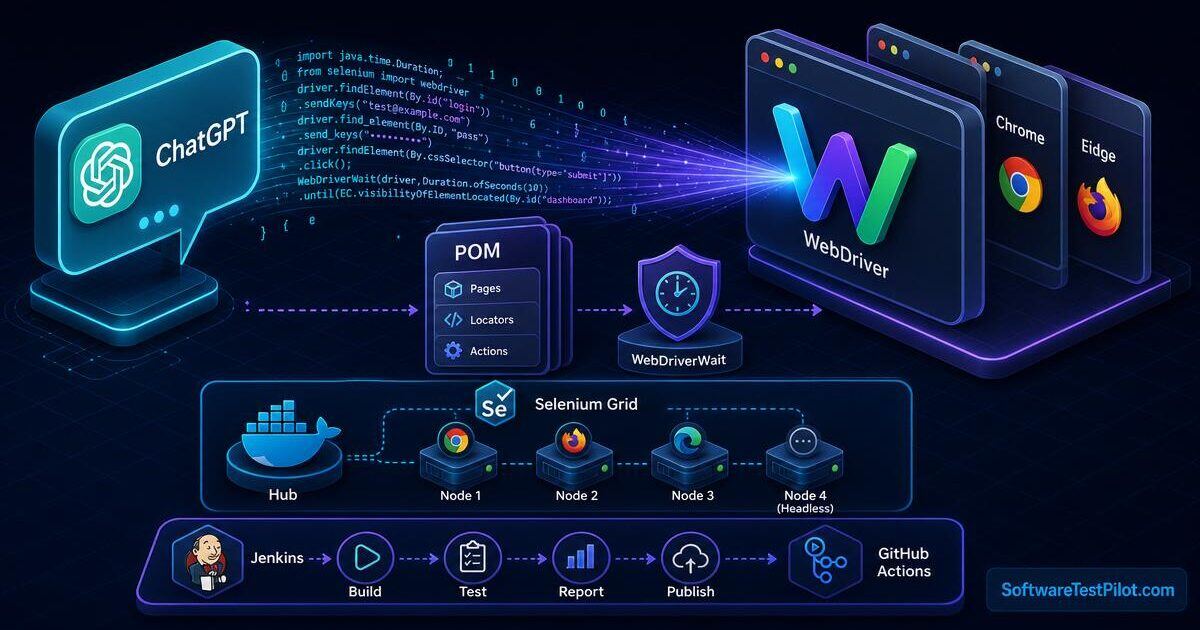
Last updated: July 14, 2026 · 18 min read · By SoftwareTestPilot
Asking ChatGPT to write Selenium code is the single fastest way for a 2026 SDET team to cut Selenium 4.20+ authoring time by 40–55% — but only if you prompt it correctly. Used well, ChatGPT (alongside Claude Opus 4.5 and Gemini 2.5 Pro) drafts Java TestNG, Python pytest and C# NUnit Selenium tests, Page Object Model classes, WebDriverWait conditions, docker-compose Selenium Grid stacks, Jenkinsfiles and GitHub Actions matrices in minutes. Used badly, it emits Thread.sleep(5000), absolute XPath, hardcoded passwords and Selenium 3-era DesiredCapabilities syntax that no longer runs.
This is the pillar every Selenium engineer, SDET and QA lead should bookmark before asking ChatGPT to write another line of Selenium. It covers what ChatGPT does well and badly for Selenium specifically, the RCTF prompt framework, fifteen copy-paste prompts (Java + Python + C#, POM refactors, self-healing locators, Selenium Grid 4 with Docker, Jenkinsfile and GitHub Actions), a strict 6-point review rubric, honest ROI, governance and the People Also Ask questions Google surfaces. Pair it with our ChatGPT for Selenium pillar, the ChatGPT Playwright tests pillar, the ChatGPT Cypress automation pillar, the ChatGPT for test automation pillar, the ChatGPT for QA testing pillar, the 50 ChatGPT prompts for software testers, the GitHub Copilot for QA guide and the Selenium vs Playwright comparison.
Key takeaways
- Measured productivity lift on healthy 2026 Selenium teams: 40–55% on script authoring, 25–40% fewer flaky-locator PRs when you pair ChatGPT with the 6-point rubric.
- Every prompt to make ChatGPT write Selenium code should follow RCTF — Role, Context, Task, Format — and pin the exact version (Selenium 4.20+, Java 21 / Python 3.12 / C# 12).
- Never ship AI output containing
Thread.sleep(),time.sleep(), absolute XPath,By.classNamealone or hardcoded credentials. Prefer relative XPath,By.id,By.cssSelectorwithdata-testid, andWebDriverWait+ expected conditions.- Never paste production data, PII, cookies or auth tokens. Use the redaction template in this guide.
- ChatGPT is a first draft engine, not a merge gate. Every AI-drafted Selenium file passes the 6-point rubric or gets regenerated.
1. What does it mean when ChatGPT writes Selenium code?
"ChatGPT write Selenium code" is the practice of using ChatGPT (or Claude, Gemini or a self-hosted Llama 4) to generate Selenium WebDriver 4.20+ code that a human SDET reviews, refactors and merges. It covers the parts of the Selenium lifecycle where an engineer spends repeatable time: designing test cases from acceptance criteria, generating TestNG / pytest / NUnit test classes, writing Page Object Models, converting Thread.sleep to WebDriverWait, drafting docker-compose Selenium Grid stacks, generating Jenkinsfiles and GitHub Actions matrices, summarising stack traces and reviewing pull requests. It sits on top of your Selenium framework — it does not replace it.
+---------------------------------------------------------------------+
|         CHATGPT WRITE SELENIUM CODE — WHERE IT FITS                 |
+---------------------------------------------------------------------+
| STAGE            | HUMAN OWNS         | CHATGPT ASSISTS WITH        |
+------------------+--------------------+-----------------------------+
| Framework design | Architecture       | pom.xml / requirements.txt  |
| Locator policy   | Stability rules    | By.id, By.cssSelector picks |
| Test authoring   | Acceptance criteria| First-draft TestNG / pytest |
| Waits            | Sync strategy      | Thread.sleep -> WebDriverWait |
| Page objects     | Contract truth     | POM class + typed methods   |
| Data providers   | Test data source   | @DataProvider / pytest.mark |
| Grid + Docker    | Capacity plan      | docker-compose, K8s / KEDA  |
| CI/CD            | Gates & secrets     | Jenkinsfile, GH Actions YAML|
| Failure triage   | Root cause         | Stack trace + log summary   |
+------------------+--------------------+-----------------------------+
Independent research from GitHub's Copilot code-quality study puts the productivity boost on well-scoped code tasks at 40–55%. The official Selenium documentation and the W3C WebDriver spec are the ground truth every AI prompt should be checked against, and the DORA State of DevOps confirms AI-assisted teams are most likely to reach elite delivery when human review stays in the loop.
What it is not: a replacement for a Selenium framework, a chatbot that runs your suite for you, or a magic autopilot. Any "AI Selenium autopilot" pitch that skips human review is selling marketing.
2. The RCTF prompt framework for Selenium code generation
The single biggest lever on ChatGPT output quality for Selenium is prompt structure. Every prompt should have four explicit layers — Role, Context, Task, Format:
- Role — "You are a senior SDET fluent in Selenium 4.20, Java 21, TestNG 7 and AssertJ."
- Context — paste the framework version, the existing
BasePage.java, the target acceptance criteria and the style rules ("locator order:By.id,By.cssSelectorwithdata-testid, relative XPath. Never absolute XPath. NeverThread.sleep. Waits viaWebDriverWait+ExpectedConditions."). - Task — "Write one
CheckoutCouponTest.javaclass using the sharedBasePage, covering valid, expired and stacked coupons with 3@Testmethods." - Format — "Output a single
.javafile. No comments, noThread.sleep, no hardcoded credentials. End with a self-critique against this rubric: assertion truth, locator quality, wait discipline, data isolation, coverage vs risk, reproducibility."
Then run the 3-step iteration loop: baseline → self-critique → regenerate. On our internal audits this alone moves Selenium coverage scores from ~60% to ~88% on the same feature.
3. Prompts to make ChatGPT write Selenium Java + TestNG code
Prompt: generate a Selenium 4.20 TestNG test from an acceptance criterion
You are a senior SDET fluent in Selenium 4.20, Java 21, TestNG 7 and
AssertJ. Pin the exact versions in the imports.

Context:
- Locators: By.id, then By.cssSelector with data-testid, then relative
  XPath. NEVER absolute XPath, NEVER By.className alone.
- Waits: WebDriverWait(Duration.ofSeconds(10)) + ExpectedConditions.
  NEVER Thread.sleep().
- Driver: managed by Selenium Manager (no WebDriverManager).
- Base: extend com.qa.BasePage; DO NOT redeclare driver / wait.
- Test data via @DataProvider; NEVER hardcode credentials.

Acceptance criteria:
- Cart $100 + SAVE10 -> total $90.
- EXPIRED2023 -> toast contains "expired".
- Two coupons cannot be stacked.

Task: produce ONE CheckoutCouponTest.java with 3 @Test methods.

Format: single .java file. End with a self-critique against:
assertion truth, locator quality, wait discipline, data isolation,
coverage vs risk.
Prompt: refactor a Selenium Java test into a Page Object Model
You are a senior SDET fluent in Selenium 4.20 + Java 21 + POM.
Refactor the .java file below into:
- pages/CheckoutPage.java exposing typed methods
  (goto(), applyCoupon(String code), assertTotal(BigDecimal amount))
- tests/CheckoutCouponTest.java consuming the page object
- No Thread.sleep, no absolute XPath, no duplicate driver/wait.
- Preserve every existing assertion.
Output: 2 files in that order.
[paste .java]
Prompt: convert Thread.sleep to WebDriverWait
The Selenium Java file below contains N Thread.sleep calls. For each:
(1) identify the DOM signal it is really waiting on (element visible,
invisible, clickable, text present, URL contains, alert present),
(2) replace with WebDriverWait(Duration.ofSeconds(10)) +
ExpectedConditions.*, (3) if the signal is unclear, flag it as
"NEEDS-HUMAN" and leave a TODO comment.
Output: single rewritten .java file + a short markdown table of every
replacement (line, old sleep, new condition).
[paste .java]
4. Prompts to make ChatGPT write Selenium Python + pytest code
Prompt: generate a Selenium 4.20 pytest test
You are a senior SDET fluent in Selenium 4.20, Python 3.12, pytest 8
and pytest-selenium. Pin the exact versions.

Context:
- Locators: By.ID, then By.CSS_SELECTOR with data-testid, then relative
  XPath. NEVER absolute XPath, NEVER By.CLASS_NAME alone.
- Waits: WebDriverWait(driver, 10) + expected_conditions.
  NEVER time.sleep().
- Driver: managed by Selenium Manager. Fixture `driver` provided by
  conftest.py; DO NOT re-create it inside the test.
- Read secrets from os.environ, never hardcoded.

Acceptance criteria: [paste 3 bullets]

Task: produce ONE test_checkout_coupon.py with 3 test functions,
parametrised with pytest.mark.parametrize.

Format: single .py file. End with a self-critique against the rubric.
Prompt: generate a Python POM for Selenium
You are a senior SDET fluent in Selenium 4.20 + Python 3.12 + POM.
Generate pages/checkout_page.py with a CheckoutPage class exposing:
- goto()
- apply_coupon(code: str)
- assert_total(amount: Decimal)
All locators as class-level tuples (By, selector). No time.sleep.
Use type hints (PEP 604) and dataclasses where they help.
Output: single pages/checkout_page.py.
Prompt: convert Selenium C# NUnit to Selenium Python pytest
Convert the Selenium 4 C# NUnit test below to Selenium 4.20 Python
pytest. Map every By.* call, every WebDriverWait, every attribute
assertion. Preserve test names as snake_case. Read secrets from
os.environ, never hardcoded. Output: single .py file.
[paste .cs]
5. Prompts for POM refactors, self-healing locators and data providers
Prompt: propose a stable Selenium locator
For the HTML element below, produce a Selenium locator following the
2026 stability order:
1. By.id if a stable ID exists.
2. By.cssSelector("[data-testid='...']") if the app exposes test IDs.
3. Relative XPath anchored on visible text or role
   (//button[normalize-space()='Apply']).
4. By.linkText / By.partialLinkText only for anchor text.
Never absolute XPath, never By.className alone, never nth-child.
Output: one Java line + one Python line + one C# line + a one-sentence
justification.
HTML: [paste rendered element]
Prompt: self-healing locator loop (nightly job)
You are a senior SDET.
Given a JSON payload of failing locators (each with element role,
surrounding HTML and the last-known selector), for every entry produce:
- a replacement selector following the stability order above
- a confidence score 0.00–1.00
- a short reason
Return a JSON array. My CI will auto-open a PR only if confidence > 0.85;
lower-confidence entries become Jira tickets.
[paste broken-locators.json]
Prompt: generate a TestNG @DataProvider
You are a senior SDET fluent in TestNG 7.
Generate a @DataProvider(name="coupons") that returns a 2D Object[][]
with 6 rows covering: valid, expired, malformed, stacked, empty,
non-existent. No PII. Include a companion pytest.mark.parametrize
equivalent for the Python team.
Output: two code blocks (Java, Python).
6. Prompts for Selenium Grid 4 and Docker
Prompt: generate a docker-compose Selenium Grid 4 stack
You are a senior DevOps engineer.
Generate a docker-compose.yml for Selenium Grid 4.20 with:
- selenium/hub:4.20 (fixed tag, never latest)
- 2x selenium/node-chromium:4.20
- 1x selenium/node-firefox:4.20
- 1x selenium/node-edge:4.20
- SE_NODE_MAX_SESSIONS=2 per node
- SE_SESSION_REQUEST_TIMEOUT=300
- Healthchecks on hub and each node
- Shared network selenium-grid
Output: single docker-compose.yml, no comments except above
SE_* variables that need tuning.
Prompt: generate a Kubernetes + KEDA autoscaled Grid
Same as above but as Kubernetes manifests: Deployment + Service for the
hub, Deployments for chromium/firefox/edge nodes, and a KEDA
ScaledObject that scales nodes based on Grid session queue length
(target: 5 sessions per replica, min 2, max 20).
Output: 4 YAML files.
7. Prompts for Jenkinsfile and GitHub Actions
Prompt: generate a Declarative Jenkinsfile for a Selenium Maven project
You are a senior DevOps engineer.
Generate a Declarative Jenkinsfile that:
- runs on any agent with label 'linux && docker'
- stages: Checkout, Build (mvn -B clean compile), Test (mvn -B test
  -Dselenium.grid.url=$GRID_URL), Publish Report (allure-maven),
  Notify (Slack webhook on failure)
- reads GRID_URL and SLACK_WEBHOOK from Jenkins credentials
- archives target/surefire-reports and allure-results always
- publishes an HTML report link
Output: single Jenkinsfile, comment above every credentials() call to
catch invented credential IDs.
Prompt: generate a GitHub Actions workflow for a Selenium pytest project
You are a senior DevOps engineer.
Generate .github/workflows/selenium.yml that:
- runs on push to main and every PR
- uses ubuntu-latest, Python 3.12, caches ~/.cache/pip
- starts Selenium Grid 4.20 via services: selenium/standalone-chrome:4.20
- runs pytest -n 4 --html=report.html --self-contained-html
- uploads report.html and screenshots on failure only
- posts a PR comment with the pytest summary
Output: single YAML, comment above every ${{ secrets.* }} reference.
8. The 6-point review rubric for AI-drafted Selenium code
Every AI-drafted Selenium file goes through this rubric before merge. Any file failing two or more criteria is regenerated, not review-commented:
- Assertion truth — the assertion verifies the acceptance criterion, not just
isDisplayed()/is_displayed(). - Locator quality —
By.id,By.cssSelectorwithdata-testid, or relative XPath anchored on visible text/role. Never absolute XPath, neverBy.classNamealone, nevernth-child. - Wait discipline — no
Thread.sleep, notime.sleep. UseWebDriverWait+ExpectedConditions/expected_conditions. - Data isolation — test data via
@DataProvider/pytest.mark.parametrize. No hardcoded credentials; secrets from env vars only. - Coverage vs risk — negative, boundary and at least one cross-browser check present, not just happy path.
- Reproducibility — runs green 20× locally AND once through Selenium Grid parallelisation before it enters CI.
This one rubric is the difference between AI making your Selenium suite better and AI making it faster to break in production.
9. Where ChatGPT writing Selenium code still fails
- Thread.sleep / time.sleep by default. When you ask ChatGPT to fix a flaky test without pasting the DOM or the stack trace, it drops back to
Thread.sleep(5000). Enforce "no fixed waits" in the prompt and in Checkstyle / Detekt / ruff. - Absolute XPath. Without an explicit locator policy, ChatGPT emits
/html/body/div[3]/div[2]/button. Enforce the stability order in the prompt AND as a static-analysis rule. - Selenium version drift. Models still emit Selenium 3 patterns (
DesiredCapabilities,WebDriverManager,ChromeDriver.exepaths) unless you name Selenium 4.20 and Selenium Manager. - Hallucinated base classes. ChatGPT will extend a
BasePagethat does not exist or redeclaredriver/wait. Always paste the base class. - DesiredCapabilities in 2026. Force
ChromeOptions/FirefoxOptions/EdgeOptionsexplicitly. - Grid image drift. Never accept
selenium/hub:latest. Pin4.20. - Prompt log leakage. Free / personal ChatGPT plans train on your prompts by default. Enterprise / Team only, with training turned off.
10. Privacy, PII redaction and governance
The fastest way to lose the ChatGPT licence — and possibly your job — is pasting production cookies, auth tokens or customer data into a prompt. Use this redaction pre-pass on every prompt that touches app data, fixtures or logs:
Before sending any prompt containing app data, replace:
- emails      -> user{N}@example.com
- phones      -> +1-555-0100 through +1-555-0199
- names       -> Persona A, Persona B, ...
- card PANs   -> 4242 4242 4242 4242 (Stripe test)
- addresses   -> 1 Infinite Loop, Cupertino, CA 95014
- IDs / UUIDs -> TEST-000-0001 (sequential)
- session cookies / tokens -> <REDACTED>

Keep shape (length, format) so validation logic still triggers.
On the plan side: ChatGPT Enterprise and Team have training on your prompts off by default and add SSO, admin controls and longer context. Personal ChatGPT Plus is fine for open-source and public-doc prompts only. Regulated workloads should use Azure OpenAI, AWS Bedrock or a self-hosted Llama 4. Cross-check every policy against the NIST AI Risk Management Framework and the EU AI Act.
11. ROI — what ChatGPT writing Selenium code actually saves
Annual ROI = (Hours saved ⋅ loaded SDET cost)
           + (Escape defects avoided ⋅ incident cost)
           − (ChatGPT / Copilot licences)
           − (Review overhead: 10–20% of "hours saved")
           − (Governance headcount)
Honest 2026 ranges on healthy Selenium teams:
- Test authoring: 40–55% faster from acceptance criterion to a green Selenium run.
- POM + fixtures: 60–80% faster on setup boilerplate.
- Thread.sleep → WebDriverWait rewrites: 70%+ faster than hand-editing.
- Locator maintenance: 25–40% fewer flaky-locator PRs with the ID / data-testid policy plus a self-healing nightly loop.
- Failure triage: 30–50% shorter time-to-first-comment on red Grid runs with LLM summaries of the stack trace.
Anything above 10× ROI in the first quarter is a comparison against a baseline that never existed. Anything below break-even in year one usually means governance was skipped and hallucinated Selenium tests are eating the "saved" time.
12. 30-day rollout for a Selenium team
- Days 1–7 — foundations. Enable ChatGPT Enterprise / Team, turn on data-exclusion, publish the RCTF template, redaction rules and 6-point rubric in
docs/ai-usage.md. Pin Selenium 4.20, Java 21 / Python 3.12 / C# 12 as the reference versions. - Days 8–14 — prompt library. Each SDET submits three prompts they use daily. Curate the top 20 into
docs/prompts/selenium/; reject any prompt missing an RCTF layer or a version pin. - Days 15–21 — guardrails. Add Checkstyle / Detekt / ruff rules that block
Thread.sleep,time.sleep, absolute XPath,By.className-alone and hardcoded credentials. Update the PR template with the 6-point rubric checkbox. - Days 22–30 — measure. Baseline five KPIs — authoring time, flake rate, PR review comments, coverage %, MTTR on red Grid runs. Compare to pre-rollout. Cancel or expand based on data, not vibes.
13. What ChatGPT-written Selenium code means for QA careers
The 2026 hiring data is clear: Selenium engineers who can pair ChatGPT with WebDriver 4.20, POM refactors, Grid + Docker and CI YAML are seeing 15–30% salary lifts. Selenium-only SDETs who ignore AI are seeing rate compression. See the QA engineer salary guide and the SDET career roadmap.
Actively interviewing? Practice with the AI mock interview, tune your CV with the free ATS resume review and browse live openings on the QA Jobs Radar. For technical rounds, work through the Selenium interview questions, Playwright interview questions, API testing interview questions and SQL interview questions pillars.