
ChatGPT for Selenium in 2026: The Complete Playbook (Java, Python, POM, Self-Healing & FAQ)
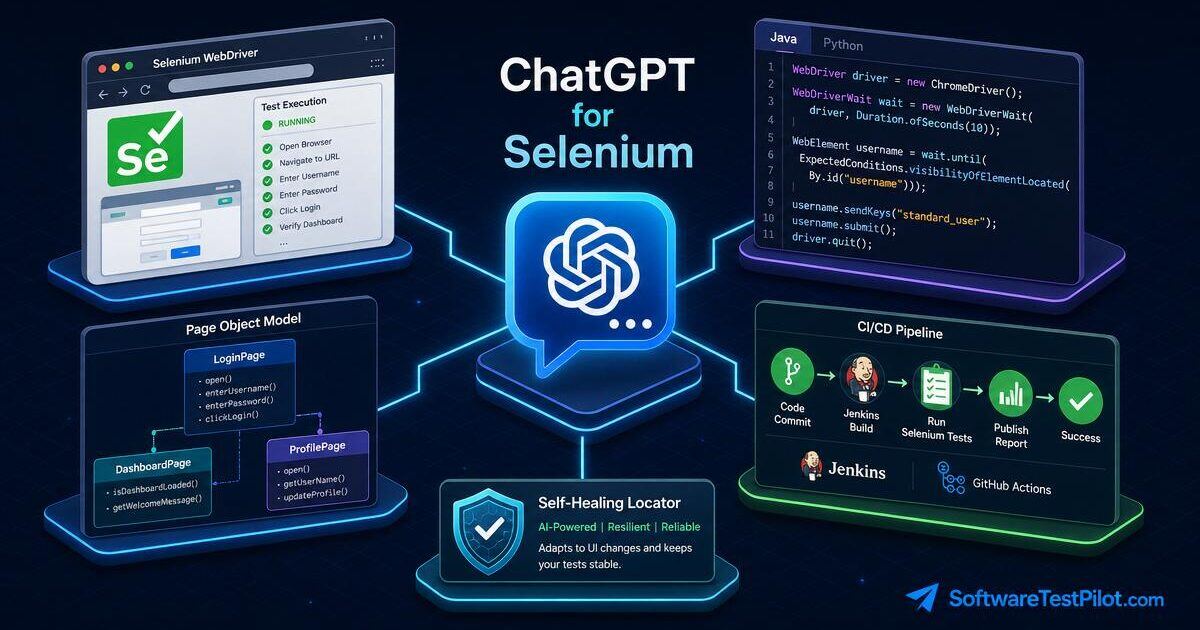
The definitive 2026 ChatGPT for Selenium guide — how to generate Selenium WebDriver tests in Java and Python, refactor Page Object Models, kill Thread.sleep, build self-healing locators, wire Grid + CI/CD and pass code review, with 15 copy-paste prompts, honest ROI and every PAA question Google surfaces.

Last updated: July 14, 2026 · 18 min read · By SoftwareTestPilot
ChatGPT for Selenium is the use of OpenAI's large language models — alongside Claude Opus 4.5 and Gemini 2.5 Pro — to design, generate, refactor, heal and review Selenium WebDriver tests in Java, Python, C#, JavaScript and Ruby. Used well on a 2026 SDET team, it cuts Selenium script-authoring time by 40–55%, drops Thread.sleep-driven flake by 25–40% and drafts Grid + Jenkins + GitHub Actions pipelines in minutes. Used badly, it ships absolute XPath, hallucinated By.id() values and fixed waits that pass locally and fail in CI.
This is the pillar every Selenium engineer, SDET and QA lead should bookmark before wiring ChatGPT into a WebDriver stack. It covers what ChatGPT does well and badly for Selenium specifically, the RCTF prompt framework, fifteen copy-paste prompts for Selenium 4 in Java and Python (POM, waits, TestNG / JUnit 5 / pytest, data-driven, Grid, Docker, Jenkinsfile, GitHub Actions), a self-healing locator loop, a strict 6-point review rubric, honest ROI, governance and the People Also Ask questions Google surfaces. Pair it with our ChatGPT for test automation pillar, the ChatGPT for QA testing pillar, the ChatGPT for software testing pillar, the 50 ChatGPT prompts for software testers, the Selenium WebDriver guide, the Selenium vs Playwright comparison, the Java for Selenium tutorial and the Selenium Python interview Q&A.
Key takeaways
- Measured productivity lift on healthy 2026 Selenium teams: 40–55% on script authoring, 25–40% fewer flaky-locator PRs when you pair ChatGPT with a self-healing loop and the 6-point rubric.
- Every Selenium prompt should follow RCTF — Role, Context, Task, Format — and pin the exact Selenium version (Selenium 4.20+, Java 21, Python 3.12) and the framework (TestNG / JUnit 5 / pytest).
- Never ship AI output containing
Thread.sleep,time.sleep, absolute XPath, bare CSS-class selectors or hardcoded credentials. Enforce this in ESLint / Checkstyle / Detekt / ruff.- Never paste production data, PII, cookies or auth tokens. Use the redaction template in this guide.
- ChatGPT is a first draft engine, not a merge gate. Every AI-drafted Selenium test passes the 6-point rubric or gets regenerated.
1. What is ChatGPT for Selenium?
"ChatGPT for Selenium" is the practice of embedding ChatGPT (or Claude, Gemini or a self-hosted Llama 4) into the parts of the Selenium lifecycle where a human SDET spends repeatable time: designing test cases from acceptance criteria, generating Java / Python / C# / JavaScript WebDriver code, refactoring Page Object Models, killing Thread.sleep with proper WebDriverWait, proposing stable locators, drafting docker-compose and Grid configs, generating Jenkinsfile / GitHub Actions / Azure Pipelines YAML, summarising red-build stack traces and reviewing pull requests. It sits on top of your Selenium 4 framework — it does not replace it.
+---------------------------------------------------------------------+
|          CHATGPT FOR SELENIUM — WHERE IT FITS                      |
+---------------------------------------------------------------------+
| STAGE            | HUMAN OWNS         | CHATGPT ASSISTS WITH        |
+------------------+--------------------+-----------------------------+
| Framework design | Architecture       | Boilerplate, POM patterns   |
| Test authoring   | Acceptance criteria| First-draft TestNG/pytest   |
| Locators         | Stability rules    | data-testid / role suggest  |
| Waits            | Sync strategy      | Replace Thread.sleep        |
| Data-driven      | Data model         | @DataProvider, @Parametrize |
| Grid / Docker    | Infra choice       | docker-compose, Grid config |
| CI/CD YAML       | Gates & secrets     | Jenkinsfile, Actions, GitLab|
| Failure triage   | Root cause         | Stack-trace summary         |
| PR review        | Merge decision     | Anti-pattern flagging       |
+------------------+--------------------+-----------------------------+
Independent research from GitHub's Copilot code-quality study puts the productivity boost on well-scoped code tasks at 40–55%; the DORA State of DevOps confirms AI-assisted teams are the most likely to reach elite delivery — provided they keep human review in the loop. The official Selenium test practices are the ground truth every AI prompt should be checked against.
What it is not: a replacement for a Selenium framework, a chatbot that runs your suite for you, or a magic autopilot. Any "AI Selenium autopilot" pitch that skips human review is selling marketing.
2. The RCTF prompt framework for Selenium
The single biggest lever on ChatGPT output quality for Selenium is prompt structure. Every prompt should have four explicit layers — Role, Context, Task, Format:
- Role — "You are a senior SDET fluent in Selenium 4.20, Java 21, Maven, TestNG and the Page Object Model."
- Context — paste the framework version, the existing
pages/directory, the target acceptance criteria and any style rules ("we useBy.cssSelector("[data-testid=...]"), never absolute XPath;WebDriverWaitwithExpectedConditions, neverThread.sleep"). - Task — "Write one TestNG test class for the checkout coupon flow that uses
pages/CartPageandpages/CheckoutPage, covers valid, expired and stacked coupons, and asserts on the visible cart total." - Format — "Output a single
.javafile. No comments, noThread.sleep, no hardcoded credentials. End with a self-critique against this rubric: assertion truth, locator quality, wait discipline, isolation, coverage vs risk, reproducibility."
Then run the 3-step iteration loop: baseline → self-critique → regenerate. On our internal audits this alone moves Selenium coverage scores from ~62% to ~89% on the same feature.
3. Copy-paste prompts for Selenium + Java + TestNG
Prompt: generate a Selenium 4 + Java 21 + TestNG test from an acceptance criterion
You are a senior SDET fluent in Selenium 4.20, Java 21, Maven and TestNG 7.
Context:
- Locators: By.cssSelector("[data-testid='...']") primary, then By.id,
  then By.linkText. Never absolute XPath, never bare CSS class.
- Waits: WebDriverWait(driver, Duration.ofSeconds(10)) with ExpectedConditions.
  Never Thread.sleep.
- Page objects: pages/CartPage.java and pages/CheckoutPage.java exist.

Acceptance criteria:
- Given a cart of $100, applying coupon SAVE10 reduces total to $90.
- Expired coupon EXPIRED2023 shows an alert containing "expired".
- Two coupons cannot be stacked.

Task: produce ONE TestNG test class with @BeforeMethod that starts a
headless Chrome driver, @AfterMethod that quits it, and 3 @Test methods
covering the criteria. Use the existing page objects.

Format: single .java file. End with a self-critique against:
assertion truth, locator quality, wait discipline, isolation, coverage.
Prompt: refactor a legacy Selenium 3 test to Selenium 4
Refactor the following Selenium 3 (Java) test to Selenium 4.20.
Requirements:
- Replace DesiredCapabilities with ChromeOptions.
- Replace FluentWait boilerplate with WebDriverWait + Duration.
- Replace Thread.sleep with ExpectedConditions.
- Replace absolute XPath with By.cssSelector("[data-testid=...]") where a
  data-testid is present in the HTML below.
- Preserve @Test method names and @DataProvider signatures.
HTML: [paste rendered HTML of the page under test]
Test: [paste .java file]
Prompt: kill Thread.sleep in an existing test
The following Selenium test uses Thread.sleep in 4 places. For each
sleep, propose the correct ExpectedConditions predicate to replace it,
citing the DOM element it is really waiting on. Rewrite the test using
WebDriverWait(driver, Duration.ofSeconds(10)). Do not add any new
sleep. If a wait cannot be replaced without a DOM signal you cannot see,
say so and ask a clarifying question.
[paste .java file]
For deeper Java setup, see our Java for Selenium tutorial and the Selenium interview questions pillar.
4. Copy-paste prompts for Selenium + Python + pytest
Prompt: generate a Selenium 4 + Python 3.12 + pytest test
You are a senior SDET fluent in Selenium 4.20, Python 3.12 and pytest 8.
Context:
- Selenium Manager resolves drivers; do not use webdriver_manager.
- Locators: (By.CSS_SELECTOR, "[data-testid='...']") primary, then By.ID,
  then By.LINK_TEXT. Never absolute XPath, never bare CSS class.
- Waits: WebDriverWait(driver, 10) with expected_conditions. Never time.sleep.
- Page objects: pages/cart_page.py and pages/checkout_page.py exist.

Acceptance criteria:
[paste acceptance criteria]

Task: produce a single pytest module with a session-scoped headless Chrome
fixture, a function-scoped page-objects fixture, and 4 test functions
covering positive, negative, boundary and accessibility. Use @pytest.mark.parametrize
for the data-driven case.

Format: single .py file. End with a self-critique against:
assertion truth, locator quality, wait discipline, isolation, coverage.
Prompt: convert unittest to pytest
Convert the following Selenium + unittest test to pytest 8. Requirements:
- Replace setUp / tearDown with fixtures.
- Replace self.assert* with plain assert.
- Preserve test names (add test_ prefix if missing).
- Use @pytest.mark.parametrize for any data-driven loop.
[paste .py file]
See the Selenium Python interview Q&A for the underlying patterns.
5. Prompts for stable locators and self-healing
Prompt: propose a stable Selenium locator
You are a senior SDET reviewing a flaky Selenium locator.
For the HTML element below, produce a Selenium 4 By locator that is
resilient to CSS class renames, text translation and DOM re-ordering.
Order of preference:
1. By.cssSelector("[data-testid='...']") if a data-testid is present.
2. By.id if the id is stable (not auto-generated).
3. By.cssSelector("[aria-label='...']") or role + name equivalent.
4. By.linkText / By.partialLinkText for anchors.
5. Only as last resort: a scoped relative XPath (never absolute).

Output: a single line in the form By.cssSelector("...") or By.id("..."),
followed by a one-sentence justification.
HTML: [paste rendered element]
Prompt: self-healing locator loop
You are a senior SDET running a nightly locator-healing job.
Given the failing selector below and the current rendered HTML, propose
the most stable Selenium By locator following the preference order above.
Output JSON only:
{
  "old": "By.xpath(\"...\")",
  "new": "By.cssSelector(\"[data-testid='...']\")",
  "confidence": 0.0-1.0,
  "reason": "..."
}
Old selector: [paste failing selector]
Current HTML: [paste rendered HTML snippet]
Auto-open a PR for suggestions with confidence > 0.85; anything lower becomes a Jira ticket for a human SDET. Never let ChatGPT merge directly. Realistic benefit on a 500-test suite: 25–40% fewer flaky-locator PRs.
6. Prompts for Selenium Grid, Docker and CI/CD
Prompt: generate docker-compose for Selenium Grid 4
You are a senior DevOps engineer fluent in Selenium Grid 4.20.
Generate a docker-compose.yml that runs:
- 1 Selenium Hub (selenium/hub:4.20)
- 3 chrome nodes (selenium/node-chrome:4.20)
- 2 firefox nodes (selenium/node-firefox:4.20)
- 1 edge node (selenium/node-edge:4.20)
With SE_NODE_MAX_SESSIONS=2, SE_NODE_SESSION_TIMEOUT=300, SE_VNC_NO_PASSWORD=1.
Expose 4444 on the hub. Add healthchecks.
Output: a single docker-compose.yml, nothing else.
Prompt: generate a Jenkinsfile for a Selenium + Maven suite
You are a senior DevOps engineer.
Generate a Declarative Jenkinsfile that:
- checks out the repo
- caches ~/.m2
- runs `mvn -B -e -Pgrid test -Dselenium.grid.url=$GRID_URL`
- publishes the Surefire report
- archives target/screenshots on failure only
- posts a Slack message with the build result
Output: a single Jenkinsfile.
Prompt: generate a GitHub Actions workflow for Selenium + pytest
You are a senior DevOps engineer.
Generate a GitHub Actions workflow that:
- runs on push to main and every PR
- uses ubuntu-latest with Python 3.12
- installs deps via pip and caches ~/.cache/pip
- spins up Selenium Grid 4 via docker-compose
- runs pytest -n 4 --html=report.html --self-contained-html
- uploads report.html and screenshots as artifacts on failure only
Output: a single .github/workflows/selenium.yml, nothing else.
7. The 6-point review rubric for AI-drafted Selenium code
Every AI-drafted Selenium test file goes through this rubric before merge. Any test failing two or more criteria is regenerated, not review-commented:
- Assertion truth — the assertion verifies the acceptance criterion, not just
Assert.assertTrue(element.isDisplayed()). - Locator quality —
data-testid,By.id(stable),By.cssSelector[aria-label],By.linkText. Never absolute XPath, never bare CSS class, never index-based XPath. - Wait discipline — no
Thread.sleep, notime.sleep, nodriver.manage().timeouts().implicitlyWait()mixed with explicit waits. - Isolation — each test creates and cleans its own data and its own driver instance. No dependency on run order.
- Coverage vs risk — negative and boundary cases present, not just happy path.
- Reproducibility — runs green 20× locally on headless Chrome AND once through Selenium Grid before it enters CI.
This one rubric is the difference between AI making your Selenium suite better and AI making it faster to break in production.
8. Where ChatGPT for Selenium still fails
- Absolute XPath by default. Without an explicit rule, ChatGPT emits
//div[3]/ul/li[2]/a-style locators. Enforce the preference order in the prompt and as a Checkstyle / ruff rule. - Thread.sleep as a "fix". When you ask it to fix a flaky test without pasting the DOM, it often adds another sleep. Always paste the rendered HTML.
- Selenium version drift. Models still emit Selenium 3 patterns (
DesiredCapabilities,PhantomJS,webdriver_manager) unless you name the version. Always specify Selenium 4.20+ and Java 21 / Python 3.12. - Hallucinated
By.id()values. ChatGPT will invent anidthat looks right. Every locator needs a real-DOM check. - Whole-framework design. Ask it to invent a framework and you'll get a Frankenstein. Own the architecture; ask for parts.
- Grid config drift. The Grid 3 vs Grid 4 API changed. Pin the exact Docker image tag (
selenium/hub:4.20) in every prompt. - Prompt log leakage. Free / personal ChatGPT plans train on your prompts by default. Enterprise / Team only, with training turned off.
9. Privacy, PII redaction and governance
The fastest way to lose the ChatGPT licence — and possibly your job — is pasting production data or auth cookies into a prompt. Use this redaction pre-pass on every prompt that touches app data or logs:
Before sending any prompt containing app data, replace:
- emails      -> user{N}@example.com
- phones      -> +1-555-0100 through +1-555-0199
- names       -> Persona A, Persona B, ...
- card PANs   -> 4242 4242 4242 4242 (Stripe test)
- addresses   -> 1 Infinite Loop, Cupertino, CA 95014
- IDs / UUIDs -> TEST-000-0001 (sequential)
- session cookies / tokens -> <REDACTED>

Keep shape (length, format) so validation logic still triggers.
On the plan side: ChatGPT Enterprise and Team have training on your prompts off by default and add SSO, admin controls and longer context. Personal ChatGPT Plus is fine for open-source and public-doc prompts only. Regulated workloads should use Azure OpenAI, AWS Bedrock or a self-hosted Llama 4. Cross-check every policy against the NIST AI Risk Management Framework and the EU AI Act.
10. ROI — what ChatGPT actually saves a Selenium team
Annual ROI = (Hours saved ⋅ loaded SDET cost)
           + (Escape defects avoided ⋅ incident cost)
           − (ChatGPT / Copilot licences)
           − (Review overhead: 10–20% of "hours saved")
           − (Governance headcount)
Honest 2026 ranges on healthy Selenium teams:
- Script authoring: 40–55% faster from acceptance criterion to a green TestNG / pytest run.
- POM refactors: 60–80% faster on well-structured page objects.
- Locator maintenance: 25–40% fewer flaky-locator PRs with the self-healing loop above.
- Grid + Jenkinsfile: hours instead of days for a new pipeline.
- Failure triage: 30–50% shorter time-to-first-comment on red builds with LLM stack-trace summaries.
Anything above 10× ROI in the first quarter is a comparison against a baseline that never existed. Anything below break-even in year one usually means governance was skipped and hallucinated Selenium tests are eating the "saved" time.
11. 30-day rollout for a Selenium team
- Days 1–7 — foundations. Enable ChatGPT Enterprise / Team, turn on data-exclusion, publish the RCTF template, redaction rules and 6-point rubric in
docs/ai-usage.md. Pin Selenium 4.20+ and Java 21 / Python 3.12 as the reference versions for every prompt. - Days 8–14 — prompt library. Each SDET submits three prompts they use daily. Curate the top 20 into
docs/prompts/selenium/; reject any prompt missing an RCTF layer or a version pin. - Days 15–21 — guardrails. Add Checkstyle / Detekt / ruff rules that block
Thread.sleep,time.sleep, absolute XPath and hardcoded credentials. Update the PR template with the 6-point rubric checkbox. - Days 22–30 — measure. Baseline five KPIs — authoring time, flake rate, PR review comments, coverage %, MTTR. Compare to pre-rollout. Cancel or expand based on data, not vibes.
12. What ChatGPT for Selenium means for QA careers
The 2026 hiring data is clear: Selenium-only SDETs who ignore AI are seeing rate compression, and Selenium engineers who pair ChatGPT with WebDriver, Grid and CI/CD are seeing 15–30% salary lifts. See the QA engineer salary guide and the SDET career roadmap.
Actively interviewing? Practice with the AI mock interview, tune your CV with the free ATS resume review and browse live openings on the QA Jobs Radar. For technical rounds, work through the Selenium interview questions, Playwright interview questions, API testing interview questions and SQL interview questions pillars.