SoftwareTestPilot
AI in TestingPublished: 14 min read

ChatGPT Jira Ticket Test in 2026: Turn a Jira Story into Test Cases in 60 Seconds (Prompts, Template & FAQ)

The 2026 guide to turning any Jira story into a complete test-case set with ChatGPT — acceptance-criteria parsing, INVEST check, test-condition extraction, edge cases, negative cases, Xray/Zephyr-ready output, 10 prompts, a 6-point rubric and every PAA question Google surfaces.

Avinash Kamble
Founder & QA Engineer at SoftwareTestPilot
Reviewed by Priyanka G.
Share:XLinkedInWhatsApp
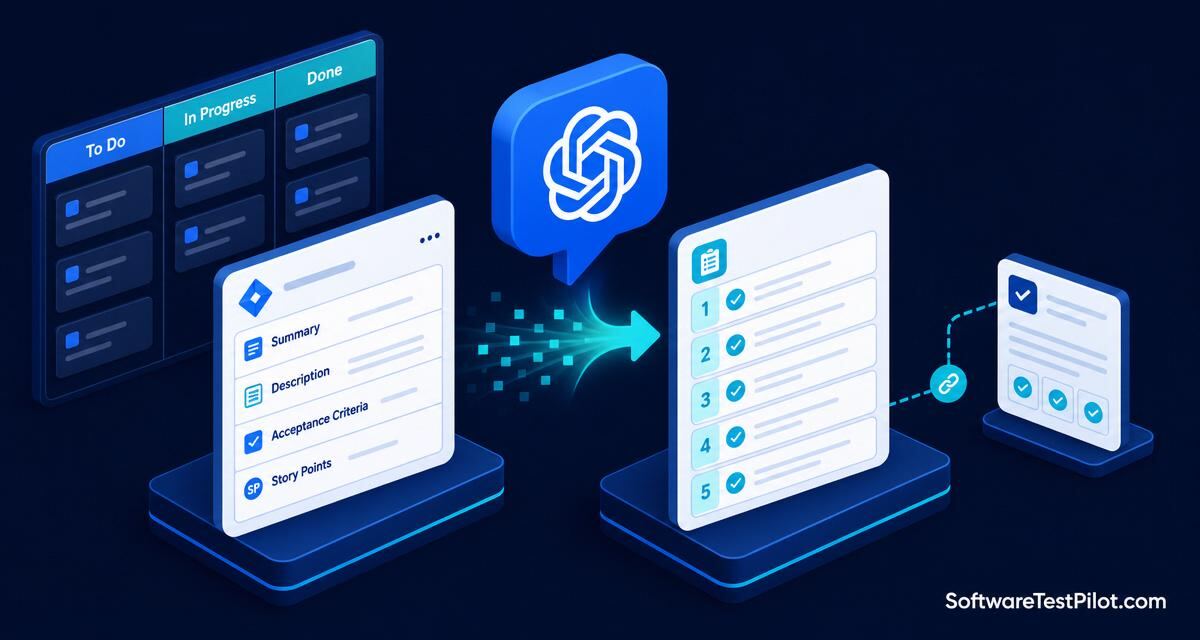
ChatGPT Jira ticket test cover — isometric infographic of a ChatGPT chat bubble converting a Jira ticket card (summary, description, acceptance criteria, story points) into a numbered test-case list, plus a Jira board with To Do / In Progress / Done columns, with the SoftwareTestPilot.com wordmark.

Last updated: July 14, 2026 · 14 min read · By Avinash Kamble, reviewed by Priyanka G.

A ChatGPT Jira ticket test workflow turns a Jira Story or Bug into a full test-case set — positive, negative, boundary and edge — in about 60 seconds, then pushes them into Xray, Zephyr Scale, TestRail or a Confluence page for review. This pillar covers the full loop: parsing the ticket, running an INVEST check, extracting test conditions, generating cases with ISTQB-aligned techniques, wiring to your test-management tool, and reviewing against a 6-point rubric.

Pair with the ChatGPT test case generation pillar, ChatGPT Gherkin scenarios pillar, ChatGPT test plan pillar and ChatGPT bug report pillar.

Key takeaways

  • A Jira ticket without INVEST-passing acceptance criteria can't be tested; run the INVEST prompt first.
  • Every AC maps to at least one positive, one negative and one boundary test.
  • Output format matters: Xray, Zephyr Scale, TestRail and Confluence all take different structures.
  • Never let ChatGPT invent field names, statuses or Jira keys. Ground in the pasted ticket only.
  • Traceability is non-negotiable: every generated test case carries the source AC ID.

1. The 5-step ChatGPT ↔ Jira workflow

1. Pull the Jira ticket (summary, description, AC, comments)
2. Run the INVEST check prompt — pass or fix AC first
3. Extract test conditions (positive, negative, boundary, edge)
4. Generate test cases in the target tool's format
5. Review against the 6-point rubric, push via API / MCP

Skipping step 2 is the #1 reason teams get garbage test cases from ChatGPT. If the AC is vague ("the page should be fast"), the generated tests will be too.

2. Prompt: INVEST check on a Jira story

You are a senior agile QA lead.
Given this Jira story: [paste summary + description + AC + linked designs].
Score it against INVEST:
- Independent (can it ship alone?)
- Negotiable (is scope discussable?)
- Valuable (user or business value stated?)
- Estimable (enough info to size?)
- Small (fits one sprint?)
- Testable (each AC verifiable and measurable?)

Return a 1-line verdict per letter, an overall PASS / FAIL,
and a rewritten "Testable" AC list for any criterion that fails T.
Never rewrite a passing AC.

3. Prompt: Jira ticket → full test-case set

You are a senior QA engineer fluent in ISTQB test design and
Xray / Zephyr Scale / TestRail conventions.

Context:
- Ticket: [paste JIRA-KEY, summary, description, AC as numbered list]
- Component / area: [name]
- Test data profile: [free / paid / admin]
- Non-functional targets: [p95 latency, WCAG level, error budget]
- Related tickets: [paste keys + 1-line context]

Task: produce a test-case set with, per AC:
- At least 1 positive case
- At least 1 negative case
- At least 1 boundary case
- Edge cases where applicable (empty, null, unicode, RTL, huge input)

Each test case row:
TC-ID | AC-ID | Title | Preconditions | Steps | Expected | Priority | Technique

Format: Markdown table. End with a coverage summary:
"AC-1: 3 cases | AC-2: 4 cases | ..." and a self-critique against the
6-point rubric (AC coverage, technique diversity, deterministic steps,
priority accuracy, traceability, PII cleanliness).

4. Prompts for Xray, Zephyr Scale, TestRail and Confluence output

Xray for Jira

Format the above test cases as an Xray "Test with steps" JSON import,
with fields: summary, projectKey, testType=Manual, steps[] with
action / data / result.

Zephyr Scale

Format as a Zephyr Scale CSV import with columns:
Name, Objective, Precondition, Priority, Status, Folder, Labels,
Test Script Type=STEP_BY_STEP, Test Script - Steps.

TestRail

Format as a TestRail CSV with columns: Title, Section, Priority,
Type, Estimate, References, Preconds, Steps, Expected Result.

Confluence page (for AC review with product)

Format as a Confluence page: H2 per AC, table of test cases beneath,
callout box at top summarising coverage %.

5. Prompts for AC gap analysis, traceability and impact

AC gap analysis

You are a QA lead. Given: [paste Jira AC list] and
[paste existing test cases for the epic].
Return a Markdown table: AC-ID | Existing coverage (test IDs) |
Gap (missing positive / negative / boundary) | Suggested new case titles.

Impact analysis on code diff

You are a QA lead. Given: [paste git diff summary or PR description]
and [paste last 6 months of test-case titles].
Return the top 20 existing tests that should re-run for this change,
ranked by risk-of-regression, with 1-line reasoning each. Flag any
"no test coverage" areas as GAP.

6. The 6-point review rubric

  1. AC coverage — every AC has ≥ 1 positive + 1 negative + 1 boundary case.
  2. Technique diversity — equivalence partitioning, boundary value analysis, decision tables and state transitions are all represented where applicable.
  3. Deterministic steps — verb-first, one action per line, no "test the thing".
  4. Priority accuracy — P0 mapped to must-work-for-release; P3 mapped to nice-to-have.
  5. Traceability — every TC references the source AC-ID and the Jira key.
  6. PII cleanliness — no real emails, names, tokens or payment data.

7. Governance, PII and MCP

Use ChatGPT Enterprise or Team with training-off. Redact customer data before paste. For automated push-back into Jira, the safest 2026 pattern is the Atlassian MCP connector with a human "File" confirmation. Fully autonomous ticket creation is not worth the audit risk. Cross-check against the NIST AI RMF.

8. ROI

  • Story-to-test-cases time drops from 45–60 min to 3–5 min.
  • AC coverage rate rises from ~65% to ~95% on the first pass.
  • "Missed AC" defect escape drops by 40–60%.
  • Time to first executable test for a new story drops by 70–80%.

Frequently asked questions

1.Can ChatGPT turn a Jira ticket into test cases?
Yes. In 2026 ChatGPT (plus Claude Opus 4.5 and Gemini 2.5 Pro) turns a Jira Story or Bug into a full test-case set — positive, negative, boundary and edge cases — in about 60 seconds, formatted for Xray, Zephyr Scale, TestRail or a Confluence page. Paste the summary, description, acceptance criteria and any linked design or spec, and use the RCTF prompt to enforce ISTQB test-design techniques (equivalence partitioning, boundary value analysis, decision tables, state transitions).
2.How do I write a ChatGPT prompt to generate tests from a Jira story?
Use RCTF. Role: senior QA engineer fluent in ISTQB and Xray/Zephyr/TestRail. Context: paste the Jira key, summary, description, acceptance criteria as a numbered list, the component, the test data profile and any non-functional targets. Task: per AC produce at least one positive, one negative and one boundary test case as a Markdown table with columns TC-ID, AC-ID, Title, Preconditions, Steps, Expected, Priority, Technique. Format: table plus a coverage summary and a self-critique against the 6-point rubric.
3.Should I run an INVEST check before generating tests?
Always. If the acceptance criteria fail Testable, the generated tests will be vague or missing. Run the INVEST prompt first: it scores the story on Independent, Negotiable, Valuable, Estimable, Small, Testable and returns a rewritten AC list for any criterion that fails Testable. Skipping this step is the #1 reason teams complain about "garbage" ChatGPT test cases — the real problem is upstream in the ticket.
4.Can ChatGPT push test cases directly into Jira / Xray?
Yes via API or the Atlassian MCP connector, but always behind a human confirmation step in 2026. The safe pattern is: ChatGPT drafts the test cases → QA engineer reviews against the 6-point rubric → engineer clicks Push → API/MCP creates the Xray Test issues. Fully autonomous push without review will occasionally create duplicates, mis-priority cases and leak un-redacted PII into your Jira project.
5.How does ChatGPT format test cases for Xray, Zephyr Scale and TestRail?
All three accept different structures. Xray: JSON import with summary, projectKey, testType=Manual and a steps[] array of action/data/result. Zephyr Scale: CSV with Name, Objective, Precondition, Priority, Status, Folder, Labels, Test Script Type=STEP_BY_STEP and Test Script - Steps. TestRail: CSV with Title, Section, Priority, Type, Estimate, References, Preconds, Steps, Expected Result. Add a Format line to the prompt naming the target tool — ChatGPT switches shape without changing the underlying test content.
6.How do I ensure every acceptance criterion has a test?
Force per-AC coverage in the prompt: "per AC produce at least 1 positive + 1 negative + 1 boundary case" and "end with a coverage summary: AC-1: N cases | AC-2: N cases | ...". Then run the gap-analysis prompt against the existing suite: paste the AC list and existing test titles, ask for a table of AC-ID | Existing coverage | Gap | Suggested new case titles. This one loop typically raises AC coverage from ~65% to ~95% on the first pass.
7.Can ChatGPT do impact analysis on a PR against Jira tickets?
Yes. Paste the PR description or git diff summary plus 6 months of test-case titles for the area and ask for the top 20 tests to re-run for this change, ranked by regression risk with reasoning. Flag no-coverage areas as GAP. This is one of the highest-ROI prompts for change-based testing and cuts regression run size by 40–70% on healthy suites without missing real regressions.
8.Is it safe to paste Jira ticket content into ChatGPT?
Story descriptions and generic acceptance criteria are usually fine on ChatGPT Enterprise or Team with training-off. Never paste attachments with real customer data, session tokens, real payment or health details, or NDA-covered material. Use the redaction template (replace real emails with user{N}@example.com, real names with Persona A/B, real tokens with [REDACTED-TOKEN]). Regulated workloads: Azure OpenAI, AWS Bedrock or self-hosted Llama 4.
9.How does ChatGPT handle epics vs stories?
For an epic, run a two-pass workflow: first ask ChatGPT to summarise the epic into 5–10 child-story-sized outcomes, each with draft AC; then run the Story → test-cases prompt per child story. Trying to generate tests directly from an epic produces shallow, generic cases. This two-pass pattern also doubles as a story-splitting aid for product managers.
10.Can ChatGPT generate exploratory testing charters from a Jira ticket?
Yes. Prompt: "Given this ticket [paste], produce 5 exploratory testing charters in the SBTM format: Explore [target] With [resources] To discover [information]. Each charter targets a different risk (data corruption, permissions, race conditions, i18n, accessibility). Timebox 30–45 min." Charters complement scripted test cases and often surface bugs that scripted cases miss.
11.How long does ChatGPT-generated test creation actually save?
On healthy 2026 QA teams: story-to-test-cases drops from 45–60 minutes to 3–5 minutes (excluding review). Review takes 5–10 minutes with the 6-point rubric. Net saving: roughly 70–80% per story, plus ~25–35% higher AC coverage on the first pass. Missed-AC defect escape drops 40–60% because gap analysis catches uncovered criteria before test design closes.
12.Does ChatGPT follow ISTQB test-design techniques?
Yes when you name them. Force the prompt to apply equivalence partitioning, boundary value analysis, decision tables, state transition testing and (for exploratory) SBTM charters. Add a rubric criterion "technique diversity — at least 3 techniques represented across the case set". This is the difference between "AI generated 15 near-duplicate happy-path tests" and "AI generated a genuine risk-covering suite".
Keep going

Practice these questions

Run a live QA mock interview tailored to this topic and get per-skill scoring in minutes.

Found this useful?
Share:XLinkedInWhatsApp

Was this article helpful?

Cluster · AI in Testing

More from ChatGPT for Testers

Prompt patterns for test design, data, review.

Pillar guide · 12 articles
More in this cluster
From the AI in Testing pillar

Keep building your QA edge

Continue reading

Join the QA Community

Connect with fellow testers, share job leads, and get career advice.

Premium QA Resources

Stop Reinventing the Wheel. Upgrade Your QA Arsenal.

Take your testing skills from beginner to Lead Engineer. Supercharge your daily workflow with our premium digital resources.

  • Ready-to-use testing strategy templates
  • Advanced API & UI automation guides
  • ⏱️ Save 10+ hours a week on test planning
4.9/5 rating
Explore All Products

⭐⭐⭐⭐⭐ Trusted by 1,000+ Software Test Pilots • Instant Access