SoftwareTestPilot
AI in TestingPublished: 16 min read

ChatGPT for Regression Testing in 2026: The Complete Playbook (Test Impact Analysis, Prompts & FAQ)

The definitive 2026 guide to regression testing with ChatGPT — risk-based selection, test impact analysis on PR diffs, smoke/sanity/full pyramid, flaky-test triage, 12 prompts, a 7-point rubric and every People Also Ask question Google surfaces.

Avinash Kamble
Founder & QA Engineer at SoftwareTestPilot
Reviewed by Priyanka G.
Share:XLinkedInWhatsApp
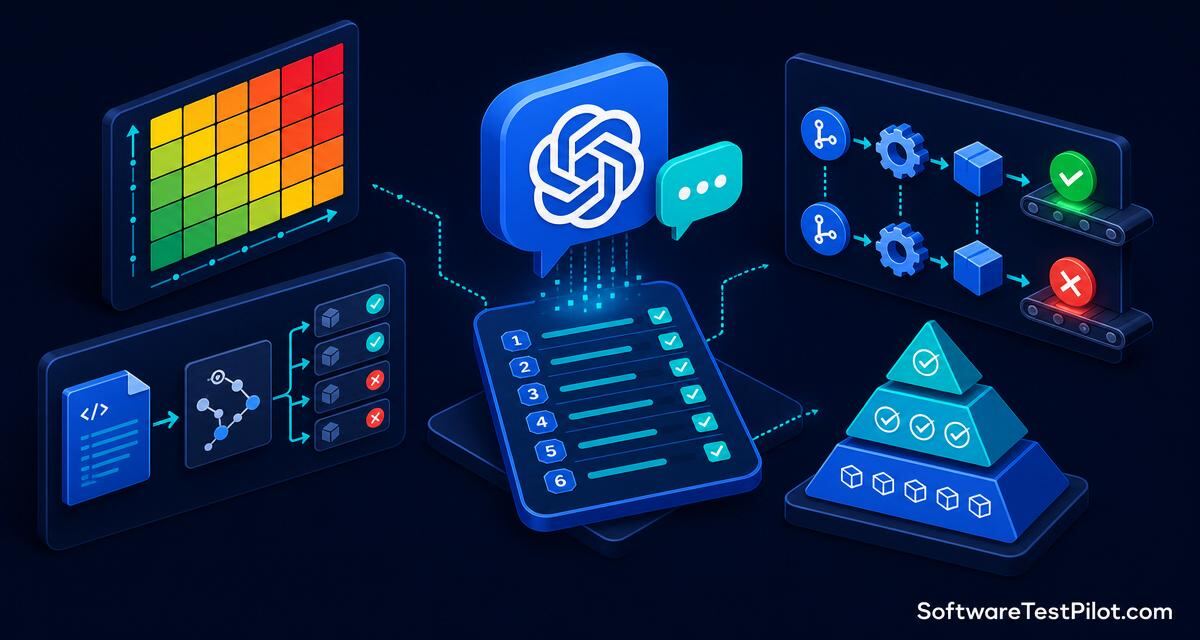
ChatGPT for regression testing cover — isometric infographic of a ChatGPT chat bubble producing a prioritized regression test list, plus risk heatmap, test-impact-analysis flow, CI pipeline with pass/fail and a smoke/sanity/full regression pyramid, with the SoftwareTestPilot.com wordmark.

Last updated: July 14, 2026 · 16 min read · By Avinash Kamble, reviewed by Priyanka G.

ChatGPT for regression testing in 2026 means using OpenAI's models — with Claude Opus 4.5 and Gemini 2.5 Pro — to pick the right subset of regression tests for each change (test impact analysis), triage flaky tests, generate missing regression cases for recent bugs, and build the smoke / sanity / full-regression pyramid that keeps CI under 15 minutes without missing real regressions. Done well, ChatGPT cuts regression run size by 40–70% without lifting escape defects, and cuts flaky-triage time by 60–80%.

Pair with the ChatGPT test case generation pillar, the ChatGPT for QA testing pillar and the QA automation 2026 guide.

Key takeaways

  • Regression is a selection problem, not a "run everything" problem.
  • Test Impact Analysis (TIA) from a code diff is the highest-leverage prompt in this pillar.
  • Build a pyramid: smoke (2–5 min) → sanity (10–15 min) → nightly full → weekly deep.
  • Every escaped defect gets a new regression test — ChatGPT drafts it in seconds.
  • Flaky tests are quarantined, not skipped; ChatGPT triages by pattern.

1. The regression pyramid

Weekly deep    | Full suite + long soak + perf + security
Nightly full   | All automated regression, all envs
Sanity (PR)    | Top 50–150 tests, 10–15 min
Smoke (commit) | Top 15–30 tests, 2–5 min
Preflight      | Unit + lint + type-check, < 60 s

Pick the tier per pipeline stage. ChatGPT helps by scoring and re-scoring tier membership continuously from usage, risk and change data.

2. Master prompt: Test Impact Analysis on a PR diff

You are a senior QA lead fluent in test impact analysis and
risk-based testing.

Context:
- PR title + description: [paste]
- git diff (files + hunks): [paste]
- Full regression test titles + tags + last-known runtime: [paste]
- Component ownership map: [paste]
- Recent 90-day escape defects by component: [paste]

Task: return a prioritised regression subset for this PR:
- Tier 1 (must run on this PR): highest risk of regression
- Tier 2 (nightly): related
- Tier 3 (weekly): unaffected

For each Tier 1 test: cite the diff hunk that triggered inclusion,
the linked component, and estimated runtime. Cap Tier 1 at 15 minutes
of total runtime. Flag any changed area with NO existing test as GAP.

Format: Markdown tables per tier + a bullet list of GAP areas.

3. Prompt: flaky test triage

You are a senior SDET fluent in flaky-test taxonomy (async wait,
test isolation, order dependency, environment drift, real-clock,
external service).

Given: [paste last 30 runs of the test with pass/fail + error snippet
+ duration]. Return:
- Flaky classification (one of the 6 categories) + confidence
- Root-cause hypothesis with 3-line reasoning
- Suggested fix (code snippet if applicable)
- Quarantine decision (Y/N) with 1-line rationale
- Suggested owner (from ownership map): [paste]

Never say "just add a wait" — cite the specific failure pattern.

4. Prompt: escaped defect → new regression test

You are a senior SDET. Given this escaped defect:
[paste bug report, RCA, hotfix diff].

Produce a new regression test that:
- Would have caught this bug pre-release
- Runs in < 30 seconds
- Belongs in the smoke tier if the fix touches critical path,
  otherwise sanity
- Uses the existing framework: [Playwright / Cypress / RestAssured /
  pytest]
- Reuses the existing page objects / API clients: [paste catalogue]

Output: full test file + a 3-line rationale linking each assertion
to the RCA cause.

5. Prompts for suite audit and dedup

You are a QA lead. Given [paste 200 regression test titles + last 90
days pass/fail/skip stats + avg runtime + last-modified date].

Return:
- Dead weight: tests with 0 failures in 90 days AND covering an area
  with 0 changes — recommend delete or move to weekly deep.
- Duplicates: near-duplicate titles (Jaccard > 0.7) — recommend merge.
- Long tail: top 20 slowest tests contributing to CI time; suggest
  parallelisation, mock strategy, or split.
- Coverage bright spots: components with heavy test coverage but
  low change rate — candidates for reduction.
- Coverage dark spots: components with recent escapes but low test
  coverage — candidates for expansion.
Format: 5 tables.

6. Prompts for risk-based re-scoring and drift detection

Re-score the P0/P1/P2 tier of every regression test based on:
- Component change frequency (last 90 days)
- Escape defect history (last 12 months)
- Business criticality (revenue path Y/N, auth Y/N, PII Y/N)
- Test run stability (pass rate last 30 runs)
Return before/after tier for every test that moves, with reasoning.

Detect drift: given [paste release notes for last 3 releases],
list regression tests that likely need updates (expected values,
new fields, deprecated endpoints).

7. The 7-point review rubric

  1. Every Tier 1 selection cites a diff hunk + a component link.
  2. Total Tier 1 runtime fits the CI budget (default 15 min).
  3. GAP areas listed and owner-tagged.
  4. Flaky triage classification uses the 6-category taxonomy, not "just retry".
  5. New regression tests reuse existing page objects / API clients.
  6. No secrets or real user data in generated tests.
  7. Traceability: escaped-defect regression tests link to the RCA ticket.

8. ROI and rollout

Honest 2026 ranges: PR regression run size drops 40–70% at equal escape rate. Flaky-triage time drops 60–80%. Time-to-quarantine drops from days to minutes. Rollout: publish the TIA and flaky-triage prompts in docs/ai-usage.md, wire the TIA prompt into a GitHub Action that comments the selected tier on every PR, and quarterly run the suite-audit prompt to prune dead weight.

Frequently asked questions

1.Can ChatGPT do regression testing?
Yes — as a selection, triage and generation layer, not as an execution engine. In 2026 ChatGPT picks the right regression subset for each PR (test impact analysis), triages flaky tests into 6 root-cause categories, generates new regression tests from escaped defects, and audits the suite quarterly for dead weight and duplicates. Measured impact on healthy teams: 40–70% smaller PR regression runs at equal escape rate, and 60–80% faster flaky triage. The tests still execute in your existing framework (Playwright, Cypress, REST Assured, pytest).
2.What is test impact analysis and can ChatGPT do it?
Test Impact Analysis (TIA) picks the subset of regression tests most likely to catch a regression from a specific code change, so CI stays fast without lowering coverage. ChatGPT does TIA well when you paste (1) the PR diff, (2) full regression titles + tags + runtime, (3) the component ownership map, and (4) 90-day escape defects by component. It returns Tier 1 (must run on PR), Tier 2 (nightly), Tier 3 (weekly), each Tier 1 test citing the diff hunk that triggered inclusion. Cap Tier 1 at your CI budget (typically 15 min).
3.How do I use ChatGPT to triage flaky tests?
Paste the last 30 runs of the flaky test (pass/fail, error snippet, duration) and ask ChatGPT to classify against the 6-category flakiness taxonomy — async wait, test isolation, order dependency, environment drift, real-clock, external service — with a confidence score. It returns a root-cause hypothesis, a suggested fix (with code snippet where possible), a quarantine decision, and a suggested owner from the ownership map. Never accept "just add a wait" — force the specific failure pattern to be cited.
4.Should ChatGPT run the regression tests too?
No. ChatGPT selects, triages and drafts; your existing framework (Playwright, Cypress, REST Assured, pytest) executes, and your CI (GitHub Actions, Jenkins, GitLab, CircleCI) orchestrates. Fully autonomous "AI runs and interprets the tests" tools exist in 2026 (Applitools Autonomous, Tricentis Copilot) but they complement, not replace, this workflow. The audit trail and deterministic reruns from a real framework are non-negotiable for regulated releases.
5.How does ChatGPT reduce regression run size without missing regressions?
By moving from "run everything" to "run what the change and history predict is at risk". A change in the checkout module surfaces the last-12-months checkout escapes and the ownership-mapped tests, ignoring the marketing-site tests. Coverage on the change area actually rises even as total run size falls. Escape-rate parity is measurable — track before/after for one quarter and expand only if flat or lower.
6.Can ChatGPT generate a regression test from an escaped defect?
Yes and it is a standard part of every 2026 post-mortem. Paste the bug report, RCA and hotfix diff. Ask for a new regression test that would have caught the bug pre-release, runs in <30s, belongs in the smoke tier if it touches the critical path (else sanity), uses the existing framework and reuses existing page objects/API clients. Output includes a 3-line rationale linking each assertion to the RCA cause. This closes the escape → regression loop that most teams do manually and inconsistently.
7.How often should I audit the regression suite with ChatGPT?
Quarterly on healthy teams; monthly on fast-moving teams. Paste 200 regression titles + 90-day pass/fail/skip + avg runtime + last-modified date and ask ChatGPT for dead weight (0 failures in 90 days, 0 changes in area), near-duplicates (Jaccard > 0.7), long-tail slowest tests, coverage bright spots (heavy tests + low change) and dark spots (recent escapes + low tests). Typical result on brownfield suites: 15–25% dead weight, 10–20% duplicates, 3–5 dark spots requiring new tests.
8.Can ChatGPT detect drift when the app changes?
Yes when you paste the last 3 releases' release notes. It flags regression tests whose expected values, field lists or endpoints likely changed and need updating. Wire this into a release checklist — ChatGPT does the initial scan in 60 seconds; the QA lead confirms and updates in an hour instead of the multi-day "why did 200 tests fail after release" firefight.
9.How does ChatGPT fit with self-healing tools like Testim or Katalon TrueTest?
Complementary. Self-healing tools handle selector churn at runtime; ChatGPT handles suite-level selection, prioritisation, triage and generation. Most mature 2026 teams use both — self-healing keeps individual scripts alive across UI changes, ChatGPT keeps the overall suite lean, risk-focused and continuously pruned.
10.How do I prevent ChatGPT from picking a bloated Tier 1?
Cap total runtime in the prompt: "Tier 1 total runtime must fit within 15 minutes. If more tests qualify, keep only the highest-risk ones and downgrade the rest to Tier 2 with reasoning." Also require every Tier 1 selection to cite the diff hunk that triggered it — this forces the model to justify inclusion instead of over-selecting to appear thorough.
11.How do I roll out ChatGPT regression triage across a QA team?
Realistic 21-day rollout: Week 1 publish the TIA prompt, the flaky taxonomy prompt and the new-regression-from-escape prompt in docs/ai-usage.md. Week 2 wire the TIA prompt into a GitHub Action that comments the Tier 1 list on every PR (advisory, not blocking). Week 3 baseline four KPIs — average PR CI time, escape-defect rate, flaky-test count, quarantine time — and compare to pre-rollout. Expand or roll back based on data.
12.Is it safe to paste diffs and test names into ChatGPT?
Generally yes on ChatGPT Enterprise or Team with training-off. Never paste diffs that contain secrets (Cursor, Gitleaks or similar should flag first), real customer data or NDA-covered material. Repository visibility matters — treat the paste with the same policy you'd apply to sharing the diff externally. Regulated workloads use Azure OpenAI, AWS Bedrock or self-hosted Llama 4.
Keep going

Practice these questions

Run a live QA mock interview tailored to this topic and get per-skill scoring in minutes.

Found this useful?
Share:XLinkedInWhatsApp

Was this article helpful?

Cluster · AI in Testing

More from ChatGPT for Testers

Prompt patterns for test design, data, review.

Pillar guide · 12 articles
More in this cluster
From the AI in Testing pillar

Keep building your QA edge

Continue reading

Join the QA Community

Connect with fellow testers, share job leads, and get career advice.

Premium QA Resources

Stop Reinventing the Wheel. Upgrade Your QA Arsenal.

Take your testing skills from beginner to Lead Engineer. Supercharge your daily workflow with our premium digital resources.

  • Ready-to-use testing strategy templates
  • Advanced API & UI automation guides
  • ⏱️ Save 10+ hours a week on test planning
4.9/5 rating
Explore All Products

⭐⭐⭐⭐⭐ Trusted by 1,000+ Software Test Pilots • Instant Access