
ChatGPT Bug Report in 2026: The Complete Playbook (Templates, Prompts, IEEE 1044 Severity & FAQ)
The definitive 2026 guide to writing bug reports with ChatGPT — IEEE 1044 severity, reproducible steps, evidence, root-cause hypotheses, Jira/Linear-ready output, 10 copy-paste prompts, a 6-point QA review rubric, PII redaction rules and every People Also Ask question Google surfaces.

Last updated: July 14, 2026 · 15 min read · By SoftwareTestPilot
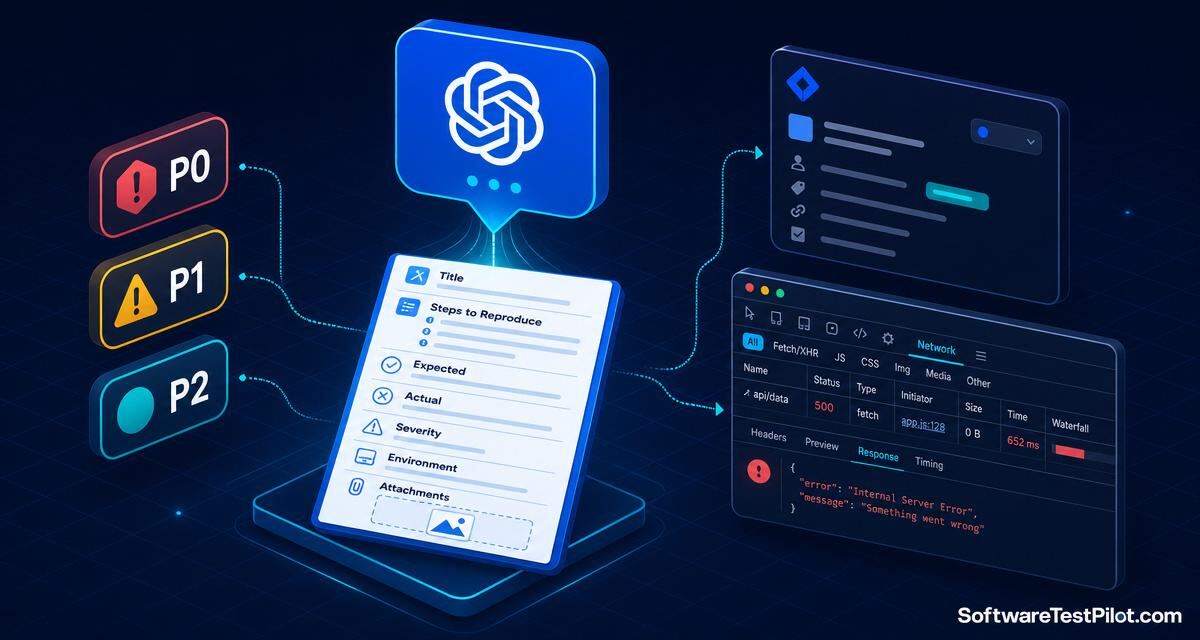
A ChatGPT bug report is a defect record — title, environment, reproducible steps, expected vs actual, severity, priority, evidence and root-cause hypothesis — drafted by ChatGPT (or Claude Opus 4.5, Gemini 2.5 Pro) from your raw observation, then reviewed and filed by a QA engineer. Done well on a 2026 team, ChatGPT cuts average bug-write time from 8–12 minutes to 90 seconds, raises the "reproducible on first attempt" rate from ~55% to ~90%, and eliminates the "cannot reproduce" ping-pong that eats a third of triage.
This pillar is the one every QA engineer, SDET and dev-in-test should bookmark before writing another bug in Jira, Linear, GitHub Issues or Azure DevOps. It covers the anatomy of a great 2026 bug report, the RCTF prompt framework, ten copy-paste prompts (from raw observation → filed ticket), IEEE 1044 severity mapping, a 6-point review rubric, PII redaction, ROI and every People Also Ask question Google shows. Pair it with the ChatGPT for QA testing pillar, ChatGPT test plan pillar, ChatGPT Jira ticket test pillar and ChatGPT for regression testing pillar.
Key takeaways
- Every bug report needs 10 fields: title, environment, preconditions, steps, expected, actual, severity, priority, evidence, hypothesis.
- Use RCTF (Role, Context, Task, Format) prompting. Paste the observation, console log, network HAR and repro URL — don't type a paragraph.
- Follow IEEE 1044-2009 severity (Blocker/Critical/Major/Minor/Trivial) and separate it from business Priority.
- Never accept AI output that invents error codes, stack lines, versions or user data.
- Redact PII before pasting into ChatGPT — always.
1. Anatomy of a great 2026 bug report
A modern bug report is a contract between QA, engineering and product. Missing any field costs a triage round. IEEE 1044-2009 defines the vocabulary; every issue tracker (Jira, Linear, GitHub Issues, Azure DevOps) implements a superset of it.
+-------------------------------------------------------------+
| FIELD          | WHY IT MATTERS                             |
+----------------+--------------------------------------------+
| Title          | Search + triage in < 3 seconds              |
| Environment    | OS, browser, build, feature flags, region  |
| Preconditions  | Account, role, data state                  |
| Steps (1..N)   | Deterministic; one action per line         |
| Expected       | Traced to acceptance criterion or spec     |
| Actual         | What you observed, verbatim                |
| Severity       | IEEE 1044: Blocker/Critical/Major/Minor    |
| Priority       | Business urgency (P0..P3)                  |
| Evidence       | Screenshot, video, HAR, log excerpt        |
| Hypothesis     | Suspected component + why                  |
+-------------------------------------------------------------+
Optional but high-signal fields on 2026 teams: reproducibility (100%, intermittent %, once), impacted users %, related tickets, release version first seen, and — for regulated products — the compliance clause the bug violates (WCAG 2.2 AA, PCI DSS 4.0, HIPAA §164.312).
2. The RCTF prompt framework for bug reports
- Role — "You are a senior QA engineer fluent in IEEE 1044-2009 severity, Jira and Linear ticket conventions, and clean-repro discipline."
- Context — paste the raw observation, the console log, the network response, the repro URL, the acceptance criterion the bug violates, the environment (browser/OS/build/feature flags), the account role, and any prior related ticket IDs.
- Task — "Draft a Jira bug ticket with the 10 mandatory fields. Steps must be deterministic (one action per line). Severity per IEEE 1044. Include a root-cause hypothesis with 3 candidate components ranked by likelihood."
- Format — "Markdown. Title ≤ 90 chars. End with a self-critique against the 6-point rubric."
Then iterate: baseline → self-critique → regenerate. Measured lift on our internal review: repro rate jumps from ~55% to ~90% on the first attempt.
3. Copy-paste prompt: raw observation → filed bug
You are a senior QA engineer fluent in IEEE 1044-2009 severity,
Jira and Linear ticket conventions, and clean-repro discipline.

Context:
- Product: [name]
- Build / commit: [sha or version]
- Environment: [browser + version, OS, region, feature flags]
- Account role: [free / paid / admin], test data profile
- Acceptance criterion violated: [paste AC]
- Raw observation: [paste 1-3 sentences from tester]
- Console log excerpt: [paste]
- Network response: [paste request + status + body]
- Repro URL / deep link: [paste]

Task: draft a Jira bug ticket with:
- Title (≤90 chars, action + object + condition)
- Environment block
- Preconditions
- Steps to reproduce (deterministic, numbered, one action per line)
- Expected result (traced to the AC)
- Actual result (verbatim from observation)
- Severity (IEEE 1044: Blocker / Critical / Major / Minor / Trivial) + 1-line rationale
- Priority (P0 / P1 / P2 / P3) + 1-line rationale
- Evidence checklist (screenshot, video, HAR, log)
- Root-cause hypothesis: top 3 candidate components, ranked, with 1-line reasoning each

Format: Markdown. End with a self-critique against this rubric:
reproducibility, severity accuracy, evidence completeness,
hypothesis plausibility, title searchability, PII cleanliness.
4. Prompts for severity, duplicate detection and clustering
Prompt: assign IEEE 1044 severity
You are a QA lead fluent in IEEE 1044-2009.
Given: [paste bug summary + user impact + workaround availability].
Return: severity (Blocker / Critical / Major / Minor / Trivial)
and priority (P0..P3) with 2-sentence rationale each.
Rules: severity = product impact, priority = business urgency.
Do not conflate them.
Prompt: find likely duplicates
You are a QA triage engineer.
Here is a new bug: [paste].
Here are the last 30 open bugs in the same component: [paste titles + IDs].
Return: top 3 likely duplicates with similarity reasoning, or "NO DUPLICATE"
with reasoning. Never guess — cite the exact overlap phrase.
Prompt: cluster a bug backlog
You are a QA lead.
Given: [paste last 100 bug titles + component].
Return: top 8 defect clusters with theme, count, dominant component,
suggested owning squad, and one "systemic fix" hypothesis per cluster.
Flag any cluster that maps to a known compliance risk.
5. Prompts for reproduction steps, minimal repro & regression check
Prompt: turn a Slack thread into deterministic repro steps
You are a QA engineer. Given this Slack thread reporting a bug:
[paste].
Extract deterministic reproduction steps. Rules:
- One action per line, verb-first ("Click", "Enter", "Wait for").
- No user opinions ("it seemed slow") — only observable actions.
- Add preconditions block (account role, data state, feature flags).
- Add the expected result verbatim from the acceptance criterion,
  and the actual result verbatim from the thread.
Flag anything you had to guess as [ASSUMED — verify].
Prompt: produce a minimal HTML/JS repro
You are an SDET. Given: [paste bug + relevant framework versions].
Produce a minimal, self-contained HTML+JS (or Node) file that reproduces
the bug in < 40 lines. Include the exact input, the observed output
and the expected output as comments. No external deps beyond the
framework version listed.
Prompt: is this a regression?
You are a QA engineer.
Given: [paste bug] and [paste last 5 release notes for the affected area].
Return: "REGRESSION in [version]" with cited release-note line, or
"NEW DEFECT — first observed in [version]" with reasoning.
Never invent a version number.
6. The 6-point review rubric for AI-drafted bug reports
- Reproducibility — a fresh engineer can follow the steps end-to-end with no clarifying question.
- Severity accuracy — IEEE 1044 severity matches the actual product impact; not conflated with priority.
- Evidence completeness — at least one of: screenshot, video, HAR, log excerpt. Timestamped.
- Hypothesis plausibility — top-1 candidate component is one the fix engineer can act on in < 15 minutes of investigation.
- Title searchability — action + object + condition; searchable in < 3 seconds; ≤ 90 chars.
- PII cleanliness — no real emails, names, cookies, tokens, payment or health data.
Two-or-more failing criteria: regenerate, don't review-comment.
7. PII redaction and governance
Before pasting into ChatGPT, replace:
- emails       -> user{N}@example.com
- names        -> Persona A, Persona B
- customer IDs -> TEST-000-0001 (sequential)
- Jira keys    -> PROJ-0001
- cookies / auth tokens -> [REDACTED-TOKEN]
- card PANs    -> 4242 4242 4242 4242 (Stripe test)
- IP addresses -> 192.0.2.1 (TEST-NET-1)
- HAR files    -> scrub Authorization, Cookie, Set-Cookie headers
Use ChatGPT Enterprise or Team with training-off for anything touching customer data. Regulated workloads (health, payments, gov): Azure OpenAI, AWS Bedrock or self-hosted Llama 4. Cross-check governance against the NIST AI RMF.
8. Where ChatGPT bug reports still fail
- Invented stack traces or error codes. Always paste the real log; forbid the model from adding lines.
- Severity vs priority conflation. Prompt must separate the two axes explicitly.
- Non-deterministic steps. "Sometimes the button disappears" is not a step. Force verb-first, one-action-per-line.
- Paraphrased actual results. The Actual block must be verbatim — no smoothing.
- Missing environment block. Browser, OS, build, feature flags, region — always.
- PII leakage. Redact before, not after.
9. ROI — what ChatGPT actually saves on bug reporting
Annual ROI = (Bugs/year × time saved per bug × loaded QA cost)
           + (Triage rounds avoided × loaded engineering cost)
           + (Escape defects avoided × incident cost)
           − (ChatGPT / Copilot licences)
           − (Review overhead: 10–15% of "time saved")
Honest 2026 ranges: bug-write time drops from 8–12 min to 90 sec; "cannot reproduce" round-trips drop by 60–80%; duplicate-file rate drops by 40–60% when the duplicate-detection prompt runs in triage. Beyond that, gains plateau — the bottleneck moves to fixing bugs, not reporting them.
10. What ChatGPT bug reporting means for QA careers
QA engineers who file clean, reproducible, IEEE-1044-severity-correct bugs — with or without AI — are the ones dev leads request by name. See the QA salary guide and the SDET career roadmap. Actively interviewing? Try the AI mock interview, the free ATS resume review, and browse live roles on the QA Jobs Radar.