
ChatGPT Gherkin Scenarios in 2026: The Complete BDD Playbook (Prompts, Anti-Patterns & FAQ)
The definitive 2026 guide to writing Gherkin BDD scenarios with ChatGPT — Given/When/Then discipline, Scenario Outline + Examples, step-definition-ready phrasing, 10 copy-paste prompts, a 7-point review rubric, anti-patterns and every People Also Ask question Google surfaces.

Last updated: July 14, 2026 · 15 min read · By SoftwareTestPilot
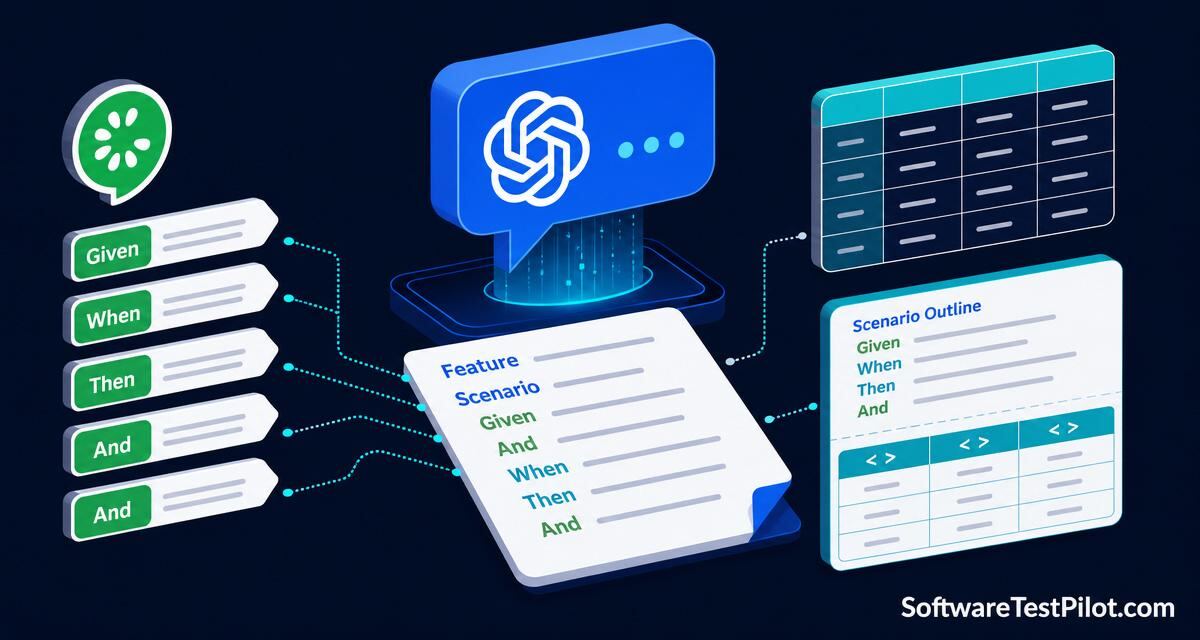
ChatGPT Gherkin scenarios are BDD Feature files — Feature, Background, Scenario, Scenario Outline, Given/When/Then/And/But, Examples — drafted by ChatGPT (or Claude Opus 4.5, Gemini 2.5 Pro) from acceptance criteria, then reviewed by a QA engineer and wired to Cucumber, SpecFlow, Behave, pytest-bdd or Reqnroll step definitions. Done well, ChatGPT cuts Gherkin authoring time by 70–85% and — more importantly — enforces the discipline (declarative phrasing, one behavior per scenario, no UI leakage) that most hand-written BDD suites lack.
This pillar covers the anatomy of a great 2026 Feature file, the RCTF prompt framework, ten copy-paste prompts (feature → scenarios → outlines → step-def stubs), the 7-point BDD review rubric, the 8 anti-patterns to reject on sight, ROI, ISTQB alignment and the People Also Ask questions Google surfaces. Pair with ChatGPT for QA testing, ChatGPT test case generation and ChatGPT write Selenium code.
Key takeaways
- Gherkin is a declarative business language. If your scenario mentions xpath, css selectors or "click", it is broken.
- One behavior per Scenario. Multi-behavior scenarios are the #1 BDD anti-pattern.
- Use Scenario Outline + Examples for data-driven cases, not five near-identical scenarios.
- Force ChatGPT to output step-definition-ready phrases (reusable, verb-first, no UI nouns).
- Reject any scenario that fails the 7-point rubric — regenerate, don't review-edit.
1. What Gherkin actually is (and is not)
Gherkin is the plain-language DSL used by Cucumber, SpecFlow, Reqnroll, Behave and pytest-bdd. It has 10 keywords: Feature, Rule, Example (a.k.a. Scenario), Given, When, Then, And, But, Background, Scenario Outline (with Examples). It exists to make acceptance criteria executable by a business-readable file that runs as a test.
Feature: Password reset
  Rule: A verified user can reset their password once per hour

    Background:
      Given the auth service is available
      And the email service is available

    Scenario: Verified user requests a reset link
      Given a verified user "alice@example.com"
      When she requests a password reset
      Then a reset link is emailed within 30 seconds
      And the link is valid for 60 minutes
What Gherkin is not: a UI script (no clicks, no selectors), a test-runner (Cucumber runs the steps), or a way to describe every edge case in prose. Cases that don't fit BDD (perf, security, deep unit tests) stay in their native frameworks — Gherkin is for user-observable behavior.
2. RCTF prompt framework for Gherkin
- Role — "You are a senior BDD engineer fluent in Gherkin 6, Cucumber, SpecFlow and pytest-bdd. You enforce declarative phrasing (business language, no UI nouns, no selectors)."
- Context — paste the acceptance criteria, personas, business rules, out-of-scope list, and any existing step-definition catalogue so the model reuses phrases.
- Task — "Produce a Feature file with a Background, one Rule per business rule, one Scenario per behavior, and a Scenario Outline + Examples for data-driven cases. Steps must be reusable and declarative."
- Format — "Plain .feature file. Two-space indent. End with a self-critique against the 7-point rubric."
3. Copy-paste prompt: acceptance criteria → Feature file
You are a senior BDD engineer fluent in Gherkin 6, Cucumber,
SpecFlow and pytest-bdd. You enforce declarative phrasing.

Context:
- Feature name: [name]
- Personas: [paste with role + permissions]
- Acceptance criteria (as numbered list): [paste]
- Business rules (Gherkin "Rule"): [paste]
- Out of scope: [paste]
- Existing step-definition catalogue: [paste phrases or "none"]

Task: produce a Feature file that:
- Starts with Feature: + 2-line goal narrative
- Uses "Rule:" for each business rule
- Has a Background for shared preconditions
- One Scenario per behavior (never combine)
- Uses Scenario Outline + Examples for data-driven variants
- Steps are declarative (business language) — no clicks, no selectors,
  no field names, no UI verbs
- Reuses existing step phrases where possible

Format: plain .feature, 2-space indent. End with a self-critique
against this rubric: declarative phrasing, one-behavior-per-scenario,
step reuse, outline usage, Background hygiene, negative-case coverage,
rule tagging.
4. Prompts for Scenario Outlines, negative cases and edge data
Prompt: convert 5 near-identical scenarios into one Outline
You are a BDD engineer. Given: [paste 5 similar scenarios].
Refactor into a single Scenario Outline with an Examples table.
Columns must be the varying variables only. Add 3 additional
Examples rows covering: boundary, negative and empty-string cases.
Prompt: generate negative + boundary scenarios
You are a BDD engineer applying ISTQB test-design techniques.
Given: [paste happy-path scenarios].
Generate the missing negative and boundary scenarios using
equivalence partitioning, boundary value analysis and decision tables.
Each scenario must add unique risk coverage — reject any that duplicate
existing coverage.
Prompt: extract step-definition stubs
You are a BDD engineer. Given this .feature file: [paste].
Emit deduplicated step-definition stubs for [Cucumber-JVM / Cucumber-JS /
SpecFlow / pytest-bdd]. Group by phrase. Include suggested parameter
types (int, string, DataTable). Flag any step that is ambiguous or
overlaps an existing catalogue phrase.
5. Prompts to refactor imperative BDD into declarative BDD
You are a BDD engineer. This scenario is imperative and UI-coupled:
[paste].
Refactor into declarative business language. Rules:
- No "click", "type", "select from dropdown"
- No CSS selectors, xpaths, or field IDs
- No "and then and then and then" chains
- Reuse existing step phrases: [paste catalogue]
Return the refactored scenario + a 3-bullet diff explaining
what you removed and why.
6. The 7-point review rubric for AI-drafted Gherkin
- Declarative phrasing — no UI verbs, no selectors, no field IDs. Business language only.
- One behavior per Scenario — no "and then and then" chains.
- Step reuse — existing catalogue phrases used where they exist.
- Outline usage — data-driven variants live in a Scenario Outline + Examples, not 5 near-duplicate scenarios.
- Background hygiene — only truly shared preconditions in Background; nothing scenario-specific.
- Negative-case coverage — at least one negative or boundary scenario per Rule.
- Rule tagging — each Scenario maps to exactly one Rule (or is tagged when it spans rules).
7. Eight Gherkin anti-patterns to reject on sight
- UI script disguise — "When the user clicks the #submit button". Reject.
- Multi-behavior scenario — Given/When/Then/When/Then. Split.
- Given with an action verb — Given contains state, not actions. "Given the user logs in" is broken.
- Then with side effects — Then asserts, never mutates.
- Missing negative cases — happy-path only.
- Background bloat — scenario-specific data in Background.
- Outline abuse — Scenario Outline with 1 Example row (should be a Scenario).
- Feature-level narrative missing — no "As a … I want … So that …" or equivalent goal statement.
8. ROI and rollout
Honest 2026 ranges: BDD authoring 70–85% faster, step-reuse rate up 40–60% when the existing catalogue is pasted, negative-case coverage roughly doubles when the boundary/negative prompt is standard. Rollout: publish the RCTF template, the 7-point rubric and the step catalogue in docs/bdd/; wire the rubric into the PR template; run a "rubric grep" in CI (fail the PR if any Then contains "click" or a selector).