
Claude for QA in 2026: The Complete Playbook (Test Plans, Cases, Bugs, Gherkin, PR Reviews & FAQ)
The definitive 2026 guide to Claude for QA — Sonnet 4.5 and Opus 4.5 for test plans, ISTQB test cases, IEEE 1044 bug reports, Gherkin, PR reviews, TSRs and every People Also Ask question Google surfaces.

Last updated: July 14, 2026 · 14 min read · By SoftwareTestPilot
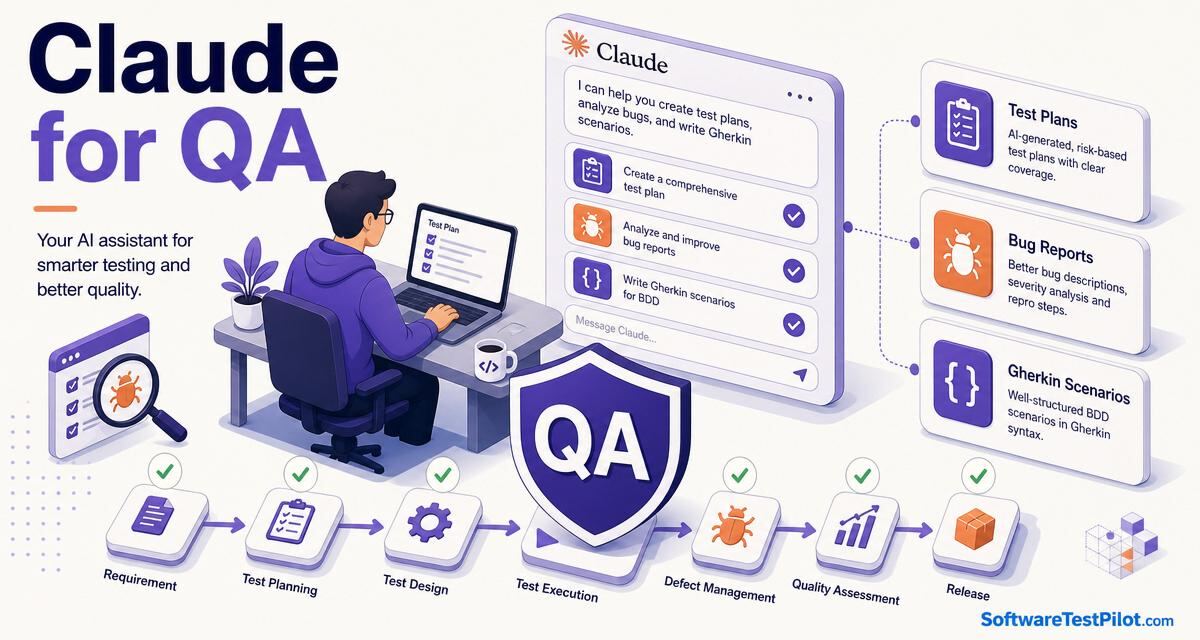
Claude for QA is the end-to-end use of Anthropic's Claude models across the QA lifecycle — test planning, test case design, execution triage, bug reporting, release readiness — for QA engineers, test analysts, SDETs and QA leads. Measured on 2026 teams, Claude cuts QA-artefact authoring by 55–75%, closes the requirements-ambiguity loop earlier (Claude flags contradictions in the PRD before test design), and produces audit-ready IEEE 829 / ISO 29119-3 artefacts with a human sign-off step.
This pillar is the QA lead's canonical reference. Pair with Claude for software testing, Claude test case generation, Claude for test automation, ChatGPT for QA testing and Copilot QA testing.
Key takeaways
- Claude covers the entire QA lifecycle: planning, design, execution, reporting, closure.
- Use Opus 4.5 for compliance-critical artefacts and risk analysis; Sonnet 4.5 for the daily backlog; Haiku 4.5 for batch triage.
- Every artefact must pass the 7-point rubric before it enters the audit trail.
- Chain prompts: PRD → risk matrix → test plan → test cases → RTM → execution → TSR.
- Use Claude for Work Team/Enterprise or the API — never the free plan — for anything touching production data.
1. Claude across the QA lifecycle
Requirement  → Claude flags ambiguity + contradictions in the PRD
Planning     → Opus drafts IEEE 829 master plan + 5x5 risk matrix
Design       → Sonnet drafts ISTQB test cases (EP/BVA/DT/ST/UC)
Execution    → Sonnet triages failures, drafts bug reports (IEEE 1044)
Automation   → Claude Code lifts coverage, fixes flakes
Reporting    → Opus drafts IEEE 829 Test Summary Report + go/no-go
Closure      → Haiku classifies defect backlog by severity + owner
Each step gets its own prompt and human sign-off. Never chain steps automatically for compliance artefacts.
2. RCTF prompting for QA work
- Role — "You are a senior SDET / ISTQB-Advanced test analyst. Prioritise risk coverage, boundary values and clarity for a QA lead reviewer."
- Context — paste the requirement / user story / OpenAPI spec / page object / stack trace, the framework + version, the compliance regime (SOC 2, HIPAA, GDPR, EU AI Act) and the coverage target.
- Task — one specific artefact: "Generate 15 test cases", "Draft an IEEE 829 test plan section 4", "Write a Playwright E2E for AC-14 with an @axe accessibility check".
- Format — exact output shape: markdown table with columns, JSON schema, Gherkin, Vitest .test.ts. End with a rubric self-critique.
3. Ten copy-paste Claude prompts for QA
Prompt 1 — PRD ambiguity review
Role: senior QA lead.
Context: paste PRD sections 1–8.
Task: list every requirement that is ambiguous, contradictory, untestable,
or missing an acceptance criterion. One row per issue.
Format: markdown table (REQ-ID, issue, severity, suggested clarification).
Prompt 2 — 5x5 risk matrix
Role: QA lead, risk-based testing per ISO 29119.
Context: feature list + historical defect density = <paste>.
Task: 5x5 risk matrix (likelihood × impact), top-5 risks in bold with owner
and mitigation.
Format: markdown table + prioritised list.
Prompt 3 — IEEE 829 master test plan
Role: test manager, ISO/IEC/IEEE 29119-3.
Context: PRD + risk matrix pasted above.
Task: IEEE 829 sections 1–16. SMART entry/exit criteria.
Format: markdown, one H2 per section.
Prompt 4 — ISTQB test cases
Role: ISTQB Advanced Test Analyst.
Context: user story + AC = <paste>.
Task: 15 TCs via EP + BVA + DT. 10 positive, 3 negative, 2 boundary.
Format: markdown table (TC-ID, Title, Precond, Steps, Expected,
Priority, Type). Rubric self-critique.
Prompt 5 — bug report from a stack trace
Role: senior QA, IEEE 1044 severity fluent.
Context: stack trace + repro steps + env = <paste>.
Task: Jira-ready bug — title, severity, environment, steps, actual,
expected, evidence, workaround, suggested owner. No speculation.
Format: markdown, ≤ 250 words.
Prompt 6 — Gherkin scenarios
Role: BDD lead, Gherkin 6.
Context: AC = <paste>. Declarative phrasing.
Task: 5 scenarios: happy, 2 alt, 2 error. One scenario outline with Examples.
Tag @regression + @auth.
Format: .feature file.
Prompt 7 — RTM (requirements traceability matrix)
Role: test analyst.
Context: REQ-IDs + TC-IDs = <paste>.
Task: RTM — REQ-ID, description, priority, linked TC-IDs, coverage %,
gap notes. Flag any REQ with 0 linked TCs.
Format: markdown table.
Prompt 8 — daily QA status update
Role: QA lead.
Context: JUnit XML (yesterday) + defect log + burndown = <paste>.
Task: 5-bullet Slack update — tests run, pass rate, top-3 defects,
blockers, tomorrow's focus.
Format: markdown, ≤ 120 words.
Prompt 9 — Test Summary Report
Role: QA lead, IEEE 829 TSR.
Context: JUnit XML + coverage LCOV + defect list = <paste>.
Task: TSR sections 1–9 incl. variances, summary of results, evaluation,
recommendations. End with a go/no-go verdict.
Format: markdown, one paragraph per section.
Prompt 10 — PR review narrative
Role: senior SDET reviewer.
Context: PR diff = <paste>. Tests added = <paste>.
Task: 4-section review — correctness, test coverage delta, edge cases
missing, refactor suggestions. Cite specific lines.
Format: markdown with line-level comments.
4. The 7-point QA rubric for Claude artefacts
- Grounded — every fact traces to pasted spec / AC / stack trace.
- Standards-aligned — IEEE 829 / ISO 29119 / ISTQB terms used correctly.
- Coverage explicit — happy + null/empty + boundary + unicode + timezone named.
- Non-speculative — no "probably" in bug reports.
- PII-clean — synthetic data only.
- Actionable — every risk has an owner; every TC has expected results.
- Format-correct — renders in Jira / Confluence / Xray without cleanup.
5. Governance, PII and audit-readiness
Claude in 2026 ships in three surfaces relevant to QA — claude.ai (chat), the Anthropic API + Console, and Claude Code (agentic CLI). All three respect the Anthropic commercial terms: Team / Enterprise plans and API traffic are not used to train models. Practical governance rules:
- Use Claude for Work (Team / Enterprise) or the API — not the free consumer plan — for anything touching customer data.
- Never paste raw production data, HAR files, JWTs, PANs or customer PII. Redact with the rules from the ChatGPT bug report pillar.
- Prefer the API with an audit log; keep prompts and outputs in a QA prompt library under version control.
- Map governance to the NIST AI RMF and the EU AI Act for regulated products.
- Add an "AI attribution" section to your PR / test plan template; a human SDET signs off before merge.
6. ROI for QA teams
Annual ROI = (Artefacts/year × time saved × loaded QA cost)
           + (Defect-escape reduction × incident cost)
           + (Audit-prep hours reclaimed × loaded lead cost)
           − (Claude for Work Team ~$30/user/month in 2026)
           − (Review overhead: ~15% of "time saved")
Honest 2026 ranges: test-plan drafting drops 85% (2 days → 2 hours); test-case authoring drops 60–75%; bug-report writing drops 40–60%; SOC 2 / ISO 27001 evidence prep drops from weeks to days. The bottleneck moves from typing to reviewing — hire for judgement.
7. What Claude means for QA careers
QA engineers, analysts and leads who can drive Claude to produce audit-ready artefacts without hallucinations are the ones execs keep on the org chart. See the QA salary guide, the SDET career roadmap, the AI mock interview, the free ATS resume review and live roles on the QA Jobs Radar.