
Claude Test Case Generation in 2026: The Complete Guide (ISTQB Techniques, Prompts, Rubric & FAQ)
The definitive 2026 guide to Claude test case generation — RCTF prompt framework, ISTQB techniques (EP, BVA, DT, ST, UC), 10 copy-paste prompts, 7-point review rubric, Jira/Xray import, and every People Also Ask question Google surfaces.

Last updated: July 14, 2026 · 14 min read · By SoftwareTestPilot
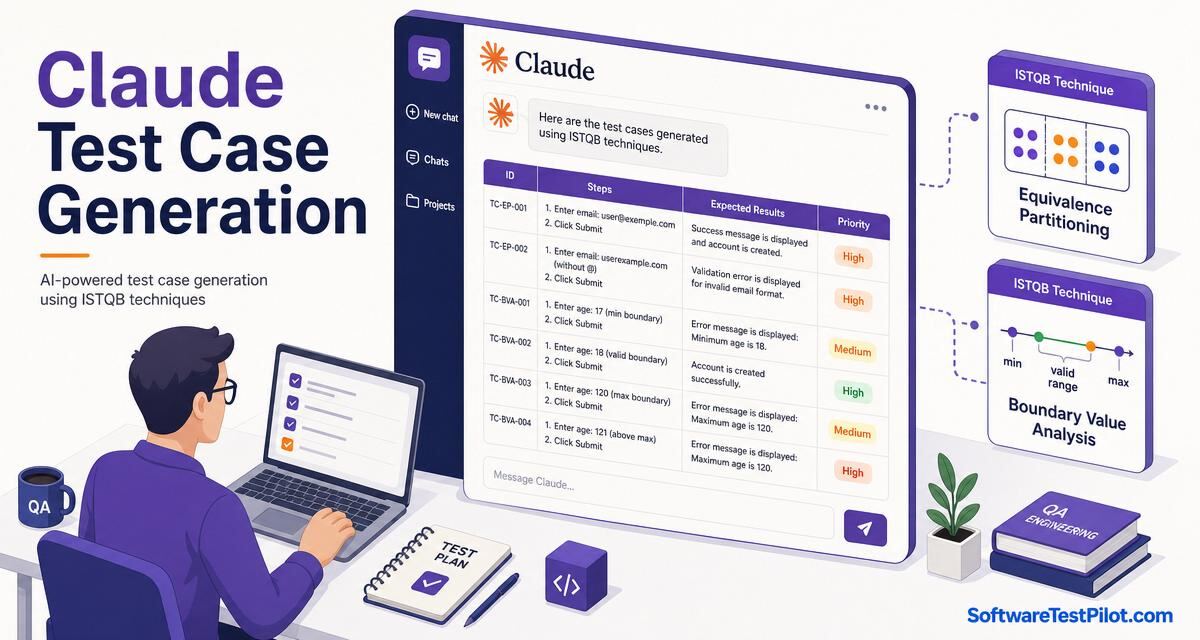
Claude test case generation is the practice of using Claude Sonnet 4.5 or Opus 4.5 to draft ISTQB-aligned test cases — positive, negative, boundary, decision table, state transition and use-case — from a user story, acceptance criterion, PRD section or OpenAPI spec, then importing them into Jira/Xray, TestRail, qTest or Zephyr. Measured on 2026 teams, Claude cuts test-case authoring time by 60–75% and — when prompted with explicit ISTQB techniques — flushes out 30–40% more edge cases than a hand-written first draft.
Pair with Claude for software testing, ChatGPT test case generation, Copilot generate test cases and the test case writing guide.
Key takeaways
- Name the ISTQB technique in the prompt — Claude switches strategy for EP, BVA, DT, ST, UC.
- Always output as a markdown table with fixed columns — Jira/Xray and TestRail parse it cleanly.
- Every set must include the negative and boundary cases explicitly; do not leave them implicit.
- Pass every draft through the 7-point rubric before import.
- Use Opus 4.5 for compliance-critical features; Sonnet 4.5 for the everyday backlog.
1. Which ISTQB technique for which requirement
- Equivalence Partitioning (EP) — categorical inputs (country, plan tier, role). One representative per class.
- Boundary Value Analysis (BVA) — numeric / date / string-length inputs. Cover min-1, min, min+1, max-1, max, max+1.
- Decision Table (DT) — multiple conditions combining (discount = f(country, tier, coupon)). One row per rule.
- State Transition (ST) — stateful workflows (order, subscription, auth). Cover valid and invalid transitions.
- Use Case (UC) — actor-driven end-to-end flows. Cover main flow + alternate + exception flows.
Reference: the ISTQB Foundation Level syllabus. Pick the technique first, then prompt.
2. RCTF prompt for test case generation
- Role — "You are an ISTQB Advanced Test Analyst. Prioritise BVA, EP and negative coverage. Use IEEE 829 test-case format."
- Context — paste the user story, AC, business rules, data ranges and any known defect history.
- Task — "Generate 20 test cases using BVA + EP + DT. 10 positive, 6 negative, 4 boundary. Each with preconditions, steps, expected, priority (H/M/L), type."
- Format — "Markdown table. Columns: TC-ID, Title, Preconditions, Steps, Expected, Priority, Type. End with a 7-point rubric self-critique."
3. Ten copy-paste prompts for Claude test case generation
Prompt 1 — 20 cases from a user story (EP + BVA)
Role: ISTQB Advanced Test Analyst.
Context: user story + AC = <paste>. Data ranges: age 18–120, amount 1–1000000.
Task: 20 test cases via EP + BVA. 10 positive, 6 negative, 4 boundary.
Format: markdown table (TC-ID, Title, Preconditions, Steps, Expected,
Priority, Type). End with a rubric self-critique.
Prompt 2 — decision table for a discount rule
Role: senior test analyst.
Context: discount = f(country ∈ {IN,US,EU}, tier ∈ {free,pro,team}, coupon ∈ {yes,no}).
Task: full decision table (18 rules) + one test case per rule.
Format: two markdown tables — DT first, TC list second.
Prompt 3 — state transition for an order lifecycle
Role: test analyst.
Context: states = created, paid, shipped, delivered, refunded, cancelled.
Valid transitions = <paste diagram>.
Task: 1 test case per valid transition + 1 per invalid transition.
Flag which invalid transitions should return 409 vs 422.
Format: markdown table.
Prompt 4 — use-case cases from an actor flow
Role: test analyst, UC technique.
Context: use case = "Applicant submits KYC" with main + 3 alt + 2 exception flows.
Task: 1 TC per flow, 1 TC per branching decision.
Format: markdown table with a Flow column (main/alt-1/etc).
Prompt 5 — API test cases from OpenAPI
Role: senior API tester.
Context: OpenAPI 3.1 for POST /orders = <paste>.
Task: 12 TCs — 201 happy, 400 (missing body, wrong type, extra field),
401 (no/expired token), 403 (wrong role), 409 (dup idempotency),
422 (business rule), 429 (rate limit), 500 (mock downstream).
Format: markdown table incl. request body JSON.
Prompt 6 — accessibility test cases (WCAG 2.2)
Role: a11y test analyst.
Context: page = /checkout, WCAG 2.2 AA.
Task: 10 TCs covering keyboard nav, focus order, color contrast,
screen-reader labels, form errors, motion-reduce.
Format: markdown table + WCAG SC reference column.
Prompt 7 — negative + security cases
Role: security-minded QA, OWASP Top 10.
Context: login form = <paste>.
Task: 12 negative + security TCs — SQLi, XSS, CSRF, brute force,
timing attack, session fixation, IDOR.
Format: markdown table. One OWASP reference per row.
Prompt 8 — mobile test cases (iOS + Android)
Role: mobile QA.
Context: feature = biometric login. Platforms = iOS 18, Android 15.
Task: 10 TCs incl. permission denial, sensor failure, low-power mode,
locale change (RTL), airplane mode.
Format: markdown table + Platform column.
Prompt 9 — data-driven test skeleton
Role: SDET.
Context: TC = "calculate_tax(country, amount)".
Task: 20 rows of parametrised data covering EU VAT, US sales tax, GST
India, zero-rated, reverse-charge, 1 xfail row for a known bug.
Format: CSV — country, amount, expected_tax, tags.
Prompt 10 — Xray-ready import
Role: QA.
Context: existing TCs = <paste markdown table>.
Task: convert to Jira/Xray CSV import format: Issue Type, Summary,
Priority, Test Type, Steps (Xray "Step, Data, Expected"), Labels.
Format: CSV.
4. The 7-point review rubric for generated test cases
- Traceable — every TC links to a REQ-ID / AC / story number.
- Technique-labelled — EP, BVA, DT, ST or UC named in the Type column.
- Executable — steps are unambiguous, deterministic, and can be run without asking the author.
- Negative + boundary present — at least one per feature; not left implicit.
- Prioritised — H/M/L with a one-line justification tied to risk.
- PII-clean — synthetic data only (user{N}@example.com, Stripe test cards).
- Format-correct — table renders in Confluence, imports into Xray/TestRail/qTest without column-shift errors.
5. Importing Claude output into Jira/Xray, TestRail, qTest
Claude's markdown-table output imports cleanly into most tools with one preprocessing step. Ask Claude at the end of the prompt for the tool-specific format:
- Jira/Xray — CSV with columns: Issue Type, Summary, Priority, Test Type, Test Steps (Xray triplet), Labels. See the Xray CSV import docs.
- TestRail — CSV or the TestRail Import UI (Preconditions, Steps, Expected). Use the TestRail-Templates repo mapping.
- qTest — Excel with Module, Name, Precondition, Test Steps sheets.
- Zephyr Scale — CSV with objective, precondition, testScript.type = STEP_BY_STEP.
6. Governance and PII rules
Claude in 2026 ships in three surfaces relevant to QA — claude.ai (chat), the Anthropic API + Console, and Claude Code (agentic CLI). All three respect the Anthropic commercial terms: Team / Enterprise plans and API traffic are not used to train models. Practical governance rules:
- Use Claude for Work (Team / Enterprise) or the API — not the free consumer plan — for anything touching customer data.
- Never paste raw production data, HAR files, JWTs, PANs or customer PII. Redact with the rules from the ChatGPT bug report pillar.
- Prefer the API with an audit log; keep prompts and outputs in a QA prompt library under version control.
- Map governance to the NIST AI RMF and the EU AI Act for regulated products.
- Add an "AI attribution" section to your PR / test plan template; a human SDET signs off before merge.
7. What Claude test case generation means for QA careers
Test analysts who can drive Claude to produce ISTQB-clean, technique-labelled test cases at scale are the ones QA leads keep on the roadmap. See the QA salary guide, the ISTQB Foundation exam tips, the AI mock interview and live roles on the QA Jobs Radar.