ISTQB Foundation Study Plan + Mock Tests (2026)
The 4-week ISTQB Foundation Level study plan with weekly schedule, mock test strategy, syllabus weightings, revision checklist, and exam-day tips for 2026 passers.

Last updated: July 1, 2026 · 12 min read · By Avinash K
Short answer: the fastest realistic path to clearing ISTQB Foundation Level (CTFL v4.0) on the first attempt is a focused four-week plan — one week per syllabus chapter cluster, 60–90 minutes a day, followed by three full-length timed mocks in the final week. You need 26 out of 40 correct (65%) in 60 minutes (75 if English is not your first language). This guide gives you the weekly schedule, the confusing term pairs that trip people up, a real exam-day walkthrough, and the mistakes I keep seeing testers repeat.
I've mentored twelve QAs through the exam since 2022 (nine passed on the first try). The ones who failed did the same three things: they binged videos without solving MCQs, they memorized definitions without applying them, and they attempted mocks too early and lost confidence. The plan below is built to avoid those traps.
SoftwareTestPilot tip: Pair this plan with our 100 ISTQB sample MCQs, Is ISTQB Worth It in 2026?, the AI Mock Interview, Resume ATS Review, and the QA Jobs Radar. Always cross-check the current syllabus on the official ISTQB website.
ISTQB Foundation Level exam format at a glance
Before you plan study hours, know what you are studying for. Skipping this is the most common reason testers over-study one chapter and under-study another.
| Detail | Value |
|---|---|
| Syllabus version | CTFL v4.0 (current in 2026) |
| Questions | 40 multiple-choice |
| Duration | 60 minutes (75 minutes if English is a second language) |
| Pass mark | 65% — that is 26 correct answers |
| Negative marking | None — always answer every question |
| Open book | No |
| Delivery | Remote-proctored or in-person at an accredited provider |
| Cost (2026, indicative) | USD 199–299 depending on country and provider |
Two practical takeaways: because there is no negative marking, never leave a question blank, and because time is tight (roughly 90 seconds per question), you must build reading speed in mocks — not just accuracy.
Syllabus weights — study proportional to marks
The v4.0 syllabus splits marks unevenly across six chapters. Study time should follow marks, not chapter length.
| Chapter | Topic | Approx. marks | Suggested hours |
|---|---|---|---|
| 1 | Fundamentals of Testing | 7 | 4–5 |
| 2 | Testing Throughout the SDLC | 5 | 3–4 |
| 3 | Static Testing | 3 | 2–3 |
| 4 | Test Analysis and Design | 11 | 8–10 |
| 5 | Managing Test Activities | 9 | 6–8 |
| 6 | Test Tools | 5 | 2–3 |
Chapter 4 (test design techniques) is the biggest single scoring area — and the hardest, because questions ask you to apply the technique to a scenario. If you have only 20 hours total, spend at least a third of them here.
The 4-week ISTQB study plan (60–90 min/day)
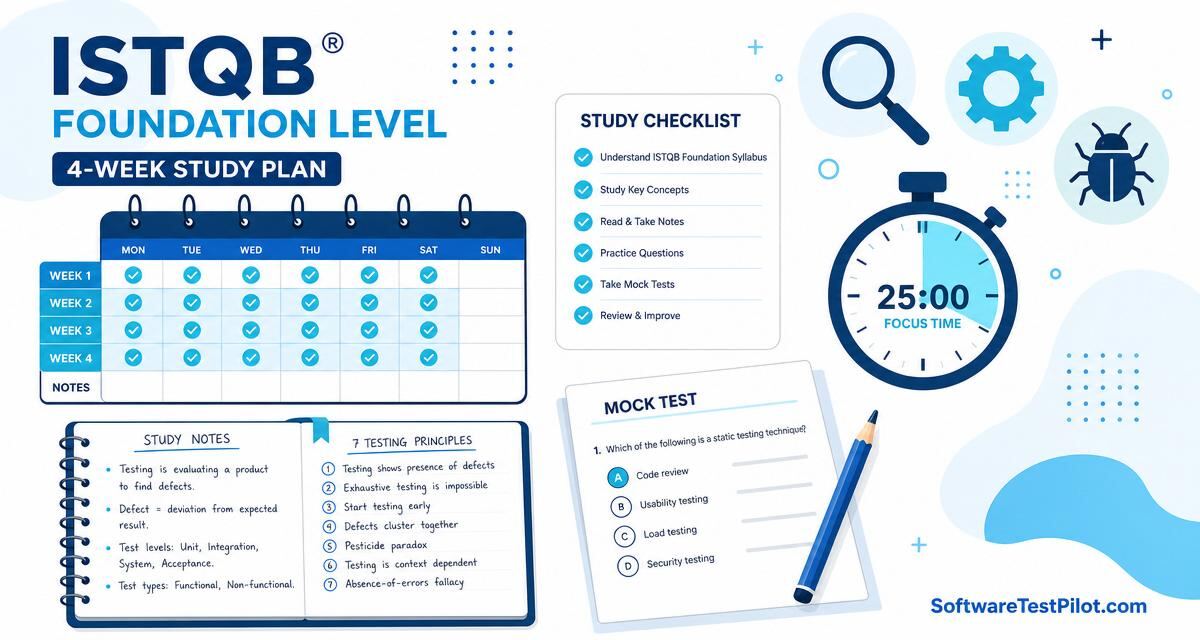
Week 1 — Fundamentals + Lifecycle. Cover Chapters 1 and 2. Learn the difference between error, defect and failure; verification vs validation; confirmation testing vs regression; and how testing fits into Waterfall, V-Model, Agile, and DevOps. End the week by writing the seven testing principles in your own words — not the syllabus wording.
Week 2 — Static + Test Design. Cover Chapters 3 and 4. Spend the first two days on reviews (roles, types, formal review process). Spend the next four days on black-box techniques — equivalence partitioning, boundary value analysis, decision tables, state transition testing, use-case testing. Solve at least five worked examples for each technique using a real screen (login, checkout, ATM). This is where marks are won or lost.
Week 3 — Managing Test Activities + Tools. Cover Chapters 5 and 6. Focus on the differences that always show up in MCQs: test plan vs test strategy, product risk vs project risk, entry criteria vs exit criteria, severity vs priority, monitoring vs control. Chapter 6 is memorization-heavy — just learn the tool categories and the risks of introducing tools.
Week 4 — Mocks + gap fixing. Take three full-length, timed mocks: one on Day 22, one on Day 25, one on Day 27. After each mock, spend 90 minutes reviewing wrong answers and updating your one-page mistake notebook. Days 28–30 are pure revision — no new material.
Working full time? Move the plan to six weeks: 30 minutes on weekdays, two hours on weekends. Do not compress it below three weeks — candidates who rush usually score 22–25/40 and just miss the cut.
The seven testing principles — the highest ROI topic
Almost every exam has 2–4 questions that map directly to the seven principles. Learn them once, verbatim, and you bank easy marks.
- Testing shows the presence of defects, not their absence.
- Exhaustive testing is impossible.
- Early testing saves time and money. (This is the ISTQB rationale for shift-left — see our shift-left guide.)
- Defects cluster together.
- Tests wear out (pesticide paradox).
- Testing is context dependent.
- Absence-of-errors is a fallacy.
Interview tip: hiring managers ask about these principles too. Being able to explain "pesticide paradox" in one sentence signals structured QA thinking.
15 confusing term pairs that trip candidates up
Roughly 6–8 exam questions test whether you can distinguish between similar-sounding terms. Print this table and skim it the night before.
| Term A | Term B | Quick differentiator |
|---|---|---|
| Error | Defect | Error = human action; defect = flaw in the work product |
| Defect | Failure | Defect exists in code; failure is what the user observes |
| Verification | Validation | Are we building it right? vs Are we building the right thing? |
| Retesting | Regression testing | Retest confirms a fix; regression checks nothing else broke |
| Test plan | Test strategy | Plan is project-specific; strategy is organization-wide |
| Test case | Test procedure | Case = what to test; procedure = steps to execute it |
| Severity | Priority | Severity = business impact; priority = how soon to fix |
| Entry criteria | Exit criteria | Conditions to start vs conditions to stop |
| Product risk | Project risk | Quality risk vs delivery/process risk |
| Static testing | Dynamic testing | No code execution vs code execution |
| Review | Walkthrough | Review is umbrella term; walkthrough is author-led |
| Inspection | Informal review | Highly formal, moderator-led vs no formal process |
| Black-box | White-box | Behavior-based vs structure-based |
| Alpha testing | Beta testing | At developer site vs at customer site |
| Test monitoring | Test control | Observing progress vs taking corrective action |
Mock test strategy — the make-or-break week
Start mocks only after you finish at least 70% of the syllabus. Early mocks demotivate because they include topics you have not studied yet. Once you start, treat every mock like the real exam: set a 60-minute timer, do not check notes, and answer every question. Warm up with our 100 practice MCQs.
After the mock, spend more time reviewing than attempting. Categorize each mistake into three buckets: (1) concept not clear — restudy the topic; (2) misread question — exam-day discipline problem; (3) silly mistake — slow down. Track the ratio. If more than 40% of mistakes are misreads, you are rushing — practise reading questions twice in mocks.
Realistic pass benchmarks: if your third mock score is 30/40 or higher, you are ready. 26–29 means you can pass but it will be tight — do one more revision pass on Chapters 4 and 5. Below 26, delay the exam by one week.
Ethics warning: braindumps and leaked "real" questions are widely available online and are a violation of ISTQB's code of ethics. Beyond the ethical issue, they teach the wrong version of the syllabus — v3.1 questions still circulate as if they were v4.0. Use only official ISTQB-accredited materials and independently-written practice sets.
Authoritative resources worth using
Stick to a small number of trusted sources. More resources rarely mean more learning.
- Official ISTQB Foundation Level page — syllabus PDF, sample exam, and glossary. Free.
- ASTQB (US board) — study guides and links to accredited providers.
- ISTQB glossary — the authoritative source for term definitions. Trust this over YouTube summaries.
- Rex Black's Foundations of Software Testing — the most widely used third-party study book, aligned to v4.0.
Exam-day walkthrough (what actually happens)
Log in 15 minutes early. The proctor will ask you to show the room, your desk, and both sides of your ID. Close every browser tab, disable notifications, and keep a plain glass of water on the desk — no bottle labels allowed.
Once the exam starts, do a two-pass attempt: first pass, answer every question you are confident about and flag the rest — aim for 35 minutes. Second pass, spend 20 minutes on flagged questions using elimination. Save the last 5 minutes for a final sanity check on any question with words like most likely, best, least, primarily, or not — these single words flip the correct answer more often than any other trap.
You get your provisional result on screen immediately in most cases. The signed certificate arrives by email within 5–10 business days.
One-page revision checklist for the last 48 hours
Do not reread the whole syllabus in the last two days — it creates confusion. Instead, revise this checklist:
- Seven testing principles (verbatim)
- Error vs defect vs failure
- Test process activities and their order
- Four test levels and their objectives
- Functional / non-functional / white-box / change-related test types
- Review types (informal, walkthrough, technical review, inspection) and roles
- Equivalence partitioning + boundary value analysis worked example
- Decision table for a login with 2–3 conditions
- State transition for account status
- Defect lifecycle states
- Test plan contents and risk-based testing basics
- Tool categories and risks of tool adoption
Common mistakes I keep seeing (and how to avoid them)
Mistake 1: Watching 20 hours of YouTube before solving a single MCQ. The exam tests application, not recognition. Start solving questions from Week 2.
Mistake 2: Memorizing exam dumps. Beyond the ethics issue, dumps are usually outdated (v3.1 questions labeled as v4.0). You will fail the questions on shift-left, DevOps, and modern test process because those topics were added in v4.0.
Mistake 3: Ignoring Chapter 5 because it "reads easy." It reads easy but tests hard — nine marks depend on distinguishing subtle definitions like monitoring vs control.
Mistake 4: Booking the exam before mocks. Book it after your first mock crosses 26/40. Otherwise you either postpone (losing the fee) or attempt underprepared.
Mistake 5: Treating the certificate as the goal. Recruiters shortlist based on skills. Pair your certificate with a small portfolio — see our student QA portfolio guide — and run your resume through the Resume ATS Review before applying.
What to do the week after you pass
The certificate is a foot in the door, not a ticket to a job. Within seven days of passing:
- Add "ISTQB Certified Tester – Foundation Level (CTFL v4.0)" to LinkedIn with your certificate number.
- Update your resume — use the ATS review to make sure it parses.
- Pick one automation tool and finish a beginner project — our Selenium guide or Playwright tutorial are good starting points.
- Run three AI mock interviews — the certificate will come up in your first two real interviews, guaranteed.
- Start tracking openings on the QA Jobs Radar.
Final thoughts
ISTQB Foundation is not a hard exam — it is a specific one. Candidates fail because they study randomly or memorize instead of apply. Follow the four-week plan, use the syllabus-weight table to allocate time, drill the 15 confusing pairs, and mock aggressively in Week 4. That is the whole formula.
The certificate will not get you a job by itself — no certificate does. It will give you the vocabulary to speak confidently in interviews and a structured mental model for real QA work. Combine it with a small portfolio, one automation tool, and consistent applications through the QA Jobs Radar, and you have a realistic path to your first (or next) QA role in 2026.
Next step: take our 100-question mock today and see where you stand. If you score below 26, this plan is your recovery route.