I Failed 6 QA Interviews Before Doing This 1 Thing (R.A.I.D. Framework)
Bombed 6 QA interviews in a row? Here is the exact architectural shift and R.A.I.D. framework that turned rejections into a $120k SDET offer in 2026.

Last updated: July 1, 2026 · 12 min read · By Avinash K
Sitting at my desk at 11:45 PM on a Tuesday in late 2025, I opened the sixth rejection email of the month. The wording was almost identical every time: “impressed by your familiarity with automated scripting… decided to move forward with a candidate who demonstrated stronger architectural vision and systems-level quality strategy.”
Six final-round interviews. Zero offers. I had four years of QA experience, wrote Playwright scripts daily, knew SQL joins cold, and lived inside Jira. I wasn’t an imposter — but every time a Staff Engineer or Director of Quality asked “How would you test our checkout page?” I launched into a checklist of positive, negative, and boundary cases. Their eyes glazed over.
A Principal SDET mentor finally said it plainly: “You are talking like a Junior Test Case Executioner. Senior hiring managers hire Quality Architects who mitigate business risk across distributed systems.” Two months and one framework later, I walked out of a cloud-infra interview loop with a $120,000 SDET offer. Here is the exact shift — and the R.A.I.D. framework you can steal.
SoftwareTestPilot tip: Pair this playbook with our AI Mock Interview, Resume ATS Review, QA Jobs Radar, and the SDET roadmap to compress your prep timeline.
1. The trap of the 'test case executioner' mindset
In continuous deployment orgs shipping to production many times a day, QA is no longer a gate that runs UI scripts at the end of a sprint. When an interviewer asks “Walk me through how you would test a microservices payment gateway,” they are probing your mental model of systems engineering.
What the executioner candidate says: verify valid cards, invalid cards, empty fields, expired CVV, automate the UI in Selenium or Playwright.
Why it fails: ninety percent of that answer sits on the most brittle, slowest, least critical layer — the UI. It ignores async message queues, database rollbacks, retry idempotency, third-party contract breaks, authorization boundaries, and observability. Answer like an executioner and you sound like a cost center, not an engineering enabler. Reinforce your fundamentals with our test case design guide and test pyramid explainer.
2. The core paradigm shift: the R.A.I.D. interview framework
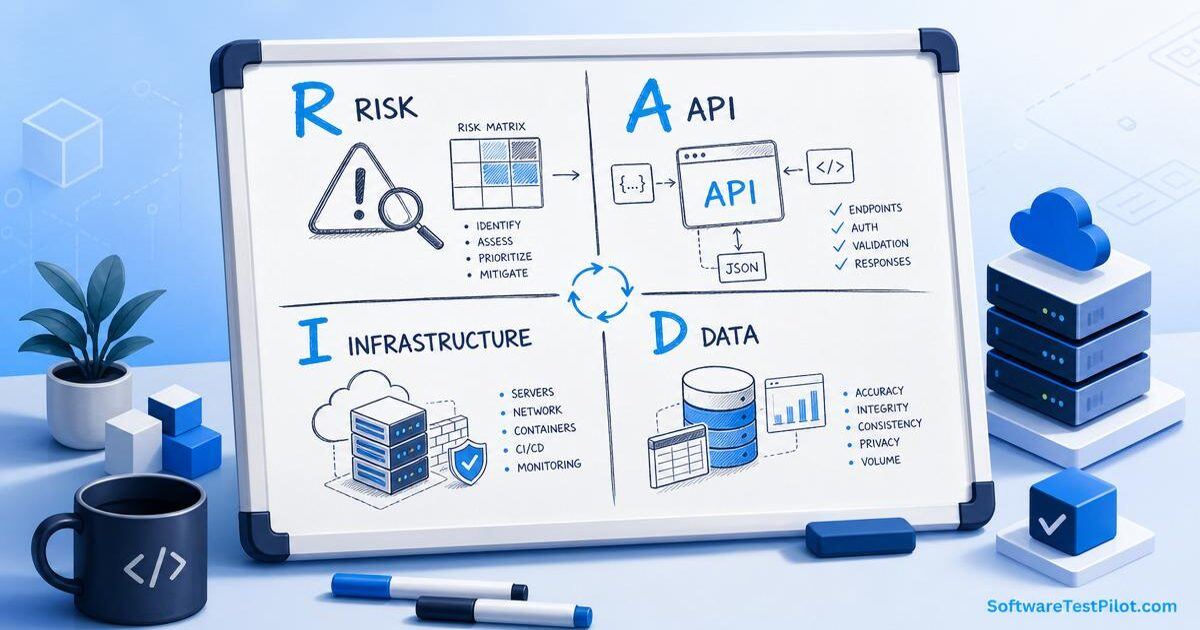
I now structure every open-ended interview question around four quadrants and, when I can, draw them on the whiteboard:
+---------------------------------+-------------------------------+
| 1. RISK & FINANCIAL IMPACT      | 2. API & CONTRACT LAYER       |
| - What breaks the business?     | - Schema verification         |
| - P1/P0 revenue loss vectors    | - Idempotency & retries       |
| - Threat modeling & compliance  | - Mocking third-party endpoints|
+---------------------------------+-------------------------------+
| 3. INFRASTRUCTURE & CI/CD       | 4. DATA STATE & OBSERVABILITY |
| - Pipeline gating strategy      | - Deterministic seeding       |
| - Containerized execution       | - Transaction rollbacks       |
| - Parallel sharding & speed     | - Datadog/Prometheus logs     |
+---------------------------------+-------------------------------+
Pillar 1 — R: Risk & financial impact
Before mentioning a locator, analyze what happens when the software fails in production. Talk about blast radius and business continuity: “A visual glitch on the submit button is a P3. Double-charging a customer via a retry storm is a P0 chargeback event. My strategy puts 80% of automated coverage on transactional integrity and auth boundaries.”
Pillar 2 — A: API & contract layer
Show you understand where testing ROI actually lives: “I architect primary regression at the API contract layer using Playwright API fixtures or REST Assured, verify OpenAPI schema adherence, and explicitly test 429 rate limiting and 503 upstream failures.” Sharpen this with our Postman API testing tutorial and API testing interview hub.
Pillar 3 — I: Infrastructure & CI/CD gating
Suites that only run on a laptop are worthless to a DevOps org. Frame execution inside the pipeline: “Tests run in ephemeral containers during GitHub Actions PR checks, sharded across five parallel runners, keeping build verification under six minutes. Schema breaks and failing contract tests block merges automatically.” See our GitHub Actions + Selenium guide.
Pillar 4 — D: Data state & observability
The #1 cause of flake is dirty data: “My harness creates synthetic users via backend APIs immediately before each run and tears them down deterministically. I also assert that failure paths emit trace IDs to Datadog so devs can root-cause instantly.”
3. Average QA vs top 5% SDET responses
| Interview scenario | Average candidate (rejected) | Top 5% SDET (hired) |
|---|---|---|
| Flaky tests | Rerun 2–3x, add Thread.sleep(5000), disable if still flaky. | Eliminate arbitrary sleeps, use deterministic polling anchored to network idle. Isolate whether flake is UI race or parallel DB collision. Quarantine unfixable tests into a nightly diagnostic lane with verbose tracing so PR pipelines stay trusted. |
| Third-party API testing | Hit Stripe/PayPal sandbox with test cards; wait if sandbox is down. | Sandboxes add latency and downtime risk in CI. Stub with Playwright page.route() or WireMock, simulate latency spikes, drops, malformed JSON. Reserve live sandbox for a nightly non-blocking health check. |
| 30-min production hotfix | Run manual smoke, verify login and dashboard, execute regression if time allows. | Full E2E is impossible and wrong. Read the PR diff, run 90-second API smoke, check DB migration compatibility, and watch Sentry/Datadog on the canary post-deploy. |
4. Code & architecture proof
When asked to sketch reliable API state setup for E2E tests, do not click through a UI registration form. Write a clean Playwright fixture that seeds via API in milliseconds:
// tests/fixtures/apiDataFactory.ts
import { test as baseTest, expect } from '@playwright/test';

type TestFixtures = {
  authenticatedUser: { token: string; userId: string; email: string };
};

export const test = baseTest.extend<TestFixtures>({
  authenticatedUser: async ({ request }, use) => {
    const email = `qa_${Date.now()}_${Math.floor(Math.random() * 1000)}@softwaretestpilot.com`;

    // 1. Seed user via backend API
    const createRes = await request.post('https://api.softwaretestpilot.com/v1/users', {
      data: { email, password: 'SecureTestPassword2026!', role: 'PREMIUM_SDET' },
    });
    expect(createRes.status()).toBe(201);
    const body = await createRes.json();

    // 2. Inject deterministic state
    await use({ token: body.accessToken, userId: body.id, email });

    // 3. Guaranteed teardown
    const del = await request.delete(`https://api.softwaretestpilot.com/v1/users/${body.id}`, {
      headers: { Authorization: `Bearer ${body.accessToken}` },
    });
    expect(del.status()).toBe(204);
  },
});
Modular, dependency-injected code like this signals clean architecture, deterministic state, and developer empathy — see our Playwright tutorial for the full framework build.
5. The 14-day interview turnaround blueprint
DAYS 1–3   AUDIT & RE-FRAME
           - Rewrite resume bullets around CI/CD ownership and metrics
           - Run draft through the SoftwareTestPilot ATS Resume Reviewer

DAYS 4–7   ARCHITECTURAL WHITEBOARDING
           - Draw data flows for 5 systems (E-commerce, Uber, Banking, SaaS, Streaming)
           - Speak the R.A.I.D. framework aloud 20 minutes daily

DAYS 8–11  TECHNICAL CODE FLUENCY
           - Master Playwright/Axios API fixtures & network interception
           - Run mock rounds using the AI Interview Coach

DAYS 12–14 BEHAVIORAL & SALARY BENCHMARKING
           - Prepare 4 STAR stories on cross-team influence with devs
           - Check live SDET bands on the QA Jobs Radar
Knowing R.A.I.D. theoretically is half the battle. Deliver it out loud in the AI Mock Interview before you speak with hiring managers, and check your resume against live requirements in the Resume ATS Review.
6. Whiteboarding system architecture for quality
When an interviewer says “Draw your testing strategy for an Uber-style ride pricing service,” don’t list functional checks. Draw the distributed flow:
[ Mobile Client ]
       |
       v  (HTTPS / WebSockets)
[ API Gateway / Load Balancer ] ----> [ Auth & Rate Limit Service ]
       |
       +----> [ Pricing Engine Microservice ]
       |              |
       |              v
       |     [ PostgreSQL + Redis Cache ]
       |
       +----> [ Kafka Event Bus ]
                       |
                       v
              [ Driver Matching Worker ]
Then point at the seams: “Here at the gateway I load-test rate limiting. At the pricing microservice boundary I run schema contract assertions. At the Kafka bus I verify idempotent consumer retries so ride requests are never dropped.” Visual systems thinking flips you from subordinate tester to peer engineer.
7. Conclusion & your 24-hour action step
Failing six interviews stung, but it forced me to trade checklist safety for engineering ownership. In 2026, quality is not tested in at the end — it is architected into the delivery pipeline. Bring risk analysis, API contract depth, CI/CD fluency, and deterministic data.
Do this today: take the last technical question that stumped you (or “How do you test a distributed shopping cart?”) and write a four-paragraph answer using R.A.I.D. Rehearse it in the AI Mock Interview, benchmark your resume in the Resume ATS Review, and pull live SDET openings from the QA Jobs Radar.
Related reading: SDET Roadmap 2026, Manual Tester → SDET, “Tell me about yourself” for QA, Postman API testing. External reference: Playwright API testing docs.