What a $180k+ Senior SDET Interview Looks Like at Big Tech (2026)
Deconstructing the 5-round Senior SDET interview loop at FAANG & Big Tech in 2026 — algorithm rounds, distributed test-harness system design, real prompts, and the 60-day prep roadmap that lands $180k–$350k offers.

Last updated: July 1, 2026 · 13 min read · By Avinash K
Mention you’re preparing for a QA interview at a Fortune 500 or traditional bank and most peers give you familiar advice: “Know severity vs. priority, brush up SQL joins, practise your manual test plans, be ready to describe a bug you found.”
Walk into a Senior SDET loop at Google, Meta, Apple, Amazon, or Netflix with that baseline and you’ll be rejected in the first forty-five minutes. When Big Tech requisitions on our QA Jobs Radar offer $180,000 base up to $350,000+ total compensation, they evaluate SDETs against the same engineering rubric they use for backend distributed-systems engineers — plus an added layer of quality architecture. You’ll face algorithmic coding on whiteboards, deconstruct microservice architectures, and pair-debug flaky concurrency race conditions live.
We analysed candidate debriefs, interviewer grading rubrics, and technical prompts from dozens of 2026 Big Tech hiring sprints. Here’s the exhaustive breakdown of the 5-Round Senior SDET Loop, the algorithm and system-design prompts you’ll actually see, and the exact 60-day prep roadmap.
Key takeaways
- SDET loops at FAANG mirror SDE loops — algorithms, system design, coding, behavioural — with a quality-infrastructure twist.
- Round 2 rewards pragmatic O(N) log/JSON parsing, not abstract dynamic programming.
- Round 3 is won by designing distributed test harnesses (Kubernetes sharding, AST impact analysis, artifact streaming), not consumer products.
- Round 5 tests how you enforce quality with zero direct authority over developers.
- 60-day prep: 45 LeetCode Easy/Medium problems → whiteboard 5 harness designs → simulated full loops.
1. Deconstructing the 5-round Big Tech Senior SDET loop
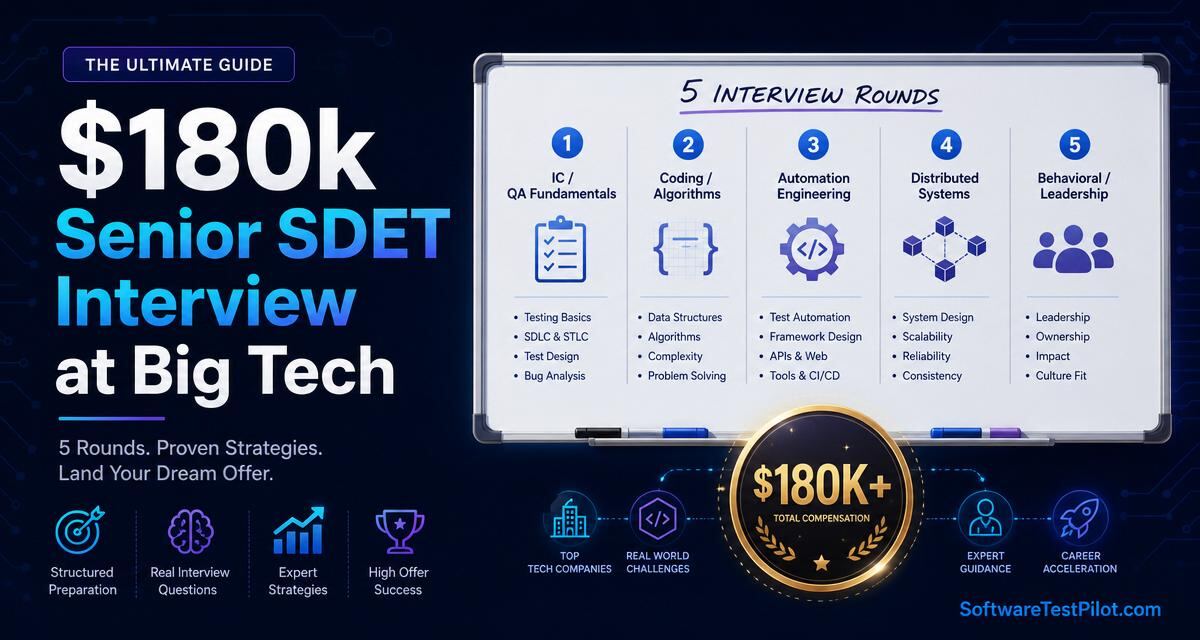
A typical L5 Senior SDET / Quality Architect loop runs five 60-minute technical rounds over one or two days.
+-----------------------------------------------------------------------------------+
|                  THE FAANG / BIG TECH L5 SDET INTERVIEW LOOP                      |
+-----------------------------------------------------------------------------------+
| ROUND 1: RECRUITER TECHNICAL SCREEN & SCREENING CODE (45 Mins)                    |
| - Rapid-fire architectural fundamentals, salary expectations, LeetCode Easy code. |
+-----------------------------------------------------------------------------------+
| ROUND 2: DATA STRUCTURES & ALGORITHMS (60 Mins)                                   |
| - LeetCode Medium string parsing, array manipulation, or graph cycle detection    |
|   tailored specifically to quality engineering scenarios.                          |
+-----------------------------------------------------------------------------------+
| ROUND 3: DISTRIBUTED TEST HARNESS SYSTEM DESIGN (60 Mins)                         |
| - Designing an enterprise CI harness that executes 50,000 automated end-to-end    |
|   tests across multi-region cloud clusters in under 5 minutes.                    |
+-----------------------------------------------------------------------------------+
| ROUND 4: PRACTICAL CODE DEBUGGING & QUALITY STRATEGY (60 Mins)                    |
| - Pair-programming inside a live IDE debugging a broken, flaky Playwright suite   |
|   and refactoring it into atomic, deterministic component architecture.           |
+-----------------------------------------------------------------------------------+
| ROUND 5: CROSS-FUNCTIONAL LEADERSHIP & BEHAVIORAL EXCELLENCE (60 Mins)            |
| - 'Googlyness' / Leadership Principles evaluation. Resolving conflicts with       |
|   pushy Product Managers and influencing engineering directors without authority. |
+-----------------------------------------------------------------------------------+
Let’s zoom into the two most intimidating rounds: Round 2 (Algorithms) and Round 3 (Distributed System Design).
2. Round 2 — Data structures & algorithms tailored to quality
Candidates often ask: “Why does Google or Amazon make quality engineers solve LeetCode?” Because Big Tech infrastructure processes billions of requests daily. Test frameworks generate huge telemetry streams and parse gigabytes of logs. Write a log verifier with an $O(N^2)$ nested loop and it will choke a CI runner analysing production traces.
Unlike core SDE loops that lean on dynamic programming or AVL/red-black trees, SDET coding rounds emphasise pragmatic data parsing, string manipulation, and graph dependency resolution.
Real Big Tech prompt: distributed server-log trace parsing
“A distributed microservice cluster outputs millions of raw log lines per minute formatted as
[TIMESTAMP] [TRACE_ID] [SERVICE_NAME] [STATUS_CODE] [EXECUTION_MS]. Write a clean, highly optimised function that takes an array of raw log strings, groups them byTRACE_ID, and returns theTRACE_IDof any transaction where total cumulative execution time exceeded 1,000 ms OR any individual service returned a 5xx status.”
How an L5 Senior SDET solves this in TypeScript
Clean hash-map aggregation, $O(N)$ time, explicit edge-case guards:
// Round 2 Solution: Highly Optimized Distributed Log Parsing (O(N) Time Complexity)
interface TransactionTrace {
  totalDurationMs: number;
  hasServerError: boolean;
}

export function detectAnomalousTraces(rawLogLines: string[]): string[] {
  // Hash map for O(1) constant-time trace lookups
  const traceMap = new Map<string, TransactionTrace>();
  const anomalousTraces: Set<string> = new Set();

  for (const line of rawLogLines) {
    if (!line || line.trim() === '') continue; // guard: empty lines

    const parts = line.trim().split(/\s+/);
    if (parts.length < 5) continue; // guard: malformed

    const traceId = parts[1];
    const statusCode = parseInt(parts[3], 10);
    const executionMs = parseInt(parts[4], 10);

    if (isNaN(statusCode) || isNaN(executionMs)) continue;

    if (!traceMap.has(traceId)) {
      traceMap.set(traceId, { totalDurationMs: 0, hasServerError: false });
    }

    const currentTrace = traceMap.get(traceId)!;
    currentTrace.totalDurationMs += executionMs;

    if (statusCode >= 500 && statusCode < 600) {
      currentTrace.hasServerError = true;
    }

    if (currentTrace.totalDurationMs > 1000 || currentTrace.hasServerError) {
      anomalousTraces.add(traceId);
    }
  }

  return Array.from(anomalousTraces);
}
Writing production-grade code like this on a shared editor while explicitly narrating space complexity ($O(U)$ where $U$ is unique traces) proves engineering foundation instantly. See our companion pieces on critical API testing mistakes and the ACCORD whiteboard framework for the surrounding interview strategy.
3. Round 3 — Designing a 50,000-test distributed CI harness
If Round 2 proves you can write clean algorithms, Round 3 is where L5/L6 SDET offers are truly won or lost. In an SDE system-design round, you design Twitter, Uber, or a URL shortener. In an SDET round, you design the quality infrastructure that tests and verifies Twitter or Uber.
Real Big Tech system-design prompt
“Our global engineering org has 2,000 developers committing to a unified Git monorepo with 50,000 automated UI, API, and integration tests. Sequentially the suite takes 18 hours. Design a scalable, cloud-native CI test execution harness that runs on every pull request and delivers feedback in under 5 minutes.”
How to structure your whiteboard architecture
+-----------------------------------------------------------------------------------+
|                  50,000-TEST DISTRIBUTED HARNESS ARCHITECTURE                     |
+-----------------------------------------------------------------------------------+
| [DEVELOPER PR COMMIT] ---> Triggers Git Webhook to Orchestrator API               |
|                                       |                                           |
|                                       v                                           |
| [INTELLIGENT IMPACT ANALYSIS ENGINE (Git Diff vs. Test Dependency Graph)]         |
| - Analyses AST code diff -> identifies only the 3,500 tests impacted by modified  |
|   microservices. Skips 46,500 completely unimpacted tests instantly.              |
|                                       |                                           |
|                                       v                                           |
| [KUBERNETES CONTAINER ORCHESTRATOR (DYNAMIC SHARDING)]                            |
| - Spawns 250 ephemeral headless Linux Pods across AWS/GCP clusters.               |
| - Shards the 3,500 impacted tests across 250 parallel workers (~14 tests/worker). |
|                                       |                                           |
|                                       v                                           |
| [TEST EXECUTION & API DATA SEEDING]                                               |
| - Workers pre-seed database state via internal REST APIs in sub-200ms.            |
| - 14 tests run inside Playwright Browser Contexts -> total Pod run: 3m 45s.       |
|                                       |                                           |
|                                       v                                           |
| [ARTIFACT AGGREGATION & RESULT STREAMING]                                         |
| - Workers stream HTML reports and trace zip files to S3/GCS bucket.               |
| - Webhook posts summary badge back to GitHub PR comment within 4m 12s.            |
+-----------------------------------------------------------------------------------+
Explaining how AST Git-diff impact analysis eliminates redundant execution and how Kubernetes pod sharding achieves horizontal parallelism proves you operate at the Staff/Principal systems level. For deeper CI patterns see our CI/CD flake-fix guide and the Playwright tutorial.
4. Round 5 — Behavioural & cross-functional influence
Big Tech places immense weight on behavioural leadership principles — famously “Googlyness” at Google or “Leadership Principles” at Amazon. For senior SDETs, one question dominates the round: How do you influence developer behaviour and enforce quality standards with zero direct authority?
+-----------------------------------------------------------------------------------+
|                  THE BEHAVIORAL 'STAR' RESPONSE STRUCTURE                         |
+-----------------------------------------------------------------------------------+
| [S - SITUATION]: A development pod was continuously merging PRs with broken tests,|
|                  causing three consecutive weekly release rollbacks.              |
+-----------------------------------------------------------------------------------+
| [T - TASK]:      Enforce PR test gating without becoming a blocker or damaging    |
|                  cross-team developer relationships.                              |
+-----------------------------------------------------------------------------------+
| [A - ACTION]:    Instead of lecturing developers, I refactored their slow 35-min  |
|                  UI suite into a fast 4-minute API + Playwright suite. Presented  |
|                  velocity gains to their eng lead and implemented an automated    |
|                  ESLint rule blocking PR merges lacking test attributes.          |
+-----------------------------------------------------------------------------------+
| [R - RESULT]:    Release rollbacks dropped to zero over the next two quarters,    |
|                  and developer PR merge speed actually increased by 22%.          |
+-----------------------------------------------------------------------------------+
See our 7 truths senior SDETs know for more influence-without-authority patterns interviewers reward.
5. Your 60-day Big Tech interview preparation roadmap
Targeting a $180,000+ offer at a tier-one company from our QA Jobs Radar? Here’s the 60-day curriculum:
- Weeks 1–3 (Algorithmic fluency). Complete 45 LeetCode Easy/Medium problems strictly focused on strings, arrays, hash maps, and two-pointer / sliding-window patterns in TypeScript or Python.
- Weeks 4–6 (Distributed quality systems). Whiteboard system-design architectures for high-load test harnesses, Docker-backed database sandboxes, and API rate-limit mocking. Reference the SDET vs QA salary gap analysis to sharpen your positioning.
- Weeks 7–8 (Simulated loop execution). Upload your resume to the ATS Resume Reviewer to ensure FAANG keywords parse cleanly. Run daily simulated loops with the AI Interview Coach to perfect spoken justifications under pressure. Deep-dive prep with the Playwright interview questions, API testing Q&A, and SQL Q&A hubs.
For authoritative external reading pair this with Google’s official How we hire guide and Amazon’s Leadership Principles.
6. Conclusion & your 24-hour action step
Securing a $180,000+ Senior SDET role at Big Tech means abandoning traditional manual QA framing and embracing deep software engineering rigour. Master pragmatic data algorithms, design distributed cloud test-execution harnesses, and demonstrate cross-functional leadership through developer enablement.
Your 24-hour action step
Open LeetCode today and solve Group Anagrams or Longest Substring Without Repeating Characters in clean TypeScript without hints. Time yourself and rehearse explaining space and time complexity in under 25 minutes — then run the same problem through the AI Mock Interview for pressure-tested feedback.