5 Critical API Testing Mistakes That Let Lethal Bugs Slip Into Production (2026)
Only asserting HTTP 200 OK? The 5 lethal API testing mistakes that cause outages — BOLA/IDOR, schema drift, rate-limit flakes, hardcoded secrets and siloed CRUD — with production-grade Playwright + Zod TypeScript.

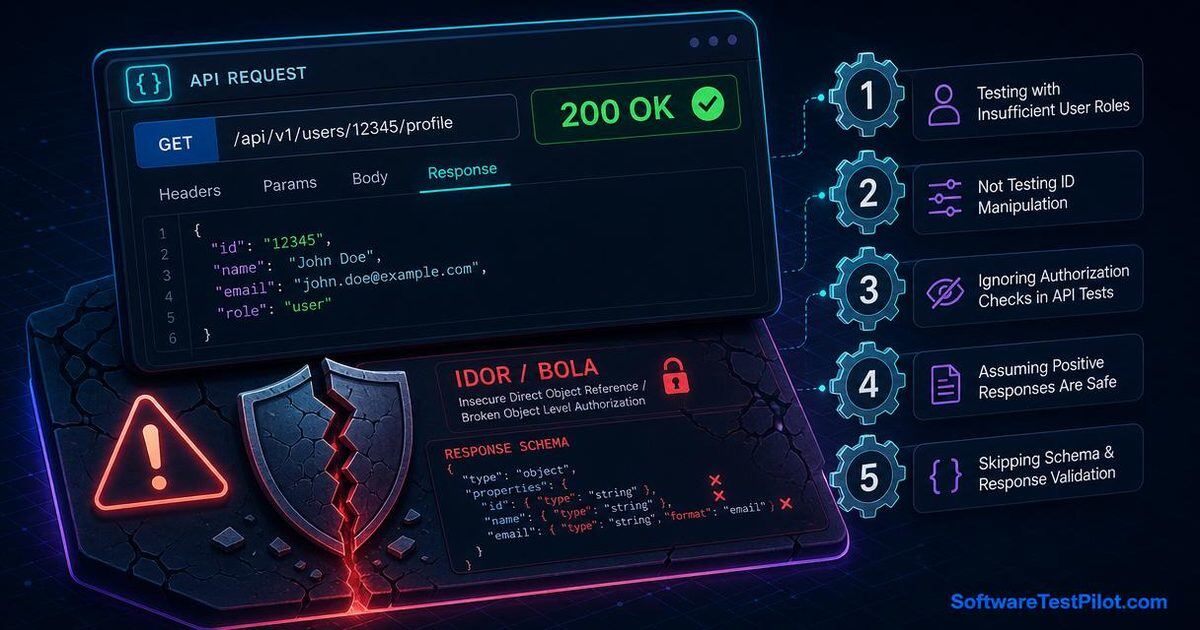
Last updated: July 1, 2026 · 15 min read · By Avinash K
In web application QA, visual UI bugs get all the attention. A misaligned button on checkout goes viral on X within an hour. But in terms of actual business impact, UI bugs are almost always cosmetic annoyances.
Backend API bugs are silent, invisible killers. When a REST or GraphQL endpoint fails in production, it doesn't cause a misaligned button — it causes catastrophic security breaches, double-billed cards, corrupted ledgers and multi-million-dollar GDPR or HIPAA violations. Modern cloud apps are decoupled frontends sitting on top of complex microservice API meshes, and the API layer is your organisation's primary line of defence.
When our engineering team reviews automated test repos submitted by candidates on the SoftwareTestPilot QA Jobs Radar, we consistently see the same failure pattern: over 75% of QA engineers test APIs with superficial, rookie-level methodologies — Postman collections or Playwright scripts that assert basic status codes and miss the authorisation flaws, rate-limit race conditions and schema mutations that actually take production down.
Below are the 5 lethal API testing mistakes that can cost you your job in 2026, and the exact architectural patterns required to fortify your suites.
SoftwareTestPilot tip: Pair this with the Postman API testing tutorial, the API mocking tools comparison, the API testing interview questions, the AI Mock Interview and the ATS Resume Reviewer.
1. Mistake 1: Only asserting HTTP 200 OK status codes
The most common and dangerous mistake in API testing is assuming that an HTTP 200 OK or 201 Created status code proves the endpoint functions correctly.
+-----------------------------------------------------------------------------------+
|                  THE SUPERFICIAL STATUS CODE TRAP                                 |
+-----------------------------------------------------------------------------------+
| [AUTOMATED TEST SCRIPT] ---> POST /v1/orders (Payload: totalAmount = -500.00)     |
|                                       |                                           |
|                                       v (API GATEWAY / BACKEND SERVER)            |
|                                                                                   |
| [SERVER RESPONSE]       <--- HTTP 200 OK                                          |
|                              Body: { "error": "Internal ledger exception", id: null}|
|                                                                                   |
| [TEST ASSERTION]        ---> expect(response.status()).toBe(200) -> PASSES GREEN! |
| RESULT: Lethal negative-balance bug merges to production unnoticed!               |
+-----------------------------------------------------------------------------------+
Why status codes lie
Poorly written backend controllers frequently catch unhandled exceptions inside generic try/catch blocks and return an HTTP 200 OK wrapped around a JSON error message ("An unexpected error occurred"). Even valid responses ignore schema contract integrity — if a dev changes an account balance from a number (149.99) to a formatted string ("$149.99"), the endpoint still returns 200, but your React dashboard crashes with NaN.
The fix: 3-layer schema contract assertion
- HTTP Status & Headers — verify status and
Content-Type: application/json. - Strict JSON schema adherence — validate types, nullable bounds and required keys with Ajv or Zod.
- Semantic business value verification — assert returned values match exact database/input state.
// tests/api/strictSchemaVerification.spec.ts
import { test, expect } from '@playwright/test';
import { z } from 'zod';

const UserProfileSchema = z.object({
  id: z.string().uuid(),
  email: z.string().email(),
  accountBalance: z.number().nonnegative(),
  role: z.enum(['STANDARD', 'PREMIUM', 'ADMIN']),
  createdAt: z.string().datetime()
});

test('Should retrieve user profile matching strict OpenAPI schema contract', async ({ request }) => {
  const response = await request.get('https://api.softwaretestpilot.com/v1/users/usr_9921', {
    headers: { Authorization: `Bearer ${process.env.TEST_API_TOKEN}` }
  });

  expect(response.status()).toBe(200);
  expect(response.headers()['content-type']).toContain('application/json');

  const payload = await response.json();
  const schemaValidation = UserProfileSchema.safeParse(payload);
  if (!schemaValidation.success) {
    console.error('Schema Contract Violation:', schemaValidation.error.format());
  }
  expect(schemaValidation.success).toBe(true);

  expect(payload.accountBalance).toBeGreaterThanOrEqual(0);
  expect(payload.email).endsWith('@softwaretestpilot.com');
});
See the Zod docs and the Playwright + TypeScript tutorial for the full patterns.
2. Mistake 2: Overlooking Broken Object Level Authorization (BOLA/IDOR)
For four consecutive years, the OWASP API Security Top 10 has ranked Broken Object Level Authorization (BOLA) — also known as Insecure Direct Object Reference (IDOR) — as the #1 most critical API vulnerability. Yet fewer than 10% of QA automation suites include automated BOLA verification.
+-----------------------------------------------------------------------------------+
|                  THE HORIZONTAL PRIVILEGE ESCALATION ATTACK                       |
+-----------------------------------------------------------------------------------+
| [ATTACKER / USER A (ID: usr_111)] ---> GET /v1/invoices/inv_8899 (Belongs to User B)|
|                                                |                                  |
|                                                v (MISSING BACKEND AUTH CHECK)     |
|                                                                                   |
| [API SERVER]                      <--- Returns 200 OK + User B's Private Invoice! |
| RESULT: Mass data exfiltration across millions of customer accounts!              |
+-----------------------------------------------------------------------------------+
Why functional testers miss BOLA
Testers usually log in as a single user, extract their token, create inv_101 and fetch it back. Green pass. What happens when User A alters the URL to inv_202 (owned by User B) while still presenting User A's token? If the backend controller lacks row-level ownership checks, private financial data leaks.
The fix: cross-role authorization matrix
// tests/api/security/bolaAuthorization.spec.ts
import { test, expect } from '@playwright/test';

test.describe('API Security: BOLA Suite', () => {
  const API_BASE = 'https://api.softwaretestpilot.com/v1';

  test('Should strictly block User A from reading private records of User B', async ({ request }) => {
    const userA_Token = 'jwt_token_for_user_a_id_111';
    const userB_Token = 'jwt_token_for_user_b_id_222';

    const createRes = await request.post(`${API_BASE}/payout-methods`, {
      headers: { Authorization: `Bearer ${userB_Token}` },
      data: { bankAccount: 'US88_BOFA_99218821', routingNumber: '021000021' }
    });
    expect(createRes.status()).toBe(201);
    const { id: resourceId } = await createRes.json();

    // ADVERSARIAL ASSERTION: User A attempts cross-account fetch
    const attackRes = await request.get(`${API_BASE}/payout-methods/${resourceId}`, {
      headers: { Authorization: `Bearer ${userA_Token}` }
    });
    expect([403, 404]).toContain(attackRes.status());

    const attackBody = await attackRes.text();
    expect(attackBody).not.toContain('US88_BOFA_99218821');
  });
});
Deep dive: our QA security testing playbook and the API testing interview questions.
3. Mistakes 3 & 4: Rate limits, pagination & hardcoded credentials
Mistake 3 — ignoring pagination, timeouts & rate limiting (429)
When QA engineers test locally, they issue requests sequentially at low volume. Production faces concurrent spikes, scraping and bulk pagination. If GET /v1/customers returns 500,000 unpaginated records, your suite (which only tests 5) will miss the out-of-memory crash. Similarly, production APIs enforce rate limits via Redis gateways. Parallel CI hitting 100+ RPS randomly fails with HTTP 429 Too Many Requests.
The fix — implement automated rate-limit retry polling:
// utils/apiClientWithRetry.ts
import { APIRequestContext } from '@playwright/test';

export async function resilientGet(request: APIRequestContext, url: string, retries = 3) {
  for (let attempt = 1; attempt <= retries; attempt++) {
    const response = await request.get(url);
    if (response.status() === 429) {
      const retryAfterSeconds = parseInt(response.headers()['retry-after'] || '5', 10);
      console.warn(`[Rate Limited] Waiting ${retryAfterSeconds}s before retry...`);
      await new Promise(res => setTimeout(res, retryAfterSeconds * 1000));
      continue;
    }
    return response;
  }
  throw new Error(`API Request failed after ${retries} attempts due to persistent rate limiting.`);
}
Mistake 4 — hardcoding credentials in Git
We still routinely find automation repos with long-lived bearer tokens committed to source:
// LETHAL: hardcoded credential committed to Git
const API_KEY = "sk_live_992818299182918291829";
This violates SOC2 and exposes your company the moment the repo leaks. The fix: read secrets from process.env.TEST_API_CLIENT_SECRET injected by GitHub Actions Secrets or AWS Secrets Manager, and mint short-lived OAuth JWTs during the test setup lifecycle. Cross-reference the GitHub Actions CI guide.
4. Mistake 5: Testing APIs in isolated silos instead of chained workflows
A junior tester writes four disconnected specs — createOrder, getOrder, updateOrder, deleteOrder — each hitting a static ord_123. Under parallel execution, deleteOrder races ahead of getOrder and the read fails with 404. Worse, isolated units never prove that state transitions persist across microservice boundaries.
The fix: chained transactional CRUD workflow
// tests/api/workflows/completeOrderLifecycle.spec.ts
import { test, expect } from '@playwright/test';

test('Chained Suite: Create -> Read -> Update -> Delete Lifecycle', async ({ request }) => {
  const BASE_URL = 'https://api.softwaretestpilot.com/v1/orders';
  const headers = { Authorization: `Bearer ${process.env.TEST_API_TOKEN}` };

  const createRes = await request.post(BASE_URL, {
    headers,
    data: { itemSku: 'SKU-ENTERPRISE-2026', quantity: 5, unitPrice: 100.00 }
  });
  expect(createRes.status()).toBe(201);
  const { id: dynamicOrderId } = await createRes.json();

  const getRes = await request.get(`${BASE_URL}/${dynamicOrderId}`, { headers });
  expect(getRes.status()).toBe(200);
  expect((await getRes.json()).totalAmount).toBe(500.00); // 5 * 100 business logic

  const updateRes = await request.patch(`${BASE_URL}/${dynamicOrderId}`, {
    headers,
    data: { status: 'SHIPPED', trackingNumber: 'TRK_99182' }
  });
  expect(updateRes.status()).toBe(200);
  expect((await updateRes.json()).status).toBe('SHIPPED');

  const deleteRes = await request.delete(`${BASE_URL}/${dynamicOrderId}`, { headers });
  expect(deleteRes.status()).toBe(204);

  const verifyDeleteRes = await request.get(`${BASE_URL}/${dynamicOrderId}`, { headers });
  expect(verifyDeleteRes.status()).toBe(404);
});
See our deterministic test data engineering deep dive for factories that make chained workflows deterministic in parallel.
5. Integrating API security into your career & interviews
As distributed microservices expand throughout 2026, hiring managers are actively filtering out generalist UI testers in favour of SDETs who master backend API contract and security testing. On the SoftwareTestPilot QA Jobs Radar, six-figure requisitions explicitly demand API security verification, OpenAPI contract automation and BOLA mitigation.
Upload your resume to the ATS Resume Reviewer and replace generic bullets with quantified API achievements:
“Engineered programmatic API security and contract regression harnesses using Playwright and Zod, automating BOLA/IDOR cross-role authorisation checks and reducing production backend defect escapes by 55%.”
Then rehearse the delivery on the AI Mock Interview and drill patterns from the API testing interview questions and Playwright interview questions.
6. Conclusion & your 24-hour action step
Testing APIs by asserting HTTP 200 OK on happy-path payloads is obsolete and leaves your organisation exposed to catastrophic breaches and ledger corruption. To operate like a Staff SDET, enforce strict schema contract validation, verify horizontal authorisation against BOLA, handle rate-limit throttling gracefully, secure your credentials and chain your tests into dynamic end-to-end CRUD workflows.
Your 24-hour action step
Open your existing API automation repo today. Pick your most critical endpoint test. If the assertion stops at expect(response.status()).toBe(200), import Zod immediately, write a strict schema representing the expected response, and add runtime validation. Watch how quickly it catches subtle type drift — then benchmark your evolving backend skillset against live six-figure requisitions on the QA Jobs Radar.