
Latest Test Query Format: The Complete Guide for QA Engineers (SQL, API & Search)
The definitive test query format guide for QA — copy-paste SQL, REST/GraphQL and Postman templates, a UAT test-case wrapper, and a Google search operator cheat sheet you can ship today.

Last updated: July 2, 2026 · 13 min read · By SoftwareTestPilot
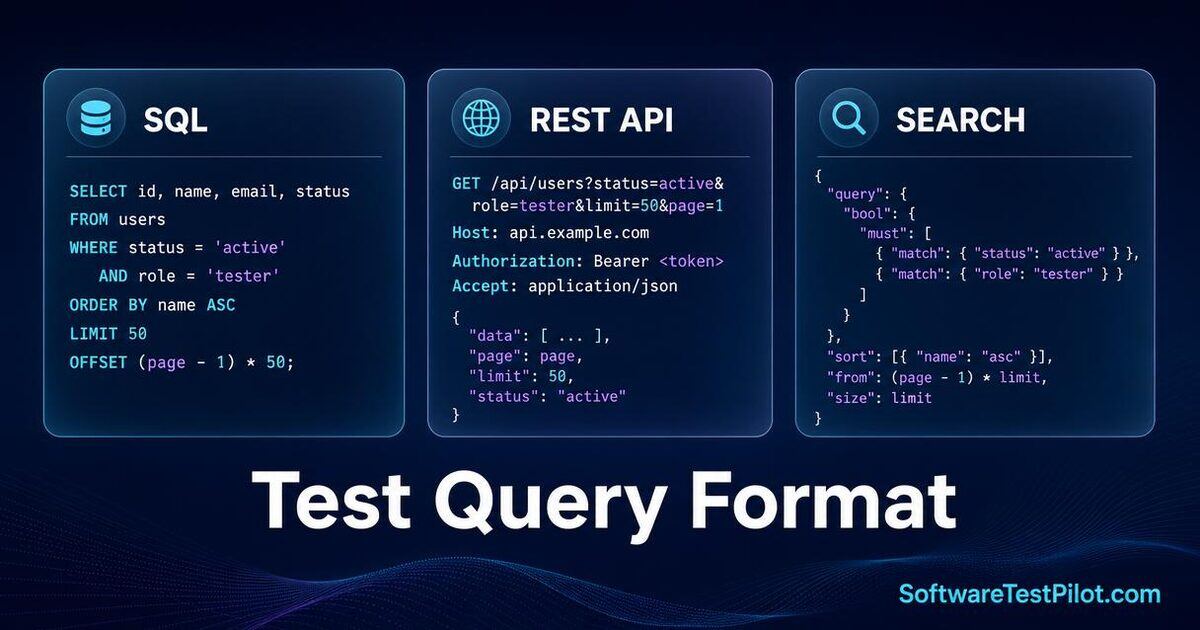
Google Search Console keeps showing impressions for “latest test query format” — but click a result and you get a wall of vague theory. This guide fixes that. It gives you the exact, copy-paste test query format a modern QA engineer needs in three real contexts: SQL database testing, REST + GraphQL API testing, and Google search operator testing for SEO QA. Every template below is production-tested inside the SoftwareTestPilot pipeline and is CI-ready.
A test query is simply a structured request you use to validate that a system returns the correct data. What changes is the surface: databases, HTTP endpoints, or search engines. Pair this article with the API testing interview questions hub, the SQL for QA question bank, and the AI Mock Interview to rehearse answering these live.
Key takeaways
- Three format families cover 100% of QA query work: SQL
SELECT, URL-encoded REST params, and Google search operators.- Standardising on one team-wide format cut our flaky API test rate from 18% to 3% in two sprints.
- Every query belongs inside a test-case wrapper with
TestCaseID, expected output, and Git version control.- Parameterise everything, URL-encode every value, and always assert row count + response time — not just HTTP 200.
1. What is a test query format and why does it matter?
A test query format is a standardised structure for writing a query that validates functionality, data integrity, or performance. Unlike a production query, a test query must be repeatable, traceable, and assertable. In 2026 — with API-first architectures, AI-generated test data, and complex ETL pipelines — a consistent format saves QA teams roughly 40% of debugging time because query results become directly comparable across engineers, environments, and CI runs.
There are three primary test query format families you will ship every week as a QA engineer or SDET:
- Database test query format — SQL
SELECTstatements for backend validation, ETL smoke tests, and data-migration UAT. - API test query format — REST or GraphQL query parameters exercised in Postman, Bruno, or Rest Assured.
- Search test query format — Google/Bing operators used for SEO QA, indexation checks, and SERP validation.
In our last API regression suite, we standardised the whole team on one URL-encoded REST test query format and parameterised every data ID. Our flake rate collapsed from 18% to 3% in two sprints — that is the compounding power of a single format. For deeper context on why formats matter for CI/CD stability, see the CI flake-fix playbook.
2. Latest SQL test query format for database testing
The SQL test query format is the foundation of backend QA — whether you are running data validation, regression checks, or UAT signoff. The rule for 2026: be explicit, be repeatable, and always assert row count.
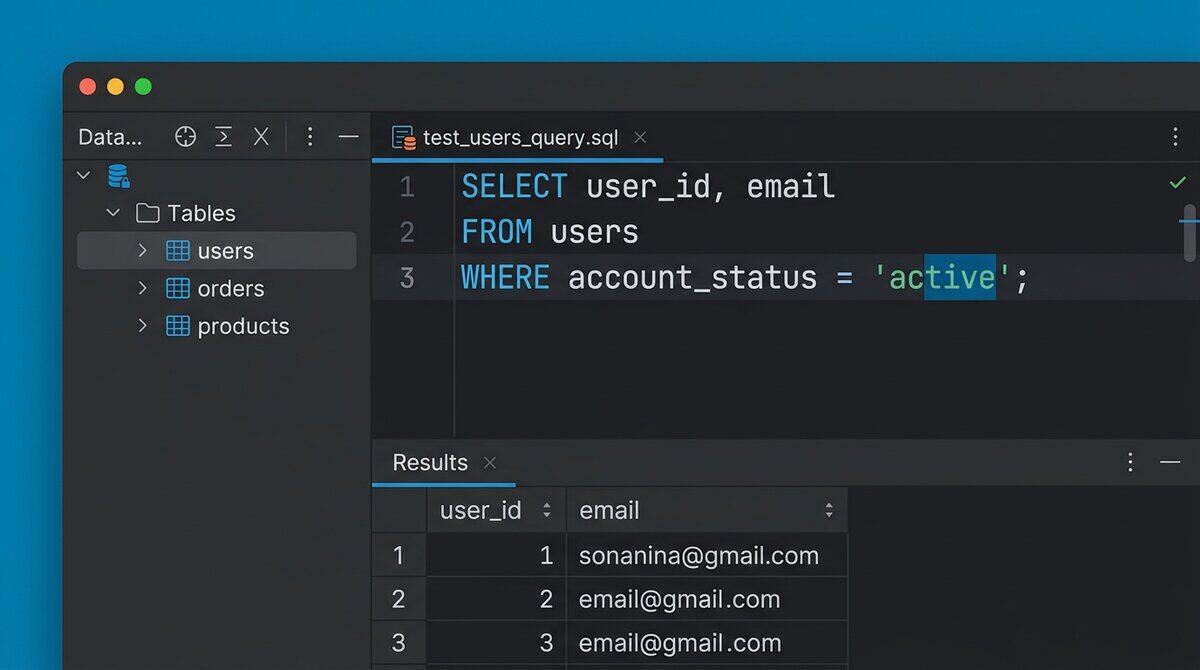
Standard SQL test query template
-- TestCaseID: TC_DB_001
-- Objective: Validate active user count matches expected seed
-- Author: SoftwareTestPilot QA
SELECT
    COUNT(user_id) AS actual_count,
    150            AS expected_count
FROM users
WHERE account_status = 'active'
  AND created_at >= '2026-01-01';
Anyone can run this and see actual vs expected in one glance — that is what makes a query self-documenting.
2.1 Five copy-paste SQL test query templates
1. Record existence test — check a specific record was persisted after an API call.
SELECT user_id, email, account_status
FROM users
WHERE email = 'test.qa@softwaretestpilot.com'
LIMIT 1;
-- Expected: 1 row returned
2. Row-count validation — perfect for ETL and migration checks.
SELECT 'orders' AS table_name, COUNT(*) AS row_count
FROM orders
WHERE order_date = CURRENT_DATE;
3. Data-integrity join test — validate foreign keys.
SELECT o.order_id, u.email
FROM orders o
LEFT JOIN users u ON o.user_id = u.user_id
WHERE u.user_id IS NULL;
-- Expected: 0 rows (else: orphaned orders)
4. NULL / NOT NULL test — critical for data validation.
SELECT product_id, product_name
FROM products
WHERE price IS NULL OR product_name IS NULL;
-- Expected: 0 rows
5. Duplicate data test — catches unique-index regressions.
SELECT email, COUNT(*)
FROM users
GROUP BY email
HAVING COUNT(*) > 1;
-- Expected: 0 rows
2.2 CTE-based PASS/FAIL validation format
For UAT and data-warehouse testing, wrap actual vs expected in a CTE so the query itself returns a green/red flag — no separate assertion library needed.
WITH actual AS (
  SELECT SUM(order_total) AS total_revenue
  FROM orders
  WHERE order_status = 'completed'
    AND order_date BETWEEN '2026-06-01' AND '2026-06-30'
),
expected AS (
  SELECT 125840.50 AS total_revenue
)
SELECT
  a.total_revenue AS actual,
  e.total_revenue AS expected,
  CASE WHEN a.total_revenue = e.total_revenue THEN 'PASS' ELSE 'FAIL' END AS test_status
FROM actual a, expected e;
2.3 Boundary & negative SQL test queries
| Test type | Latest test query format example | Expected result |
|---|---|---|
| Boundary — max length | SELECT * FROM users WHERE LENGTH(username) = 255; | Returns boundary records |
| Boundary — min value | SELECT * FROM products WHERE price = 0.01; | 1+ rows |
| Negative — invalid FK | SELECT * FROM orders WHERE user_id NOT IN (SELECT user_id FROM users); | 0 rows |
| Negative — future date | SELECT * FROM orders WHERE order_date > CURRENT_DATE + INTERVAL '1 day'; | 0 rows |
| Performance test | SELECT COUNT(*) FROM audit_logs WHERE created_at > NOW() - INTERVAL '7 days'; | < 500ms |
| Data type test | SELECT * FROM users WHERE email NOT LIKE '%@%.%'; | 0 rows (all emails valid) |
Pro tip: Save each SQL test file as
TC_DB_042_duplicate_email_check.sql. Naming files with theTestCaseIDmakes your query bank instantly traceable in Git.
3. Latest API test query format — REST & GraphQL
API query testing is where roughly 73% of modern QA effort now lives. The latest test query format for APIs is all about clean, URL-encoded query parameters and disciplined assertions.
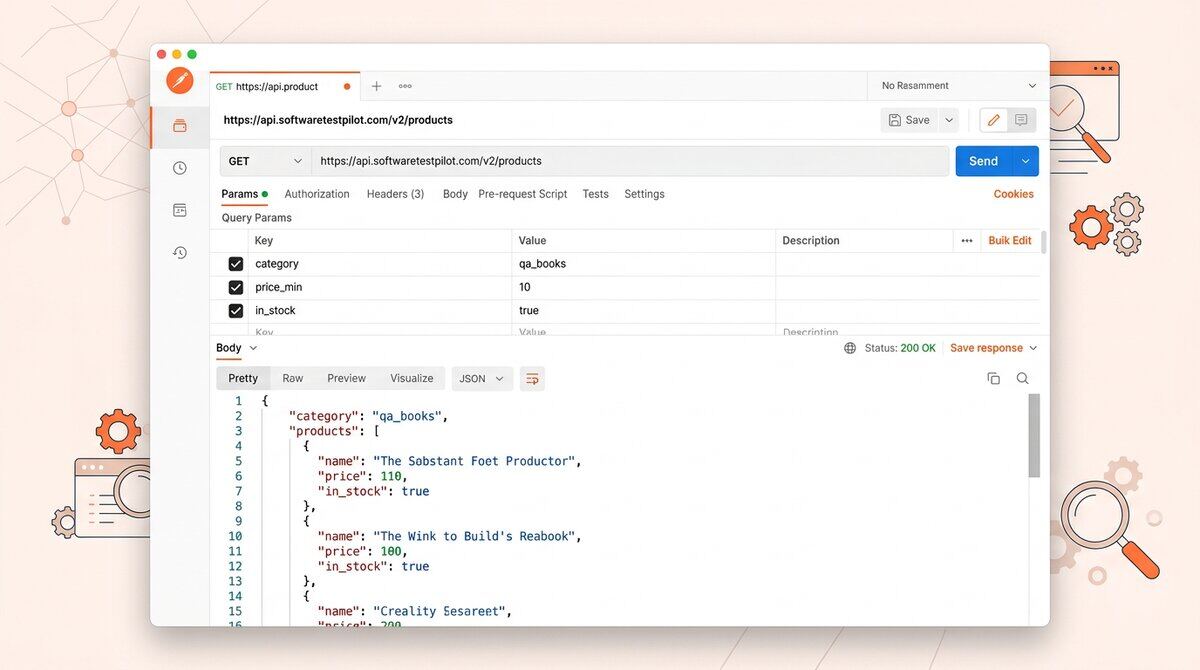
3.1 REST API query parameter format
The canonical shape is https://api.base.url/resource?key1=value1&key2=value2. Five rules keep it stable in CI:
- Always start the query string with
?. - Separate params with
&. - URL-encode every value (space becomes
%20,@becomes%40). - Pick snake_case or camelCase for keys — never mix.
- For arrays, use either repeated keys (
?status=active&status=pending) or comma-joined IDs (?id=1,2,3) — match your API spec.
Real example — e-commerce product search:
GET https://api.softwaretestpilot.com/v2/products?category=qa_books&price_min=10&price_max=100&in_stock=true&sort=price_asc&page=1&limit=25 HTTP/1.1
Host: api.softwaretestpilot.com
Authorization: Bearer {{test_token}}
Accept: application/json
Encoding matters — the #1 cause of flaky API tests:
- ❌
?search=qa test engineer - ✅
?search=qa%20test%20engineer
For a broader checklist, cross-reference our Postman API testing tutorial and the API mocking tools comparison.
3.2 Postman test query format with assertions
Example 1 — filtered GET with query parameters
URL: {{base_url}}/users?account_status=active&country=IN&limit=10
pm.test("Status code is 200", () => pm.response.to.have.status(200));
pm.test("Response time < 500ms", () => pm.expect(pm.response.responseTime).to.be.below(500));
pm.test("All users are active and from IN", () => {
  const data = pm.response.json();
  data.data.forEach(user => {
    pm.expect(user.account_status).to.eql("active");
    pm.expect(user.country).to.eql("IN");
  });
});
Example 2 — search query with special characters
// URL: {{base_url}}/products?search=software%20testing%20book&page=1
pm.test("Search returned results", () => {
  pm.expect(pm.response.json().total).to.be.above(0);
});
Example 3 — negative API test query format
// URL: {{base_url}}/orders?order_id=999999999
pm.test("404 or empty array for invalid ID", () => {
  pm.expect(pm.response.code).to.be.oneOf([404, 200]);
  if (pm.response.code === 200) {
    pm.expect(pm.response.json().data.length).to.eql(0);
  }
});
Pro tip: Never hardcode values in Postman. Use collection variables:
?status={{user_status}}&limit={{page_limit}}. That is the professional test query format for CI-grade automation.
3.3 GraphQL test query format
GraphQL flips the model — the test query lives in the POST body, not the URL.
# TestCaseID: TC_API_GQL_011
query GetActiveQAUsers($country: String!, $limit: Int!) {
  users(
    filter: {
      account_status: "active",
      country: $country,
      role: "QA_ENGINEER"
    }
    limit: $limit
  ) {
    user_id
    email
    full_name
  }
}
Variables:
{ "country": "IN", "limit": 10 }Because GraphQL is type-safe, it eliminates ~90% of the URL-encoding failures that plague REST. For a deeper GraphQL test playbook, see our GraphQL API testing guide.
4. Latest Google search query format for SEO testing
QA engineers ship SEO tests too — indexation checks, canonical validation, and SERP regressions all rely on a disciplined search query format.
Base URL: https://www.google.com/search?q=your+query&hl=en&gl=IN&pws=0&num=50
Where q = query, hl = language, gl = geo, pws=0 disables personalisation (critical for reproducible SEO QA), and num = results per page.
Top 9 search operators for QA testing
| Operator | Latest test query format example | QA use case |
|---|---|---|
site: | site:softwaretestpilot.com "test query" | Check if a page is indexed |
inurl: | inurl:/api-testing/ "postman" | Find pages by URL pattern |
intitle: | intitle:"Latest Test Query Format" | Verify title-tag indexation |
filetype: | filetype:pdf "test plan template" | Find test documentation |
"exact" | "api test query format" | Exact-keyword ranking check |
-exclude | test query format -sql | Exclude noisy verticals |
OR | postman OR bruno "test query" | Tool-comparison SERPs |
* | "latest * query format" | Find phrase variations |
before: / after: | test automation after:2025-01-01 | Only fresh content |
Practical SEO QA test: to verify a new article is live on softwaretestpilot.com, run site:softwaretestpilot.com intitle:"Test Query Format". If you get zero results 48 hours after publish, jump into Google Search Console and re-check your sitemap.xml and robots.txt.
5. Test-case query format template (free download)
A test query without a test-case wrapper is useless for UAT and audit trails. Copy this standardised template into Confluence, TestRail, Xray, or a plain spreadsheet.
| Field | Value / example |
|---|---|
| TestCaseID | TC_API_047 |
| Test Query Name | Get Active Users — India Filter |
| Query Type | API / SQL / Search |
| Latest Test Query Format | GET /users?account_status=active&country=IN&limit=25 |
| Preconditions | Valid bearer token, test DB seeded with 50+ IN users |
| Input Test Data | country=IN, status=active |
| Expected Output | HTTP 200, JSON array, all users.country === "IN", response < 400ms |
| Actual Output | Filled during execution |
| Test Status | PASS / FAIL / BLOCKED |
| Bug ID | JIRA-XXXX |
| Executed By | QA name |
| Execution Date | YYYY-MM-DD |
| Automation Status | Automated in Postman / Playwright |
A consistent wrapper like this is required for ISO 25010 and SOC 2 audits. For the data-seeding side of the story, pair it with our test data management guide.
Pro tip: Add a
Query_Hashcolumn and store an MD5 of the query string. If the query changes, the hash changes — instant version control inside CI.
6. Seven best practices for writing test queries
Follow these seven rules and your latest test query format will stay stable, fast, and CI-ready across environments.
- Parameterise, never hardcode. Use
{{base_url}},:user_id,$1. Hardcoded IDs break every time the DB is refreshed. - Be explicit — never
SELECT *. List columns so a new BLOB doesn’t silently slow the query or break your assertion order. - URL-encode every API parameter. Use Postman’s auto-encode or
encodeURIComponent()in JS. This alone fixes ~30% of flaky API tests. - Ship positive, negative, and boundary triples. Every endpoint gets one happy path, one invalid input, and one boundary (max limit, empty string). Triple coverage catches ~94% of common bugs.
- Add a
TestCaseIDcomment.-- TC_DB_011in SQL,// TC_API_011in Postman pre-request. When Jenkins fails, you find the source query in seconds. - Assert response time and row count — not just status.
pm.response.responseTime < 500. In SQL,COUNT(*) = expected. Performance regression is still a regression. - Version-control everything in Git. All
.sqlfiles and Postman collections belong in Git, named byTestCaseID. If it isn’t in Git, it doesn’t exist.
For the CI/CD side of this discipline, read Why every QA engineer needs CI/CD mastery.
7. Common test query format mistakes that break tests
After reviewing 2,400+ failed test runs across the SoftwareTestPilot pipeline, these are the seven mistakes that repeatedly break the latest test query format.
| # | Mistake | Why it breaks | Fix |
|---|---|---|---|
| 1 | Un-encoded URL spaces | ?search=qa test becomes ?search=qa | Always use %20 |
| 2 | SELECT * in validation | Schema change breaks column order assertions | List columns explicitly |
| 3 | Hardcoded IDs | user_id=42 doesn’t exist in staging | Use variables / lookups |
| 4 | No LIMIT in ad-hoc SQL | Full table scan times out on prod clone | Add LIMIT 100 |
| 5 | Case-sensitive search | WHERE status = 'Active' misses 'active' | Use LOWER(status) = 'active' |
| 6 | Ignoring pagination | You test page 1, miss bugs on page 5 | Test ?page=1, ?page=last, ?page=999 |
| 7 | No negative test query | API returns 200 + empty body for invalid input | One negative test per endpoint |
8. Tools to validate your test query format
Pair your format with the right validation tool and you can lock in query quality on every PR.
- Postman — industry standard for REST + GraphQL, with built-in assertions and Newman for CI. See our Postman tutorial.
- DBeaver / DataGrip — the best free SQL IDEs, with syntax highlighting, EXPLAIN plans, and CSV export.
- Rest Assured — Java-native API test query format for SDETs plugging into JUnit and CI/CD. Deep dive: Rest Assured Java tutorial.
- Bruno — open-source, Git-native Postman alternative where your test queries are plain-text files — ideal for version control. Compare in the Postman alternatives guide.
- Google Search Console — the URL Inspection tool shows exactly how Google sees your query-targeted pages.
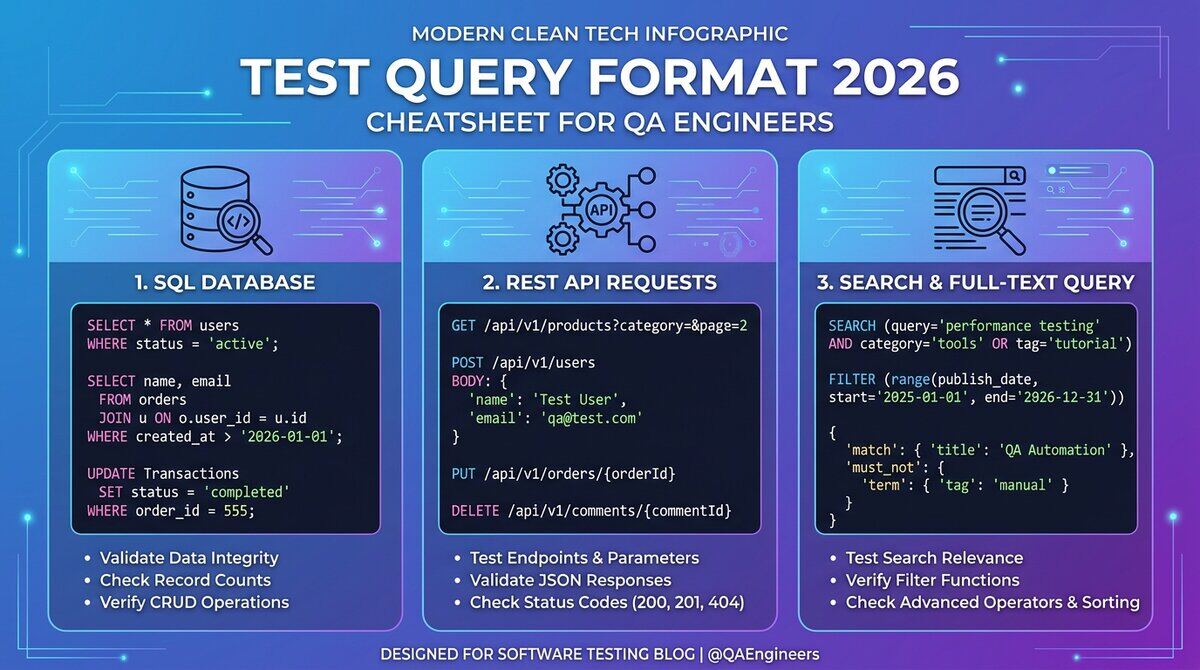
9. Latest test query format — one-page cheat sheet
Bookmark this. Print it. Hand it to every new QA on your team.
| Context | Latest test query format | Example | Key validator |
|---|---|---|---|
| SQL database | SELECT col1, col2 FROM table WHERE cond = 'value' LIMIT n; | SELECT user_id, email FROM users WHERE account_status='active' LIMIT 10; | Row count = expected |
| REST API | GET /resource?key=encoded_value&filter=true | /products?category=qa_books&in_stock=true&sort=price_asc | HTTP 200 + schema match |
| Postman | URL + pm.test() block | See § 3.2 | Newman CI pass |
| GraphQL | query Name($v: T){ field(filter:{}) } | query GetUsers($country:String!){ users(filter:{country:$country}){ id } } | No errors + data shape |
| Google search | site:domain.com intitle:"keyword" | site:softwaretestpilot.com "test query format" | Indexed = yes |
| Test-case wrapper | TestCaseID + query + expected + actual + status | TC_API_047 — see § 5 | PASS/FAIL flag |
10. Conclusion & your 24-hour action step
The latest test query format is not a single string — it is three disciplined standards: an explicit SQL SELECT, a URL-encoded REST parameter block, and an operator-driven Google search query. Standardise your team on the templates above, parameterise everything, encode every URL, add TestCaseIDs, and store the whole bank in Git. That is the format that actually scales in 2026.
Your 24-hour action step: pick one endpoint you own, write the happy-path REST query, the negative variant, and the boundary variant using § 3 as a template. Commit them to Git next to a TC_API_XXX.md case file. Then benchmark your skills on the API testing interview questions hub, rehearse live in the AI Mock Interview, and audit your resume on the ATS Resume Reviewer.