
Microservices Testing in 2026: The Complete Pillar Guide (Strategy, Tools, Examples & FAQ)
The definitive 2026 microservices testing guide — the honeycomb test model, contract testing with Pact, Testcontainers integration, WireMock service virtualization, chaos & observability testing, tool comparison and a 30-day rollout plan for real distributed systems.

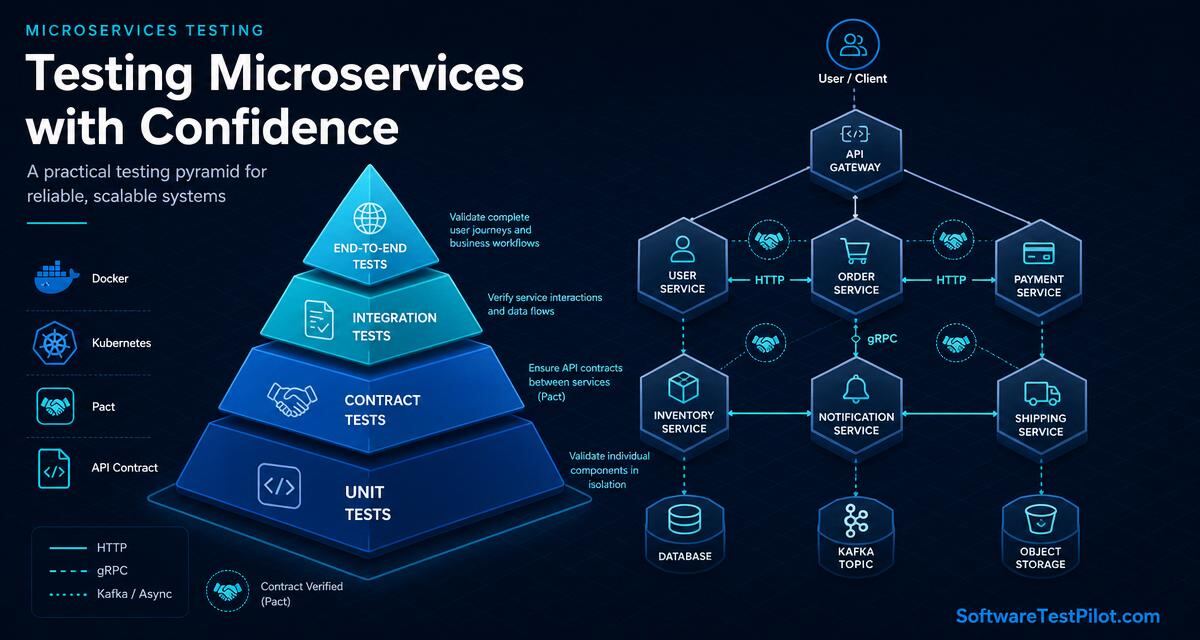
Last updated: July 14, 2026 · 18 min read · By SoftwareTestPilot
Microservices testing is the practice of verifying that dozens — sometimes hundreds — of independently deployable services behave correctly on their own and when they collaborate over HTTP, gRPC, message queues and event streams. A monolith fails in one place; a microservices architecture fails in a network of places, and a single missed contract can cascade into a 3 AM production incident.
This is the one guide we wish every backend, SDET and platform engineer had bookmarked before writing their first Pact contract or Testcontainers spec. It covers the honeycomb test model that has replaced the classic pyramid for distributed systems, the exact tools we use in 2026 (Pact, Testcontainers, WireMock, k6, OpenTelemetry, Chaos Mesh), copy-paste code examples for Java, Node and Python, an anti-pattern autopsy, and a 30-day rollout plan that has taken teams from a red flaky CI to sub-10-minute confidence. Pair it with our deeper Microservices Testing Strategy playbook, the API Testing Tutorial, the GraphQL API Testing Guide and the Test Pyramid Explained.
Key takeaways
- The right shape for microservices is a honeycomb (heavy integration + contract, light unit & E2E), not a pyramid.
- Contract testing with Pact catches 80–90% of the breaking changes that used to leak to production — before merge.
- Testcontainers lets every service run with the real database, queue and cache in CI, killing the "works with H2, breaks with Postgres" class of bug.
- Keep end-to-end tests to < 5% of the suite — anything more and your pipeline becomes a lottery ticket.
- You are not done until observability tests assert that trace IDs, structured logs and RED metrics are actually emitted in every failure path.
1. What is microservices testing?
Microservices testing is the discipline of verifying quality across a distributed system where every service owns its own database, deploys on its own cadence and talks to peers over the network. It combines classic unit and integration testing with two categories the monolith world never needed: contract testing (do consumer and provider agree on the API shape?) and resilience testing (does the system degrade gracefully when a peer service, network hop or message broker misbehaves?).
It is not the same as API testing. API testing verifies one endpoint against a spec; microservices testing verifies the emergent behaviour of many services under partial failure, latency variance and independent deployment. The Martin Fowler microservices canon is still the best conceptual grounding, and Sam Newman's Building Microservices, 2nd edition remains the standard reference on the design trade-offs behind every testing decision below.
+-----------------------------------------------------------------------+
|            MICROSERVICES TESTING — WHAT WE ACTUALLY VERIFY           |
+-----------------------------------------------------------------------+
| 1. Single service logic          → unit + component tests           |
| 2. Service + its real deps       → integration (Testcontainers)     |
| 3. Consumer ↔ provider API      → contract tests (Pact)            |
| 4. Downstream failure paths      → virtualization (WireMock)        |
| 5. Cross-service business flow   → small, curated E2E              |
| 6. Under load                    → performance (k6, JMeter)         |
| 7. Under failure                 → chaos (Chaos Mesh, LitmusChaos)  |
| 8. In production                 → observability + synthetic checks |
+-----------------------------------------------------------------------+
2. Why testing microservices is harder than testing a monolith
Every senior SDET we hire can name the same five root causes for why a microservices test suite ends up slow, flaky and mistrusted. If your team has any of them, fix the root cause before adding more tests.
- Independent deployability. Service A can deploy on Monday, service B on Tuesday. A test that assumes both are on the same version is guaranteed to flake.
- Distributed data. There is no single database to seed. Cross-service state has to be built through APIs or events, not SQL fixtures.
- Network as a first-class failure mode. Latency, timeouts, retries, 429s and cold starts must be tested, not wished away. The AWS Builders' Library on timeouts, retries and backoff is required reading for anyone writing integration tests against a real network.
- Polyglot stacks. One team ships Kotlin + Spring, another ships Node + Nest, another ships Go. A single test framework rarely fits all — standardise on contracts and observability instead of tooling.
- Ownership drift. Who owns the E2E suite? Every incident, no one. Make ownership explicit per test level or the suite will rot.
The DORA State of DevOps research consistently shows that elite performers combine trunk-based development with automated contract, integration and observability testing — not more manual end-to-end coverage.
3. The honeycomb model (why the classic pyramid breaks for microservices)
The classic test pyramid assumes most bugs live inside a single process. In a microservices architecture, most bugs live between processes — wrong payload shapes, missing headers, retries that duplicate a charge, timeouts that never fire. That is why Spotify, ThoughtWorks and most mature platform teams now draw a testing honeycomb:
+-----------------------------------------------------------------------+
|               MICROSERVICES TESTING HONEYCOMB — 2026                 |
+-----------------------------------------------------------------------+
|                    __________                                          |
|                   /          \   ~5%   End-to-end (curated journeys)   |
|                  /____________\                                        |
|                 /              \  ~55% Integrated / contract tests     |
|                /                \        (Pact + Testcontainers)       |
|                \________________/                                      |
|                 \              /   ~40% Implementation detail          |
|                  \____________/           (unit & component)           |
+-----------------------------------------------------------------------+
Read it top-down: keep end-to-end tests small and precious, invest heavily in the middle band (contract + integrated), and only unit-test the parts of a service whose logic is genuinely non-trivial. The moment your suite drifts back into an ice-cream cone (E2E-heavy), pipeline time and flake rate explode — the exact story we broke down in why 78% of automated tests fail in CI/CD.
4. The eight test types every microservices team needs
| # | Test type | Scope | Typical tools (2026) | % of suite |
|---|---|---|---|---|
| 1 | Unit | One class / function, no I/O | JUnit 5, Jest, Vitest, pytest | 30–40% |
| 2 | Component | One service in-process, real code paths, mocked I/O | Spring Boot slice tests, Nest testing module | 10–15% |
| 3 | Integration | Service + real DB / queue / cache in containers | Testcontainers, LocalStack | 20–25% |
| 4 | Contract | Consumer↔provider API agreement | Pact + Pact Broker, Spring Cloud Contract | 15–20% |
| 5 | Service virtualization | Real service vs simulated downstream | WireMock, Mountebank, Hoverfly | Cross-cutting |
| 6 | End-to-end | Full journey across many services | Playwright, REST Assured, k6 scenarios | ≤ 5% |
| 7 | Performance / resilience | Load, spike, soak, chaos | k6, JMeter, Gatling, Chaos Mesh | Cross-cutting |
| 8 | Observability / prod | Traces, logs, RED metrics, SLOs | OpenTelemetry, Datadog, Prometheus, synthetic monitors | Cross-cutting |
Contract and integration tests are the two levels where microservices teams win or lose. Everything else is either a supporting cast (unit, component) or a safety net (E2E, chaos, observability).
5. Contract testing with Pact — the single highest-ROI move
Contract testing is the moment a consumer service publishes an interaction it expects ("when I GET /orders/42 with header X-Tenant: acme, I expect 200 with this JSON shape") and the provider service is verified against that expectation in its own pipeline — without either service ever needing to be deployed together.
The two dominant tools in 2026 are Pact (consumer-driven, polyglot, open-source Pact Broker) and Spring Cloud Contract (provider-driven, JVM-first). If your stack is polyglot, use Pact.
Consumer side (Node / TypeScript)
import { PactV3, MatchersV3 } from '@pact-foundation/pact';

const provider = new PactV3({
  consumer: 'orders-web',
  provider: 'orders-service',
});

describe('GET /orders/:id', () => {
  it('returns the order the UI expects', async () => {
    await provider
      .given('order 42 exists for tenant acme')
      .uponReceiving('a request for order 42')
      .withRequest({
        method: 'GET',
        path: '/orders/42',
        headers: { 'X-Tenant': 'acme' },
      })
      .willRespondWith({
        status: 200,
        headers: { 'Content-Type': 'application/json' },
        body: {
          id: MatchersV3.integer(42),
          total: MatchersV3.decimal(19.99),
          currency: MatchersV3.regex(/^[A-Z]{3}$/, 'USD'),
        },
      })
      .executeTest(async (mock) => {
        const res = await fetch(`${mock.url}/orders/42`, {
          headers: { 'X-Tenant': 'acme' },
        });
        expect(res.status).toBe(200);
      });
  });
});
Provider verification (Java / Spring Boot)
./gradlew pactVerify \
  -Ppact.verifier.publishResults=true \
  -Ppact.provider.version=$GIT_SHA \
  -Ppact.broker.url=https://pacts.example.com
Ship the generated pacts to a Pact Broker, wire the broker's can-i-deploy check into every provider pipeline, and you have earned the right to deploy services independently without asking Slack "is anyone breaking me?" ever again. For deeper API-level patterns, see our API testing interview questions pillar and 5 API testing mistakes that get you fired.
6. Integration testing with Testcontainers (real Postgres, Kafka, Redis in CI)
Nothing burns a microservices team faster than the classic "works on H2, breaks on Postgres" bug — an in-memory database silently accepts a query that the real engine rejects, and the failure only appears in staging. Testcontainers ends that class of bug by running the actual database, message broker or object store inside Docker for every test run.
Spring Boot 3 + Postgres example
@SpringBootTest
@Testcontainers
class OrderRepositoryIT {

  @Container
  static PostgreSQLContainer<?> POSTGRES =
      new PostgreSQLContainer<>("postgres:16-alpine")
          .withDatabaseName("orders")
          .withUsername("test").withPassword("test");

  @DynamicPropertySource
  static void datasource(DynamicPropertyRegistry r) {
    r.add("spring.datasource.url", POSTGRES::getJdbcUrl);
    r.add("spring.datasource.username", POSTGRES::getUsername);
    r.add("spring.datasource.password", POSTGRES::getPassword);
  }

  @Autowired OrderRepository repo;

  @Test
  void persists_and_reads_back_with_real_jsonb() {
    var saved = repo.save(new Order("acme", Map.of("sku-1", 2)));
    var found = repo.findById(saved.id()).orElseThrow();
    assertThat(found.items()).containsEntry("sku-1", 2);
  }
}
Common containers we recommend by default
- Databases —
postgres:16-alpine,mysql:8,mongo:7,redis:7-alpine. - Messaging —
confluentinc/cp-kafka:7.5.0,rabbitmq:3.13-management. - Search / analytics —
opensearchproject/opensearch:2,clickhouse/clickhouse-server:24. - AWS locally —
localstack/localstack:3for S3, SQS, SNS, DynamoDB.
Use Ryuk (Testcontainers' built-in reaper) plus per-worker Docker networks to keep parallel test workers isolated. This is the exact pattern we use for the CI harness we broke down in hidden reasons automation tests fail in CI/CD.
7. Service virtualization with WireMock — simulate the world you cannot run
Some downstream systems cannot be run in CI — a partner bank's OAuth server, a payment provider, a shipping carrier, a mainframe. That is where WireMock, Mountebank and Hoverfly earn their keep: they stand up a fake that behaves exactly like the real dependency, including delays, timeouts, 5xx storms and malformed responses.
stubFor(post(urlEqualTo("/v1/payments"))
    .inScenario("3ds-flow")
    .whenScenarioStateIs(STARTED)
    .willReturn(aResponse()
        .withStatus(202)
        .withFixedDelay(1200) // simulate real bank latency
        .withHeader("Content-Type", "application/json")
        .withBody("{\"id\":\"pi_123\",\"status\":\"requires_action\"}"))
    .willSetStateTo("3ds-pending"));
The rule of thumb we give teams: mock the things you don't own, integrate for real with the things you do. Over-mocking your own services is how you end up with green CI and red production. For a broader list of free mocking tools see our free API mocking tools guide.
8. End-to-end tests — keep them small, precious and business-critical
End-to-end tests are the most expensive tests you own. Every service is real, every network hop is real, every timing bug is real. That is exactly why you want them — and exactly why you want as few of them as possible.
Our rule of thumb: one E2E test per revenue-critical journey, no more than 30 total for a mid-size platform. Everything else belongs in contract or integration. Concrete examples of what a good E2E covers:
- Sign-up → verify email → first paid checkout (payments, ledger, notifications).
- Add-to-cart → apply coupon → place order → refund — the round trip.
- Admin exports a GDPR data package for a real tenant.
Drive them from the API layer with REST Assured or your language's HTTP client, and reserve UI-level Playwright / Cypress for the handful of journeys where the browser is the real user contract. For the deeper "how to make E2E not flake" playbook, see Playwright testing tutorial and every Playwright feature you are not using.
9. Performance and chaos testing microservices
You have not tested a microservices system until you have watched it under load and under partial failure. Two families of tools cover this in 2026:
Performance — k6 first, JMeter second
k6 (JavaScript scenarios, 30k+ RPS per worker, Grafana Cloud integration) is our default for developer-owned performance tests. Fall back to JMeter when you need protocols k6 does not speak (JDBC, LDAP, JMS). See our full k6 load testing tutorial and k6 vs JMeter comparison.
import http from 'k6/http';
import { check, sleep } from 'k6';

export const options = {
  scenarios: {
    checkout_spike: {
      executor: 'ramping-arrival-rate',
      startRate: 50, timeUnit: '1s',
      preAllocatedVUs: 200, maxVUs: 1000,
      stages: [
        { target: 200, duration: '2m' },
        { target: 800, duration: '2m' },  // spike
        { target: 200, duration: '3m' },
      ],
    },
  },
  thresholds: {
    http_req_duration: ['p(95)<800'],
    http_req_failed:  ['rate<0.005'],
  },
};

export default function () {
  const r = http.post('https://api.example.com/checkout', JSON.stringify({ sku: 'sku-1', qty: 2 }), {
    headers: { 'Content-Type': 'application/json' },
  });
  check(r, { 'status is 200': (r) => r.status === 200 });
  sleep(1);
}
Chaos — break it on purpose, in staging first
Use Chaos Mesh or LitmusChaos to inject pod kills, CPU pressure, DNS failures, packet loss and clock skew. Every critical service should have a "kill one pod and prove the SLO still holds" test in its pipeline — not just a wiki page saying it does.
10. Observability testing — the level most teams still skip
A microservices test suite is not complete until it asserts that the system is debuggable in production. That means writing tests that fail if:
- An outbound request is missing a
traceparentheader (broken W3C Trace Context). - A caught exception is not accompanied by a structured log line with
trace_id,tenant_idandcorrelation_id. - A 5xx does not increment the
http_server_errors_totalcounter, or a business event does not emit its OpenTelemetry span.
Wire OpenTelemetry as a first-class dependency and assert on the in-memory span exporter inside your integration tests. This one habit change turns the "can we debug this at 3 AM" question from prayer into contract.
11. The 2026 microservices testing tool stack (one-screen cheat sheet)
| Need | First choice | Alt / when |
|---|---|---|
| Contract testing | Pact + Pact Broker | Spring Cloud Contract (JVM-only) |
| Integration with real deps | Testcontainers | LocalStack (AWS-heavy) |
| Service virtualization | WireMock | Mountebank, Hoverfly |
| Client-side API mocking | MSW (JS), Prism (OpenAPI) | WireMock for JVM |
| E2E (API) | REST Assured, supertest | Karate for BDD-style |
| E2E (UI) | Playwright | Cypress, Selenium |
| Performance | k6 | JMeter, Gatling |
| Chaos | Chaos Mesh | LitmusChaos, Gremlin |
| Observability | OpenTelemetry + Grafana / Datadog | Elastic APM, New Relic |
| CI | GitHub Actions, GitLab CI | Jenkins for self-hosted |
For an enterprise-wide procurement view of automation tooling, cross-reference our 12 best test automation tools for enterprise and 12 best enterprise API testing tools rankings.
12. Worked example — testing an Orders service end-to-end
Take a realistic Orders service that depends on a Payments service, a Notifications service and a Postgres database. Here is how we would layer the tests:
- Unit — pure functions: tax calculation, currency rounding, coupon rules. Fast, no I/O.
- Component — the Orders HTTP handler in-process, with Payments and Notifications wired to in-memory fakes. Verifies routing, validation, auth.
- Integration — Orders + real Postgres via Testcontainers. Verifies migrations, JSONB queries, unique constraints, transactional rollbacks.
- Contract (consumer) — Orders publishes a Pact for what it expects from Payments
POST /chargesand NotificationsPOST /emails. - Contract (provider) — Payments and Notifications each verify the Orders pact in their own pipeline; broker's
can-i-deploygates their deploys. - Service virtualization — a WireMock stub of Payments returning
202 requires_actionwith 1200ms latency to prove Orders handles the 3DS flow. - E2E — one Playwright + REST Assured journey: create order → pay → refund. Runs nightly, not per-PR.
- Performance — k6 spike scenario at 800 RPS with a p95 < 800ms threshold, wired into the release pipeline.
- Chaos — Chaos Mesh kills one Payments pod during the k6 run; SLO must still hold.
- Observability — integration tests assert every failure path emits a span with
tenant_idand a structured error log withtrace_id.
That is a complete microservices testing strategy for one service in ten bullets. Scale the same pattern to every service and you have an org-wide quality operating model.
13. Ten anti-patterns that keep microservices suites red
- Shared staging — one broken deploy poisons everyone's tests. Prefer per-PR ephemeral environments.
- Shared database in tests — kills isolation. Every service owns its schema and its Testcontainer.
- Mocking your own services — you get green CI and red prod. Mock what you don't own, integrate for real with what you do.
- No contract tests — breaking changes escape to staging or prod. Pact + Broker is table stakes.
- Ice-cream cone — too many E2E, too few contract/integration. Invert the ratio.
- Assertions on "element exists" — not the same as verifying the acceptance criterion.
- Fixed sleeps —
Thread.sleep(5000),page.waitForTimeout(3000). Replace with deterministic polling. - Ignoring retries / idempotency — the number one cause of double-charged customers.
- No chaos / observability tests — you cannot fix in prod what you never proved could fail safely.
- No ownership — the "E2E suite" belongs to no team, so no team fixes it. Assign per test level.
14. A pragmatic 30-day microservices testing rollout
- Week 1 — measure the baseline. Count tests per level, mean CI time, top-10 flake list, MTTR for the last five incidents. No changes yet.
- Week 2 — introduce Testcontainers on the two highest-traffic services. Kill H2 / SQLite fakes. Expect a short-term red build; do not compromise.
- Week 3 — stand up a Pact Broker and add the first consumer-provider pair. Wire
can-i-deployas a warning, not a gate, in week 3. - Week 4 — cut the E2E suite in half. Move logic-only journeys down into contract / integration. Add one k6 threshold, one chaos experiment, one observability assertion per critical service.
- Day 30 review — re-measure the week 1 numbers. Elite teams see CI time cut 30–50% and flake rate drop below 1% inside a quarter.
For team-level upskilling, point new SDETs at our SDET career roadmap, the API testing interview questions pillar and the AI mock interview to rehearse system-design rounds that increasingly ask exactly the questions above.