7 Engineering Truths Senior SDETs Know That Juniors Learn the Hard Way (2026)
Staff and Principal SDETs earn $180K–$240K+ for a reason. Here are the 7 unspoken engineering truths — coverage ROI, flaky-test governance, shift-left, test pruning, and cross-team negotiation — that separate juniors from senior quality architects.

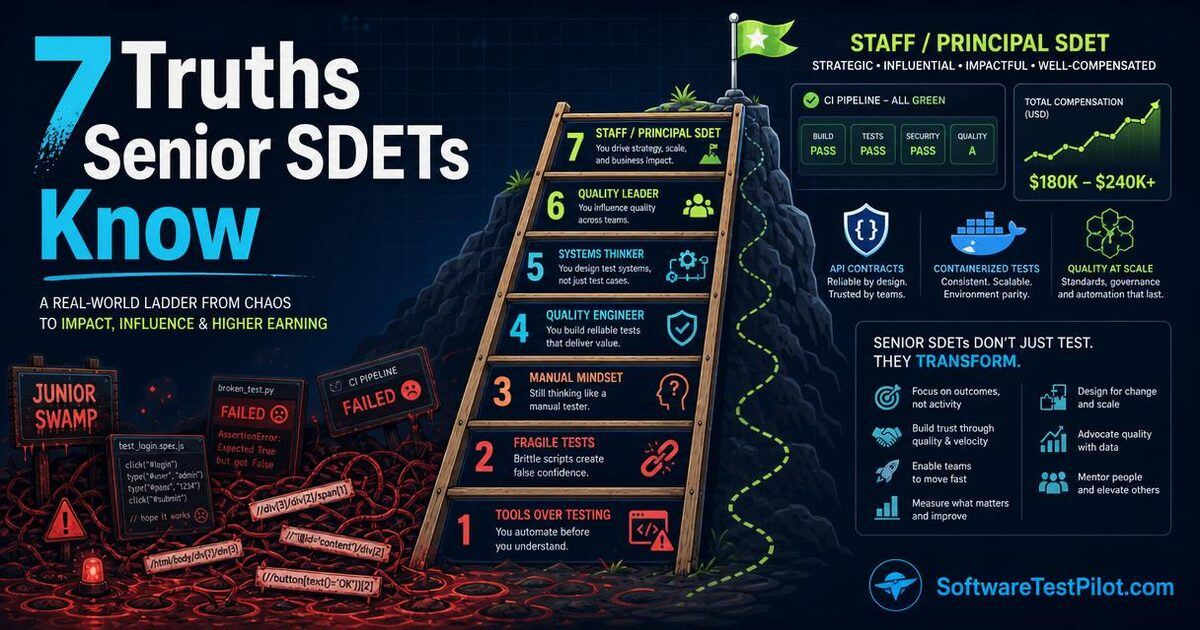
Last updated: July 4, 2026 · 14 min read · By Avinash K
Watch a newly hired automation engineer during their first six months. Armed with Playwright, TypeScript, and XPath selectors, they attack every user story with one mission: automate everything. Script counts climb from 50 to 200. Then, six months later, the architectural debt bill arrives — CI slows from 8 to 45 minutes, flaky failures plague every PR, developers stop reading red build alerts.
Compare that firefighting to the calm workflow of a Principal SDET earning $180,000–$240,000+ at companies tracked on our SoftwareTestPilot QA Jobs Radar. Senior SDETs don't work 70-hour weeks chasing locators — they run pristine pipelines under five minutes and command engineering-director respect. The gap isn't a magic language or a proprietary AI tool. It's a set of unspoken engineering truths earned through years of production outages and repo maintenance.
Here are the 7 paradigm shifts that elevate a junior script writer into a Staff-level Quality Architect — plus a self-assessment matrix and the exact interview scripts hiring managers listen for.
Key takeaways
- Chasing 100% coverage is a vanity metric — Staff SDETs optimise for risk-based ROI.
- Your job is building infrastructure so 50 developers write their own tests, not writing them yourself.
- Flaky tests are P1 outages that erode pipeline trust — quarantine, don't retry.
- UI E2E is the last resort; push scenarios down to unit and API layers.
- Cross-team negotiation in dollars, not code elegance, drives your compensation.
1. Truth 1 — 100% test automation coverage is a dangerous vanity trap
Ask a junior what their quality objective is and they'll almost always answer: “100% automated coverage.” To a Principal SDET, chasing 100% coverage is an expensive anti-pattern.
+-----------------------------------------------------------------------------------+
|                  THE LAW OF DIMINISHING QUALITY RETURNS                           |
+-----------------------------------------------------------------------------------+
| COVERAGE TIER  | AUTOMATION EFFORT & COST  | VALUE & RISK MITIGATION              |
+----------------+---------------------------+--------------------------------------+
| 0% to 70%      | Linear, High ROI          | Catches 90% of critical P0/P1 bugs.  |
| 70% to 85%     | Moderate Effort           | Catches edge cases & complex flows.  |
| 85% to 100%    | Exponential, Massive Cost | Catches trivial, low-probability UI  |
|                |                           | variance; huge maintenance debt.     |
+-----------------------------------------------------------------------------------+
Push automated UI coverage past 80% and the cost to automate and maintain the remaining 20% skyrockets. Scripts for highly dynamic, third-party-dependent, or low-probability flows (locale swaps mid-checkout, credit-card re-auth during viewport resize) become fragile and break every sprint.
Senior SDETs operate under Risk-Based Quality Economics: focus 80% of automation effort on the 20% of journeys that carry revenue or legal/security liability — checkout, auth, ledger APIs. If a static info modal breaks once every two years, a monitoring alert is cheaper than a brittle E2E script forever.
2. Truth 2 — Your primary job isn't writing tests, it's building infrastructure
A junior thinks their deliverable is test scripts. A Staff SDET knows that if you're personally writing every automated test in your company, your quality strategy has failed.
+-----------------------------------------------------------------------------------+
|                  THE QUALITY ASSISTANCE SCALING MODEL                             |
+-----------------------------------------------------------------------------------+
| [TRADITIONAL QA SILO MODEL (Linear Bottleneck)]                                   |
| 50 Developers ---> Write Application Code ---> Hand off to 5 SDETs to write tests.|
| Result: SDETs become overworked gatekeepers slowing release velocity.             |
+-----------------------------------------------------------------------------------+
| [MODERN STAFF SDET ENABLEMENT MODEL (Exponential Multiplier)]                     |
| 1 Staff SDET ---> Builds API data factories, Docker sandboxes & CI/CD pipelines.  |
| 50 Developers ---> Write application code AND their own automated tests.          |
| Result: Zero QA bottlenecks; quality scales instantly across 50 product pods.     |
+-----------------------------------------------------------------------------------+
At Atlassian, Stripe, and GitLab, SDETs are internal tools engineers. Your job is to make writing and running automated tests so effortless that developers gladly ship their own unit, integration, and E2E tests before requesting review. When you deliver a custom Playwright fixture (test.extend) that seeds DB state and handles auth in two lines, developers adopt it immediately — see our advanced Playwright features guide for the exact patterns. You transition from gatekeeper into platform multiplier.
3. Truth 3 — Flaky tests are P1 outages, not minor annoyances
Juniors dismiss intermittent CI failures: “Just re-run the build.” Senior engineers treat every flake as a Priority 1 outage that threatens organisational trust.
+-----------------------------------------------------------------------------------+
|                  THE PSYCHOLOGICAL EROSION OF FLAKY TESTS                         |
+-----------------------------------------------------------------------------------+
| Day 1:  A flaky test fails in CI. Developer re-runs the job. It passes.           |
| Day 15: 3 flaky tests fail daily. Developers start ignoring red build alerts.     |
| Day 45: Developers assume ALL red build alerts are false-negative flakiness.      |
| Day 60: A REAL P0 regression turns the build red. Developers ignore it and       |
|         force-merge the pull request into production.                             |
| RESULT: CATASTROPHIC PRODUCTION OUTAGE CAUSED BY ERODED PIPELINE TRUST.           |
+-----------------------------------------------------------------------------------+
Enforce zero-flake governance
If a test is non-deterministic, do not leave it in the blocking pre-merge pipeline. Immediately quarantine it (@quarantine tag) into a non-blocking nightly diagnostic run and file a high-priority engineering bug for root cause. A suite of 100 deterministic tests passing 100% of the time is infinitely more valuable than 1,000 tests passing 94% of the time. For the underlying network mocking and race-condition patterns, revisit our Playwright tutorial.
4. Truth 4 — UI automation is the last resort, not the first defense
Because apps are visual, juniors reach for a headless browser first. Senior SDETs enforce the Testing Pyramid: UI tests execute 10× slower and suffer 20× more environmental flakiness than API contract or DB tests.
Apply strict downward-push governance to every scenario:
- “Can this checkout calculation be a sub-second unit test in the backend domain service?” → push it down to unit testing.
- “Can this gateway error handling be tested via a 50 ms REST call using Axios or Playwright
APIRequestContext?” → push it down to API integration. - “Does this scenario strictly require verifying a visual CSS modal in a real browser viewport?” → only then authorise a UI E2E script.
Blueprint: the 5 critical API testing mistakes and the API testing tutorial.
5. Truth 5 — Quality is designed at the PR layer, not tested at the end of the sprint
Legacy teams QA'd at the tail end of the release. Senior SDETs know testing quality in after code compiles is an expensive failure.
+-----------------------------------------------------------------------------------+
|                  THE EXPONENTIAL COST OF DEFECT DISCOVERY                         |
+-----------------------------------------------------------------------------------+
| DEFECT FOUND DURING...       | TIME TO FIX        | FINANCIAL COST TO COMPANY     |
+------------------------------+--------------------+-------------------------------+
| Architecture / Design Review | 15 minutes         | $25 (verbal discussion)       |
| Developer Pull Request (CI)  | 45 minutes         | $75 (code commit adjustment)  |
| Staging Regression (Day 10)  | 6 hours            | $600 (context switch & triage)|
| Production Outage (Customer) | 3 days + hotfix    | $15,000+ (churn & SLA breach) |
+-----------------------------------------------------------------------------------+
Shift-left governance
Elite SDETs join architectural design reviews before a single line of code is written and ask: “How will we observe and independently verify this microservice in isolation?” They wire fast API and component tests into GitHub Actions on every commit — see our GitHub Actions CI guide — so a broken contract blocks the merge within four minutes, while context is still fresh in the developer's head.
6. Truth 6 — Aggressively deleting tests reduces maintenance debt
The hardest psychological leap for intermediate engineers is learning when to delete tests. Juniors treat every script as sacred. Over four years, a repo swells from 200 to 1,500 tests — many covering deprecated features or user paths less than 0.1% of customers visit.
Senior SDETs view every line of test code as technical liability. Every script must pay rent by actively mitigating business risk. Run a quarterly Suite Pruning Audit and ask:
- Has this UI test caught a genuine regression in the past 18 months?
- Is this E2E workflow already covered more reliably by our expanded API contract suite?
- Does this script eat three hours of maintenance every quarter due to third-party sandbox updates?
If a script consumes high labour while delivering negligible risk mitigation, delete it ruthlessly. A lean, fast, credible harness beats a bloated one every day of the week.
7. Truth 7 — Cross-team negotiation drives pay more than coding speed
The seventh truth is what separates $120K mid-level engineers from $220K+ Principal architects: your compensation is dictated by executive soft skills and cross-team negotiation, not typing speed.
A junior complains in team chat: “Management doesn't care about quality! They won't give us time to refactor.” A Principal SDET speaks the language of executive leadership — revenue, risk, and time-to-market. When they need three weeks to refactor a legacy pipeline, they present a quantified business proposal to the VP of Engineering:
“Our current legacy testing pipeline takes 45 minutes per PR run and suffers a 15% flaky re-run rate. This wastes an estimated 420 developer hours per month, costing the company $38,000 in lost engineering productivity monthly while delaying releases by two days. I'm requesting two developers join me for a two-week sprint to refactor container sharding and API data factories. This investment pays for itself in operational savings within 45 days.”
When you negotiate quality improvements using financial ROI, executives listen, approve, and reward you with top-tier comp. Salary bands here are unambiguous — see our SDET vs QA salary gap analysis for the exact 2026 bands.
8. Self-assessment matrix — where do you sit on the seniority ladder?
+-----------------------------------------------------------------------------------+
|                  SDET SENIORITY SELF-ASSESSMENT CHECKLIST                         |
+-----------------------------------------------------------------------------------+
| BEHAVIORAL & ARCHITECTURAL INDICATORS               | JUNIOR / MID | STAFF SDET   |
+-----------------------------------------------------+--------------+--------------+
| Primary goal when writing automated test suites     | 100% Coverage| ROI Risk Prep|
| Action taken when a CI test fails intermittently    | Re-run build | Quarantine   |
| Primary layer chosen for regression automation      | UI Browser   | API & Unit   |
| Approach to legacy tests that rarely catch bugs     | Preserve all | Prune & Del  |
| Relationship with developer pull request workflows  | Post-merge   | Pre-merge CI |
| Justification used when pitching QA upskilling      | "Better code"| "$ ROI Speed"|
+-----------------------------------------------------+--------------+--------------+
Score yourself honestly. Every “Junior/Mid” column you tick is a specific habit to invert this quarter.
9. Demonstrating executive presence during interviews
When interviewing for Staff and Principal SDET roles on our QA Jobs Radar, interviewers intentionally test your maturity against these truths with behavioural prompts: “Tell me about a time you decided NOT to automate a feature,” or “How do you handle a PM who refuses to prioritise pipeline refactoring?”
Ensure your resume reflects senior architectural leadership rather than script writing — upload your draft to the ATS Resume Reviewer and replace task descriptions with executive impact metrics:
“Spearheaded enterprise quality governance across 6 microservice pods, eliminating 400 redundant legacy UI scripts in favour of programmatic API contract checks and reducing CI/CD build times by 65%.”
Rehearse cross-functional negotiation stories out loud on the SoftwareTestPilot AI Mock Interview. Drill senior scenarios from the Playwright, API testing, and Selenium hubs so the technical layer is automatic and you can spend interview time on leverage stories.
10. Conclusion & your 24-hour action step
Elevating from junior script writer to Staff SDET requires a shift in perspective. Stop chasing 100% UI coverage. Stop tolerating flaky tests. Stop operating as an isolated downstream gatekeeper. Build robust API data factories, enforce pre-merge CI gates, aggressively delete unmaintained legacy tests, and communicate quality ROI in financial engineering velocity.
Your 24-hour action step
Audit your team's automation repository today. Identify five slow, unmaintained, or flaky UI regression scripts that have not caught a genuine defect in the past twelve months. Document why those scripts represent maintenance liabilities, delete or quarantine them from the primary PR pipeline, and measure the immediate improvement in CI execution velocity. Then benchmark yourself against active Principal SDET openings on the QA Jobs Radar. Related reading: SDET roadmap 2026 · why ISTQB alone won't get you hired.