Manual Tester to SDET: Step-by-Step Transition Guide (2026)
Step-by-step guide to transition from manual QA to SDET in 2026. Skills to learn, 6-month timeline, portfolio projects, salary impact, and how to pitch yourself.

Last updated: June 27, 2026 · 7 min read
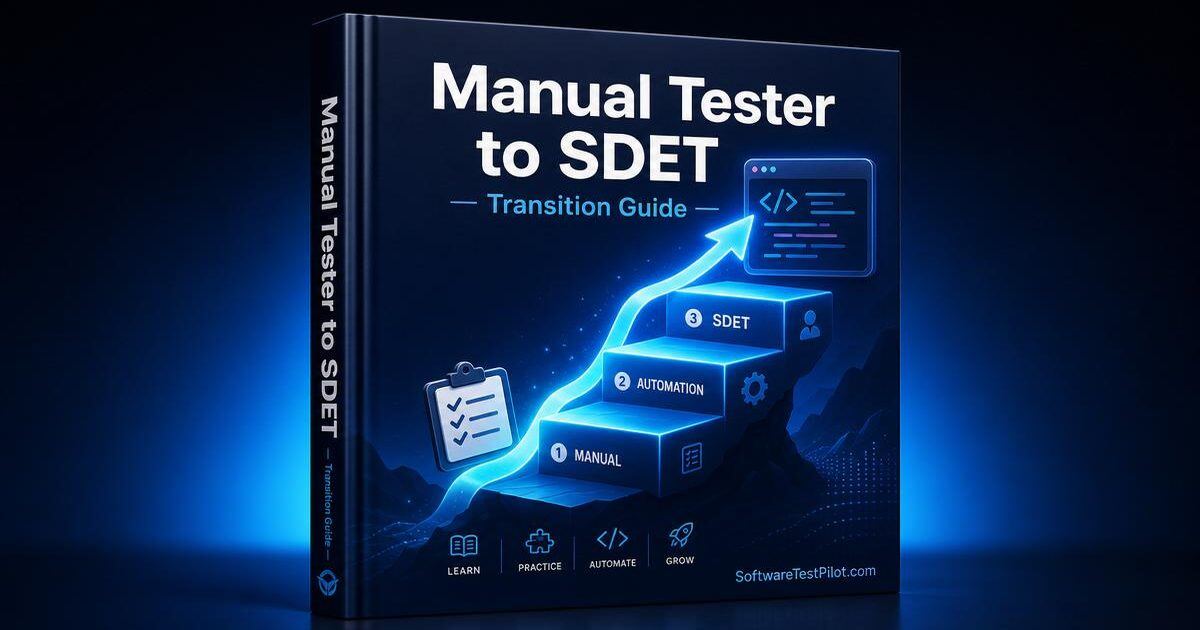
If you're a manual QA engineer and want to transition to an SDET role in 2026, this guide gives you the exact 6-month plan, skills, and portfolio projects to land your first automation-heavy role. Pair it with our SDET Career Roadmap and the QA Engineer Resume Guide.
Why transition from manual to SDET?
- Salary uplift: 30–60% higher than manual-only roles
- Job security: Manual-only roles are shrinking; SDET demand is growing
- Career trajectory: Clear ladder to Senior SDET, Staff, and Principal
- Intellectual challenge: More engineering, less repetition
For the full career picture, see our SDET Career Roadmap.
Skills You Need to Learn
| Skill | Priority | Time to learn |
|---|---|---|
| Programming language (Python or Java) | Critical | 2–3 months |
| Automation framework (Playwright or Cypress) | Critical | 1–2 months |
| API testing (Postman or REST Assured) | Critical | 2–4 weeks |
| Git + GitHub | Critical | 2 weeks |
| CI/CD (GitHub Actions or GitLab CI) | Important | 2 weeks |
| SQL basics | Important | 2 weeks |
| Docker basics | Nice-to-have | 1 week |
| Cloud basics (AWS or GCP) | Nice-to-have | 1 month |
The 6-Month Learning Plan
Month 1 — Programming fundamentals
- Pick: Python (easier) or Java (more enterprise jobs)
- Resources: Automate the Boring Stuff (Python) or Effective Java
- Practice: 30 min LeetCode daily + 1 hour building a small CLI tool
- Outcome: Write clean, idiomatic code
Month 2 — Test automation framework
- Pick: Playwright (TypeScript) — see our Playwright guide
- Build: POM library with login, dashboard, search flows
- Outcome: Working framework with 20+ tests
Month 3 — API testing
- Tool: Postman (visual) + REST Assured or Playwright (automation)
- Build: Test suite for 30+ endpoints
- Outcome: Cover full CRUD + auth
Month 4 — CI/CD
- Pick: GitHub Actions — see our GitHub Actions CI guide
- Build: Pipeline that runs tests on every PR, publishes HTML report
- Outcome: Working CI/CD with parallel execution
Month 5 — Portfolio projects
Build 3 public GitHub repos:
- Playwright POM framework for an open-source app
- API test suite for a public API
- AI-assisted test tool (CLI that drafts test cases from user stories)
For more portfolio ideas, see our SDET Career Roadmap.
Month 6 — Job search
- Update resume (see our QA Engineer Resume Guide)
- Apply to 5 roles per week on Jobs Radar
- Network in QA communities — join the QA Network
- Practice mock interviews with our AI Mock Interview and the Software Testing Interview Questions bank
Common Mistakes to Avoid
Mistake 1 — Trying to learn everything at once
Focus on one skill per month. Don't try to learn Python, Selenium, JMeter, and Docker simultaneously.
Mistake 2 — Skipping programming fundamentals
Don't jump to Selenium if you don't know Python/Java. The frameworks are easy; the language is the foundation.
Mistake 3 — Building toy projects
Build projects on real open-source apps. Toy projects don't impress hiring managers.
Mistake 4 — Ignoring soft skills
SDETs need to communicate with devs, PMs, and leadership. Practice writing, presenting, and explaining technical decisions.
Mistake 5 — Not asking for feedback
Find a senior SDET who will review your code and portfolio. Free mentoring accelerates growth.
Salary Impact of the Transition
| Role | US median salary |
|---|---|
| Manual QA | $70k |
| Mid QA (automation) | $115k |
| Senior SDET | $160k |
| Staff SDET | $215k |
A successful transition typically adds $40k–$60k to your annual salary within 2 years.
For global salary data, see our QA Salary Guide.
How to Pitch Yourself to Hiring Managers
When applying for SDET roles from a manual background, position yourself as:
"QA engineer with 5 years of manual testing experience and 6 months of focused automation training. I've built a production-ready Playwright framework and an API test suite that I've open-sourced on GitHub."
This framing emphasizes your domain expertise (5 years of manual testing) plus your new technical skills (the framework). It's a powerful combination.
Sample Portfolio Project: Login Automation Suite
A common first portfolio project — build it in a weekend.
Tech stack
Playwright + TypeScript + GitHub Actions
Features
- 30+ test cases covering happy path, validation, security, accessibility
- Page Object Model with reusable component classes
- CI pipeline that runs on every PR
- HTML report published to GitHub Pages
- README with setup instructions and screenshots
Sample structure
login-automation-suite/
├── tests/
│   ├── login.spec.ts
│   ├── validation.spec.ts
│   ├── security.spec.ts
│   └── accessibility.spec.ts
├── pages/
│   ├── base-page.ts
│   ├── login-page.ts
│   └── dashboard-page.ts
├── components/
│   └── header.ts
├── fixtures/
│   └── test-fixtures.ts
├── .github/workflows/
│   └── playwright.yml
├── playwright.config.ts
└── README.md
This project demonstrates framework design, test coverage breadth, CI/CD integration, documentation skills, and production-quality code. See our Playwright POM TypeScript guide for the full pattern.
Quick-Win: Your First Automation Test This Week
If you're a manual QA reading this, here's a 30-minute exercise to write your first automated test.
Step 1 — Install Playwright (10 minutes)
mkdir my-first-test
cd my-first-test
npm init -y
npm install -D @playwright/test
npx playwright install chromium
Step 2 — Write your first test (10 minutes)
Create tests/login.spec.ts:
import { test, expect } from '@playwright/test';

test('login with valid credentials', async ({ page }) => {
  await page.goto('https://the-internet.herokuapp.com/login');
  await page.getByLabel('Username').fill('tomsmith');
  await page.getByLabel('Password').fill('SuperSecretPassword!');
  await page.getByRole('button', { name: 'Login' }).click();

  await expect(page.getByText('You logged into a secure area!')).toBeVisible();
});
Step 3 — Run the test (10 minutes)
npx playwright test --headedYou just wrote and ran your first automated test. Repeat daily for a week, and you've started your transition. For the full walkthrough, see our Playwright Complete Guide.
Continue your transition journey
Many testers stop one step short of SDET and land an automation role instead, which pays well and gets you writing code daily. The Automation QA Engineer role guide covers what that job actually involves.