10 Best Software Testing Courses on Udemy & Coursera (2026)
Hand-picked QA, automation, Selenium, Playwright, and AI testing courses that actually help you get hired in 2026.

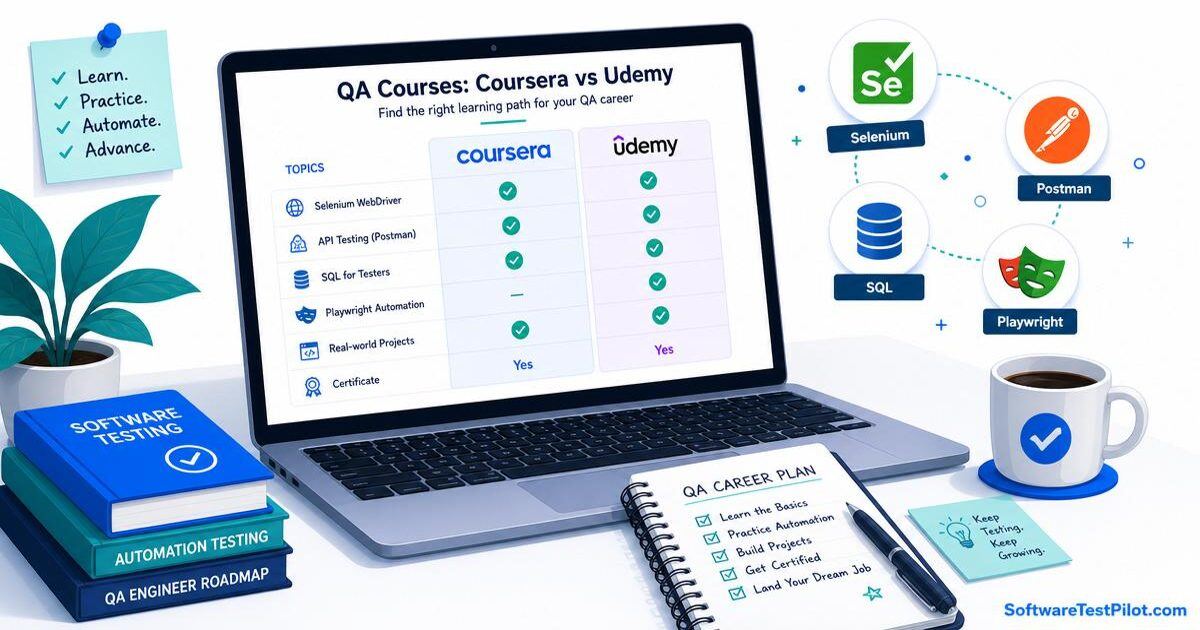
Choosing a software testing course in 2026 is confusing because there are hundreds of options. Some are excellent, some are outdated, and some promise a job too easily. Students often ask whether Coursera is better than Udemy, whether paid courses are necessary, and which course actually helps them land a QA role.
The honest answer is that the best course depends on your current level. A complete beginner needs testing fundamentals and practical assignments. A manual tester needs API, SQL, and automation. A student targeting SDET roles needs programming, framework design, Git, CI, and real projects. This guide explains how to choose wisely instead of buying courses randomly.
SoftwareTestPilot tip: Pair this article with the AI Mock Interview, Resume ATS Review, QA Jobs Radar, and our interview hubs for Selenium, API testing, and SQL for testers.
How to judge a testing course
A good course should teach concepts, show practical examples, include assignments, and help you build something. Avoid courses that only read slides. Also check whether the course is updated for modern tools and workflows — Selenium is still useful, but courses should teach waits, Page Object Model, test data, Git, and reporting instead of only recording scripts. Our Selenium WebDriver Guide and Playwright Tutorial are good reference points for what "modern" looks like.
Watch preview videos before buying. If you cannot understand the instructor in the preview, you probably will not finish the course. Also read recent reviews, not only total ratings — a highly rated course from five years ago may still be outdated. See the official Coursera catalog and Udemy catalog for current previews.
Best Coursera-style learning path
Coursera is useful when you want structured academic learning. University-backed software testing courses often explain verification, validation, test design, white-box testing, black-box testing, and automation theory clearly. This is helpful for students who want deeper understanding, not only tool steps.
The downside is that some Coursera courses may feel less job-project focused than Udemy bootcamps. Fix this by combining Coursera theory with your own practical project. After learning black-box testing, write test cases for a real demo app. After learning automation basics, create a small GitHub repository and link it from your QA resume.
Best Udemy-style learning path
Udemy is useful for practical tool learning. You can find courses on Selenium Java, Selenium Python, Playwright, Cypress, Postman, REST Assured, JMeter, SQL, and interview preparation. Many courses are hands-on and project-based, which helps freshers show visible work.
The downside is quality variation. Some courses are too long, some are outdated, and some teach bad habits like fixed waits or fragile XPath. Choose courses that include framework design, real projects, and modern best practices — see our Playwright TypeScript tutorial and Postman tutorial for what "good enough" looks like.
Recommended order for beginners
Start with software testing fundamentals: SDLC, STLC, test cases, defect lifecycle, test techniques, regression, smoke, sanity, and UAT. Next learn API basics with Postman. Then learn SQL for testers using our SQL interview questions. After that pick one automation path: Selenium with Java or Python, Playwright with TypeScript, or Cypress with JavaScript.
Do not start with automation on day one if you do not understand testing. Automation is not only writing code — it is deciding what should be automated, how to assert correctly, and how to keep tests maintainable. The SDET Career Roadmap shows the full sequence.
Course combinations that work
For manual QA roles, combine a manual testing fundamentals course, an API testing course, SQL basics, and one live project. For automation QA roles, add Java or JavaScript basics, Selenium or Playwright, Git, and CI/CD. For SDET roles, go deeper into programming, data structures basics, API automation, framework design, and cloud execution.
A good combination is one structured theory course plus one hands-on tool course. Too many courses at once create confusion. Finish one, build a project, then move to the next.
How to avoid course addiction
Course addiction is real. Students keep buying courses because learning feels productive, but they avoid building projects because projects are uncomfortable. Set a rule: after every course section, create an output. If you learn test cases, write test cases. If you learn Postman, create a collection. If you learn Selenium waits, automate a dynamic page.
Your resume should not list ten course names. It should list skills and projects. Recruiters care more about what you can do than how many videos you watched — run your draft through our free Resume ATS Review before applying.
Final recommendation
Coursera is better for structured fundamentals and theory. Udemy is better for practical tool skills and project-based learning. The best 2026 approach is to use both carefully: one foundation course, one automation course, one API course, and one portfolio project.
Do not chase the perfect course. Pick a good enough course, finish it, practise daily, and build proof. That is what turns online learning into job readiness.
A practical course selection checklist
Before enrolling in any course, check five things. First, does it match your current level? A beginner course should not assume strong coding knowledge. Second, does it include hands-on assignments? Watching videos without tasks will not build skill. Third, is the content updated for current tool versions and modern practices? Fourth, does the instructor explain mistakes and debugging, not only perfect flows? Fifth, can you build a portfolio project after finishing it?
For Udemy, wait for discounts and read recent reviews. For Coursera, check whether you want only audit-style learning or a paid certificate. Do not buy courses because of fear — buy or enroll because the course fits your plan.
A simple rule: one foundation course, one tool course, one project. Finish them before moving to the next stack. If you choose Selenium Java, stay with it long enough to build a framework. If you choose Playwright TypeScript, stay with it long enough to understand locators, fixtures, assertions, and reports. Depth beats random variety.
Weekly execution plan for students
Use a simple weekly rhythm so learning becomes measurable. On Monday, choose one topic and read or watch only enough to understand the basics. On Tuesday, practise the topic on a small example. On Wednesday, write notes in your own words. On Thursday, improve one portfolio file. On Friday, answer interview questions related to that topic using the AI Mock Interview. On Saturday, review mistakes and clean your GitHub. On Sunday, rest or lightly revise.
This rhythm prevents passive learning. It also creates visible progress every week. After four weeks, you will have notes, test cases, bug reports, API checks, SQL queries, or automation code instead of only browser history. Recruiters cannot see how many videos you watched, but they can see what you created.
If you are studying alongside college or a job, reduce the size but keep the habit. Even thirty focused minutes per day can build momentum.
How to turn this into a real career advantage
Reading one article or finishing one course is not enough by itself. Students who get interviews usually do three things consistently. First, they learn the concept. Second, they practise it on a small public project. Third, they explain the work clearly on GitHub, LinkedIn, and their resume. This loop is more powerful than collecting ten certificates without proof of skill.
For every topic you study, create one visible output. If you learn test case design, publish a test case document for a demo ecommerce site. If you learn Selenium, push a small framework to GitHub. If you learn API testing, share a Postman collection with positive and negative scenarios. If you prepare for ISTQB, write notes in your own words and create a small cheat sheet.
Also keep your language practical. Do not write "expert in automation" if you only completed one beginner course. Write what you can actually do: "Created Selenium tests for login and search using Java, TestNG, explicit waits, and Page Object Model." Honest, specific statements build trust faster than big claims.
Common mistakes students should avoid
The first mistake is jumping between too many resources. Pick one course or plan, finish it, and build something from it. The second mistake is studying only theory — QA is a practical job. You must practise writing test cases, finding bugs, using tools, and explaining issues. The third mistake is ignoring communication. A clear bug report and a clean test summary can separate you from other freshers.
Another mistake is waiting until you feel fully ready before applying. You will never feel completely ready. Once you have a basic portfolio, a resume, and interview practice, start applying while you continue learning — browse open roles on the QA Jobs Radar. Real interviews teach you what to improve.