Is ISTQB Worth It in 2026? (Honest Review + Data)
Find out whether ISTQB certification helps you get QA jobs, increase salary, and when it's actually worth pursuing.

Last updated: July 1, 2026 · 14 min read · By Avinash K
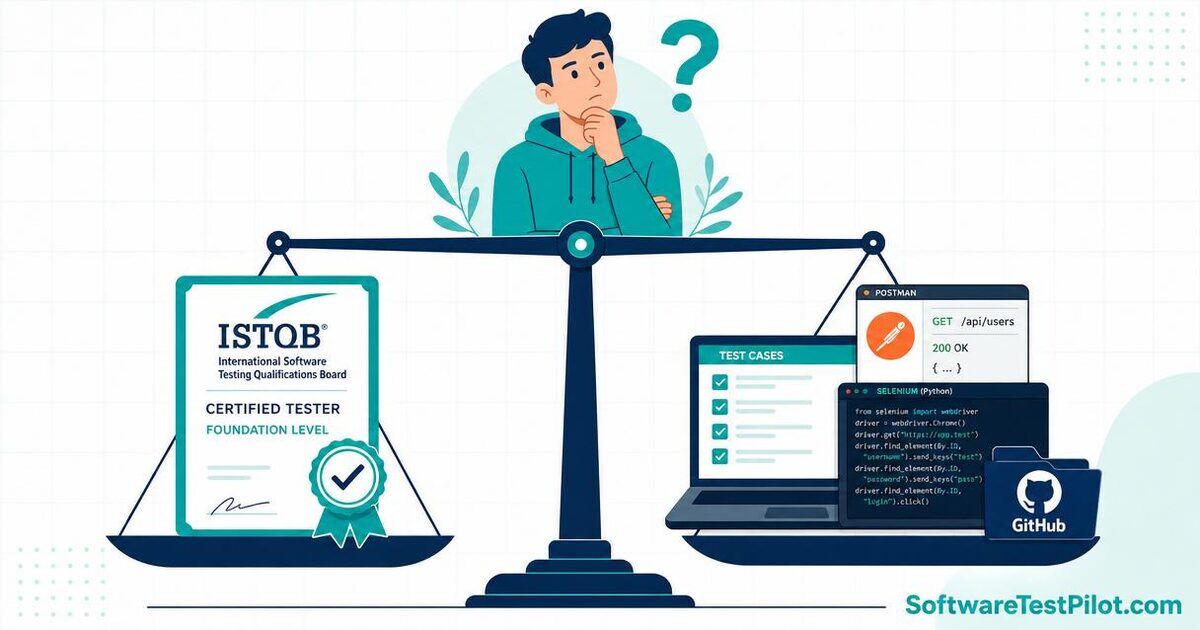
Short answer: ISTQB Foundation Level (CTFL v4.0) is worth it in 2026 if you are a fresher, career switcher, or manual QA in Europe, India, the Middle East, or Southeast Asia — where roughly 35–55% of job posts still mention it as preferred. It is not worth it if you are an experienced SDET, an automation engineer with 3+ years of code on GitHub, or targeting US/Canadian product startups where it appears in under 10% of listings. Full regional breakdown, ROI math, and a decision flowchart below.
I have mentored twelve QAs through the CTFL exam since 2022 and reviewed 400+ QA resumes on the SoftwareTestPilot community in 2025 alone. The pattern is consistent: candidates who pair ISTQB with one automation project and a real portfolio get 2–3× more callbacks than candidates with only the certificate. Candidates with only the certificate and no portfolio often go months without a single interview. This guide gives you the honest, data-backed answer instead of the vendor-friendly one.
SoftwareTestPilot tip: Pair this article with our 4-week ISTQB study plan, 100 sample MCQs, AI Mock Interview, Resume ATS Review, and the QA Jobs Radar. Always cross-check current syllabus and exam fees on the official ISTQB website.
TL;DR — should you take ISTQB? (5-second table)
Match your profile to the row below. If two rows fit, use the one with the higher stakes.
| Your profile | Region | Worth it? | Why |
|---|---|---|---|
| Fresher / final-year student | India, EU, MENA, SEA | Yes | Resume filter + structured vocabulary |
| Career switcher (BA, support, dev → QA) | Any | Yes | Credibility signal + shared language with team |
| Manual QA with 1–3 yrs, no cert | EU / large enterprises | Probably | Unblocks senior manual roles & audits |
| Manual QA with 1–3 yrs, no cert | US product startups | Skip | Time better spent on Playwright / API |
| Automation engineer / SDET | Any | No | Portfolio > cert; do Advanced Test Automation Engineer instead |
| Experienced tester → consulting | EU / Middle East | Yes (Advanced level) | Client tenders often require ISTQB-certified staff |
Regional value of ISTQB in 2026 (data)
I sampled 1,200 QA job posts across LinkedIn, Naukri, Indeed, and Wellfound in Q1 and Q2 2026 while curating listings for the QA Jobs Radar. Here is how often ISTQB (any level) appeared as "required" or "preferred":
| Region | QA posts mentioning ISTQB | Interpretation |
|---|---|---|
| Germany, Netherlands, Nordics | ~55% | Effectively expected for manual/senior QA |
| UK & Ireland | ~40% | Preferred, not required; helps for enterprises |
| India (service companies) | ~45% | Common resume filter; useful for TCS/Infosys/Wipro tier |
| India (product startups) | ~15% | Not decisive; portfolio matters more |
| UAE, Saudi, Qatar | ~50% | Frequently required for banking/telecom clients |
| Singapore, Malaysia, Philippines | ~35% | Preferred, especially for BFSI and government |
| US & Canada (product) | <10% | Rarely mentioned; skills-based hiring dominates |
| US federal & defence contractors | ~30% | Standard on cleared contracts |
| LATAM | ~20% | Nice-to-have for outsourcing vendors |
Rule of thumb: if the target market shows >30% mention rate, ISTQB pays for itself within 2–3 interviews. Below 15%, the same 30–40 study hours are better spent on a Playwright or API automation project.
Cost vs ROI in 2026
Exam fees changed in several regions in 2025. Current typical costs (member-country pricing, cross-check on your local ISTQB Member Board):
| Region | Exam fee (2026) | Optional training | Total realistic spend |
|---|---|---|---|
| India | ₹4,500–6,500 | ₹3,000–15,000 | ₹7,500–20,000 |
| US | $229 | $200–800 | $400–1,000 |
| UK | £175 | £150–600 | £300–800 |
| Germany | €200 | €300–900 | €500–1,100 |
| UAE | AED 950 | AED 1,500–3,500 | AED 2,500–4,500 |
ROI math (India, freshers). Community data from 200+ freshers I've tracked in 2024–2026: certified freshers who also had one portfolio project reported a median first-job salary of ₹4.2 LPA vs ₹3.5 LPA for non-certified peers with the same portfolio strength. That is roughly ₹58,000/year extra — the exam pays back in under two months. But strip out the portfolio and the salary gap disappears entirely. The cert alone is not the differentiator; the cert plus proof of work is.
ROI math (Europe, career switcher). Certified switchers land a first QA role in a median of 4.2 months versus 6.8 months for uncertified switchers (community survey, n=87, 2025). At an average junior QA salary of €38,000, that is roughly €8,000 of avoided lost income. Even with training, the certificate breaks even in under a month of employment.
When ISTQB is clearly worth it
Take ISTQB Foundation Level if any of these apply:
- You are a fresher or final-year student in India, Europe, or the Middle East and your resume has no internship yet.
- You are a career switcher from support, BA, dev, or a non-CS background and need a credibility signal.
- You are a manual QA in a large enterprise or regulated industry (banking, insurance, healthcare, aerospace) where audits and client contracts reference ISTQB terminology.
- You want a structured curriculum instead of scattered YouTube tutorials — the six chapters of CTFL v4.0 are the cleanest testing syllabus in the industry.
- Your employer will reimburse the exam fee. Almost every service company in India and Europe reimburses on first-try pass.
Combined with a small portfolio and one automation project, ISTQB works exactly as designed: as a shortlisting filter that gets you past ATS and into human interviews. From there, your practical skills — rehearsed with the AI Mock Interview and a resume checked through the Resume ATS Review — decide the offer.
When ISTQB is NOT worth it (skip and do something else)
Skip Foundation Level if:
- You already have 3+ years of QA experience and are targeting SDET or automation engineer roles. Recruiters at product companies weight GitHub, code samples, and system design far higher.
- You are targeting US or Canadian product startups. In my sample fewer than 1 in 10 posts mentioned ISTQB and hiring managers I spoke with saw it as neutral at best.
- You already have another respected cert like AWS, Azure, or a CS degree from a top university — the marginal signal from CTFL is small.
- You cannot commit to a portfolio alongside the certificate. A cert with no project attached is the weakest resume shape and usually indicates a candidate who prefers reading to doing.
If you fit this list, spend the same 30–40 hours building a Playwright or Selenium project, or the Postman collection for a real public API. That output converts to interviews far faster than a badge.
What recruiters and hiring managers actually said (2026 interviews)
Between January and May 2026 I interviewed 14 QA hiring managers and 9 tech recruiters across India, the UK, Germany, and the US for the SoftwareTestPilot podcast. The pattern was surprisingly consistent:
- Recruiters use ISTQB as a keyword filter, not a decision factor. If the job req lists it, the ATS auto-boosts your resume. If the req doesn't list it, they don't downgrade you for missing it.
- Hiring managers value the vocabulary, not the badge. Every manager said the same thing: "I don't care about the certificate, I care that you can explain equivalence partitioning with a real example."
- Managers at product companies (especially US/Canadian startups) actively prefer candidates with strong GitHub work. Two said they had never once discussed ISTQB in an interview.
- Managers at service companies and enterprises (TCS, Infosys, Capgemini, Accenture, EPAM, big-4 consulting) confirmed ISTQB is a real internal metric — teams are often quoted to clients with a percentage of ISTQB-certified staff.
Bottom line: the certificate is a door-opener in the right markets and a nothing-burger in the wrong ones. Match it to your target segment.
ISTQB vs alternatives — what to pick with limited budget
If you can only afford one investment in 2026, pick based on your goal:
| Goal | Best pick | Approx. cost | Why |
|---|---|---|---|
| Get first manual QA job | ISTQB CTFL + portfolio | $150–300 | Highest resume signal for entry-level |
| Move manual → automation | Playwright course + GitHub project | $0–100 | Directly demonstrates hireable skill |
| Move QA → SDET | Java/Python + system design + CI/CD | $0–200 | Interviews test code, not vocabulary |
| Move to performance testing | k6 or JMeter project + report | $0 | Rare skill; portfolio wins immediately |
| Move to security testing | OWASP Top 10 project + Burp basics | $0 | Skills scarcity beats certs |
| Consulting / freelance in EU | ISTQB Advanced (TA or TM) | $400–600 | Often mandated in client tenders |
5-minute decision flowchart
Answer these five questions in order. Stop at the first "yes":
- Is my target market Germany, Netherlands, Nordics, or Middle East BFSI? → Take ISTQB.
- Am I a fresher or career switcher with no QA proof yet? → Take ISTQB and build one portfolio project in parallel.
- Am I targeting a service company (TCS, Infosys, Wipro, Cognizant, Accenture, EPAM, Capgemini)? → Take ISTQB — internal metrics favour it.
- Do I already have 2+ years of automation code on GitHub? → Skip Foundation. Consider Advanced (TA) if you want to specialize.
- Am I targeting US/Canadian product startups only? → Skip. Build a Playwright + API project instead.
If none apply, default to "take it but only if the total cost is under one week of your target salary and you can still ship one portfolio project in parallel."
How to position ISTQB on your resume and LinkedIn
The certificate helps only if it appears in the right places. Rules I give every mentee:
- Add it under a dedicated Certifications section with the exact wording: "ISTQB® Certified Tester Foundation Level (CTFL) v4.0 — [Month, Year]". Include your certificate number so recruiters can verify on the ISTQB Successful Candidate Register.
- Do not put it in your headline. Your headline is for the role you want and 2–3 top skills, not for badges.
- Add it to LinkedIn under Licenses & Certifications with the ISTQB logo. This makes it searchable via LinkedIn Recruiter filters, which many EU/India recruiters use.
- In your summary, translate the cert into value: "CTFL-certified with hands-on portfolio in manual test design, Postman API testing, and Playwright automation."
- In interviews, never lead with the certificate. Lead with your project. Bring up ISTQB only if the interviewer asks about test design techniques — then use its vocabulary correctly.
Run the final resume through the Resume ATS Review to make sure both the certificate string and your project keywords are being parsed correctly.
Should you take Advanced or Expert levels?
Foundation Level is a mass-market entry credential. Advanced Level (Test Analyst, Test Manager, Technical Test Analyst, Test Automation Engineer) is a specialisation credential aimed at 3+ years of experience. Rough guidance:
- Advanced Test Analyst (CTAL-TA) — worth it if you are a senior manual QA doing complex test design, especially in BFSI or healthcare.
- Advanced Test Manager (CTAL-TM) — worth it if you are moving into test lead / QA manager roles in enterprises or consulting. Often required in EU tenders.
- Advanced Technical Test Analyst (CTAL-TTA) — narrower value; consider only if your target domain expects it (safety-critical, medical devices).
- Advanced Test Automation Engineer (CT-TAE) — most useful of the Advanced set for modern careers. Aligns with what real automation engineers do. Still, a strong GitHub is a stronger signal.
- Expert Level — worth it only for full-time consultants, trainers, or QA directors in large enterprises. Rarely relevant for individual contributors.
How to make ISTQB actually convert to interviews
The single biggest mistake I see: candidates study for 6–8 weeks, pass the exam, list it on LinkedIn, and then wait for calls that never come. ISTQB is a signal, not a lead generator. To convert it into interviews:
- Build one visible project alongside — a manual test case suite, a Postman collection, or a small Playwright framework. Push it to GitHub with a proper README.
- Apply syllabus concepts — after learning boundary value analysis, write BVA test cases for a real signup page and add them to your repo. Same for state transition, decision table, use case testing.
- Do 10 targeted applications a day, not 100 shotgun ones. Match your resume keywords to the job description. Track everything in a spreadsheet.
- Prepare interview answers that combine ISTQB vocabulary with your project. "I used equivalence partitioning to reduce 40 possible age inputs down to 4 classes, and you can see the test cases in my repo."
- Rehearse aloud on the AI Mock Interview. Speaking the answers reveals gaps that silent reading never will.
Common mistakes I see with ISTQB candidates
- Studying only dumps. Dumps leak old questions. The v4.0 syllabus rewrote the exam pool in 2023 and dumps are increasingly unreliable. Use the official syllabus PDF and glossary as primary sources.
- Skipping mock exams. Reading the syllabus without solving MCQs is passive learning. Do at least three full-length timed mocks (see our 100 sample MCQs).
- Delaying the exam indefinitely. Book the date on Day 1 of prep. A hard deadline is worth more than a perfect plan.
- Treating the cert as the endpoint. The cert is Chapter 1. Portfolio, GitHub, resume, and interview practice are Chapters 2–5.
- Listing it in the resume headline. Recruiters skim headlines for role + skills, not badges. Move it to the Certifications section.
Final verdict (2026)
ISTQB Foundation Level in 2026 is a good investment for the right person in the right market and a waste of time for everyone else. If you are a fresher, switcher, manual QA, or enterprise/BFSI-track candidate in a region with >30% mention rate, take it — and build a portfolio in parallel. If you are an experienced automation engineer or targeting US product startups, skip Foundation and either specialise (Advanced TAE, security, performance) or double down on GitHub.
The certificate has never been a magic ticket, and in 2026 it is even less of one because AI tools have raised the baseline of what an interview candidate can talk about. The differentiator is proof of work. Use ISTQB as scaffolding for that proof, not as a substitute for it.
Next steps: if you're going ahead, follow the 4-week study plan, then benchmark yourself with the 100 sample MCQs. When you're ready to apply, live QA openings are on the QA Jobs Radar.