
Copilot Generate Test Cases in 2026: The Complete Playbook (ISTQB Techniques, Prompts, RTM & FAQ)
The definitive 2026 guide to generating test cases with GitHub Copilot and Copilot Chat — ISTQB techniques (EP, BVA, decision tables, state transition), Jira-ready format, traceability, 10 prompts, a 6-point rubric and every People Also Ask question Google surfaces.

Last updated: July 14, 2026 · 14 min read · By SoftwareTestPilot
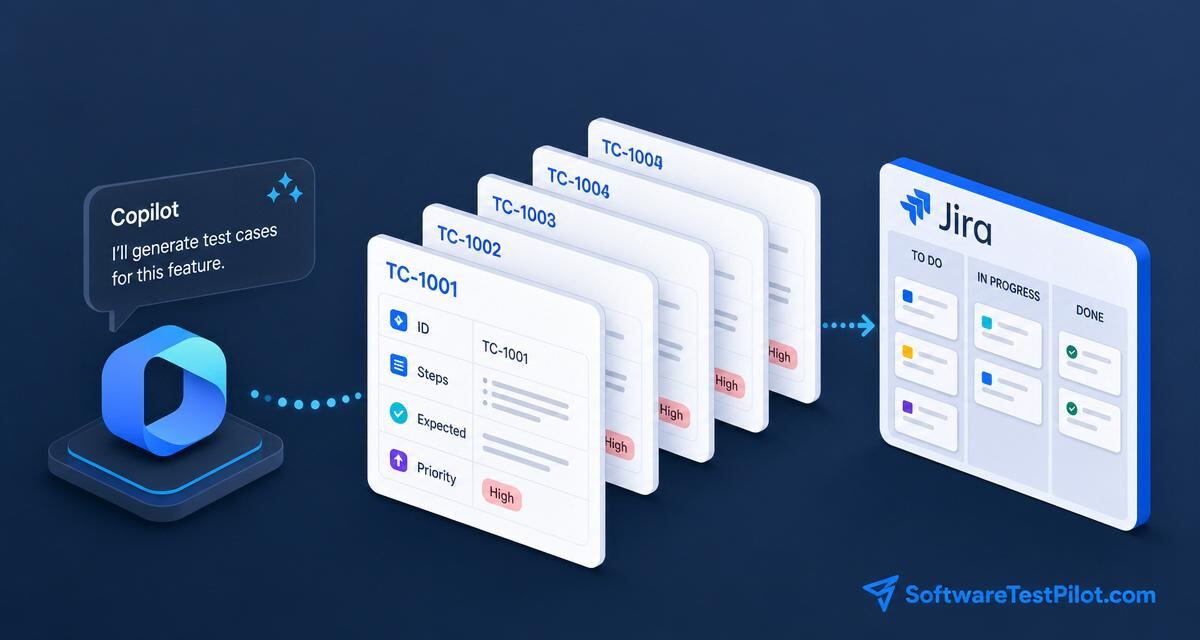
Copilot generate test cases is the workflow of using GitHub Copilot Chat (in VS Code, JetBrains, Visual Studio or GitHub.com) to draft structured, ISTQB-aligned test cases — Title, Preconditions, Steps, Expected, Priority, Traceability — from a user story, acceptance criterion, PRD, Figma spec or OpenAPI schema, then reviewing and importing into Jira, Xray, Zephyr, TestRail or Azure Test Plans. On 2026 teams, this cuts test-design time from hours to minutes and dramatically improves technique coverage (equivalence partitioning, boundary value analysis, decision tables, state transition).
Pair with ChatGPT test case generation, Copilot write tests, Copilot QA testing, ChatGPT Gherkin scenarios and the manual testing interview questions.
Key takeaways
- Every test case = Title, Preconditions, Steps (deterministic), Expected, Priority, Traceability. Miss any field and Jira import breaks.
- Force ISTQB techniques by name: EP, BVA, decision table, state transition, use case, exploratory charter.
- Traceability matters — every test case links to an AC ID and a requirement ID.
- Copilot is fastest inside VS Code with the story pasted; ChatGPT / Claude are stronger for pure prose input.
- Human review is non-negotiable — reject cases that fail the 6-point rubric.
1. Anatomy of a great 2026 test case
+-----------------------------------------------------------+
| FIELD           | REQUIRED CONTENT                        |
+-----------------+-----------------------------------------+
| Test Case ID    | TC-CHECKOUT-042                         |
| Title           | Verb + object + condition (<90 chars)  |
| Preconditions   | Account role, data state, feature flags |
| Steps           | Deterministic, one action per line      |
| Expected        | Traced verbatim from the AC             |
| Priority        | P0 / P1 / P2 / P3 (business urgency)    |
| Severity        | Blocker / Critical / Major / Minor      |
| Traceability    | AC-042, REQ-CHK-018, RISK-R-07          |
| Test Type       | Functional / Regression / Smoke / E2E   |
| Technique       | EP / BVA / DT / ST / Exploratory        |
| Test Data       | Explicit inputs, no "some user"         |
+-----------------------------------------------------------+
2. Force ISTQB techniques by name
- Equivalence Partitioning (EP) — one test per input class (valid / invalid / boundary).
- Boundary Value Analysis (BVA) — min-1, min, min+1, max-1, max, max+1.
- Decision Table Testing (DT) — one test per row of the decision matrix; ensures all combinations of conditions.
- State Transition Testing (ST) — one test per legal transition; one per illegal transition (rejected).
- Use Case Testing — one test per primary flow + one per alternate + one per exception flow.
- Exploratory Charter — a mission and time-box, not a script.
Copilot picks a technique on its own only ~40% of the time. Name it in the prompt and coverage of edge cases doubles.
3. RCTF prompt for test case generation
- Role — "You are an ISTQB Advanced Test Analyst fluent in EP, BVA, decision tables and state transitions."
- Context — paste the user story, acceptance criteria (with IDs), any Figma / OpenAPI reference, target module and risk level.
- Task — "Generate 15 test cases: 8 functional (EP + BVA), 3 negative, 2 accessibility, 1 performance smoke, 1 security (input sanitisation). Each linked to an AC ID."
- Format — "Markdown table with the 11-field schema. End with a coverage matrix per AC ID and a rubric self-critique."
4. Ten copy-paste prompts
1 — From a user story
/tests As an ISTQB Advanced Test Analyst, generate 15 test cases
for this story: [paste].
Cover EP, BVA, decision table (paste table if present), state transition
and 2 negative paths. Link each to the AC ID. Markdown table.
2 — From an OpenAPI endpoint
#file:openapi.yaml
Generate API test cases for POST /orders: happy 201, 400 missing body,
401 no token, 403 wrong role, 409 duplicate idempotency-key, 429 rate limit,
schema-validation for response, and one contract-drift check.
3 — Boundary value coverage
Given the "coupon percent" field accepts integers 1..99,
generate all BVA cases: 0, 1, 2, 49, 50, 51, 98, 99, 100, -1, 999,
1.5, "50%", empty, null.
4 — Decision table
Build a decision table for shipping cost given: country (US/EU/RoW),
weight (<1kg / 1-5kg / >5kg), member tier (Free/Pro).
Emit one test case per row. Highlight impossible combinations.
5 — State transition
The order state machine is: NEW -> PAID -> SHIPPED -> DELIVERED
(with CANCEL from NEW/PAID only). Generate one test per legal
transition and one per illegal (must be rejected with 409).
6 — Exploratory charter
Draft a 45-minute exploratory charter for the new checkout flow.
Mission, scope, tactics, oracles, risks to cover, note-taking template.
Do not produce a script.
7 — Accessibility cases
Add WCAG 2.2 AA test cases for the login form: keyboard-only nav,
screen-reader label, colour contrast (4.5:1), focus-visible indicator,
error announcement (aria-live=polite).
8 — Non-functional smoke
Generate NFR smoke test cases for the /search endpoint: p95 latency
< 400ms at 50 rps, error rate < 0.1%, memory ceiling 512MB.
Emit as k6 test outline + acceptance table.
9 — Regression selection
@workspace Given this PR diff [paste], list the top 20 regression test
cases from tests/regression that are most likely to be impacted.
Rank by dependency proximity.
10 — Traceability matrix
Given [paste 15 test cases] and [paste 8 ACs],
emit a Requirements Traceability Matrix (RTM) as a Markdown table.
Flag any AC with zero linked cases and any case with no AC.
5. The 6-point review rubric
- Deterministic steps — one action per line, verb-first, no opinions.
- Technique named — EP / BVA / DT / ST / Use Case / Exploratory labelled per case.
- Traceability — every case links to at least one AC ID.
- Expected traced verbatim — no paraphrasing of the AC.
- Coverage matrix present — every AC has ≥ 1 case; zero orphan cases.
- PII / secrets clean —
user{N}@example.com, Stripe test cards only.
6. ROI and honest limits
Test-design time drops 60–80% on functional cases; technique coverage (BVA, DT, ST) rises from ~50% to ~90% when techniques are named in the prompt; RTM coverage becomes automatic. Diminishing returns kick in on exploratory testing — Copilot writes decent charters but the actual exploration is still a human craft.